

1N4007 Datasheet, Pinout, and Sourcing Checks for OEM Buyers
1N4007 pinout, package, and datasheet limits buyers actually check — plus lot inspection notes. Request a quote on IC-Online; no invented stock claims.
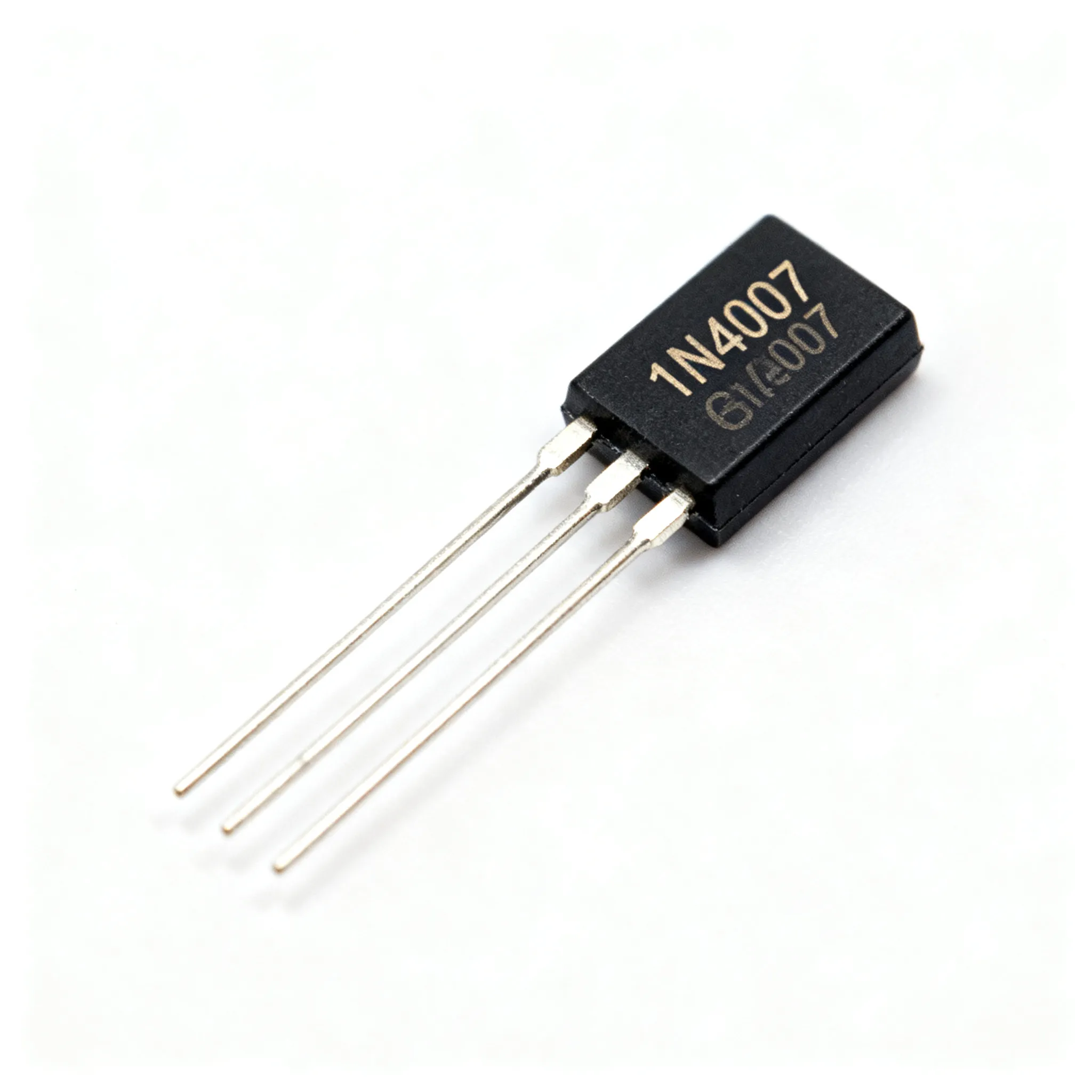
1N4007 Diode: Datasheet, Pinout & Sourcing Checks for OEM Buyers
The 1N4007 is one of the most widely recognised part numbers in electronics—a 1 A, 1000 V glass-passivated rectifier that turns up in everything from compact power adapters to industrial motor drives. That ubiquity can create a false sense of security. When a component has been around for decades, engineers and buyers sometimes assume that every reel on the shelf is identical and that supply will always be smooth. Recent lifecycle changes and the sheer volume of variants now make that assumption risky for OEMs. This article deconstructs the datasheet, pinout, sourcing checks, and active alternatives that procurement and engineering leads should have on their radar before committing the 1N4007 to a production BOM.
Why the 1N4007’s Ubiquity Hides Supply-Chain Pitfalls
Few rectifier diodes enjoy the same cross-manufacturer ecosystem as the 1N4007. Datasheet aggregators such as Alldatasheet[source] list dozens of entries under the same base number, each representing a different manufacturer, revision, or even a variant with subtle parametric differences. On the surface that looks like a healthy multi-source market. In practice, many of those files point to archive-only status, and one of the most significant signals arrived when Diodes Incorporated moved the classic 1N4007 to “Not Recommended for New Design” (NRND)[source]. That public notice alone should trigger a review of every approved vendor list (AVL) that still carries the original Diodes part number without a migration path.
The supply-chain risk is compounded by three factors: stockists may still sell old-date-code NRND parts as “new,” uncontrolled second-sourcing can introduce parts with different leakage or thermal margins, and the ubiquitous DO-41 axial package is one of the easiest form factors to remark or counterfeit. For OEMs, the priority is no longer just comparing price breaks—it is confirming lifecycle status, qualifying active second sources, and establishing lot-acceptance checks that align with the official datasheets. The sections that follow translate the latest manufacturer documentation into a concrete engineering and procurement workflow.
Decoding the 1N4007 Datasheet and Pinout
Before a buyer can evaluate alternatives or spot non-conforming lots, the team needs a solid baseline of the 1N4007’s electrical signature and physical pinout. The device is an axial-lead, glass-passivated standard recovery rectifier[source]. A silver-coloured cathode band marks the negative terminal, so the banded lead should face the DC output side in a bridge or the lower potential in a freewheeling configuration[source]. No hidden pins, no centre-tap complications—but getting the band orientation wrong during assembly is still a common root cause of field failures.
Two manufacturer datasheets are central to any modern qualification effort: the Diodes Incorporated DS28002 (revision 11)[source] and the ON Semiconductor (now onsemi) version[source]. Across these documents, the following absolute maximum and electrical characteristics define the part’s design boundaries.
| Parameter | Value / Range | Conditions & Notes |
|---|---|---|
| Peak Repetitive Reverse Voltage (VRRM) | 1000 V | TJ = 25 °C unless otherwise noted |
| Average Forward Rectified Current (IF(AV)) | 1.0 A | Resistive or inductive load, TA = 75 °C (lead length dependent) |
| Non‑Repetitive Peak Forward Surge Current (IFSM) | 30 A | 8.3 ms single half‑sine wave, TJ = 25 °C |
| Forward Voltage (VF) | ≤ 1.1 V | IF = 1.0 A, TJ = 25 °C |
| Reverse Leakage Current (IR) | ≤ 5 µA | VR = VRRM = 1000 V, TJ = 25 °C ≤ 50 µA at TJ = 100 °C (typical) |
| Junction Temperature Range (TJ) | -55 °C to +150 °C | Storage temperature range typically -55 °C to +150 °C |
| Package | DO‑41 (Axial) | Glass‑passivated die, corrosion‑resistant terminals[source] |
The reverse leakage specification deserves particular attention during incoming inspection. A reading significantly above 5 µA at 25 °C—or one that climbs steeply at elevated temperature beyond the parametric trend shown in the DS28002 curves—often flags a die that cannot sustain the full 1000 V rating[source]. That is the kind of parametric drift that field returns never trace back to the diode until it is too late. Engineering teams should also note that the forward voltage of 1.1 V at 1 A, while modest, translates to a steady-state conduction loss of roughly 1.1 W per diode—a figure that demands adequate lead and pad thermal relief in high-density designs.
Alternatives and Cross-References: Matching Form, Fit, and Lifecycle
Given the NRND status of the base 1N4007 at a major manufacturer, procurement and design teams need a clear map of active equivalents and pin-compatible alternatives. The table below draws on cross-reference data from Parter.ai[source], official manufacturer pages, and buyer guides[source] to compare the original part with recommended active options.
| Comparison Metric | Diodes Inc. 1N4007 (classic) | Diodes Inc. 1N4007-T (active) | onsemi 1N4007 (active) | Vishay 1N4007-E3/54 (active) | S1M (surface‑mount reference) |
|---|---|---|---|---|---|
| Lifecycle Status | NRND / Inactive[source] | Active | Active (verify with onsemi) | Active | Active |
| VRRM | 1000 V | 1000 V | 1000 V | 1000 V | 1000 V |
| IF(AV) | 1 A | 1 A | 1 A | 1 A | 1 A |
| IFSM (8.3 ms) | 30 A | 30 A | 30 A | 30 A | 30 A |
| Package | DO‑41 axial | DO‑41 axial | DO‑41 axial | DO‑41 axial | SMA (DO‑214AC) |
| Key Differentiator | Baseline; do not use in new designs | Direct active replacement, tape‑&‑reel suffix | Widely available, UL recognised (E230084) | RoHS/REACH, popular E3 suffix | Surface‑mount equivalent; verify thermal pad |
| Selection Note | Verify single‑source risk; migrate | Preferred migration path for Diodes Inc. users | Evaluate for AVL expansion with lifecycle confirmation | Confirm packaging (ammo/reel) to match pick‑&‑place | Use only when through‑hole is eliminated; derate for thermals |
Beyond the table, evaluation candidates from MCC, Taiwan Semiconductor, and ROHM populate the same parametric space. However, no alternative should be accepted into the AVL without a side-by-side review of the full datasheet, specifically the reverse leakage vs temperature curve, the thermal resistance junction‑to‑ambient (RθJA) for the intended lead‑length and PCB footprint, and any documented compliance marks. For surface‑mount migration, the S1M is the most common drop‑in candidate, but its smaller die-attach area means engineers must verify junction temperature at the maximum expected ambient and load current. A short‑term laboratory validation on the actual PCB—not just a datasheet comparison—is the only way to confirm that a surface‑mount alternative does not creep into thermal runaway under sustained high‑voltage reverse bias.
Sourcing Checks Every OEM Buyer Should Perform for 1N4007
Procurement teams managing a BOM that includes any variant of the 1N4007 can integrate a lightweight but high‑impact set of verification steps. These checks do not assume a component can be allocation-sensitive — confirm availability via RFQ; they simply reflect the reality that an NRND part, or a part with dozens of sources, benefits from structured due diligence.
Step 1: Confirm the lifecycle directly with the manufacturer. Diodes Incorporated clearly states that the classic 1N4007 is inactive and directs users to the 1N4007‑T[source]. If your AVL still lists the NRND base number, flag it for immediate migration. For other manufacturers, do not rely on aggregator status bars; request a written lifecycle confirmation from the supplier or an authorised distributor.
Step 2: Demand lot‑ and date‑code traceability on every shipment. Certified distributors will provide date codes; a batch dated more than three or four years earlier may be legitimate warehouse stock but could also include parts that have been challenged by storage conditions or are older mask‑set revisions. Match the physical cathode‑band uniformity and body dimensions against the datasheet[source]. A magnified visual of the glass passivation should show a clean, bubble‑free surface; cracks or discolouration are grounds for rejection.
Step 3: Benchmark reverse leakage on a sample before line‑loading. Using a source measure unit (SMU) or a curve tracer, apply the rated 1000 V reverse voltage at room temperature on a statistically significant sample from the incoming lot. The current should stabilise below 5 µA and should not exhibit a “soft knee” that could indicate a lower‑voltage die relabelled as a 1N4007. Document the measurements as part of your incoming inspection record.
Step 4: Qualify an active second source before you need it. If your design uses the 1N4007 in a safety‑critical or high‑temperature location, do not wait until the existing source becomes unavailable. Pre‑qualify the 1N4007‑T from Diodes Inc. or the onsemi equivalent on a small pilot run, verifying that board‑level thermal performance and surge‑handling behaviour match your existing qualification data. Parter.ai cross‑reference tools[source] can accelerate the parametric filter, but they never replace your own electrical characterisation.
Step 5: Request compliance documentation that matches your assembly flow. Most current production 1N4007 variants are RoHS and REACH compliant, but the documentation package can vary by region and distributor. Ask for a full material declaration (FMD) and, if the end equipment carries UL or VDE certification, verify that the diode is a Recognized Component under the applicable file number. Many datasheets, including onsemi’s, list UL recognition (e.g., E230084)[source]. Finally, confirm packaging format: tape‑and‑reel (T suffix or TR suffix), ammo‑pack, or bulk. A mismatch between the ordered packaging and the pick‑and‑place feeder can cause unplanned line stoppages and re‑reeling expense.
| Check Item | Why It Matters | Recommended Action |
|---|---|---|
| Lifecycle verification | Avoids placing NRND/EOL parts on a new BOM | Request written manufacturer statement; review official product page[source] |
| Lot & date‑code traceability | Identifies aged stock and potential relabelled dice | Require date codes; inspect marking/glass passivation against datasheet |
| Reverse leakage spot‑check | Detects sub‑standard or relabelled lower‑voltage parts | Test at 1000 V / 25 °C; reject if >5 µA or soft breakdown |
| Active second‑source qualification | Mitigates single‑source risk now, before a line‑down event | Pre‑qualify 1N4007‑T or onsemi equivalent on a pilot build |
| Compliance & packaging alignment | Ensures certification continuity and avoids re‑reeling costs | Request FMD, UL/VDE file numbers, and confirm reel/ammo pack |
1N4007 Sourcing and Application FAQs
Q: Is the classic 1N4007 still recommended for new designs, or should I choose a different part number?
A: Major suppliers such as Diodes Incorporated have marked the generic 1N4007 as Not Recommended for New Design (NRND). For new projects, use an active equivalent like the 1N4007-T from Diodes Inc. or the ON Semiconductor 1N4007 (still active as of 2025) to avoid premature EOL and requalification costs.
Q: Can I replace a 1N4007 with another 1N400x series diode if I only need a lower voltage rating?
A: Yes, the 1N4001 through 1N4007 share the same forward current and surge ratings; only the peak reverse voltage (PRV) differs. A 1N4004 (400 V) or 1N4005 (600 V) can replace a 1N4007 in circuits where the applied reverse voltage never exceeds the lower PRV, but using a lower-voltage part in a 1000 V application will cause immediate failure.
Q: How can I spot counterfeit or substandard 1N4007 diodes before assembly?
A: Check the cathode band position, uniformity of the glass passivation and body markings against the manufacturer’s datasheet. Measure reverse leakage at rated voltage (1000 V) on a sample: a reading significantly above 5 µA at 25 °C, or erratic reverse characteristics, often indicates a relabelled lower-voltage die. Always buy from franchised distributors and request traceability documentation.
Q: What is the surface-mount equivalent of the through-hole 1N4007 for next-generation board designs?
A: The S1M rectifier in the SMA (DO-214AC) package is a common drop-in for 1000 V, 1 A requirements. Other options include the US1M (ultra-fast) or the 1N4007-W in a MELF package. When migrating, pay attention to thermal design: the small SMD footprint has lower heat-dissipation capability, so verify junction temperature in the actual circuit.
Q: What surge current should I design for when using a 1N4007 in a low-power AC-DC supply?
A: The 1N4007 is rated for a non-repetitive peak forward surge current of 30 A (8.3 ms half-sine wave). In practice, bulk capacitor inrush current at turn-on can exceed this momentarily; use a series NTC thermistor or limit the primary-side peak current with a soft-start circuit to stay within the 30 A rating and extend diode lifetime.
Q: Are there any compliance or certification issues when sourcing 1N4007 diodes from multiple regions?
A: Standard 1N4007 variants are typically RoHS and REACH compliant, but always request full material declaration sheets. If the assembly will be used in safety-agency-approved equipment (UL, VDE), verify that the diode is a Recognized Component under the relevant standard—many datasheets list those file numbers, and you should confirm them during vendor qualification.
References & Further Reading
- 1N4007 Datasheet Aggregator – Alldatasheet
- Diodes Incorporated 1N4007 Product Page (NRND notice)
- Diodes Incorporated DS28002: 1N4001–1N4007 Datasheet (Rev. 11)
- ON Semiconductor 1N4007 Datasheet (via Mouser)
- 1N4007 Rectifier Diode: Pinout, Datasheet, and Applications – Utmel
- 1N4007 Rectifier Diode: Pinout, Datasheet, & Applications Guide – Partstack
- 1N4007 Diode Pinout, Equivalent, Specs, Datasheet – Components Info
- Diodes Incorporated 1N4007-T Alternatives & Cross-References – Parter.ai
- 1N4007 Diode: Datasheet, Alternatives, and Buying Guide – Onzuu
Procurement takeaway: The 1N4007 remains a workhorse rectifier for countless designs, but its lifecycle status and sourcing landscape demand careful attention. Whether