

2026 Microprocessor Sourcing for OEM Buyers: AI, Chiplet Architectures, and Inspection Checks
Buyer-side specification, inspection, and RFQ checks on this technical topic. Not a hobby explainer. Request a quote on IC-Online.
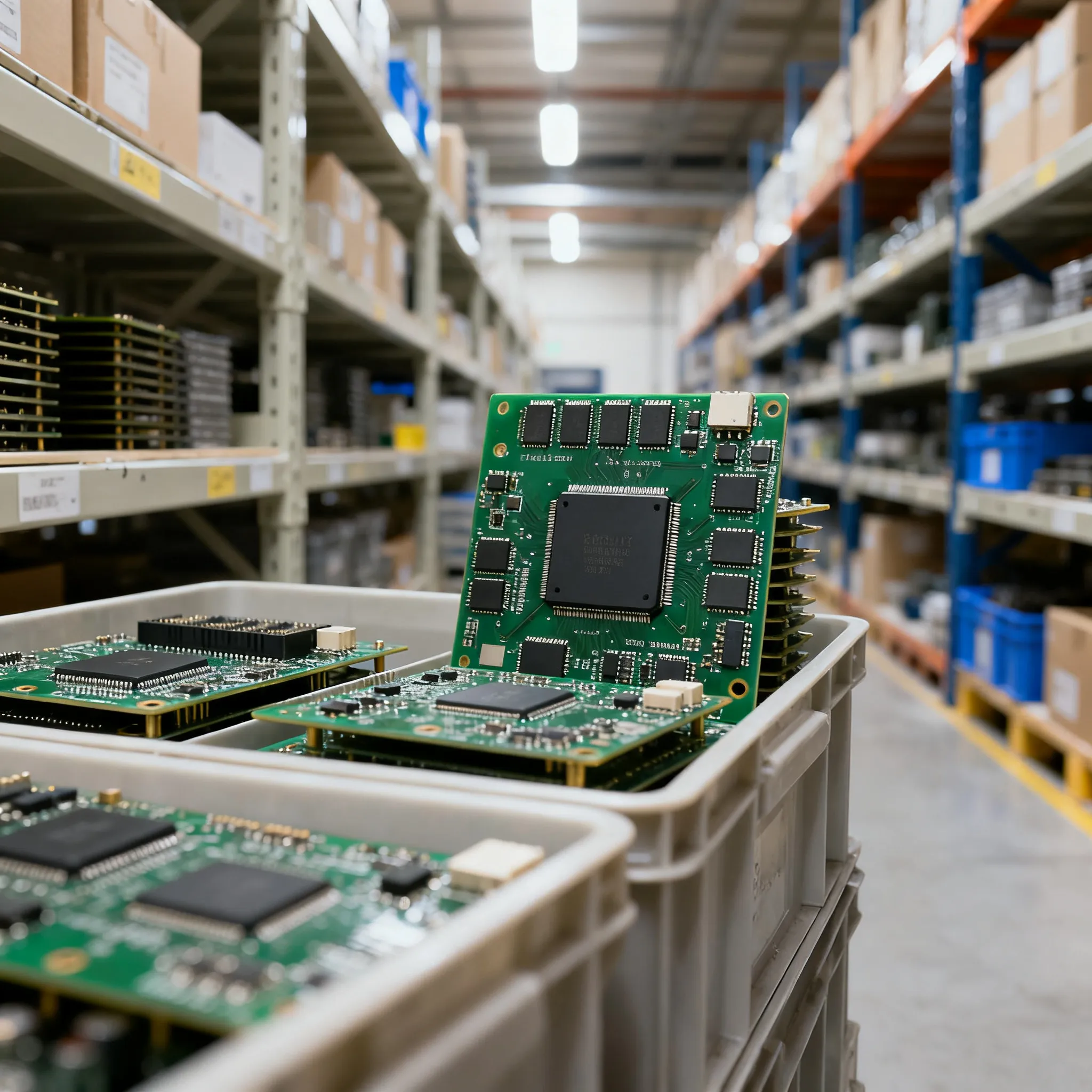
2026 Microprocessor Sourcing for OEM Buyers: AI, Chiplet Architectures, and Inspection Checks
Why 2026 Microprocessor Sourcing Is Now an Allocation and Yield Game
For OEM buyers, 2026 microprocessor sourcing is not a repeat of 2024. The main CPU or AI accelerator may be available, but the surrounding bill of materials can still stop production. Accuris highlights a hard allocation dynamic: when AI data centers absorb 70% of memory production, every other buyer competes for the remaining 30%. That pressure flows into DRAM, NAND, power stages, MLCCs, and SiC devices, not just high-end processors.
NextPCB’s 2026 shortage breakdown flags DRAM/NAND price surges, the Nexperia crisis, MLCC and SiC constraints, and the knock-on effect on production schedules. Buyers should treat these not as isolated component events but as collateral shortage risks around a microprocessor socket. LimChip advises OEM/EMS buyers to identify collateral shortage parts early and consider approved vendor list expansion; for power stages such as MP86945, TPS536C5, or LTM4680, security stock and alternative source qualification are now critical.
Yield has also become a sourcing variable, not just a foundry concern. AIChipLink reports that chiplet designs beat monolithic chips on yield: a chiplet-based approach with smaller dies and known-good die assembly exceeds 50% yield, while a large monolithic chip of similar total area can fall below 30%. That gap changes how OEMs should qualify suppliers, compare processor architectures, and structure incoming inspection.
Procurement teams should also be tracking supplier performance before placing volume orders. SpecForge recommends tracking an 11-supply-chain-KPI set for any new CPU fleet: order-to-delivery cycle time, forecast accuracy, on-time-in-full, inventory turnover, days of supply, supplier defect rate, perfect order rate, cash-to-cash cycle, gross margin return on inventory, fill rate, and supply chain cycle time. In 2026, that KPI set should govern both the processor supplier and the collateral component suppliers that can stop the line.
Chiplet Architectures vs. Monolithic Dies: What Known-Good Die Yield Means for OEM Risk
Monolithic microprocessors concentrate risk in a single large die. A defect anywhere can force the whole part into a lower bin or scrap, and the larger the die, the harder it becomes to maintain acceptable yielding die per wafer. Chiplet architectures shift the model: smaller dies are assembled into a package, and only known-good die are used where possible. That is why AIChipLink’s yield comparison matters for OEM risk rather than only for silicon economics.
In practice, moving to chiplets does not eliminate failure risk. It transfers some risk from wafer yield to interposer assembly, substrate routing, thermal interface quality, and test escapes across multiple die-to-die interfaces. Arm’s chiplet guidance shows how partitioning affects architecture, topologies, standards, and ecosystem readiness. For a buyer, the key question is whether the supplier can prove known-good die coverage and package-level test limits, not whether the chiplet approach sounds technically attractive.
| Parameter | Monolithic Die | Chiplet-Based Module | Sourcing / Risk Note |
|---|---|---|---|
| Wafer yield behavior | Can fall below 30% at similar total area | Known-good die assembly can exceed 50% | Verify lot-level yield data from supplier |
| Binning granularity | Coarse; one defect can degrade full part | Finer; defective die can be excluded pre-assembly | Ask for known-good die coverage criteria |
| Test access | Easier single-die test flow | Multiple die, interposer, and package-level coverage required | Require package and interface test reports |
| Rework potential | Limited after packaging | Potentially higher, but requires package rework capability | Evaluate reball and rework supplier capability |
| Failure signature | Wafer defect-driven | Assembly, substrate, and interconnect-driven | Inspect for coplanarity and X-ray defects |
| Lead-time confidence | Depends on single die allocation | Depends on multiple die, substrate, and assembly capacity | Confirm allocation-backed lead time via RFQ |
| Total cost exposure | Unit price plus wafer yield risk | Unit price plus packaging, test, and assembly yield risk | Model total cost, not unit price alone |
| Second-source flexibility | Socket may tie to one large die | Potential to qualify alternative chiplet suppliers or substrates | Verify UCIe/BoW conformance and documentation |
The table should push OEM engineering and procurement to ask for yield data before locking a 2026 socket. A chiplet module with attractive specs but weak known-good die documentation can be more dangerous than a monolithic part with clearer test limits. The selection boundary is not architecture type; it is verifiable yield, test coverage, and rework capability.
Where Microprocessor Buyers Can Actually Source in 2026: Direct Allocation, Authorized Distribution, and AVL Expansion Compared
Sourcing channels now carry different trade-offs. Direct manufacturer allocation may secure AI processor capacity but can limit flexibility and require longer forecast commitments. Authorized distribution adds traceability, buffer inventory, and commercial recourse. AVL expansion targets the collateral components that stop a build even when the main processor arrives. Qishuai’s procurement strategy guidance recommends reviewing the sourcing portfolio by part criticality, then mapping each critical device against lead-time confidence, alternative availability, compliance requirements, and total cost exposure.
CircuitDigest notes that procurement-side validation should include stock availability, lead time, date code, packaging condition, price validity, and manufacturer traceability. In a constrained market, these checks separate a resourceful AVL candidate from a risky spot-buy. Silicon Analysts provides historical time-series data for wafer pricing, HBM/DRAM costs, fab utilization, CoWoS capacity, and NRE trends, plus side-by-side manufacturing cost comparisons across logic die, HBM memory, packaging, and assembly for AI accelerators. That data helps buyers compare direct allocation against alternative architecture paths without relying on supplier quotes alone.
| Comparison Metric | Direct Manufacturer Allocation | Authorized Distribution | AVL Expansion / Mixed BOM |
|---|---|---|---|
| Lead-time confidence | High if allocation is confirmed | Moderate; depends on distributor allocation | Improves for support parts; verify main MPN separately |
| Price validity | May require long-term commitment | Shorter validity windows; negotiate carefully | Allows cost comparison across qualified alternates |
| Stock availability | Allocation-backed, not guaranteed | Can buffer via distributor inventory | Reduces single-part dependency |
| Manufacturer traceability | Direct from manufacturer | Requires distributor traceability documentation | Must validate qualified alternate provenance |
| Documentation depth | Full datasheets and PCN access | Distributor-supported, may need follow-up | Require machine-readable chiplet data and test docs |
| Change control | Strong direct line to factory | Good but gated through distributor | Validate alternate supplier change control |
| Best use case | Strategic AI processor families | Mixed BOM and buffer supply | Collateral parts, power stages, memory, passives |
Direct allocation alone is rarely enough for a full microprocessor BOM. Microchip USA points out that while direct sourcing from manufacturers is common, third-party distributors are increasingly essential in helping OEMs, CMs, and buyers optimize semiconductor sourcing and logistics. In many cases, the practical answer is a hybrid: direct allocation for the processor, authorized distribution for standard nodes, and AVL expansion for high-risk collateral parts.
When evaluating alternate microcontroller or peripheral candidates in the same BOM, do not assume they are drop-in replacements. Alibaba’s 2026 microcontroller sourcing guide notes that 32-bit microcontrollers and ARM Cortex-M architecture dominate buyer preference because buyers are increasingly seeking performance and compatibility. The correct move is to evaluate any candidate as a proof-of-compatibility exercise, not as a guaranteed substitution. Use IC-Online to request quotes across mixed BOMs and confirm allocation with suppliers before committing.
Incoming Inspection Checks to Run Before Accepting Microprocessor or Chiplet Module Shipments
When supply is constrained, incoming inspection is the buyer’s last real line of defense before a marginal lot reaches the SMT line. For microprocessors and especially high-value chiplet modules, visual inspection is insufficient. The receiving team should require documentation and perform physical checks that match the failure modes of the architecture.
SemiEngineering’s 3DKS coverage on chiplet standards states that companies listing chiplets should include chiplet models in machine-readable format, and that documentation such as an IC datasheet for each ASIC should describe the device, pinout, and operating conditions. That requirement should be carried into your RFQ and acceptance criteria. If the supplier cannot provide machine-readable chiplet data or lot-level test documentation, the lot is not ready for production acceptance.
Before accepting any microprocessor or chiplet module shipment, run this sequence:
- Verify date code and lot traceability against the RFQ requirement; reject mixed lots or undated reels.
- Check packaging integrity, tray condition, seal integrity, and moisture indicator cards before opening high-value modules.
- Inspect terminal coplanarity and substrate flatness under magnification for BGA and chiplet packages.
- For expensive chiplet modules or reballed devices, require X-ray inspection for solder voids, die attach anomalies, and substrate cracks.
- Validate known-good die documentation, interposer test limits, and conformance to UCIe or BoW where applicable.
- Qualify any alternative source before accepting a shipment under a relaxed AVL, not after the line stops.
| Inspection Parameter | What to Check | Pass/Fail Boundary | Buyer Requirement / Note |
|---|---|---|---|
| Date code | Consistency across reels/trays | Mixed or expired date code fails | Require max date code window in RFQ |
| Lot traceability | Lot number, supplier COC, assembly lot | Missing or mismatched COC fails | Require manufacturer traceability documents |
| Packaging integrity | Tray, reel, moisture barrier, seal | Broken seal or damaged tray fails | Reject before opening if seal is broken |
| Moisture indicator | HIC card status | Exceeded exposure fails | Bake per supplier if allowed; verify first |
| Coplanarity | BGA ball or land grid array flatness | Beyond supplier spec fails | Require coplanarity check for chiplet modules |
| X-ray / reball inspection | Voids, cracks, die attach, substrate | Voids above acceptance limit fail | Use for high-value chiplet or AI modules |
| Test data | Known-good die coverage, package test limits | Missing lot-level yield data fails | Require test report within 90 days |
| Machine-readable data | Chiplet model, pinout, operating conditions | Non-machine-readable documentation fails | Cite 3DKS requirement in RFQ |
After these checks, quarantine any lot with a single failed parameter. In constrained supply, production pressure can tempt a buyer to accept marginal material. That is exactly when a chiplet module with hidden interposer damage or missing lot-level test data becomes a field reliability problem. Arm’s guidance on partitioning and integrating chiplets reinforces that architecture-level choices affect assembly and test complexity. Your incoming inspection should reflect that complexity.
Five Questions OEM Engineering and Procurement Leads Should Ask Before 2026 Microprocessor Commitments
These five questions should be resolved before volume orders are placed. They are not academic checks; they are the difference between a controlled build and an enforced stop-line event.
Q: How do we verify a chiplet-based microprocessor is not hiding yield or test-escape problems?
A: Ask the supplier for known-good die coverage, interposer and package test limits, lot-level yield data, and conformance to UCIe or BoW. Compare those numbers against the 2026 monolithic yield benchmark cited by AIChipLink: known-good die assembly can exceed 50%, while a large monolithic die of similar area can fall below 30%. If the supplier cannot produce test data at the package and interface level, do not lock the BOM.
Q: Which shortage signals should trigger an AVL expansion for microprocessor support parts?
A: Track DRAM and NAND allocation pressure, AI data center memory absorption, power-stage lead-time risk for parts such as MP86945, TPS536C5, and LTM4680, plus MLCC and SiC constraints and any Nexperia-related supply gaps. NextPCB’s 2026 shortage data and LimChip’s collateral shortage warning both point to early AVL expansion as the practical trigger.
Q: Should we make a longer-term volume commitment to one AI microprocessor family or keep chiplet-based design flexibility?
A: Use total cost exposure modeling, not unit price alone. Longer commitments may secure allocation but lock the socket and reduce negotiating power. Chiplet approaches preserve second-source options and architectural flexibility, but add packaging, interposer, and test complexity. Qishuai’s criticality mapping and Silicon Analysts cost tools can support the trade-off analysis.
Q: What incoming inspection checks are realistic for microprocessors when supply is constrained?
A: Check date code and lot traceability, packaging integrity, moisture indicators, terminal coplanarity, and for expensive chiplet modules add X-ray or reball inspection. Require machine-readable chiplet documentation for traceability. SemiEngineering’s 3DKS guidance and CircuitDigest’s procurement-side checks support these acceptance gates.
Q: Which supplier KPIs should we set before placing 2026 microprocessor volume orders?
A: Set the 11-KPI framework recommended by SpecForge: order-to-delivery cycle time, forecast accuracy, on-time-in-full, inventory turnover, days of supply, supplier defect rate, perfect order rate, cash-to-cash cycle, gross margin return on inventory, fill rate, and supply chain cycle time. These KPIs should apply to the processor supplier and to the collateral parts that often stop the line first.
Bottom line for OEM buyers
2026 microprocessor sourcing rewards buyers who treat yield, allocation, and incoming inspection as one continuous risk chain. Do not buy the main processor in isolation. Validate known-good die coverage, collateral part availability, and supplier KPIs before committing. In a market where AI data center demand is absorbing capacity, the winning OEM strategy is a hybrid sourcing model: direct allocation for strategic processors, authorized distribution for mix, and qualified AVL expansion for the support devices that can silently stop production. Confirm current availability and allocation via RFQ rather than assuming a single part is safe. Use IC-Online to request a quote or upload a full BOM for flexible MOQ and mixed-part sourcing.
References & Further Reading
- 2026 Microprocessor Trends: AI, Chiplets, and Beyond — AIChipLink
- Shortage of Electronic Components in 2026: Causes and Sourcing Strategies — NextPCB
- CPU Supply Chain 2026: Silicon Sourcing, Open-Source Risk and AI Workload Routing — SpecForge
- AI Server Component Shortage 2026: Power, Memory and Thermal Supply Pressure — LimChip
- Component Selection Guide for AI Hardware: What to Check Before Finalizing MLCC, MCU, and CPU/GPU Peripheral BOMs — CircuitDigest
- How AI Data Centers Are Reshaping Electronic Component Supply in 2026 — Accuris
- Procurement Strategy for Semiconductor Buyers — Qishuai
- Silicon Analysts — Free Semiconductor Cost Calculators & AI Chip Analysis
- The Ultimate Buyers Guide — Semiconductor Components — Microchip USA
- Microcontroller IC Chip Sourcing Guide 2026 — Alibaba.com Seller Blog
- Multi-chip modules or modular design chiplets for custom silicon — Arm
- 3DKs: Making Headway On Chiplet Standards — SemiEngineering
- IC-Online — RFQ and BOM upload for electronic components