

3224W-1-103E Datasheet, Pinout, and Sourcing Checks
3224W-1-103E pinout, package, and datasheet limits buyers actually check — plus lot inspection notes. Request a quote on IC-Online; no invented stock claims.
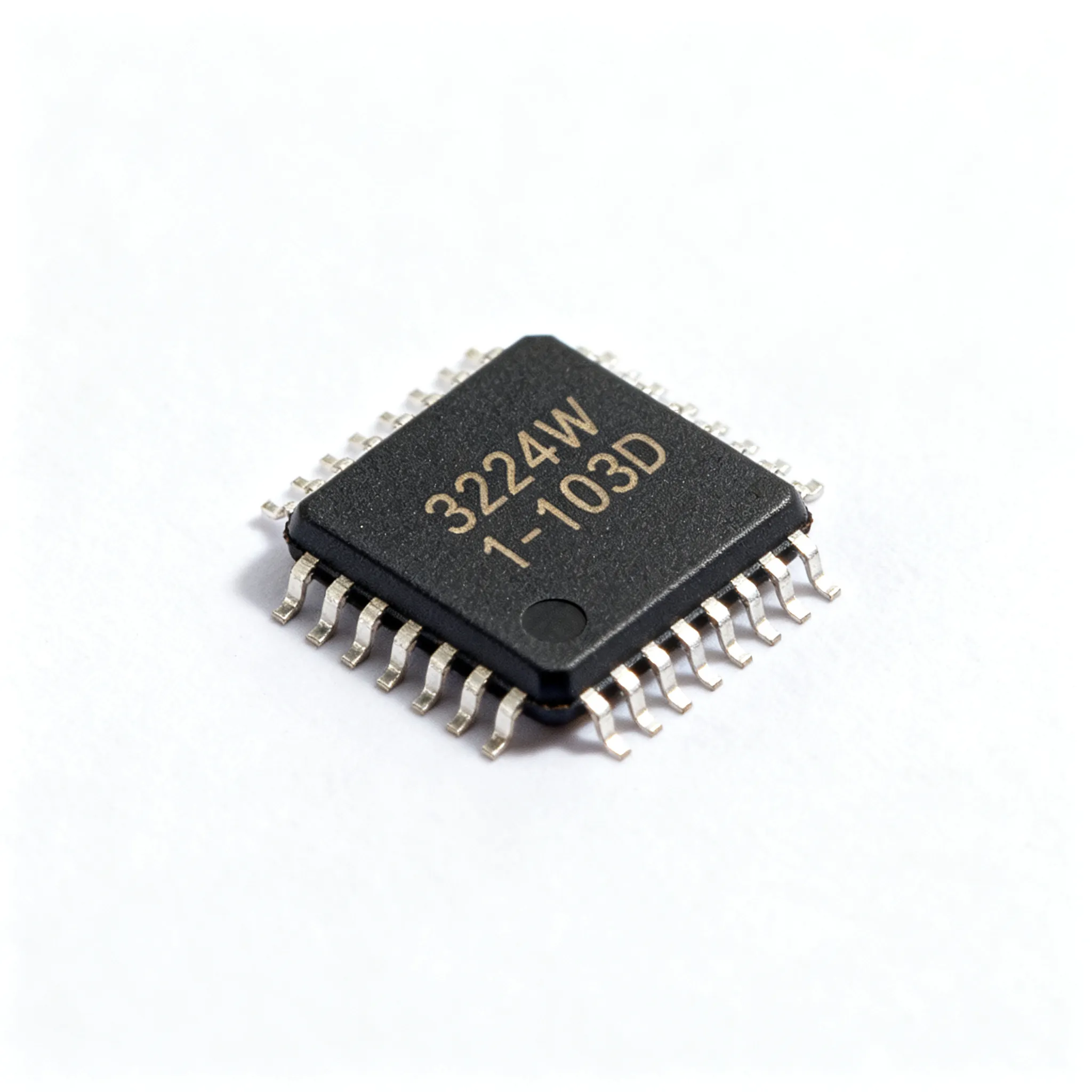
3224W-1-103E Datasheet, Pinout, and Sourcing Checks
Why the 3224W-1-103E Keeps Appearing on Procurement Radar
When a surface‑mount trimmer earns more than 19 quotation requests in five years and a documented average market price of USD 0.8152, it stops being a commodity resistor and becomes a part that engineering and procurement leads need to manage carefully. The Bourns 3224W-1-103E — a 10 kΩ, 4 mm SMD, multiturn cermet trimmer — fits that profile exactly. According to Avaq’s pricing insight, the part has been highly volatile from 2020 to 2025, with the average hovering around that figure while spikes appeared during allocation‑sensitive windows (Avaq). Meanwhile, NetSource Technology enforces a $250 minimum order unless prior approval is granted, creating a real barrier for small‑batch prototyping or one‑off repairs (NetSource).
These dynamics make it clear: you cannot treat the 3224W-1-103E as a simple off‑the‑shelf part. A reliable datasheet, a thorough pinout check, and a disciplined sourcing process are the only things standing between a clean production build and a line stoppage — or worse, a batch of counterfeit trimmers that drift under temperature. In the sections that follow, we break down what the manufacturer’s documents reveal, how to compare distributor alternatives without getting burned, and what layout and verification steps will keep your BOM healthy.
What the Latest Datasheets Reveal About the 3224W-1-103E Trimmer
Bourns has published the 3224W-1-103E datasheet across multiple aggregators and distributor sites, but the core specifications are consistent. The component belongs to the 3224 series, a 4 mm square, surface‑mount, multiturn trimmer that uses cermet technology and a sealed, industrial‑grade construction. The primary resources you should reference include the official Bourns document hosted at LCSC, the technical summary on AllAboutCircuits, the Alldatasheet compilation, and the Octopart datasheet PDF — all of which agree on the essentials (LCSC, AllAboutCircuits, Alldatasheet, Octopart datasheet PDF).
| Parameter | Value | Notes |
|---|---|---|
| Resistance | 10 kΩ | ±10% tolerance |
| Power rating | 0.25 W at 70°C | Derate linearly above 70°C |
| Mechanical turns | 11 (nominal) | Multiturn cermet element |
| Adjustment orientation | Top adjust | Wiper moves across 11 turns from one end to the other |
| Termination | J‑lead | SMD; matched to a 4 mm square footprint |
| Dimensions (L × W × H) | 4.8 × 3.5 × 5.3 mm | Height includes adjustment screw |
| Operating temperature | -55°C to +150°C | Industrial range |
| Sealing | Sealed construction | Washable; not hermetic |
| TCR (Temperature Coefficient) | ±100 ppm/°C | Typical for cermet trimmer |
| Contact resistance variation | ≤2% or 3 Ω (whichever greater) | After mechanical cycling |
Those figures frame the 3224W-1-103E as a rugged trimmer suited for industrial bias adjustments, sensor calibration, and power supply margining where you need both fine granularity and resistance to wash processes. The sealed body — often mistaken for a hermetic rating — blocks most fluxes and cleaning solvents, but extended exposure to condensing humidity or corrosive gases may still require a secondary conformal coating. The 150°C upper limit is a genuine ceiling: Bourns specifies a derating curve that drops the power rating to zero as temperature approaches 150°C, so verify your operating envelope against the official plot.
Distributor Showdown: Sourcing 3224W-1-103E Without Surprises
Buying the 3224W-1-103E today means navigating a landscape where pricing visibility, minimum‑order hurdles, and date‑code transparency vary dramatically. We compared four sourcing channels that engineers and buyers frequently consult. The table below captures the experience you can expect, but always cross‑reference real‑time inventory through an aggregator like Octopart before committing (Octopart).
| Source | Pricing & Terms | Inventory Visibility | Procurement Tip |
|---|---|---|---|
| Octopart (aggregator) | Real‑time price comparison from multiple distributors; no direct order placement | Displays stock levels and lead‑time estimates per distributor | Start here to understand market spread; flag alternate Bourns part numbers listed on the page to avoid ordering the wrong variant |
| Avaq | Historical average USD 0.8152; fast quoting; equivalent‑part search | Shows stock; 19+ historical RFQs indicate active procurement | Use equivalent‑part suggestions cautiously — verify footprint and sealed rating before substituting; request a current date‑code confirmation |
| NetSource Technology | $250 minimum order unless prior approval; date codes provided (e.g., 1006) | Limited transparency; must request quote | Suitable for volume buyers; always ask for a test report within 90 days and check if the quoted lot matches Bourns’ original packaging |
| AllAboutCircuits | Pricing information shown alongside datasheet; no storefront | Does not display live inventory | Use as a datasheet/price benchmark; confirm actual availability through the linked distributor |
Across these channels, three themes emerge. First, the historical price average of USD 0.8152 masks spikes that can occur when allocation tightens, so treat the 3224W-1-103E as allocation‑sensitive and confirm current availability via RFQ. Second, minimum‑order thresholds like NetSource’s $250 floor can trip up engineering labs that only need 10–20 pieces; aggregators and full‑service distributors often offer lower MOQs, but you must verify. Finally, the presence of alternate Bourns numbers on Octopart means a careless buyer could inadvertently order a non‑sealed or J‑hook variant — always cross‑check the full manufacturer part number.
Tip: Before placing a large order, require the distributor to supply a photo of the actual reel label that shows Bourns logo, date code, and lot number. Match that against the Bourns 3224 series documentation to flag any inconsistency early (Alldatasheet).
Pinout and PCB Layout Tips for the 3224W-1-103E
The 3224W-1-103E uses a straightforward three‑terminal J‑lead configuration that both LCSC and Avaq datasheets illustrate clearly (LCSC, Avaq). Terminal 1 is the counter‑clockwise end (CCW), terminal 2 is the wiper, and terminal 3 is the clockwise end (CW). As you rotate the top‑adjust screw across its 11 mechanical turns, the wiper resistance moves smoothly between the two endpoints. Centering the wiper before soldering — that is, setting it to roughly mid‑scale — reduces thermal drift by balancing the resistive element’s thermal mass.
For PCB layout, the J‑lead form factor demands attention to pad geometry and stencil design. The following table summarizes the key footprint parameters derived from the Bourns 3224 series land pattern recommendation.
| Layout Parameter | Typical Value | Units |
|---|---|---|
| Pad width (J‑lead) | 1.1 | mm |
| Pad length | 2.0 | mm |
| Terminal pitch (approximate) | 2.54 | mm |
| Soldermask expansion | 0.1 | mm |
| Stencil thickness | 0.127 – 0.15 | mm |
While these numbers align with the Bourns documentation, always pull the verified land pattern from the official datasheet for your PCB library — variations in plating thickness can shift ideal dimensions. Below are the layout and assembly rules that experienced engineers apply to avoid field failures.
- Keep vias outside the trimmer silhouette. Even a sealed trimmer can trap flux residues under its body if vias are present, leading to leakage paths over time. Place all escape vias at least 1.5 mm away from the component edge.
- Stencil aperture should be ~80% of pad area. Full‑paste coverage under J‑leads can cause floating or excessive solder balls. Reduce aperture to keep a consistent fillet without starving the joint.
- Specify a ceramic or plastic adjustment tool. Metal screwdrivers can score the adjustment screw, introduce micro‑cracks, or short adjacent traces if you slip. Bourns’ own H‑90 tool is the reference; any non‑conductive equivalent works.
- Never exceed the 11‑turn mechanical end stops. Forcing past the stop can delaminate the cermet element, permanently shifting resistance or creating a dead spot. Always count turns and stop when you feel the hard limit.
- Verify Bourns branding before reflow. Counterfeit trimmers often lack the crisp laser‑etched logo or show inconsistent orientation markers. Compare the incoming lot against the official Bourns datasheet packaging drawing, and reject anything with blurry markings or missing date codes.
- Inspect for tombstoning after reflow. J‑lead trimmers can lift on one side if pad thermal balance is off. Ramp up the reflow profile symmetrically, and consider a nitrogen atmosphere if solderability becomes marginal.
Questions Engineers and Buyers Ask Before Committing to the 3224W-1-103E
Q: Can I substitute the 3224W-1-103E with another 10 kΩ SMD trimmer?
Yes, but substitution requires careful verification. Bourns itself offers variants within the 3224 family — for example, the 3224W‑1‑104E changes the resistance to 100 kΩ, and the 3224J series uses a different termination style. Cross‑reference the official Bourns datasheet and an aggregator like Octopart (Octopart) for pin‑compatible alternatives. Avaq lists equivalent parts, but you must confirm the sealed rating, adjustment range, and footprint match your application; a non‑sealed trimmer may fail after board wash, and a different housing height can interfere with enclosures. Treat any alternative as a candidate only — design validation is mandatory.
Q: What are the most common procurement pitfalls with this part?
The biggest pitfalls are volatile pricing — the historical average sits at USD 0.8152 but spikes can emerge without warning — and unexpected minimum‑order requirements. NetSource, for example, requires a $250 minimum unless you obtain prior approval. Stock tightening can occur during peak manufacturing cycles; checking multiple distributors via Octopart gives you a real‑time picture, but do not assume all listed inventory is current. Counterfeit parts also circulate in the trimmer market, so validating date codes, laser marking, and Bourns packaging against the manufacturer’s documentation is essential.
Q: How do I read the pinout from the datasheet?
The 3224W-1-103E pinout is documented in the LCSC and Bourns datasheets as three J‑lead terminals: terminal 1 (CCW), terminal 2 (wiper), and terminal 3 (CW). The wiper moves linearly as you rotate the top‑adjust screw through 11 mechanical turns. For the best thermal stability, set the wiper to mid‑scale (approximately 5.5 kΩ between wiper and each end) before soldering. When laying out the board, pay attention to the terminal numbering diagram — swapping CW and CCW orientation can cause confusing calibration procedures later.
Q: Does the sealed construction make it suitable for harsh environments?
Yes, the “sealed” label in the Bourns datasheet means the trimmer withstands standard industrial contaminants and aqueous wash processes. However, it is not hermetic. If your product faces prolonged condensing humidity, salt spray, or corrosive gases (H₂S, SO₂), plan for an additional conformal coating over the trimmer body, and keep the adjustment screw accessible only after coating cure. The 150°C upper operating temperature is genuine, but the power rating derates above 70°C, so calculate your hot‑spot dissipation carefully.
Q: What is the typical lead time for the 3224W-1-103E in 2025?
Lead times vary by distributor. As of early 2025, many sources including LCSC and Avaq show inventory ready to ship, but the high quotation activity noted by Avaq — over 19 RFQs over five years — signals that the part can enter allocation‑sensitive periods. Octopart’s aggregator view gives you a snapshot of current lead‑time estimates, but the only safe approach is to confirm allocation‑backed lead time directly with your supplier and request a written delivery commitment tied to a specific date code lot.
After integrating the component into your design and locking in the supply, keep a running dialog with your distributor: if the 3224W-1-103E allocation status changes, the earlier you receive a notice, the less likely you’ll face a line‑down situation. Pair that vigilance with the datasheet‑grounded pinout and layout practices above, and the Bourns trimmer will deliver the adjustment repeatability your industrial circuit demands.
References & Further Reading
- Bourns 3224W-1-103E datasheet download – LCSC Electronics
- 3224W-1-103E datasheet and pricing – AllAboutCircuits
- 3224 series SMD trimming potentiometer datasheet – Alldatasheet
- Octopart datasheet PDF for 3224W-1-103E
- Historical pricing and sourcing insight – Avaq
- ← Previous ArticleNext Article >>
Related Articles
 Blog
What Does MFD Stand for on a Multimeter
MFD on a multimeter means microfarads, the unit for capacitance. Learn how to use this setting to test capacitors and troubleshoot circuits safely.
 Blog
How to Wire Potentiometer and Why It Matters
Learn how to wire potentiometer correctly: connect outer pins to voltage and ground, and the middle wiper pin to your signal. Step-by-step guide.
 Blog
RF Module Procurement for OEM BOMs: What Buyers Should Verify Before Sourcing
One procurement checklist: shortage lines, incoming inspection, and alternate qualification. Prefer a part-number RFQ over another BOM-upload explainer.
 Blog
How Electronic Hardware Controls the Purge Valve
What does the purge valve do? It meters fuel vapor from the canister to the intake, controlled by the ECM via a solenoid for precise flow.
 Blog
RS232 Sourcing Guide: Pinout Inspection, Circuit Equivalents, and Datasheet Cross-Checks for OEM Procurement
RS232 pinout, package, and datasheet limits buyers actually check — plus lot inspection notes. Request a quote on IC-Online; no invented stock claims.
 Blog
Is GND Positive or Negative in Consumer and Industrial Electronics?
Is GND positive or negative? GND is neither; it's a zero-voltage reference. In DC circuits, it's often tied to the negative terminal, but it's not a polarity.