
88E1512A0NNP2I000 Supply Risk Assessment: What to Ask Before You Buy
What to verify on 88E1512A0NNP2I000 before you buy: date code, CoC, test evidence, and allocation-backed lead time. Ask these RFQ questions on IC-Online.
Why That One Ethernet PHY Could Land You in a Recall Notice—88E1512A0NNP2I000 Under Scrutiny
When a medical infusion pump drops off the network, a factory robot stops mid-operation, or a building’s fire-alarm panel goes silent, the failure doesn’t begin with a software bug. Often, it starts with a single component that looked identical on the outside but wasn’t from the authorized channel. The 88E1512A0NNP2I000 Marvell Alaska Gigabit Ethernet PHY sits on hundreds of industrial, telecom, and embedded designs, and any break in its supply integrity can cascade into a field recall that regulators flag under mandatory reporting.
This is not hypothetical. Browse the CPSC recalls bulletin and you’ll find medical devices, industrial controls, and networking gear pulled from the market because a component-level substitution introduced intermittent link drops or thermal runaway. The FDA publishes safety alerts and recalls that cite electronic component reliability as a root cause, and the Product Safety Planning and Recall Handbook details how manufacturers and importers must report defects that could create a substantial product hazard. That handbook, together with the Recall Guide for Manufacturers, makes it clear: responsibility for defective components travels upstream, even when a production buyer sourced the parts from an independent broker.
If your design relies on the 88E1512A0NNP2I000, the sourcing decision is more than a bill-of-materials line. It’s a regulatory exposure that deserves the same rigor as a safety-critical tolerance stack-up. This article frames the supply risk assessment you must perform before you click “buy”—what questions to ask, what technical parameters narrow your sourcing options, and how to distinguish a procurement bargain from a latent recall liability.
Technical Levers That Shape the 88E1512A0NNP2I000 Supply Chain (and Your Sourcing Options)
Supply-chain risk for an Ethernet PHY isn’t driven only by market conditions; it’s encoded in the silicon. The 88E1512A0NNP2I000 comes with architectural decisions that both simplify board design and limit the field of alternative parts. Understanding those levers tells you which alternate sourcing approaches are viable—and which will force a board respin or compromise reliability.
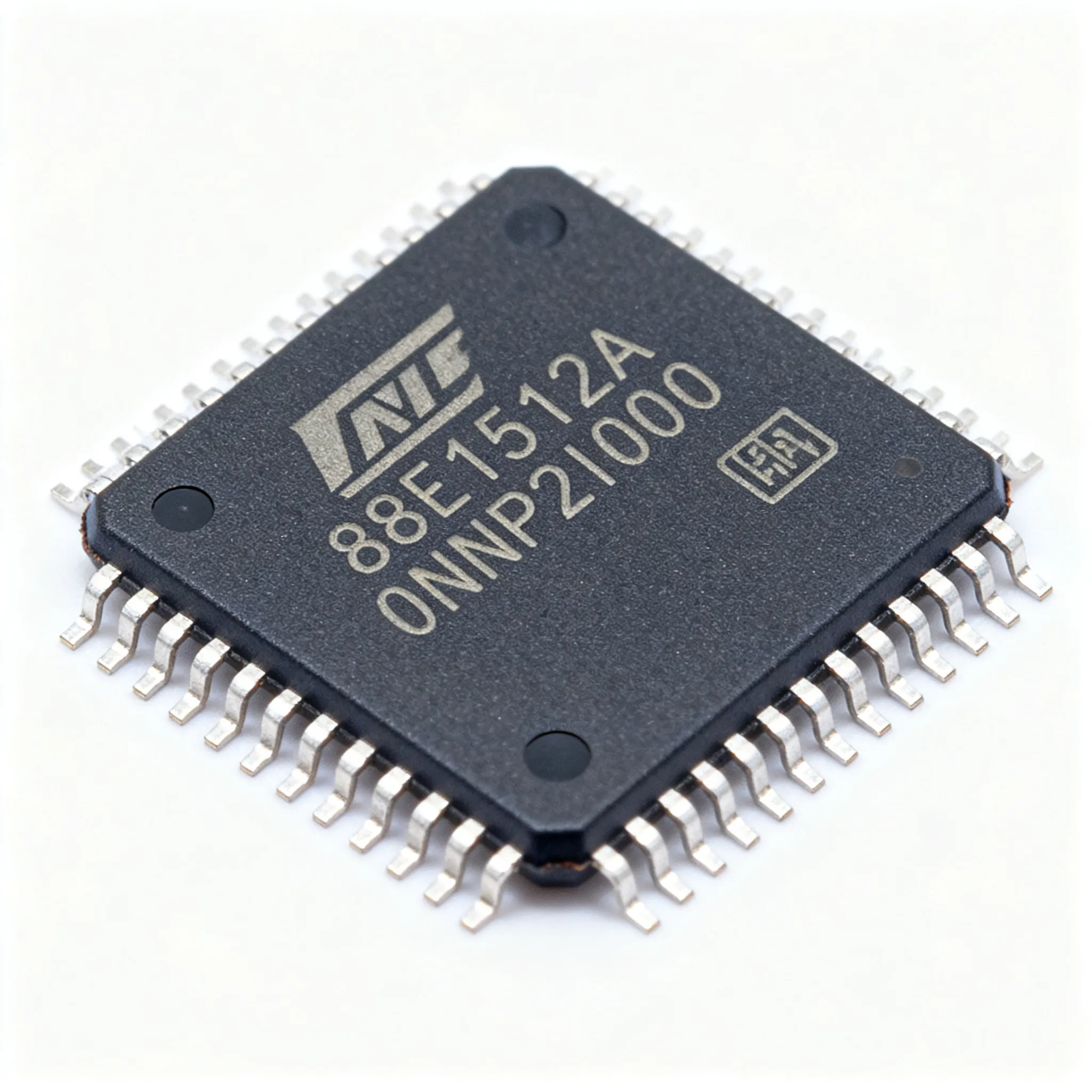
The device integrates a switching voltage regulator so the entire transceiver runs from a single 3.3 V supply (SZComponents summary, Utmel overview). That cuts the external regulator count, but it also means that many competing PHYs—which expect a 1.8 V or 2.5 V rail—are not drop-in candidates. The package is a 56‑lead QFN with a 0.4 mm pitch and an exposed pad, making rework and counterfeit detection challenging. The part is rated for industrial temperatures (‑40 °C to +85 °C), and its LVCMOS I/O can interface at 1.8 V, 2.5 V, or 3.3 V, which provides flexibility but also invites substitution with parts that claim compatible logic levels while missing integrated termination or ESD structures.
Below, each key specification is mapped to a supply-risk consequence. Use this table early in your RFQ preparation to identify which sourcing deviations are acceptable and which put your design at risk of latent field failure.
| Technical Parameter | Marvell 88E1512A0NNP2I000 Specification | Supply Chain Risk Impact | Mitigation & Verification |
|---|---|---|---|
| Supply Rail Architecture | Single 3.3 V with integrated switching regulator | Eliminates external LDOs but makes a true second source scarce. A candidate that needs separate 1.8 V/2.5 V rails forces a board change. | Review any alternative’s power tree; request evaluation boards early. |
| Package | 56‑pin QFN (8 × 8 mm), 0.4 mm pitch, exposed pad | QFN packages are targets for remarking; poor-quality lead frames cause solder joint fatigue and intermittent opens in the field. | In-house X‑ray inspection on incoming lots; require known good date codes (max 2 years old). |
| Temperature Grade | Industrial: ‑40 °C to +85 °C ambient | Commercial‑grade (‑C‑) variants cannot be derated into industrial designs without risking parametric drift and early wear‑out. | Stick to the ‑I000 suffix; ask for lot‑specific thermal cycling test data when buying from non‑authorized channels. |
| I/O Standards | 1.8 V, 2.5 V, and 3.3 V LVCMOS | Multi‑voltage I/O can mask incompatible drive strength or signal integrity issues until the product passes functional test but fails regulatory EMC. | Run an eye‑diagram test at the RGMII/GMII interface on a sample from each batch. |
| Integrated ESD & Termination | On‑die termination and robust ESD structures per QFN design | Substituted parts may lack the same ESD tolerance; field failures show up as port damage after common‑mode transients. | Request full datasheet for any proposed substitute (available via Octopart); compare ESD ratings explicitly. |
| Authorized Distribution Footprint | Sold through Marvell’s franchised channel; availability aggregated on TrustedParts | Any supply chain outside the authorized network lacks factory traceability and may consist of mixed batches, refurbished, or remark units. | Verify distributor authorization via Marvell’s published list; confirm each lot’s Certificates of Conformance. |
The spec sheet also informs your lead‑time risk: any alternative that matches the single‑rail architecture, industrial temperature range, and 56‑QFN footprint is likely a custom part that itself faces capacity constraints. Checking authorized inventory via TrustedParts and monitoring market listings on Octopart gives you a real‑time sense of channel breadth without requiring you to commit to a single broker’s story.
Sourcing Channel Reality Check: Authorized vs. Independent for the 88E1512A0NNP2I000
Procurement teams often face three paths when the primary approved vendor list can’t meet demand: authorized distributors with allocation, aggregator marketplaces like Octopart that surface multiple inventory sources, and independent brokers claiming OEM excess. Each channel brings a different mix of traceability, price, and lead‑time certainty. The table below maps the comparison factors that matter specifically for a device as design‑specific as the 88E1512A0NNP2I000.
| Comparison Metric | Authorized Distributor (TrustedParts) | Independent Broker | Octopart Marketplace Aggregation | Selection Criteria & Failure Boundary |
|---|---|---|---|---|
| Traceability | Factory direct; full chain‑of‑custody documents available | Varies; may lack lot‑specific evidence; seals can be forged | Depends on listed supplier; must verify each seller’s authorization yourself | If a supplier cannot produce a factory‑issued Certificate of Conformance dated within 90 days, treat the lot as unverified. |
| Quality Assurance | Original packaging, moisture‑barrier bag, date codes within control limit | Refurbished or mixed‑date‑code lots are common; solderability testing becomes mandatory | Some sellers are authorized, many are not; quality is not curated uniformly | Require a solderability test report per J‑STD‑002 for any broker lot before acceptance. |
| Lead‑Time Realism | Allocation‑backed; start date is manufacturer‑confirmed reschedule | Promised lead times often start from payment receipt, not factory shipping; hidden material‑purchasing lags | Lead times shown are seller‑provided and must be validated individually | Always ask “When does the clock start?” (insight from Compare Supplier Quotes). |
| Price | Contract pricing or published; reflects factory cost plus margin | Can be below or above market, depending on urgency; low price often signals excess, high risk | Aggregated price‑comparison data; lowest price may hide rework or return‑policy limitations | Weight total cost of quality, not unit price — include incoming inspection and rework cost estimates. |
| Return Policy & Recall Support | Full warranty; traceable return path to manufacturer | Often limited to initial DOA; no recall‑support infrastructure | Varies by seller; Octopart itself doesn’t enforce return terms | Verify that the supplier’s recall cooperation process exists in writing (Supplier Selection Process). |
| Supplier Discipline | Regular performance reviews, documented process control | No ongoing process‑capability data; reliant on transactional trust | You must assess each supplier individually | Ask suppliers for evidence of finish consistency and production control, not just a one‑time sample (Sourcing Risk Control). |
The Octopart listing for the 88E1512A0NNP2I000 (Marvell 88E1512-A0-NNP2I000 on Octopart) shows multiple offers from a mix of authorized and independent sellers. The platform gives you a pricing snapshot, but the responsibility to unpack a supplier’s actual authorization, lead‑time promise cadence, and recall‑handling history remains on the buyer. That’s why procurement teams increasingly apply a supplier‑risk assessment matrix that ranks not just price, but the likelihood of a supply disruption snowballing into a field safety issue—a discipline outlined in Precoro’s supplier selection framework (Supplier Selection Process).
Lean on TrustedParts to filter for authorized sources first; if that path is allocation‑constrained and you explore the open market, overlay the seven verification questions from the next section on every quote you receive.
Before You Click Buy: 7 Questions That Expose 88E1512A0NNP2I000 Supply Gaps
A competitive RFQ rarely guards against the risks that matter most to a product’s long‑term reliability. The following seven questions turn a purchase order into a risk‑managed process. Embed them in your RFQ form, require written answers, and never close a buy without passing all seven gates.
- Can you provide a complete chain‑of‑custody statement from Marvell to my loading dock? — Without it, every subsequent assurance is supposition. The document should list intermediate handlers, storage conditions, and dates.
- What is the date‑code range, and can you supply a solderability test report performed within the last 90 days? — Older date codes risk lead‑frame oxidation and whisker formation in the 56‑QFN; a J‑STD‑002 solderability report is a reasonable gate for any broker lot.
- Describe your ESD and moisture‑handling protocol from receiving to dispatch. — The 88E1512A0NNP2I000 is moisture‑sensitive level 3 (per QFN standard handling). An unsealed bag or missing humidity indicator card voids any reliability assumption.
- When exactly does your quoted lead time start—upon receipt of purchase order, upon materials sourcing sign‑off, or upon factory release? — We expand on the insight from Compare Supplier Quotes: a supplier who quotes four weeks but only starts counting after they’ve bought the die and drawn the package could easily push you into a production gap. Get the schedule breakdown in writing.
- Will you provide a Certificate of Conformance that ties to this specific lot, not a generic template? — A genuine C of C includes part number, lot number, quantity, test reference, and an authorized signature. Generic documents are a red flag for mixed or refurbished inventory.
- What is your written return policy for functional failures discovered after board assembly, and will you cover the cost of rework labor if traceability proves the cause? — Some brokers limit returns to DOA; an industrial Ethernet PHY can pass an initial link‑test and then fail under thermal cycling. Your supplier’s willingness to stand behind the silicon matters as much as the unit price.
- Have you been involved in a component‑level recall in the past three years, and how did you support your customer through the CPSC or FDA reporting process? — The Recall Handbook makes it clear that responsibility travels through the supply chain. A supplier who cannot describe recall remediation steps is not ready to supply safety‑consequent designs.
A quick‑reference version of these gates, with the risk each one mitigates, appears in the table below. Tape it to your monitor or embed it in your ERP’s supplier‑approval workflow.
| # | Pre‑Purchase Question | Supply Risk Addressed | What to Demand from the Supplier |
|---|---|---|---|
| 1 | Chain‑of‑custody from Marvell to dock? | Counterfeit, mixed batch, or gray‑market injection | Written, lot‑specific traceability statement |
| 2 | Date‑code range & 90‑day solderability report? | Oxidation, whiskering, unsolderable QFN pads | J‑STD‑002 solderability test report |
| 3 | ESD and moisture‑handling protocol? | Latent ESD damage, popcorning during reflow | Documented MSL‑3 handling procedures and HIC evidence |
| 4 | When does the lead‑time clock really start? | Material‑purchasing lag hiding realistic delivery | Granular schedule with materials, build, and ship milestones |
| 5 | Lot‑specific Certificate of Conformance? | Generic paperwork hiding non‑conforming product | Signed C of C with exact lot number and quantity |
| 6 | Return policy for functional fails and rework costs? | Buyer bearing the burden of a supplier’s quality escape | Written policy covering board‑level failures and labor |
| 7 | Recall‑support experience and remediation process? | Regulatory exposure when a component defect triggers a recall | Documented recall‑cooperation record and reporting support |
The seven‑question filter doesn’t eliminate supply risk—nothing can—but it forces the conversation from “how much per unit” to “will this lot hold up in a field failure analysis.” When your company’s name appears on a recall notice, that shift in emphasis is priceless.
88E1512A0NNP2I000 Supply Risk: Questions From the Floor at Sourcing Reviews
- Q: Is there a pin‑compatible replacement for the 88E1512A0NNP2I000 if lead times exceed 40 weeks?
- There is no true drop‑in second source documented by Marvell. Any candidate must match the 56‑QFN footprint, single‑3.3V‑supply architecture with integrated regulator, industrial temperature grade, and LVCMOS I/O flexibility. Even if a third‑party part appears to meet those requirements, it will almost certainly require full functional validation across all interface modes and may demand a board respin. Verify single‑source risk through your authorized distributor and build contingency stock rather than rushing an unvalidated swap. Treat any “equivalent” PHY as a candidate for evaluation only, never as a guaranteed drop‑in.
- Q: What is the actual lead time range for the 88E1512A0NNP2I000 right now?
- Lead times for Marvell Ethernet PHYs fluctuate with wafer allocation and back‑end packaging capacity. Instead of quoting a number that may be stale tomorrow, we recommend two actions: check authorized distributor stock and factory‑scheduled deliveries on TrustedParts, and monitor market availability on Octopart for a broader picture. When you receive a lead‑time quote, require a written confirmation that specifies the exact start event (e.g., receipt of order vs. raw‑material procurement sign‑off) and ask for allocation‑backed schedule updates every two weeks.
- Q: Should I trust an independent broker that claims OEM excess stock with Marvell factory seals?
- Excess stock scenarios do occur, but they are high‑risk without independent verification. Factory seals can be replicated, and OEM “excess” lots sometimes contain mixed date codes or devices that failed qualification. Demand full chain‑of‑custody documentation showing the original purchase from Marvell, any intermediate storage conditions, and lot‑specific packing slips. Pair that with in‑house X‑ray inspection of the 56‑QFN package and electrical testing on a sample pulled from every reel. If the broker hesitates on any of these steps, walk away.
- Q: Can I use the commercial‑grade 88E1512‑A0‑NNP2C000 in an industrial design if I derate?
- The commercial‑grade variant is not guaranteed to operate across the industrial ambient temperature range of ‑40 °C to +85 °C. Subjecting it to such extremes, even with thermal margin in the system, risks parametric failures, increased bit‑error rate, and reduced lifetime that no amount of derating can mitigate. Stick with the 88E1512A0NNP2I000 for industrial applications to preserve reliability warranties and avoid a recall-threshold defect.
- Q: How do I confirm a distributor is truly authorized by Marvell?
- Cross‑reference the distributor’s name against Marvell’s official channel list, which is typically posted on the manufacturer’s website. Alternatively, search for the 88E1512A0NNP2I000 on TrustedParts—the platform aggregates inventory only from authorized distributors. An authorized source will readily supply factory‑issued certificates and provide direct traceability back to the original wafer fab.
- Q: What testing should we perform on incoming 88E1512 lots to catch counterfeits?
- At minimum, execute a three‑step incoming inspection: (1) visual inspection under a microscope for package marking anomalies, uneven mold compound, or signs of re‑work; (2) X‑ray examination to verify die orientation and bond‑wire consistency match a known‑good reference unit; (3) functional test on a validated board, running a full link‑up and traffic stress test across all supported speeds. For high‑volume or safety‑consequential products, add decapsulation and electrical parametric screening on a sample from each date code. Such protocols close the gap left by the questions described earlier and give you documented evidence for any future regulatory inquiry.
References & Further Reading
- CPSC Recalls & Product Safety Warnings
- FDA Recalls, Market Withdrawals, & Safety Alerts
- Product Safety Planning, Reporting, and Recall Handbook
- Recall Guide for Manufacturers, Importers, Distributors, and Retailers
- 88E1512-A0-NNP2I000 SZComponents Product Page
- 88E1512 Transceiver Datasheet, Pinout and Alternative (Utmel)
- Marvell 88E1512-A0-NNP2I000 — Octopart Component Search
- Marvell 88E1512-A0-NNP2I000 on TrustedParts
- Supplier Selection Process: 7 Steps and Evaluation Criteria (Precoro)
- Sourcing Risk Control: What to Compare Before Approving a Supplier (Yusheng)
- How to Compare Supplier Quotes Beyond the Lowest Price (Sourceready)
Supply risk assessment for the 88E1512A0NNP2I000 is not a one‑time exercise; it’s a continuous discipline that ties engineering specifications to procurement due diligence. The moment a supplier can’t answer the seven questions definitively, you should treat that line item as a potential recall pathway. When you’re ready to source, skip the guesswork: send your RFQ through IC-Online and upload your BOM to compare allocation, cross‑referenced pricing, and channel choices across authorized and open‑market options. Mix quantities, adjust MOQ, and get the documentation layers that turn a purchase into a defensible, safety‑conscious decision.