

AD1580BRTZ-REEL7 Obsolescence Risk Checklist: Verify Lifecycle and Secure Allocation via RFQ
AD1580BRTZ-REEL7 EOL / NRND checklist: last-time-buy vs redesign, what to require on traceability, and how to RFQ without assuming a drop-in.
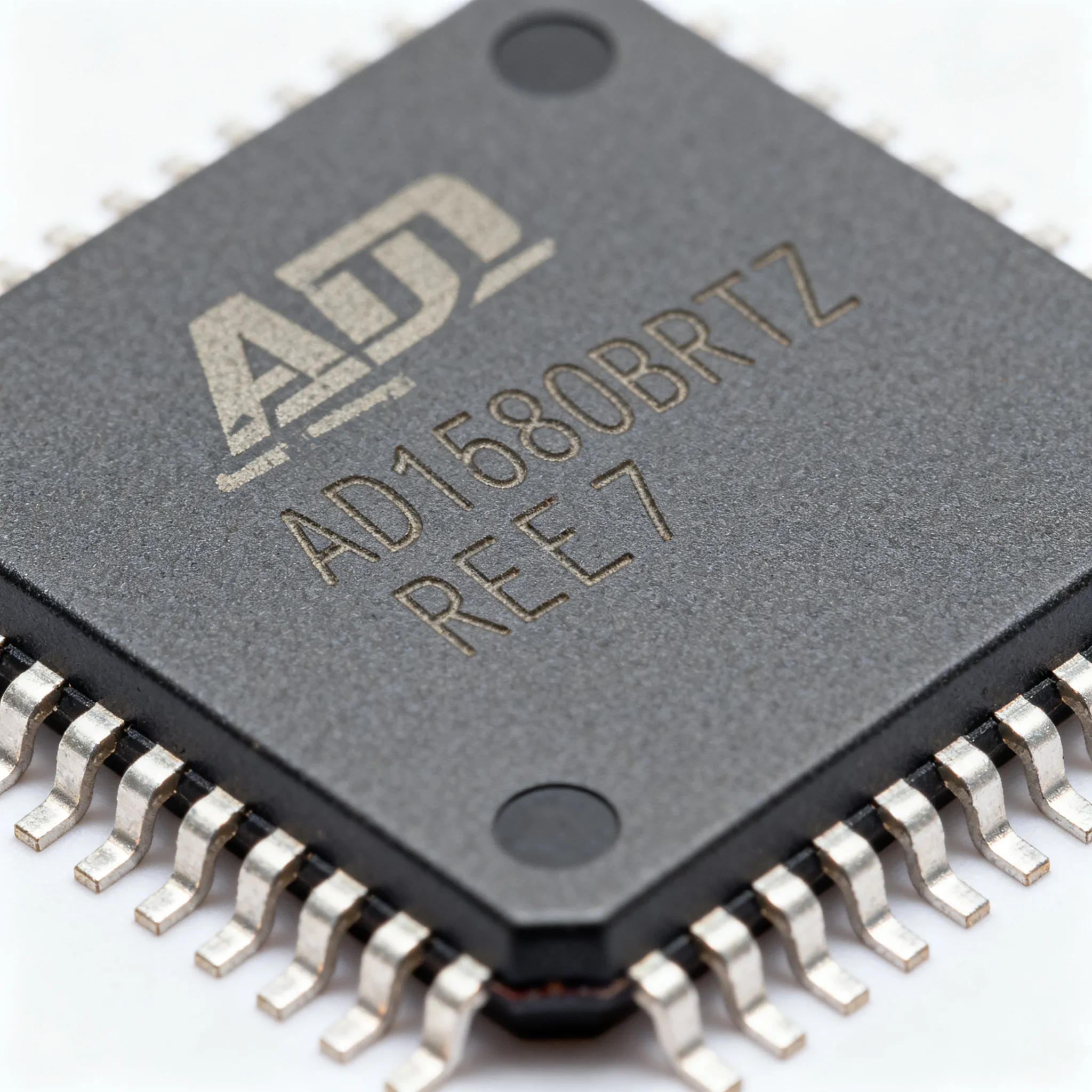
The Quiet Risk in Your Precision 1.225 V Reference: AD1580BRTZ-REEL7 Obsolescence Flags
If your bill of materials carries AD1580BRTZ-REEL7—Analog Devices' 1.225 V micropower shunt voltage reference in SOT‑23‑3—you may already sense the tightening. This part has been a workhorse in battery-powered instrumentation, portable medical monitors, and industrial data-acquisition front ends for over a decade. Yet procurement teams tracking it over the last twelve months have observed a pattern that warrants a structured obsolescence-risk review: thinning franchised-distributor listings, increasing reliance on authorized aftermarket channels, and a datasheet that has not seen a revision in years.
The immediate trigger for concern is not a formal end-of-life notice. Analog Devices has not posted an EOL or NRND (Not Recommended for New Design) flag on AD1580BRTZ-REEL7 as of this writing. However, engineers and buyers who rely on this device should understand that ADI's own lifecycle philosophy—while unusually generous—does not eliminate risk. ADI's product lifecycle policy commits to two-year advance notification when obsolescence cannot be avoided, and the company tracks revenue by product vintage as a key performance metric. That is reassuring, but it is not a guarantee of indefinite production for any single part number.
What has shifted procurement sentiment is the growing prominence of AD1580BRTZ-REEL7 on continuous-source platforms. Rochester Electronics lists the device as part of its authorized aftermarket portfolio, which often signals that a part has transitioned—or is transitioning—from high-volume original production to a die-bank, build-to-order, or lifetime-buy model. When a precision reference with ±0.08% initial accuracy moves into this channel, the procurement conversation must shift from "what is the lead time?" to "how do I lock down an allocation I can trust for my production horizon?"
The table below maps the key drivers that make AD1580BRTZ-REEL7 a prime candidate for a formal lifecycle audit today—before your next production build is exposed to a hard stop.
| Risk Driver | Mechanism | Procurement Impact |
|---|---|---|
| Thinning franchised-distributor stock | Octopart aggregator data shows fewer authorized distributors carrying active inventory compared to broader ADI portfolios; listings increasingly point to broker or secondary-market sources | Buyers must distinguish between genuine allocation and opportunistic broker listings; RFQ becomes mandatory rather than optional |
| Rochester Electronics authorized-aftermarket listing | Rochester maintains die-bank and test capability for AD1580BRTZ-REEL7, indicating the part may have exited volume production | Long-term supply depends on wafer inventory, not ongoing fab runs; allocation agreement is essential |
| Datasheet revision freeze | The last available datasheet revision shows no recent updates; LCSC's hosted datasheet and Alldatasheet's PDF archive confirm a mature, stable design—but no active revision cycle | No PCN alerts for process changes; a static datasheet can precede lifecycle reclassification |
| Single-source architecture risk | The AD1580 family is proprietary to Analog Devices; no pin-for-pin second source exists from another manufacturer | Verify single-source risk in manufacturer/distributor documentation; prioritize allocation over spot-buy strategy |
| Niche output voltage (1.225 V) | 1.225 V is less common than 1.2 V or 2.5 V bandgap references; fewer drop-in alternatives exist at this exact voltage node | Redesign lead time increases if allocation fails; start evaluating alternative families now |
Key Takeaway: The absence of a formal EOL notice is not the same as guaranteed continuity. When a precision reference like AD1580BRTZ-REEL7 appears on Rochester's continuous-source roster while simultaneously showing diminished franchised-distributor availability—as tracked on Octopart's AD1580BRTZ-REEL7 aggregator page—the prudent course is to treat supply as allocation-sensitive and initiate a structured RFQ process. The following sections give you the technical grounding and the practical checklist to execute that audit efficiently.
Inside the AD1580BRTZ-REEL7: Precision, Micropower, and the SOT‑23 Trade‑Off
Before you can assess lifecycle risk for AD1580BRTZ-REEL7 or evaluate alternatives, you need a clear-eyed view of exactly what this part delivers—and what design constraints it imposes. The AD1580 is a two-terminal shunt voltage reference built on a bandgap core, factory-trimmed to 1.225 V ±0.08% at 25°C. Unlike three-terminal series references that source current, a shunt reference sinks current to ground and requires an external resistor to set the bias point. That architecture brings both a standout advantage—ultra-low minimum operating current—and a thermal trade-off that engineers often underestimate.
Download the full datasheet from All About Circuits' AD1580BRTZ-REEL7 datasheet page or Datasheets.com for the complete electrical characteristics. The core parameters that matter for procurement and design decisions are summarized below.
| Parameter | Value | Unit / Condition |
|---|---|---|
| Output voltage (VOUT) | 1.225 | V, fixed, factory-trimmed |
| Initial accuracy | ±0.08% (max) | At 25°C, B-grade |
| Temperature coefficient | 50 (typ), 100 (max) | ppm/°C, −40°C to +85°C |
| Shunt current range | 50 µA to 10 mA | Operational range for specified regulation |
| Minimum operating current | 50 | µA; enables micropower designs |
| Dynamic impedance | 0.5 (typ), 1.0 (max) | Ω, at 100 µA shunt current |
| Output voltage noise | 5 (typ) | µV p-p, 0.1 Hz to 10 Hz |
| Wideband noise | 20 (typ) | µV rms, 10 Hz to 10 kHz |
| Package | SOT‑23‑3 | TO‑236‑3, SC‑59 compatible footprint |
| Operating temperature range | −40 to +85 | °C, industrial grade |
| Maximum junction temperature | 150 | °C, absolute maximum rating |
The 50 µA minimum operating current is what makes AD1580BRTZ-REEL7 attractive in battery-powered analog front ends. A precision reference that draws only 50 µA from the rail leaves more headroom for sensor excitation, ADC conversion, and wireless transmission. Compare that to older bandgap references requiring 500 µA or more, and the power-saving advantage is clear in duty-cycled data loggers, portable gas detectors, and wearable vital-sign monitors.
However, the shunt architecture introduces a thermal constraint that the SOT‑23‑3 package amplifies. When the shunt reference sinks 10 mA at a rail voltage of, say, 5 V, the device dissipates roughly (5 − 1.225) × 0.01 = 37.75 mW across the junction. With a SOT‑23‑3 junction-to-ambient thermal resistance (θJA) in the range of 300–400°C/W on a minimal copper pour, that 38 mW translates to a junction temperature rise of 11–15°C above ambient. In a sealed enclosure at 70°C, the junction could approach 85°C—the upper limit of the specified temperature range. Self-heating also shifts the output voltage by the temperature coefficient, eroding the ±0.08% accuracy you paid for. For designs operating near the 10 mA ceiling, increase the PCB copper area under the SOT‑23‑3 pad or consider a series reference that dissipates less power at higher load currents.
AD1580 vs. AD1582: When a Sibling Voltage Reference Fits Your BOM
If AD1580BRTZ-REEL7 becomes allocation-constrained, the first device procurement teams typically examine is its sibling—the AD1582BRTZ-REEL7. Both share the same SOT‑23‑3 package, the same shunt-reference architecture, and the same Analog Devices pedigree. But the voltage difference is not a rounding error: one outputs 1.225 V, the other 2.5 V. That factor of two must be accounted for in any substitution plan, and it is where BOM-line misreads can cascade into field failures.
The comparison below draws on the Ovaga Technologies AD1580BRTZ vs AD1582BRTZ-REEL7 specification comparison, cross-referenced with manufacturer datasheets. Use it as a starting point for your own evaluation—verify every parameter against your circuit's tolerance budget before committing to a redesign.
| Comparison Metric | AD1580BRTZ-REEL7 (1.225 V) | AD1582BRTZ-REEL7 (2.5 V) | Selection Criteria & Failure Boundary |
|---|---|---|---|
| Output voltage | 1.225 V | 2.5 V | Direct substitution requires downstream circuit to tolerate 2× reference voltage; verify ADC full-scale range and comparator thresholds |
| Initial accuracy | ±0.08% (max) | ±0.08% (max) | Identical accuracy spec; no degradation risk if the voltage change is acceptable |
| Temperature coefficient | 50 ppm/°C (typ) | 50 ppm/°C (typ) | Equivalent drift performance across the −40°C to +85°C industrial range |
| Shunt current range | 50 µA – 10 mA | 50 µA – 10 mA | Same biasing requirements; external resistor recalculation needed for new VOUT |
| Package | SOT‑23‑3 | SOT‑23‑3 | Footprint-compatible; no PCB layout change required |
| Noise (0.1 Hz – 10 Hz) | 5 µV p-p (typ) | 10 µV p-p (typ, estimated bandgap scaling) | Higher output voltage typically raises noise floor proportionally; verify noise budget in sensor front-end |
The footprint compatibility is a genuine advantage—if your downstream signal chain can absorb a 2.5 V reference instead of 1.225 V, the AD1582BRTZ-REEL7 drops onto the same pads. But "if" is the operative word. A 12-bit ADC configured for a 1.225 V external reference will saturate at half its previous full-scale input range if fed 2.5 V without firmware or gain-stage adjustment. Conversely, a resistor divider on the reference output introduces tolerance and temperature-coefficient errors that can erase the benefit of moving to the sibling part. Engage your analog design lead before the procurement team commits to a last-time buy of the AD1582 as a hedge.
Warning: Part-number confusion on the BOM. The AD1674BD occasionally appears in cross-reference suggestions alongside AD1580BRTZ-REEL7 because alphanumeric similarity can fool automated BOM-scrubbing tools. The AD1674BD is a 12-bit analog-to-digital converter—a completely unrelated function. The Ovaga AD1674BD vs AD1580BRTZ-REEL7 comparison page documents the fundamental differences. Always verify the full manufacturer part number against the datasheet before approving an alternative. A voltage reference and an ADC do not belong on the same substitution shortlist.
A Practical Lifecycle and RFQ Checklist for AD1580BRTZ-REEL7 Buyers
When the supply signal for a precision reference starts blinking amber rather than green, the worst mistake is to treat procurement as a single buy-or-wait decision. Instead, treat it as a four-step verification sequence that moves from official sources to binding commitments. The checklist below is designed specifically for AD1580BRTZ-REEL7 buyers who need to confirm lifecycle status and lock down allocation before a competitor's PO consumes the remaining inventory.
- Cross-check ADI's official product lifecycle page. Start at Analog Devices' Product Life Cycle Information portal. Search for AD1580 and verify whether any NRND, EOL, or Last Time Buy notice has been posted. ADI's stated policy is to provide two years' notice when obsolescence cannot be avoided. Bookmark this page and set a quarterly calendar reminder—lifecycle status can change between design reviews.
- Survey franchised distributor stock via an aggregator. Use Octopart's AD1580BRTZ-REEL7 price and availability page to view inventory across multiple authorized distributors simultaneously. Pay attention not just to the quantity-on-hand number, but to the number of distributors showing zero stock. When only one or two franchised sources carry inventory while others redirect to marketplace sellers, the part is likely in allocation or post-volume-production status. Request a formal allocation confirmation from the distributor showing stock on their shelf—not a drop-ship from an intermediary.
- Contact continuous-source specialists for long-term allocation. Rochester Electronics' listing for AD1580BRTZ-REEL7 is a critical data point. Rochester maintains die-bank inventory and test capability for devices that have exited volume wafer fabrication. Request a written allocation letter specifying the number of pieces reserved for your account, the die-bank source (original ADI wafers or Rochester-recreated), the test flow applied, and the date-code range of finished goods. This document becomes your insurance policy if franchised channels dry up entirely.
- Craft an RFQ that goes beyond price-and-quantity. An allocation-sensitive RFQ for AD1580BRTZ-REEL7 must include provisions that a standard spot-buy RFQ omits. Specify: (a) target annual volume and minimum order quantity (MOQ); (b) acceptable lead time with a requirement for allocation-backed confirmation—not an estimate; (c) a fixed-price window (e.g., 12 months) to protect against allocation-driven price escalation; (d) a written commitment from the supplier on the number of pieces held for your account; (e) a last-time-buy clause that guarantees notification and a minimum order window if EOL is declared; and (f) a date-code verification requirement (within 12 months of delivery) with a test report no older than 90 days. Submit the RFQ to multiple authorized distributors via IC-Online's BOM upload tool to compare offers on equal terms.
Tip: When verifying date codes on received stock, do not rely solely on the distributor's certificate of conformance. Visually inspect the SOT‑23‑3 marking against ADI's datasheet marking diagram. A part with ±0.08% initial accuracy is sensitive to mishandling—if the marking shows signs of re-marking, blacktopping, or inconsistent laser-etch depth, quarantine the lot and request traceability documentation back to the wafer lot.
If you must consider non-franchised sources—and for a part in allocation, the pressure to do so can be intense—insist on full traceability and independent third-party electrical testing. Continuous-source suppliers like Rochester, who maintain die-bank and test capability under authorization from the original manufacturer, offer a fundamentally safer secondary path than independent brokers who cannot document chain of custody.
Questions You'll Hear in the Purchasing Meeting About AD1580BRTZ-REEL7
Below are the six questions that consistently surface when engineering and supply-chain teams sit down to review AD1580BRTZ-REEL7 sourcing strategy. Each answer is structured to equip you with the factual grounding and the specific action items needed to move the conversation from concern to decision.
Q: Is AD1580BRTZ-REEL7 still in active production, and how can I get official lifecycle confirmation?
A: Analog Devices' product lifecycle page does not currently list AD1580BRTZ-REEL7 as obsolete or NRND. However, the combination of low franchised-distributor stock and the device's presence on Rochester Electronics' continuous-source platform strongly suggests that volume wafer production may have concluded, with supply now managed through die-bank inventory. Always request official lifecycle confirmation in writing from your local ADI sales office or franchised distribution partner. Reference ADI's two-year advance notification commitment in your inquiry—this holds the manufacturer accountable and creates a paper trail for your internal quality system.
Q: What is the closest functional alternative if AD1580BRTZ-REEL7 becomes unavailable?
A: The AD1582BRTZ-REEL7 (2.5 V) is the nearest sibling—identical SOT‑23‑3 package, matching ±0.08% accuracy, and equivalent 50 ppm/°C drift performance as documented in the Ovaga specification comparison. The output voltage is double, so verify that your downstream ADC, comparator, or sensor-excitation circuit can accept 2.5 V with appropriate firmware scaling or a precision resistor divider. For an exact 1.225 V replacement from a different manufacturer, evaluate candidates such as the MAX6126AASA12+ or the LT6650-1.225. Both require careful side-by-side comparison of initial accuracy (±0.02% to ±0.1% depending on grade), temperature coefficient, quiescent current, and noise—parameters where the AD1580's 5 µV p‑p low-frequency noise is competitive and not trivial to match.
Q: How do I structure an RFQ to secure allocation and protect against future shortages?
A: An allocation-grade RFQ for AD1580BRTZ-REEL7 should include: target annual volume with ±20% flexibility, maximum acceptable lead time (request allocation-backed confirmation—do not accept an estimate), a fixed-price window of 12 months, a written commitment specifying the number of pieces reserved for your account, a last-time-buy clause that guarantees notification and a minimum 90-day order window if EOL is declared, and a date-code verification requirement (within 12 months of shipment) backed by a test report not older than 90 days. Submit the RFQ through multiple authorized channels simultaneously. Use Octopart's distributor comparison to identify which franchised partners currently show stock, and send the RFQ to at least three of them. Comparing allocation offers side-by-side gives you leverage and a clearer picture of actual supply depth.
Q: What are the risks of buying AD1580BRTZ-REEL7 from non‑franchised sources?
A: Three risks dominate. First, counterfeit parts—a precision reference with 0.08% accuracy and 5 µV p‑p noise is a target because visual inspection alone cannot verify electrical performance. Second, uncontrolled storage conditions—moisture ingress, thermal cycling, or ESD exposure in a non-certified warehouse can degrade the laser-trimmed bandgap accuracy long before the part is soldered onto your board. Third, the absence of product-change-notice (PCN) support—if ADI issues a process change that affects electrical parameters, non-franchised buyers will not receive notification and may unknowingly mix old and new revision stock on the same production line. If a non-franchised source is the only option, insist on full lot-traceability documentation, third-party electrical testing on a sample from the actual lot, and a written guarantee of authenticity with a refund-for-cause provision. Rochester Electronics' authorized-aftermarket model—which maintains original-manufacturer die-bank and test capability—offers a far lower risk profile than an untraceable broker.
Q: Does Rochester Electronics stock guarantee that I can stop worrying about obsolescence?
A: No. Rochester is the semiconductor industry's largest authorized aftermarket supplier and its AD1580BRTZ-REEL7 listing confirms that die-bank inventory exists and can be packaged and tested to original specifications. This provides a bridge—often measured in years, not months—but it cannot prevent ADI from eventually exhausting wafer supply. Rochester's model extends availability; it does not guarantee perpetual production. The safest posture is to combine a Rochester allocation with a written lifecycle confirmation from ADI and an active migration plan that names at least one evaluated alternative. Treat the Rochester allocation as a time-buying strategy, not a permanent solution.
Q: Is the AD1674BD a pin‑compatible alternative? I saw it in a cross‑reference.
A: Absolutely not. The AD1674BD is a 12-bit successive-approximation analog-to-digital converter—a completely different function from the AD1580 series shunt voltage reference. Its presence in cross-reference results is a cautionary tale about automated part-number matching algorithms that confuse similar alphanumeric strings. The Ovaga AD1674BD vs AD1580BRTZ-REEL7 comparison page documents the fundamental differences in function, pinout, package, and application. Before approving any alternative part number on your BOM, pull the datasheet from the manufacturer's website and verify function, pinout, package, and electrical specifications against the original. A 12-bit ADC cannot substitute for a 1.225 V reference—and the field failure that results from confusing the two will cost far more than the time spent reading the datasheet.
References & Further Reading
- Analog Devices — Product Life Cycle Information
- Rochester Electronics — AD1580BRTZ-REEL7 Continuous Source Listing
- Octopart — AD1580BRTZ-REEL7 Price, Availability, and Distributor Comparison
- Ovaga Technologies — AD1580BRTZ vs AD1582BRTZ-REEL7 Specification Comparison
- Ovaga Technologies — AD1674BD vs AD1580BRTZ-REEL7 Specification Comparison
- LCSC Electronics — AD1580BRTZ-REEL7 Datasheet (PDF)
- All About Circuits — AD1580BRTZ-REEL7 Datasheet
- Alldatasheet — AD1580BRTZ-REEL7 Datasheet PDF (Analog Devices, 12 Pages)
- Datasheets.com — AD1580BRTZ-REEL7 Technical Specifications
- ICONE-chip — AD1580BRTZ-REEL7 Product Detail and Availability
Secure your allocation for AD1580BRTZ-REEL7 before the next production cycle tightens supply further. Upload your complete bill of materials—including this 1.225 V precision reference and all supporting passives—via IC-Online's RFQ platform. Our team routes mixed-BOM enquiries to authorized distributors and continuous-source specialists simultaneously, giving you comparable allocation offers with verified date codes and traceability documentation. Do not wait for a formal EOL notice to trigger your sourcing review—the time to lock down allocation is now.