
AD5593RBCBZ-RL7 Supply Risk Assessment: What to Ask Before You Buy
What to verify on AD5593RBCBZ-RL7 before you buy: date code, CoC, test evidence, and allocation-backed lead time. Ask these RFQ questions on IC-Online.
AD5593RBCBZ-RL7 Supply Risk Assessment: What to Ask Before You Buy
Why the AD5593RBCBZ-RL7 Is Suddenly a Supply-Chain Talking Point
For procurement engineers and buyers managing mid-volume production, mixed-signal peripherals rarely make headlines—until a single configurable I/O chip threatens to hold up an entire board. The AD5593RBCBZ-RL7, an 8-channel, 12-bit ADC/DAC/GPIO combo from Analog Devices, has moved into that uncomfortable spotlight. Tight fab allocations for analog-intensive nodes, combined with sustained demand from industrial control and optical module markets, mean that what used to be a standard 8–12 week item now demands an allocation-conscious sourcing strategy.
You’ve likely noticed the chatter on distributor portals. Pages from Win Source and Abacus Technologies reflect real-time availability signals that flicker between “limited inventory” and “request quote.” While no official shortage has been declared, the pattern mirrors the allocation pressure we’ve seen on similar mixed-signal ICs over the past eighteen months. Buyers who treat supply as “available until proven otherwise” risk discovering that their first production run ships with seven of eight I/O channels unpopulated.
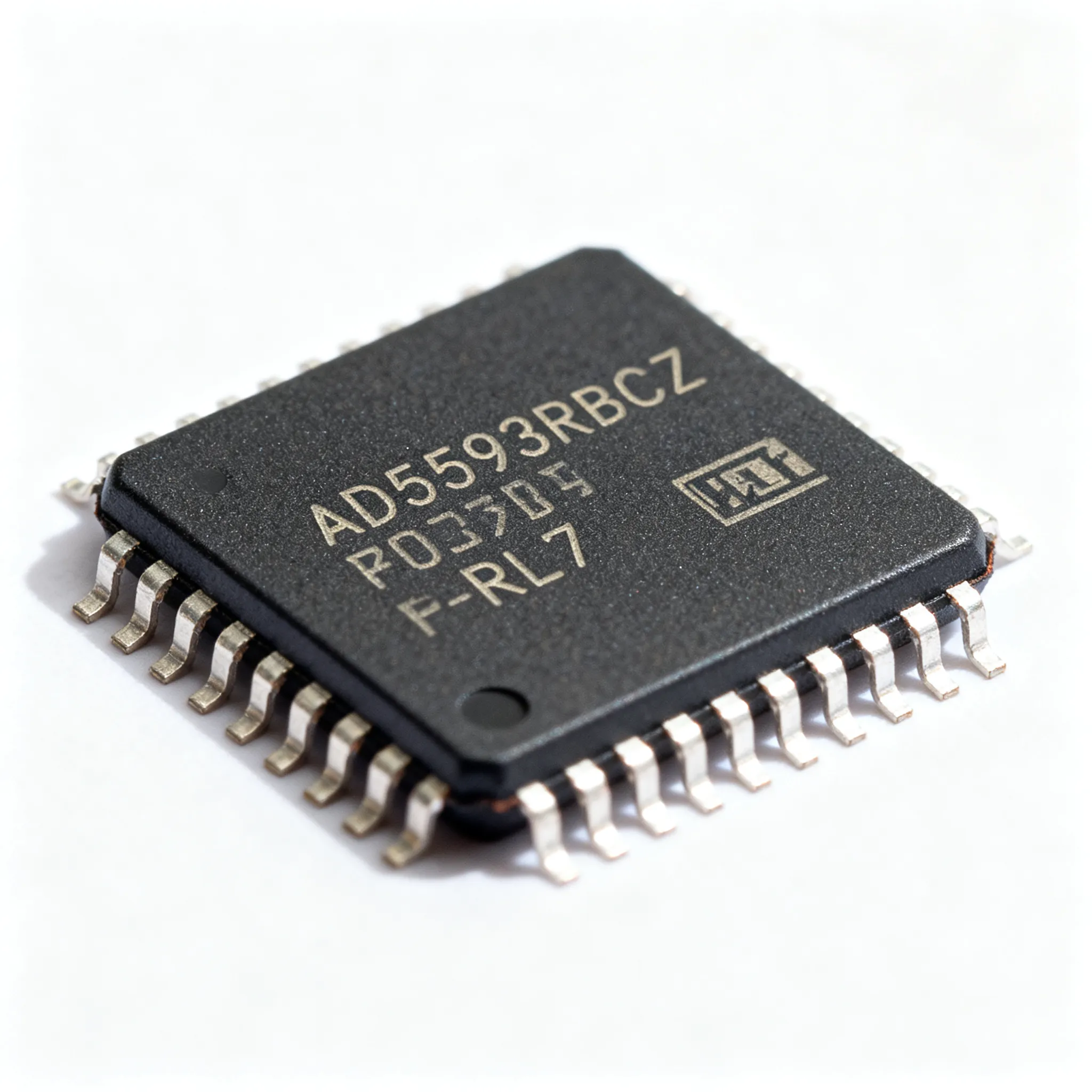
The risk isn’t theoretical. Configurable analog front-ends that combine ADC, DAC, and digital I/O on a single I²C bus are notoriously difficult to substitute. The AD5593RBCBZ-RL7 sits inside a 16-ball WLCSP package with a 0.5 mm pitch—compact, efficient, and almost impossible to drop-in replace with a competitor’s part without a board re-spin. That’s why senior engineers and supply-chain managers now treat this device as a strategic component that must be qualified, buffered, and second-sourced through RFQ validation, not passive reordering.
Key Takeaway: The AD5593RBCBZ-RL7 isn’t obsolete, and Analog Devices has not announced any end-of-life. But its position in the supply chain merits the same rigor you’d apply to a microcontroller or power management IC. The questions you ask before issuing a purchase order will determine whether your line keeps running or stalls.
Inside the AD5593R: Configurable ADC/DAC on a Single I²C Bus
Before you can assess supply risk, you need to know exactly what you’re specifying. The AD5593R family, detailed on Analog Devices’ product page, integrates eight input/output pins that you can independently configure as DAC outputs, ADC inputs, digital outputs, or digital inputs. All configuration and data transfer happen over an I²C-compatible 2-wire serial interface, which drastically reduces the wiring harness and microcontroller pin count compared to discrete solutions.
At the core, a 12-bit successive-approximation ADC can sample each channel sequentially, while a 12-bit DAC with a 6 µs settling time drives analog voltages directly. An internal 2.5 V reference (with external reference option) keeps the BOM lean. The part operates from a single 2.7 V to 5.5 V supply, making it suitable for both 3.3 V and 5 V logic domains—a flexibility that has made it a favourite in optical transceivers, portable instrumentation, and industrial I/O modules.
| Parameter | Value/Range | Unit / Notes |
|---|---|---|
| Number of configurable I/O pins | 8 | Independently set as ADC, DAC, DI, DO |
| ADC resolution | 12 | bits |
| DAC resolution | 12 | bits |
| DAC settling time | 6 | µs (typical) |
| Interface | I²C (2-wire) | Up to 400 kHz fast mode |
| Supply voltage | 2.7 – 5.5 | V |
| Internal reference | 2.5 | V (optional external reference) |
| Package | 16-ball WLCSP | 1.96 mm × 1.96 mm, 0.5 mm pitch |
| Operating temperature | −40 to +105 | °C |
| I²C address options | 2 | Via AD0 pin: GND or VDD |
The WLCSP package is both a gift and a curse. It saves precious board area, but the 0.5 mm ball pitch demands precision assembly. If your contract manufacturer isn’t set up for X-ray inspection and fine-pitch stencils, you’ll need to address that before committing to a production volume. Supplementary details from Win Source’s product catalog and Abacus Technologies confirm that the DAC settling time and converter specifications remain consistent across distribution channels, which simplifies incoming inspection—provided you’re sourcing from authorized or trusted independent distributors.
AD5593R vs. AD5592R: SPI or I²C — Choosing the Interface That Keeps Your Line Running
When allocation pressure builds on the I²C-based AD5593RBCBZ-RL7, many engineers glance at the SPI variant within the same product family. The AD5592RBCPZ-1-RL7 offers identical analog performance but uses a 4-wire SPI interface and lands in a 16-lead LFCSP package instead of WLCSP. It’s the logical backup candidate—but calling it a backup implies a level of interchangeability that simply doesn’t exist.
A detailed comparison at Utmel highlights the interface divergence: I²C vs. SPI is a fundamental architectural choice, not a pin-swap. Meanwhile, OMO electronic’s cross-reference confirms that even the -U1 suffix variant of the AD5593R retains the same analog core, so the interface type remains the primary differentiator. The table below lays out what that means for your sourcing strategy.
| Comparison Metric | AD5593RBCBZ-RL7 (I²C) | AD5592RBCPZ-1-RL7 (SPI) | Selection Criteria & Failure Boundary |
|---|---|---|---|
| Serial interface | I²C (2 wires + AD0) | SPI (4 wires + SYNC) | I²C saves pins but limits speed; SPI is faster but consumes four GPIOs on the host MCU. Firmware rewrite is mandatory. |
| Package | 16-ball WLCSP (1.96 × 1.96 mm) | 16-lead LFCSP (3 × 3 mm) | WLCSP saves 65% board area compared to LFCSP. A redesign must recapture that space or accept a larger footprint. |
| Reel quantity | 3,000 (RL7 suffix = 7-inch reel) | 1,500 (typical for CPZ-1-RL7) | Different reel quantities can disrupt pick-and-place setup; verify with your CM before switching. |
| Supply voltage | 2.7 – 5.5 V | 2.7 – 5.5 V | Identical; no level-shifting changes needed. |
| Analog performance | 12-bit ADC/DAC, 6 µs DAC settling | 12-bit ADC/DAC, 6 µs DAC settling | ADC and DAC specs match. If your design only uses general-purpose I/O, performance parity holds. |
| Second-source viability | No pin-compatible alternative | No pin-compatible alternative | Both are sole-sourced from ADI. Using the SPI variant as a second source still means you depend on the same wafer fab. |
The takeaway is clear: the AD5592R can serve as an architectural fallback only if you are prepared for a board re-spin, firmware port, and full requalification cycle. It is not a buffer-stock substitute you can drop in when I²C parts go allocation-only. Use it strategically—for a next-generation design that intentionally decouples from the I²C variant’s availability risk, not as a reactive patch.
Three Verification Steps Before You Issue a PO for AD5593RBCBZ-RL7
Acting on supply risk doesn’t mean hoarding. It means verifying three specific details before you execute a purchase order, so that every reel you receive is genuinely production-ready. These steps apply whether you’re buying through authorized distribution or a broad-market platform like IC-Online.
- Confirm the RL7 suffix and reel orientation against your pick-and-place program. The “RL7” suffix denotes a 7-inch reel loaded with 3,000 units. If your contract manufacturer’s feeders are calibrated for a different reel diameter or orientation, you risk machine stoppage. Request a physical label photo or packing slip that shows the exact suffix. For variants like AD5593RBCBZ-RL7-U1—highlighted by OMO electronic—note that the -U1 may carry factory-level variations in reel winding direction or moisture-barrier bag configuration. Ask your supplier to confirm the reel standard (EIA-481) and provide a certificate of conformance.
- Require allocation-backed lead-time quotes from at least two authorized channels. Do not rely on a single distributor’s portal badge that says “In Stock.” Request a written quote that states the order code, committed delivery date, and whether the quantity is subject to allocation. Use the RFQ tools on platforms like Win Source or IC-Online to gather multiple quotes in parallel. If a supplier cannot provide an allocation-backed date, treat that quantity as uncommitted and factor it into your safety-stock model accordingly.
- Audit your contract manufacturer’s WLCSP assembly capability for 0.5 mm pitch. The AD5593RBCBZ-RL7’s 16-ball array demands X-ray inspection, a stencil thickness no greater than 0.1 mm, and a reflow profile compatible with Pb-free SAC305 balls. Request a solderability test report from the distributor dated within the last 90 days, and share ADI’s application note on WLCSP assembly with your CM. If your CM has never processed a 0.5 mm pitch CSP, you may need to qualify a secondary assembly partner before committing to high-volume orders.
To help your team act on these steps systematically, the table below maps each verification action to the risk it mitigates and the document you should demand.
| Verification Step | What to Confirm | Red Flag If Not Met |
|---|---|---|
| Suffix & reel standard | RL7 / -U1 orientation matches feeder program; EIA-481 compliance | Supplier cannot produce label photo or CoC; risk of mis-pick and line stoppage |
| Allocation-backed lead time | Written quote with committed date, order code, and allocation flag | Vague “call for availability” or conflicting stock levels across portals |
| WLCSP assembly readiness | CM has X-ray capability, 0.1 mm stencil, and SAC305 profile; solderability cert ≤ 90 days | No prior 0.5 mm CSP experience; oxidation risk on stored reels |
| Distributor traceability | Date code, MSL label, country of origin match ADI’s authorized channel data | Mixed date codes, missing moisture indicator card, or grey-market packaging |
These steps don’t attempt to predict the market. They arm you with the data to make informed decisions whether lead times are four weeks or fourteen. If the I²C part remains tight, evaluating the -U1 variant as a fallback—as OMO electronic’s data suggests—might keep your line moving, but always verify reel dimensions and test compatibility with your actual pick-and-place setup.
AD5593RBCBZ-RL7 Procurement FAQ: Senior Engineers’ Top Concerns
Q: What’s the difference between AD5593RBCBZ-RL7 and AD5593RBCBZ-RL7-U1, and can they be swapped without firmware changes?
A: The -U1 suffix typically indicates a factory-level variation in reel orientation, test flow, or moisture-barrier packaging. Electrically, the devices are identical per the base datasheet from Analog Devices. However, you should not assume a drop-in swap without confirming the Product Change Notice (PCN) from ADI. Reel winding direction can affect automatic pick-and-place feeders, and your optical inspection program may need a minor update if the pin-1 indicator position shifts. OMO electronic’s comparison shows identical electrical specs but different ordering codes, underscoring the need for mechanical verification.
Q: If lead times stretch beyond 26 weeks, is the AD5592R SPI version a viable backup, and what redesign effort is needed?
A: The AD5592RBCPZ-1-RL7 uses an SPI interface and an LFCSP package instead of the I²C WLCSP of the AD5593RBCBZ-RL7. As the Utmel comparison confirms, it is not a drop-in replacement. You will need to reroute your board to accommodate the larger 3×3 mm LFCSP footprint, rewrite the MCU driver from I²C to SPI, and requalify the entire assembly. Budget for a board re-spin and a minimum 8–12 weeks of firmware validation. Use this path only if you can absorb the NRE and timeline; it is not a short-term buffer solution.
Q: How can I verify that the WLCSP package won’t cause assembly issues at my contract manufacturer?
A: The 16-ball WLCSP has a 0.5 mm pitch, which requires X-ray inspection capability and a stencil thickness of 0.1 mm or less to avoid bridging. Ask your CM to demonstrate successful builds using 0.5 mm pitch CSPs, and share ADI’s recommended stencil design. Require solderability test certificates from the distributor, dated within 90 days, to screen for oxidation on stored reels. Reflow profiles must match the Pb-free ball composition per J-STD-020. Distributors like Win Source often supply date-code and moisture-sensitivity labels that help your CM validate incoming material.
Q: Where can I find reliable stock alerts without paying for premium subscriptions?
A: Aggregator sites such as Win Source and OMO electronic offer free stock-level views and “back in stock” notifications. Cross-check ADI’s direct inventory page and sign up for alerts on authorized distributor platforms like Digi-Key or Mouser. Avoid relying on a single source; allocation windows open and close quickly, and having alerts from three independent channels increases your odds of securing inventory without premium tools.
Q: Has Analog Devices issued any end-of-life notice for AD5593RBCBZ-RL7, and what’s the product lifecycle commitment?
A: As of the latest check, ADI lists the AD5593R as “Production” with no EOL notification on the product page. The device is covered by ADI’s standard industrial product longevity policy, which historically ensures availability for a decade or more. You can subscribe to PCN alerts on the same page. Still, always confirm lifecycle status with your regional FAE before designing this part into a system with a required 10+ year field life.
Q: What second-source parts with similar configurable I/O exist if ADI allocates this chip?
A: There is no pin-compatible second source for the AD5593RBCBZ-RL7. Alternatives from Maxim Integrated or Texas Instruments exist that offer configurable ADC/DAC/GPIO channels, but they come in different packages and require firmware changes and board redesign. The AD5592R SPI variant is the closest functional substitute within ADI’s own portfolio, yet it still requires a board spin and driver rewrite, as discussed. This single-source reality means you must manage supply risk through buffer stock, contractual delivery commitments, and multi-source RFQ strategies, not by simply swapping part numbers at the last minute.
References & Further Reading
- AD5593R Datasheet and Product Info – Analog Devices
- AD5592RBCPZ-1-RL7 vs AD5593RBCBZ-RL7 Comparison – Utmel
- AD5593RBCBZ-RL7 – Price, Stock & Datasheet – Win Source
- AD5593RBCBZ-RL7 – D/A Converter – Abacus Technologies
- AD5593RBCBZ-RL7 vs AD5593RBCBZ-RL7-U1 vs AD5593RBCBZ – OMO electronic
- IC-Online – RFQ and BOM upload for mixed-part sourcing
Supply risk management for the AD5593RBCBZ-RL7 isn’t about predicting shortages; it’s about building a process that keeps your options open. Verify the suffix details, demand allocation-backed quotes, and audit your assembly chain before you commit. The I²C-based AD5593R is a compact, highly flexible part—and with the right sourcing discipline, it can stay that way through any market cycle.
Ready to secure your allocation? Upload your BOM to IC-Online for a consolidated RFQ that covers the AD5593RBCBZ-RL7 and all supporting passives, mixed MOQ, with no premium subscription required.