

AD7606BSTZ: Package, Specs, and How Buyers Verify Lots
AD7606BSTZ pinout, package, and datasheet limits buyers actually check — plus lot inspection notes. Request a quote on IC-Online; no invented stock claims.
Why the AD7606BSTZ Stays a First-Choice 8-Channel ADC When Factory Lead Times Stretch Past 65 Weeks
Even as the semiconductor supply chain stabilises in some corners, high‑resolution simultaneous‑sampling ADCs remain among the tightest components on a BOM. The AD7606BSTZ is a case in point: it is one of the few 8‑channel, 16‑bit converters that can accept true bipolar ±10 V inputs without external signal conditioning, yet its factory lead time has stretched well beyond the typical planning window. Data tracked by bomzon shows a manufacturer‑standard lead time of 65 weeks for this tray‑pack device, while the newer AD7606C-16BSTZ—which Analog Devices positions as a functional successor—faces its own crunch: zero stock at major distributors paired with 38 weeks of factory lead time, according to PCBSync.
That imbalance creates a procurement dynamic where the established AD7606BSTZ often remains the more accessible candidate, provided teams are ready to verify lot authenticity at every junction. Octopart’s aggregator, drawing pricing and inventory from seven authorised distributors, confirms that the tray‑pack AD7606BSTZ regularly shows small‑lot availability while the reel‑pack variant and the newer 16‑bit family parts slide into allocation (Octopart). The math is straightforward for an engineer or buyer: you can have a known‑good, datasheet‑gated device with a long product life, but only if you treat lot inspection and traceability as a non‑negotiable gate before production commitment.
In the sections that follow, we dissect the AD7606BSTZ from three angles that matter most to design teams and procurement professionals: what the silicon actually delivers, how the ordering suffixes split the supply stream, and what concrete steps separate an authentic tray from a grey‑market risk.
Inside the AD7606BSTZ: True Simultaneous Sampling, No External Op-Amps, and the 10×10 mm LQFP-64 Package
The defining architectural trait of the AD7606BSTZ is its ability to sample all eight analogue inputs at exactly the same instant, holding each value on integrated track‑and‑hold amplifiers before the SAR core digitises them in sequence. That simultaneous aperture removes the phase‑skew headaches that plague multiplexed systems and makes the device a natural fit for power‑quality analysers, protective relays, multi‑axis motor drives, and any application where channel‑to‑channel phase is a measurement variable, not a calibration afterthought.
The integrated analogue front‑end is equally important to the bill‑of‑materials story. Each channel embeds a programmable‑gain amplifier, a true bipolar input stage, a second‑order anti‑aliasing filter, and a dedicated ADC driver—all powered from a single 5 V supply. This means a ±10 V or ±5 V signal can be connected directly to the pin, without the external level‑shifting op‑amp circuits that consume board area and add drift budgets in competing architectures (PCBSync).
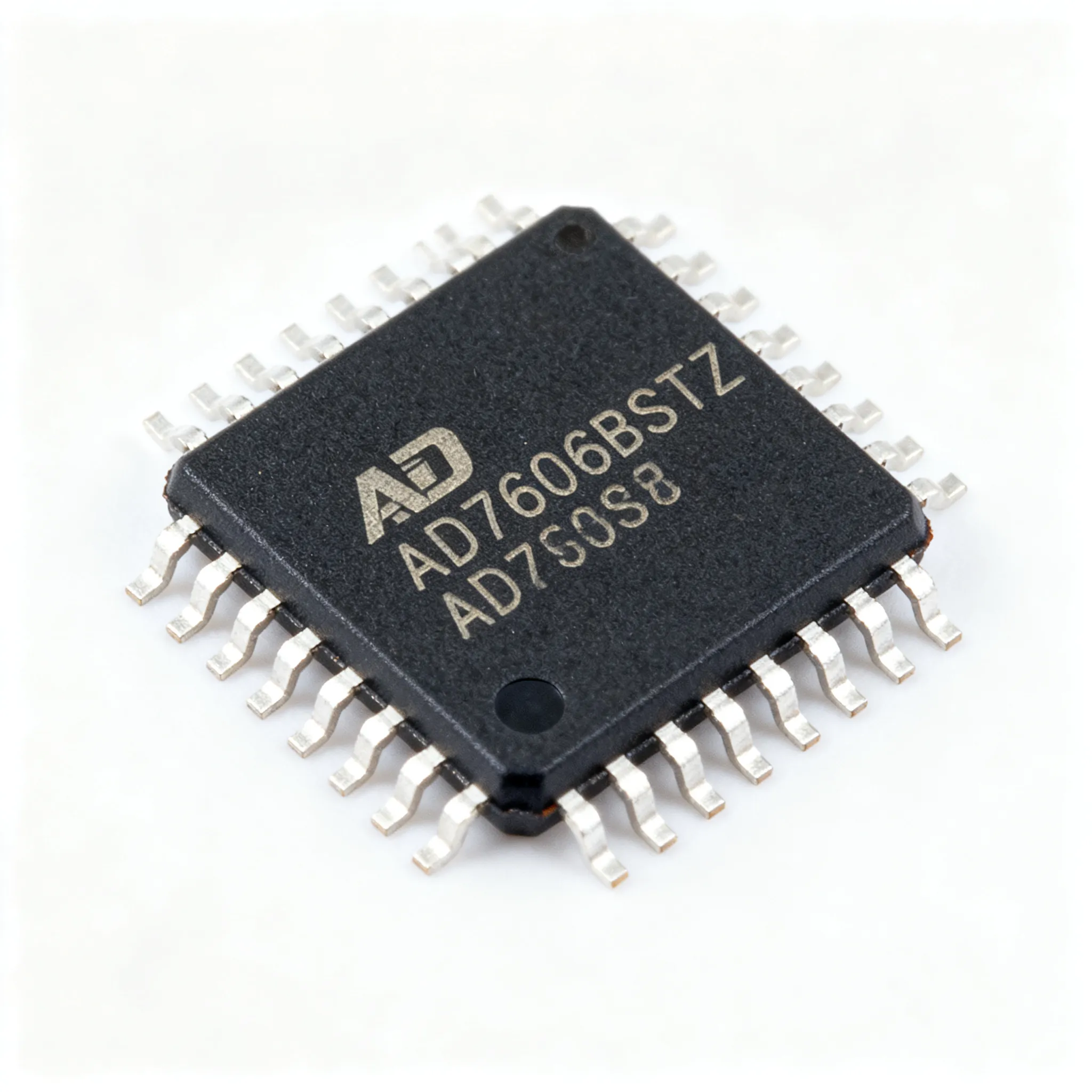
Physically, the AD7606BSTZ comes in a 64‑lead LQFP package measuring 10 mm × 10 mm. The “BSTZ” suffix is the key procurement signpost: it indicates a RoHS‑compliant, lead‑free tray pack of 160 pieces—the format preferred for prototype builds, small‑batch production, and manual placement workflows. Every tray should carry a moisture‑sensitivity level (MSL) label of MSL 3, a detail that becomes critical during the lot‑verification routine covered later.
Key Specs at a Glance (Datasheet-Grounded)
| Parameter | Value/Range | Unit/Notes |
|---|---|---|
| Resolution | 16 | Bits, no missing codes guaranteed |
| Channels | 8 | Simultaneous sampling |
| Maximum Throughput | 200 | kSPS (aggregate) |
| Input Ranges | ±10 V, ±5 V | True bipolar, software‑selectable |
| Analogue Supply | 4.75 – 5.25 | V (single supply) |
| Interface Supply | 2.3 – 5.25 | V |
| DNL | ±0.5 | LSB max |
| Internal Reference Drift | 10 | ppm/°C |
| Operating Temperature | −40 to +85 | °C |
| Digital Interfaces | Parallel, SPI, QSPI, DSP, MICROWIRE | Selectable byte‑wide or serial mode |
| Package | 64‑lead LQFP (10×10 mm) | RoHS, tray pack (BSTZ suffix) |
Table data consolidated from JLCPCB part detail, manufacturer datasheet, and PCBSync specifications.
The 10 ppm/°C drift on the internal 2.5 V reference deserves particular attention. In a three‑phase power analyser that may sit inside a substation enclosure swinging from −20 °C to +60 °C across the day, reference drift directly translates into long‑term accuracy error. With the AD7606BSTZ, the guaranteed maximum of 10 ppm/°C means the total reference‑induced error over that 80 °C span is typically a few LSBs, but often stays within system budgets, leaving the system accuracy budget intact.
AD7606BSTZ vs. AD7606BSTZ-RL vs. AD7606C-16BSTZ: Choosing the Right Ordering Suffix and Migration Path
Procurement confusion frequently starts with the suffix. For the same silicon, Analog Devices provides three ordering variants that split the supply chain into distinct logistics streams, and for design teams eyeing the newer 16‑bit family, the choice becomes a question of supply availability versus feature headroom.
The AD7606BSTZ and AD7606BSTZ-RL share an identical die in an identical 64‑lead LQFP package. What differs is the handling format: BSTZ ships in a 160‑piece tray, while BSTZ‑RL ships on a 1,500‑piece tape‑and‑reel suitable for automated pick‑and‑place. No electrical re‑qualification is needed when moving from tray to reel, and both carry the same MSL 3 rating (PCBSync RL overview). The practical decision for a buyer is therefore driven by production volume and line logistics, not by performance.
The AD7606C-16BSTZ adds per‑channel oversampling, an extended input range, and an improved internal reference, but its supply picture is starkly different. While the specifications look attractive on paper, the part has been difficult to source in any quantity, with zero distributor stock reported against 38‑week factory lead times (PCBSync C‑16). For many BOM‑owners, that turns the older AD7606BSTZ from a legacy placeholder into the primary sourcing path, at least until the C‑16 channel stabilises.
For designs that need only four simultaneous channels, the AD7606BSTZ-4RL offers a reduced‑channel variant that maintains the same core analogue architecture but with a smaller digital footprint. Its datasheet, available on All About Circuits, shows identical input‑stage behaviour and the same single‑supply operation, making it a candidate when a lower channel count is sufficient and the designer wants to keep the same qualification chain.
The table below captures the essential trade‑offs, with supply‑chain notes based on public aggregator data from Octopart and the PCBSync sources.
| Comparison Metric | AD7606BSTZ (Tray) | AD7606BSTZ-RL (Reel) | AD7606C-16BSTZ | Selection Criteria & Failure Boundary |
|---|---|---|---|---|
| Package & Die | 64‑LQFP, identical die | 64‑LQFP, identical die | 64‑LQFP, updated die | No re‑qual needed for tray↔reel swap; C‑16 requires driver/register verification |
| Pieces per Unit | 160 (tray) | 1,500 (tape‑&‑reel) | 160 (tray) typical | Prototype/low‑volume → tray; automated SMT → reel |
| Channels | 8 simultaneous | 8 simultaneous | 8 simultaneous + per‑channel oversampling | C‑16 offers extra features but no channel‑count difference |
| Input Range | ±10 V / ±5 V | ±10 V / ±5 V | Expanded range (max ±12.5 V) | C‑16’s wider swing may simplify CT scaling; verify front‑end protection |
| Internal Reference Drift | 10 ppm/°C | 10 ppm/°C | 8 ppm/°C (typical) | BSTZ drift fits most industrial ±1‑bit budgets; C‑16’s gain is marginal for most |
| Supply Status (Public Aggregator Snapshot) | Small‑lot stock across authorised distributors; factory lead time up to 65 weeks | Often in tighter allocation; confirm reel stock via RFQ | Near‑zero stock reported; 38‑week factory lead time | BSTZ tray currently the most consistently available; always verify lot date |
| Price Band (Authorised Channels) | Bulk pricing visible on Octopart; tray pricing around $47–$55/unit in small qty | Slightly lower per‑unit cost at reel qty; confirm MOQ | List pricing lower on paper, but real availability drives open‑market premiums | Base commercial decisions on landed cost with confirmed lead time, not list price |
| Migration Risk | — | None (same silicon) | Pin‑compatible but register map differs; true drop‑in not guaranteed | Test analogue front‑end response and software driver before committing C‑16 |
The tray‑pack AD7606BSTZ thus occupies a unique spot: it is the most predictable member of the family from a supply‑continuity perspective, provided the buyer can tolerate the factory lead‑time stretch and has a process in place to validate every lot that arrives at the dock. That validation process is the subject of the next section.
How Procurement Teams Verify AD7606BSTZ Lots: Date Codes, Traceability, and Counterfeit Red Flags
When factory lead times for an in‑demand mixed‑signal IC exceed 65 weeks, non‑authorised channels inevitably become active. The AD7606BSTZ sits right at that sweet spot—high enough in volume across industrial and energy markets that grey‑market operators know buyers are searching for it. The defence against a non‑conforming tray is a disciplined, multi‑check inspection routine that can be performed at incoming quality control without extravagant equipment.
Begin with the tray label. Every authentic Analog Devices tray carries a laser‑etched lot number, a date code in YYWW format, and a 2D matrix that can be entered into the ADI Lot Traceability portal. Cross‑reference the lot and date codes with the manufacturer’s system; a mismatch between the label and the database, or a date code that claims a production week in the future, is an immediate red flag. Confirm that the moisture‑sensitivity label reads MSL 3 and that the humidity indicator card inside the sealed bag has not tripped.
Under a stereo microscope, inspect the device markings on several units from different corners of the tray. Genuine AD7606BSTZ parts display clean, sharp laser engraving with consistent font weight. Pay special attention to the “Z” in the part number: the “Z” suffix denotes RoHS compliance and lead‑free terminations, distinguishing the part from older lead‑bearing variants that may have been washed and relabelled. A faded, sanded, or re‑printed marking line, particularly around the “BSTZ,” should trigger rejection of the entire lot.
The next‑level check is electrical, and it leans on the very architecture that makes the device attractive. Because all eight channels sample simultaneously, a quick bench test with a ±10 V reference applied to all inputs in parallel should return simultaneous digital codes within the guaranteed DNL of ±0.5 LSB. A significant channel‑to‑channel skew, missing codes, or a gross offset deviation points either to a relabelled lower‑grade die or to a unit that has been exposed to electrical overstress. This test takes minutes with a basic signal generator and logic analyser and can be scripted into an incoming‑inspection station for higher‑volume receipts.
The table below summarises the minimum verification gates that a buyer should require of any source before moving a lot into the production floor.
| Checkpoint | What to Look For | Red Flag | Tool/Portal |
|---|---|---|---|
| Lot & date code | YYWW format, matches ADI trace system | Future date, database mismatch | ADI Lot Traceability portal |
| RoHS/“Z” suffix | Laser‑etched “BSTZ” with uniform font | Sanded, re‑printed, or missing “Z” | Stereo microscope (10×–20×) |
| MSL label | MSL 3, intact humidity indicator | Tripped indicator, missing label | Visual; reference J‑STD‑020 |
| Device markings | Consistent laser engraving across tray | Mixed fonts, pin‑1 indent variation | Microscope + tray sampling plan |
| Simultaneous‑sampling test | 8 channels digitise within ±0.5 LSB of applied ±10 V | Channel skew > 1 sample, missing codes | ±10 V source, logic analyser |
| Distributor pedigree | Listed on ADI authorised roster; Octopart “authorised” tag | Open‑market seller with no factory trace | Octopart (ADI AD7606BSTZ page) |
No single gate catches every issue, but layering lot traceability, visual inspection, and a fast electrical signature check removes the bulk of risk that attends long‑lead‑time, high‑value analogue parts. When you combine this routine with a standing request that your distributor supply a certificate of conformance dated within 90 days of shipment, you create a solid barrrier against the non‑compliant lots that the 65‑week factory lead time inevitably encourages.
AD7606BSTZ Sourcing and Specification Questions Engineers and Buyers Ask
Q: What is the practical difference between the AD7606BSTZ (tray) and AD7606BSTZ-RL (reel) beyond packaging?
The die and performance are identical. The AD7606BSTZ ships in 160‑piece trays for prototyping, manual placement, and small‑batch builds, while AD7606BSTZ-RL comes on a 1,500‑piece tape‑and‑reel optimised for automated SMT lines. No re‑qualification is needed when switching between the two; just confirm the reel quantity matches your placement feeder and that the MSL‑3 handling is preserved.
Q: Can the AD7606BSTZ be used as a drop‑in replacement for the AD7606C-16BSTZ when that part is unavailable?
Pinout and basic parallel/SPI timing are compatible, but the AD7606C-16BSTZ adds per‑channel oversampling registers and a different internal reference startup sequence. Validate your software driver against the AD7606BSTZ register map, and bench‑test the analogue front‑end response in your circuit before committing—true drop‑in is not guaranteed. In many cases, the BSTZ will operate correctly, but the marginal accuracy difference and any user‑programmable filter settings need verification.
Q: How can I verify that a tray of AD7606BSTZ parts is genuine before committing to full production?
Read the lot and date codes from the tray label, cross‑reference them with Analog Devices’ lot‑trace portal, and inspect the LQFP‑64 markings under a microscope for uniform laser etching. Check the moisture‑sensitivity label for MSL 3 and verify the humidity indicator. Then run a quick simultaneous‑sampling check: apply a known ±10 V signal to all channels and confirm that the digitised values sit within the ±0.5 LSB DNL window with no channel‑to‑channel skew.
Q: Why does the AD7606BSTZ not need external driver op‑amps for bipolar inputs?
Each analogue input channel integrates a high‑impedance programmable gain amplifier with a true bipolar input range, a second‑order anti‑aliasing filter, and an ADC driver, all powered from a single 5 V supply. The signal chain is designed to accept ±10 V or ±5 V directly, so the board designer can omit the external level‑shifting amplifiers and their associated drift, noise, and power budgets. This is one of the key reasons the AD7606BSTZ remains popular in dense multi‑channel instruments.
Q: What are the most critical specs for using the AD7606BSTZ in a power‑quality or protection relay application?
Simultaneous sampling of all eight channels prevents phase error between voltage and current measurements; the true bipolar ±10 V range allows direct connection to CT and PT secondary signals without extra gain stages; the guaranteed no‑missing‑codes performance at 16 bits ensures that fault transients are captured cleanly; and the internal reference drift of 10 ppm/°C keeps long‑term accuracy within limits across temperature swings. The 200 kSPS throughput is adequate for harmonic analysis through the 50th order in a 50/60 Hz system.
Q: Where can I find a realistic lead‑time and pricing snapshot for the AD7606BSTZ?
Factory lead time can extend to 65 weeks, as reported on bomzon, but authorised distributors often hold small‑lot inventory independent of factory backlog. Use Octopart’s real‑time aggregator (Octopart AD7606BSTZ page) to see current stock and price bands across seven authorised sources. Contact the distributor directly to confirm the actual lot date, minimum order quantity, and whether the inventory is on the shelf or allocation‑backed. Always request a formal quote that includes the lead time to your factory gate, not just the advertised warehouse availability.
For any design or procurement situation not covered here, the simplest path to a validated quote is to upload your complete BOM or submit an RFQ through the IC‑Online platform. A mixed‑bill enquiry—with flexible MOQ—lets you lock in authentic AD7606BSTZ units alongside supporting components, backed by the same rigorous traceability checks described above. No guesswork, no grey‑market gambling.
References & Further Reading
- AD7606BSTZ Datasheet, Pinout & Buy — PCBSync
- AD7606BSTZ-RL: Specs, Pinout, Alternatives & Sourcing — PCBSync
- AD7606BSTZ-RL: 8‑Channel 16‑Bit Simultaneous‑Sampling ADC — PCBSync (additional page)
- AD7606C-16BSTZ: Specs, Pinout, Alternatives & Sourcing — PCBSync
- AD7606BSTZ Part Detail — JLCPCB
- AD7606BSTZ Price, Stock & Datasheet — Octopart
- AD7606BSTZ Specifications & Lead Time — Bomzon
- AD7606BSTZ-4RL Datasheet — All About Circuits