

BOM Line Risk Review Before Production Release: A Checklist to Prepare Your BOM for RFQ
BOM and RFQ best practices for electronic component procurement. Upload your BOM or request a quote for mixed lines and flexible MOQ.
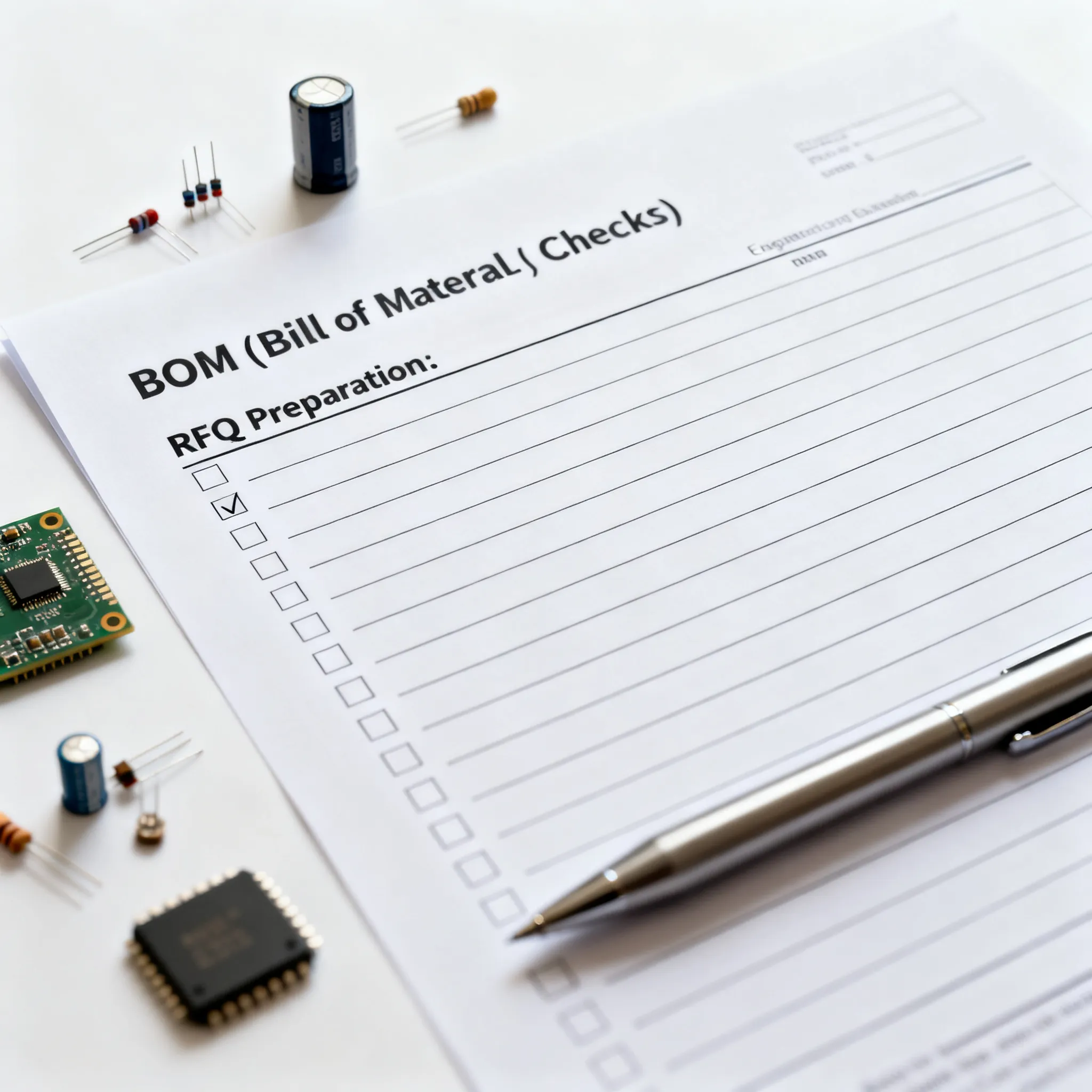
When a Missing Manufacturer Part Number Becomes a Line Stop
A production line doesn't stop because a design is wrong. It stops because someone assumed a component would be available, and nobody checked. The semiconductor shortages of 2020–2023 revealed what many procurement teams already knew but rarely formalized: a disturbingly large number of products depend on a small number of manufacturing facilities and supply sources, and a single unverified BOM line can cascade into weeks of lost output (iebrain.com).
Before a release, a missing manufacturer part number is merely a data issue. After release, it becomes a purchasing delay, a production shortage, a quality escape, or a compliance gap that surfaces during customer delivery or certification (OpenBOM). The distinction matters enormously: catching the gap during a structured pre-release review costs an afternoon of engineering time. Missing it costs production throughput, customer trust, and—in regulated industries—potentially a recall.
Revision control compounds the risk. When engineering change orders (ECOs) propagate unevenly across teams, different groups act on different inputs, and the immediate risk is not that a defect has occurred but that no two stakeholders share the same baseline (GNS). A buyer quotes from revision B while the assembler builds from revision C—and neither party knows the discrepancy exists until parts arrive at the line.
The traceability dimension is equally sobering. When a product recall becomes necessary, regulatory bodies require a concise summary of all incidents, the defect type, the hazard or risk category, and the approximate retail price range—information that depends entirely on knowing which components went into which production lots (CPSC Recall Handbook). If your BOM lines don't carry full manufacturer part numbers with traceable lot origins, reconstruction becomes forensic archaeology at the worst possible moment.
None of this is theoretical. Engineering teams routinely release BOMs that passed prototype validation but were never screened for production supply-chain viability. The prototype run used distributor samples. The production forecast assumes 5,000 units per month. Between those two points, allocations shift, obsolescence notices post, and alternate parts that worked on the bench turn out to have different package suffixes that don't fit the footprint. A structured pre-release BOM line review exists to catch exactly those gaps—before the RFQ goes to suppliers and long before the line stops.
What a Pre-Release BOM Line Review Actually Checks: The Anatomy of a Risk Screen
A pre-release BOM line review is not a design review. It does not ask whether the circuit will function. It asks whether every line on the bill of materials is procurable, unambiguous, and aligned with the production schedule—the three conditions that separate an RFQ-ready BOM from one that generates three rounds of supplier questions and a delayed build.
The review operates across four risk categories, and experienced teams check each line against all four. Here is what that looks like in practice.
Data completeness. Every line must carry a full, verifiable manufacturer part number including suffixes that encode package, temperature grade, and packing format. Check each MPN at the manufacturer or an authorized distributor, including suffixes—because a single missing character can change the package from TSSOP to QFN (flj-pcb.com). The unit of measure (UOM) must be standardized: one line counting in pieces while another counts in reels creates quoting ambiguity that distorts both unit pricing and total cost. Always consult the supplier's datasheet or packaging specifications for accurate UOM, and don't rely solely on internal documentation that may be outdated (ChecklistGuro).
Sourcing health. For every line, confirm that the part is currently orderable through authorized distribution. Verify single-source risk: a sole-source microcontroller with allocation constraints requires a different procurement strategy than a commodity resistor available from six qualified manufacturers—provided engineering has approved that flexibility. Approved alternates must be documented as distinct lines or in an attached approved vendor list (AVL), with clear rules governing substitution conditions.
Schedule alignment. Lead times are checked against the actual production schedule, not the schedule from six months ago (Vergent Products). A 12-week lead-time part is irrelevant to a build that starts in eight weeks, regardless of what the original project timeline assumed. Schedule-sensitive lines must be flagged as schedule drivers and escalated before the RFQ package leaves your desk.
Documentation and revision control. The BOM must be released alongside the correct revision of schematics, PCB layout files, DRC reports, and any SI/PI simulation outputs for critical nets. Gather all documentation—latest schematics in PDF and source formats, PCB layout files, the BOM itself, DRC reports, component datasheets for new or critical parts, and any specific design guidelines—and distribute materials in advance so reviewers have at least two to three days to study the design independently (Magellan Circuits). If the BOM says revision D and the layout files still reference revision C, the RFQ is not ready to send.
| Risk Driver | Mechanism | Procurement Impact |
|---|---|---|
| Incomplete or truncated MPN | Missing package, temperature, or packing suffix in the part number string | Quotes arrive for the wrong physical part; re-quoting delays the RFQ cycle by 3–7 days |
| Unverified sole-source dependency | Single manufacturer for a function with no documented and qualified alternate | Allocation risk; any supply disruption becomes a line-stop event with no immediate mitigation |
| Stale lead-time assumptions | BOM uses lead-time data from prototype phase or an outdated market snapshot | Production schedule becomes unbuildable; expedite costs or air-freight premiums erode margin |
| Revision mismatch across files | ECO applied to BOM but not propagated to schematics, layout, or assembly drawings | Supplier quotes against wrong revision; received parts don't match assembly instructions |
| Undefined source type (consigned vs. turnkey) | BOM doesn't specify whether components are consigned, kit-supplied, or turnkey-procured | Supplier assumptions about ownership, customs, and receiving create quoting gaps and delivery delays |
| Unqualified alternates listed without rules | Alternate parts appear on BOM or AVL without engineering qualification status or substitution logic | Buyers may substitute based on price alone, introducing functional or reliability risk |
These six drivers interact. A stale lead-time assumption on a sole-source MPN with no approved alternate is a schedule-risk multiplier. A missing package suffix on a part with consigned-stock ambiguity creates a quoting loop that burns procurement hours. The pre-release review catches these interactions before they become urgent—which is the entire point of doing the review before the RFQ, not after the first supplier response flags a problem.
Which Pre-Production BOM Checklist Covers the Risks You're Actually Facing?
Not all BOM checklists serve the same purpose. A checklist calibrated for PCBA release—focused on placement layers, paste masks, and programmed-device handling—may be perfectly adequate for the assembly floor and still miss the sourcing risks that matter during RFQ. Conversely, a procurement-centric checklist that flags every sole-source line may generate noise for a design team that has already qualified alternates and simply hasn't documented them in a format buyers can act on.
The table below compares four documented checklist approaches, each with a distinct emphasis. The goal is not to pick one and discard the others; it's to understand which lens each applies so you can assemble a review that covers the risks your program actually carries.
| Comparison Metric | Vergent Products (Schedule-Aligned) | bestpcbs (Cost & Sourcing Risk) | flj-pcb (Risk-Flag & Alternates) | qfpcb (Source-Type Awareness) |
|---|---|---|---|---|
| Primary focus | Lead-time vs. actual production timeline verification | Sourcing risk, PCBA cost stability, and repeat-production repeatability | Consequence-ranked risk rows; alternate part validation | Source-type classification: public library, pre-ordered, consigned, globally sourced |
| Lead-time handling | Check against current schedule, not six-month-old plan; flag schedule-driver parts | Verify lead-time as a component of total landed cost and production stability | Recheck risky rows when the order is placed and again if the schedule changes | Distinguish lead-time by source type; public-library parts can be selectable now but short at order release |
| Alternate part strategy | Require documented replacement plan for any part without confirmed availability | Common passives sourced from multiple qualified manufacturers if engineering approves | Flag alternates by shortage consequence, not unit price; sole-source controllers flagged as high-consequence | Source type governs alternate availability; consigned parts add packaging, quantity, and customs questions |
| Assembly-readiness check | Implicit; schedule alignment presupposes build readiness | Explicit: BOM management controls assembly quality and repeat production stability | Explicit: part numbers, alternates, and risk flags validated before assembly | Explicit: public-library vs. pre-ordered vs. consigned determines assembly-feed timing |
| RFQ suitability | High for schedule-driven RFQs; moderate for cost-comparison RFQs where alternates are the primary lever | High for RFQs where total landed cost and repeat-build stability drive supplier selection | High for RFQs where risk-flag transparency lets suppliers propose credible alternates | Moderate for RFQ; high for internal readiness before committing a BOM to an assembly partner |
| Documentation requirements | Production schedule, lead-time data, replacement plans | Revision-controlled BOM matched to same-revision design files | MPN verification at manufacturer/distributor level; alternate qualification status | Source-type conventions clearly stated per line; consigned-part packaging and customs documents |
The critical insight from this comparison is that PCB BOM management helps buyers control PCBA cost, sourcing risk, lead time, assembly quality, and repeat production stability before the order reaches the line (bestpcbs.com). But controlling those variables requires selecting the right checklist lens for the phase you're in. During RFQ preparation, the Vergent and flj-pcb approaches serve best because they prioritize schedule realism and risk-flag transparency—exactly what suppliers need to return accurate quotes. The qfpcb source-type lens becomes critical when you're preparing a BOM for a specific assembly partner, where consigned-stock rules and public-library availability determine whether parts are even usable (qfpcb.com).
Tip: For a BOM heading into RFQ, combine the schedule-aligned lead-time check (Vergent) with the risk-flag approach (flj-pcb) and add a source-type column. That single composite review catches the three failure modes that most often delay quotes: unavailable parts, unqualified alternates, and ambiguity about who supplies what.
Your BOM RFQ Checklist: A Line-by-Line Review to Catch the Risks Before the RFQ Goes Out
The checklist below is designed for the moment just before you attach a BOM to an RFQ email or upload it to a procurement platform. It assumes the design is functionally validated. What it checks is whether every line is quotable—meaning a supplier can read it, understand it, source against it, and return a price and lead time without a chain of clarifying emails.
The product definition, BOM, manufacturing files, tooling, test plan, quality criteria, and approval responsibilities should be controlled before pilot production begins (SILKBRIDGE). For the BOM specifically, that control means the following line-level checks are complete and signed off.
- Verify every MPN and suffix with a live distributor search. Open the manufacturer's product page or an authorized distributor's listing. Confirm the exact part number—including package, temperature range, and packing suffix—matches what's on the BOM line. A single missing character invalidates the quote. Do this for every line, not just the expensive ones. If an MPN returns no results or shows as discontinued, flag it immediately and confirm lifecycle status via RFQ.
- Document approved alternates with substitution rules. For every line where an alternate exists, list it as a distinct BOM row or in the AVL with a clear rule: "use only if primary is unavailable, notify engineering before substitution." If a part is supplied as a kit, connector pair, or programmed device, state whether it is placed on the PCB, packed with the product, or installed later—those are different operations and should not be collapsed into a single line that assembly must interpret (flj-pcb.com).
- Validate lead times against the current production schedule. For every line, confirm allocation-backed lead time with the supplier and compare it against the production start date. Flag any part whose confirmed lead time extends beyond the build window. Recheck risky rows when the order is placed and again if the schedule changes. A BOM that was validated during prototyping can require a controlled revision before volume production (flj-pcb.com). Prioritize by consequence of shortage, not only unit price.
- Check source type and unit of measure for every line. Mark each line as turnkey, consigned, or kit-supplied. Confirm UOM consistency: are all passives in pieces, or are some in reels? Those routes do not have identical lead times, ownership rules, or availability conditions, and that distinction matters (qfpcb.com). A public-library item can be selectable now but short when the order is released. Consigned stock adds packaging, quantity, customs, and receiving questions.
- Reconcile the BOM revision with the latest ECO and design files. Confirm the BOM revision number matches the schematics, layout files, and assembly drawings. If an ECO changed a part number since the last review, verify the change propagated to all files. Use engineering change control to reconcile the intended baseline with the issued files (GNS). Distribute the complete package to reviewers at least two to three days before the RFQ release deadline.
- Include component-level traceability markers for regulated products. If the end product falls under any regulatory regime that could require a recall, ensure every BOM line carries enough information to trace component origin to the production lot—manufacturer, MPN, date code range, and distributor. This is tedious during BOM preparation and catastrophic to reconstruct after a recall notice. The CPSC recall handbook makes clear that the recall package depends on knowing which components are in which units (CPSC); your BOM is the foundation of that traceability.
These six steps map to a mitigation framework that helps prioritize effort based on the risk each line presents. Not every BOM line needs the same level of scrutiny—a 1% thin-film resistor in an 0805 package carries different procurement risk than a sole-source FPGA with configuration memory.
| Mitigation Action | When to Use | Trade-Off |
|---|---|---|
| Escalate to manufacturer allocation or expedite channels | Sole-source IC with lead time exceeding the production window; no qualified alternate exists | Higher unit cost and allocation commitment; may require NCNR (non-cancellable, non-returnable) terms |
| Activate documented alternate and notify engineering | Primary MPN is allocation-constrained but a qualified alternate is available with acceptable lead time | Requires engineering sign-off; firmware or test changes may be needed even for pin-equivalent parts |
| Re-sequence the production schedule around long-lead items | Multiple schedule-driver lines can be grouped; partial build feasible while waiting for constrained parts | Increases WIP inventory and complicates kitting; may not be viable for turnkey builds with fixed line slots |
| Board-level redesign or function substitution | No alternate exists and the primary part is allocation-backed beyond the program's acceptable delay | Engineering cost, re-validation time, and potential certification impact; last-resort option but sometimes unavoidable |
| Buffer stock at distributor via NCNR order | Part is currently available but allocation is tightening; production volumes are forecast with reasonable confidence | Carrying cost and obsolescence risk if forecast changes; requires finance approval for pre-production inventory |
Key takeaway: The mitigation table is not a post-RFQ exercise. The most expensive mitigation—board-level redesign—becomes far cheaper when the BOM review surfaces the problem before the RFQ, not after the supplier responds with a 52-week lead time and no alternate. Run the checklist, populate the mitigation table, and only then send the RFQ. The sequence matters.
RFQ BOM Line Review: Questions Engineers and Buyers Ask Before Hitting Send
Q: Our design passed prototype review—why is a separate line-level BOM review needed before production release?
Prototype review validates function, not supply chain viability. During prototyping, you may have used distributor samples, lab stock, or parts purchased in single-unit quantities with no attention to allocation constraints. Component availability, lead times, and alternate qualifications change between prototyping and production—sometimes dramatically. An unvalidated MPN, a missing package suffix that worked on the bench because the lab had the right part in inventory, or a part that went obsolete between prototype and production release can stop the line even if the design is electrically proven. The line-level review catches procurement gaps that prototype validation was never designed to find.
Q: How do we handle a sole-source IC with an extended lead time when the production schedule demands parts much sooner?
Flag the line immediately as a schedule-driver risk. Engage authorized distributors and the manufacturer directly to confirm current allocation and explore expedite options—allocation-backed lead time may differ substantially from the published figure. In parallel, evaluate any pin-equivalent candidate parts from alternate manufacturers, verifying package, pinout, and firmware compatibility before assuming interchangeability. Model the cost of air-freight versus line-down delay so the trade-off is visible to the program team. If no alternate exists and allocation cannot meet the schedule, the BOM line becomes a program-level decision—either the schedule moves, or the board gets redesigned. Surfaces this before the RFQ goes out, while you still have time to act.
Q: What's the difference between a BOM that's 'ready for RFQ' and one that's 'ready for PCBA release'?
An RFQ-ready BOM must be unambiguous for quoting: complete MPNs with suffixes, quantities, documented acceptable alternates with substitution rules, lead-time assumptions, and source-type designations (turnkey, consigned, kit). Suppliers need this to return accurate pricing and delivery commitments. A PCBA-release BOM adds assembly-critical details: component orientation, package markings, placement layer, paste mask requirements, and any special handling for programmed devices or moisture-sensitive parts. The PCBA-release BOM assumes a supplier has been selected and the quoting phase is complete. Sending an assembly-oriented BOM for RFQ creates confusion; sending an RFQ-oriented BOM to the assembly line creates defects. They serve adjacent but distinct phases.
Q: Should we include alternate parts in the RFQ BOM or keep them separate?
Include qualified alternates as distinct BOM lines or in an attached approved vendor list (AVL), with clear rules governing when substitution is permitted—for example, "use only if primary is unavailable, notify engineering before substitution." This approach lets suppliers propose cost or lead-time trade-offs without compromising design integrity. Avoid burying alternates in a notes column where they can be overlooked. Avoid listing unqualified parts as alternates simply because they appear pin-compatible on a datasheet; qualification status must be explicit. The RFQ BOM is a procurement document, and the alternate list is where procurement flexibility meets engineering control.
Q: How often should we refresh lead-time and availability data after the initial BOM review?
Recheck risky rows when the order is placed and again if the production schedule changes. A BOM that was validated for a 12-week build plan can become unbuildable if the schedule moves forward or market demand shifts allocations—particularly for parts sourced from a small number of manufacturing facilities. For long-lead or allocation-sensitive parts, a recheck immediately before Purchase Order release is prudent. Some teams build a "refresh trigger" into their ERP or procurement workflow: any line flagged as single-source or allocation-sensitive during the pre-release review gets re-verified within five business days of order placement. The cost of the recheck is negligible compared to discovering an availability gap after the PO is issued.
Q: What documentation must accompany the BOM for a supplier to quote without delays?
A complete RFQ package includes: the revision-controlled BOM with full MPNs and quantities; an approved manufacturer/vendor list (AVL) with documented alternates and substitution rules; the latest schematics in PDF format (source files optional but helpful); assembly drawings showing placement reference; any special-process requirements such as conformal coating, underfill, or press-fit connectors; and a clear note on source-type conventions per line—which parts are consigned, which are turnkey, and which arrive as kits. Ambiguity in any of these items is the most common cause of quoting delays. If a supplier has to email you to ask whether a line is consigned or what the acceptable alternate is, the BOM was not RFQ-ready when it left your outbox.
References & Further Reading
Related Articles
 Blog
What Arduino Simulators Do for Electronic Functionality
Arduino simulators emulate boards and components to test code and circuits virtually. They replicate pin states, signals, and protocols for faster debugging.
 Blog
April 2025 GDDR6 vs HBM Memory Sourcing: Allocation Checks for Gaming and AI OEM Buyers
Allocation notes for OEM buyers this month: what to verify on memory, MCU, and power lines. Confirm current terms via RFQ — no invented lead times.
 Blog
What Does ECT Sensor Mean in Electronics?
ECT sensor meaning: Engine Coolant Temperature sensor. It measures coolant temperature via a thermistor, sending a signal to the ECU for fuel and fan control.
 Blog
What Are the Three Terminals of a Potentiometer Connection?
A potentiometer has three terminals: two fixed ends and one adjustable wiper. Learn how these potentiometer connections enable voltage division and variable resistance.
 Blog
Test Your Lawn Mower Starter with a Multimeter
Learn how to test a lawn mower starter with a multimeter: check battery voltage, test the solenoid, and measure voltage and continuity at the starter.
 Blog
Power Sequencer IC or Discrete Sequencing? Critical RFQ Verification Steps for OEM Power Rails
Buyer-side specification, inspection, and RFQ checks on this technical topic. Not a hobby explainer. Request a quote on IC-Online.