

Broadcom MegaRAID 9560-8i PCIe 4.0 Tri-Mode Adapter: OEM Sourcing and Anti-Counterfeit Inspection Guide
Buyer-side specification, inspection, and RFQ checks on this technical topic. Not a hobby explainer. Request a quote on IC-Online.
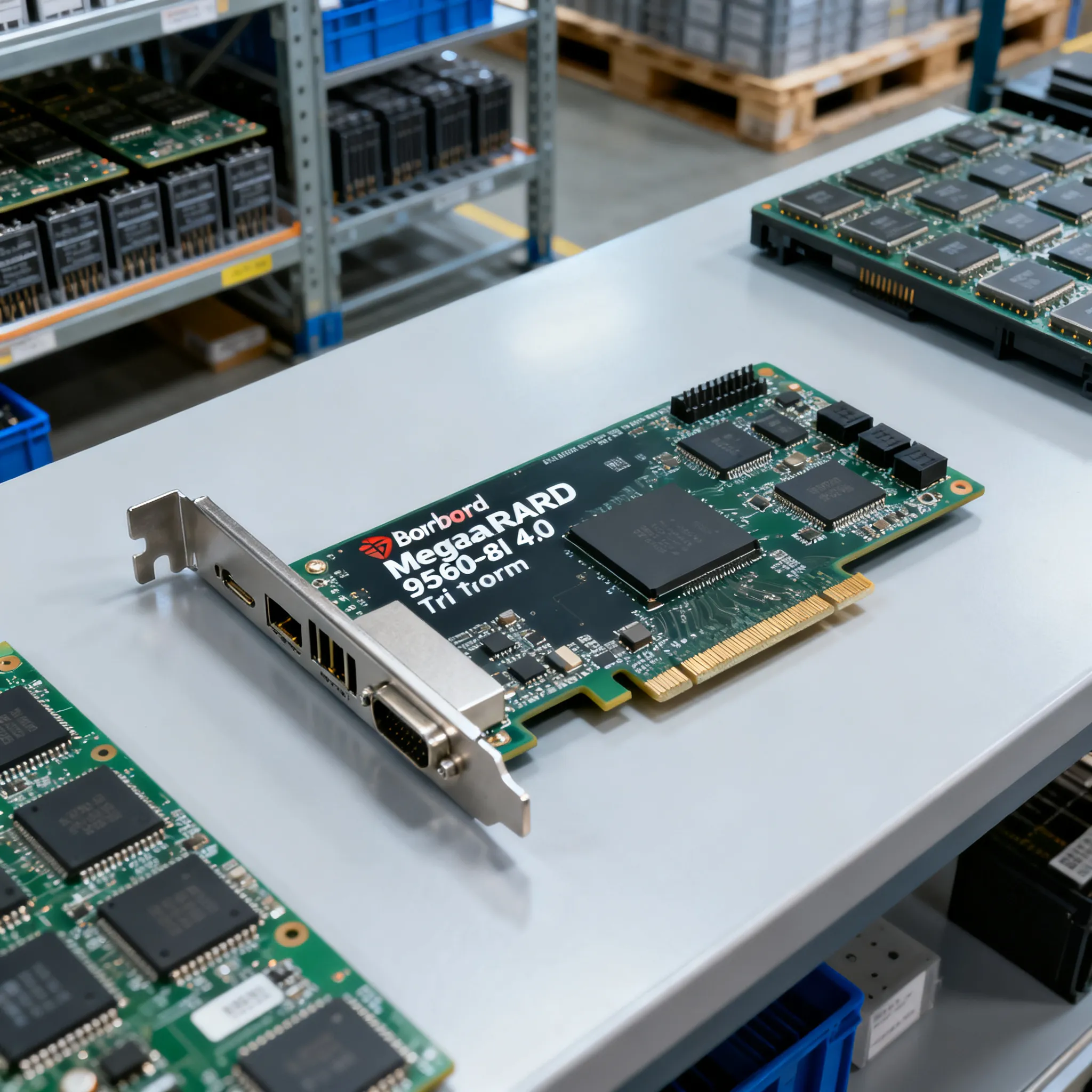
Why the MegaRAID 9560-8i Is a Strategic Controller for Next-Gen Storage
Enterprise storage architects and OEM procurement teams face a turning point. The proliferation of NVMe U.2/U.3 drives, combined with the need to protect existing SAS and SATA storage investments, has made tri-mode controllers a critical backbone for rack-scale server and hybrid array deployments. Broadcom’s MegaRAID 9560-8i sits at that inflection point: it delivers PCIe 4.0 throughput on a hardware RAID-on-Chip (ROC) platform that can simultaneously negotiate SATA, SAS, and NVMe protocols through a single adapter. For data centers scaling transactional databases, hyperconverged infrastructure, and high-density cold storage, the 9560-8i is not just a performance upgrade—it is a topology decision that influences total cost of ownership, rack density, and spare parts planning.
The supply environment for enterprise RAID adapters has become allocation-sensitive. EE Times has documented persistent tension between server build rates and PCIe Gen4 chipset availability, compounded by advanced substrate and ASIC packaging constraints. When a single part number like the 9560-8i influences the throughput of entire storage clusters, sourcing authenticity and origin become as important as the MTBF rating. Buyers who treat this adapter as a generic PCIe card risk introducing grey-market relics that lack firmware updates, wear-leveled cache modules, or even legitimate Broadcom MAC/SAS address ranges. The stakes are high: a relabeled card with corrupted NVDIMM-backed cache can silently corrupt data weeks before a fault is logged. This guide helps engineers and procurement leads specify, inspect, and RFQ the 9560-8i without accepting counterfeit risk.
Inside the 9560-8i: Tri-Mode Throughput, Cache Architecture, and PCIe 4.0 Lanes
At its core, the MegaRAID 9560-8i houses the Broadcom SAS3916 ROC, an integrated I/O controller and RAID engine that exposes eight internal ports through two SFF-8654 SlimSAS x4 connectors. Each port can negotiate individually as 6 Gbps SATA, 12 Gbps SAS-3, or PCIe Gen4 NVMe—without requiring a separate HBA mode or additional cabling. The card connects to the host via a PCIe 4.0 x8 lane interface capable of 16 GT/s per lane, providing an aggregate theoretical bandwidth of approximately 128 Gbps. That headroom becomes essential when mixing multiple NVMe drives behind a RAID 5/6 volume, where the ROC must compute parity across high-speed lanes without letting the bus stall on dirty cache flushes.
The adapter ships with 4 GB of NVMe-backed DDR4 cache (often referred to as CacheVault NVCACHE), a design that dumps dirty data to non-volatile flash upon power loss and restores it on the next boot. This cache architecture supports RAID levels 0, 1, 5, 6, 10, 50, and 60, with up to 240 SAS/SATA devices or up to 32 NVMe drives when using SAS expander topologies. Engineers evaluating the 9560-8i should note that the NVMe support operates in “direct-attach” mode for U.2/U.3 drives via appropriate SFF-8654 to SFF-8639 cables; the ROC does not require a PCIe switch, minimizing latency. Table 1 collects the key parameters a technical buyer will need during initial qualification.
| Parameter | Value/Range | Unit/Notes |
|---|---|---|
| Host Interface | PCIe 4.0 x8 | 16 GT/s per lane; backward compatible to PCIe 3.0 |
| Internal Ports | 8 | Two SFF-8654 SlimSAS x4 connectors |
| Protocols per Port | SATA (6 Gbps), SAS (12 Gbps), NVMe (PCIe Gen4) | Auto-negotiation; tri-mode single port |
| ROC | Broadcom SAS3916 | Dual-core RAID-on-Chip |
| Cache | 4 GB DDR4 (NVMe-backed) | CacheVault NVCACHE; flash backup on power loss |
| RAID Levels | 0, 1, 5, 6, 10, 50, 60 | Supports mixed-drive RAID (SAS/SATA) and NVMe passthrough |
| Max Drive Support | 240 SAS/SATA (expander), 32 NVMe | NVMe count depends on bus bifurcation and backplane |
| Form Factor | Low-profile MD2, full-height bracket included | 167.6 mm × 68.9 mm |
| Operating Temperature | 0 °C to +55 °C (ambient) | Verify airflow requirements in dense chassis |
| Firmware Management | StorCLI, LSIUtil, HII, UEFI | Broadcom reference firmware; OEM variants may differ |
What the table cannot convey is the importance of the power-loss protection circuit. In the 9560-8i, a supercapacitor or battery-backed module (depending on the exact board revision) guarantees that the DRAM cache contents are written to onboard flash when host power is interrupted. During inspection, buyers should verify that this module is present and not a salvaged part with degraded capacitance—a common red flag on relabeled cards. A quick bench test: install the card, create a RAID volume, start a large write, and pull power. After reboot, StorCLI should report the cache restored without a “foreign configuration” error.
OEM Buyer's Checklist: Authenticating and Sourcing the 9560-8i Without Risk
Procurement and receiving teams need a repeatable physical and logical verification sequence that separates legitimate OEM stock from reworked or remanufactured hardware. Relying solely on a visual glance at the heatsink is insufficient because sophisticated counterfeiters now replicate label fonts, QR codes, and even the laser etching on the PCB. The following checklist draws on field experience and recommendations documented by ERAI, an organization that tracks counterfeit electronic components worldwide.
- Verify SAS address range and MAC address: Boot the card in a test server and read the SAS World Wide Name (WWN) and the Ethernet MAC (used for out-of-band management) via StorCLI. An adapter with an all-zero SAS address (00:00:00:00:00:00) or a MAC that falls outside Broadcom’s assigned OUI ranges was likely re-programmed from a blank flash. Cross-reference the sticker on the card with the addresses read from the firmware.
- Check firmware revision with genuine checksum: Use
storcli /c0 show allto capture the firmware version and NVDATA build date. Compare the checksum against Broadcom’s published download package. A mismatched checksum often indicates a modified or third-party firmware, especially on cards resold from server vendors that may have locked the flash to prevent cross-flashing. - Inspect PCB silk-screen and date codes: Look for Broadcom’s logo and a legible 4-digit date code (YYWW) on the PCB near the SAS3916 ROC. The silk-screen should match reference photos from authorized samples. Re-worked cards often show solder flux residue around the ROC or cache memory BGA, inconsistent PCB finish, or missing test points.
- Examine bracket and heatsink markings: Original brackets carry Broadcom part numbers stamped in the metal, and the heatsink typically has a laser-etched serial number or QR code. A plain heatsink without any marking or with a sticker that appears to be consumer-grade suggests a field-assembled card from decommissioned server pulls.
- Inspect DB-15 connector and SFF-8654 ports: The DB-15 (VGA-style) connector on the bracket is used for CacheVault status LEDs; counterfeit cards sometimes have a dummy connector or mismatched pin count. The SFF-8654 receptacles should be squarely soldered without any hand-solder rework signs. Measure continuity from the connector shell to the bracket ground to ensure proper EMI grounding.
- Validate cache module authenticity: Remove the heatsink (if permitted) and check the NVDIMM module’s label for a Broadcom P/N. After power-up, issue
storcli /c0 show cachevaultto confirm the cache module’s serial number matches the label and that the charge cycle count is within expected limits. A high cycle count or a “degraded” status could indicate a used cache module approaching end of life.
Tip: When an incoming batch of 9560-8i cards fails even one of these checks, reject the entire lot and document the findings with high-resolution photos. Use IC-Online to submit a BOM-level RFQ for factory-sealed stock and specify the need for lot-code traceability and a 90-day test report. Distributors operating outside Broadcom’s authorized channel may not provide this documentation, which is itself a warning sign.
Table 2 summarizes the visual and electronic inspection points that should become part of your standard receiving quality plan.
| Inspection Item | Expected/OEM Condition | Red Flag / Counterfeit Indicator |
|---|---|---|
| SAS WWN address | Non-zero, within Broadcom OUI 00:10:18 or 00:25:B5 range | 00:00:00:00:00:00 or completely blank |
| Firmware checksum | Matches published Broadcom download (MR 7.x series) | Mismatch, custom build string, missing digital signature |
| PCB silk-screen & date code | Broadcom logo, YYWW date, clean BGA underfill | No logo, rough edges, flux residue, re-balled BGA appearance |
| Heatsink marking | Laser-etched Broadcom P/N or QR code | Plain aluminum, home-printed label, no serial correlation |
| CacheVault module | Genuine Broadcom NVCACHE, serial in firmware matches label | High cycle count, swollen capacitor, no serial match |
| SFF-8654 connector mounting | Machine-soldered, consistent fillets, no pin misalignment | Hand-solder marks, tilted housing, cracked solder joints |
Integrating these inspection steps into the incoming quality procedure adds minutes per card and can prevent thousands of dollars in array rebuild time and data integrity investigations. Next, we look at how to systematize this effort under traceability and compliance frameworks.
Counterfeit Reporting and Supply Chain Integrity for Broadcom RAID Adapters
When a counterfeit or grey-market MegaRAID 9560-8i enters the supply chain, the financial and operational impact extends far beyond a single defective card. Enterprise users report instances where a re-labeled card operated normally for weeks before silent data corruption triggered an unrecoverable RAID volume loss. To combat this, OEMs and contract manufacturers are embedding counterfeit reporting and supplier qualification into their ISO 9001:2015 quality management systems and adopting the AS5553 fraud/counterfeit prevention standard originally developed for aerospace but now used by storage OEMs as a supply-chain benchmark.
The ERAI counterfeit reporting system allows any organization to submit suspect parts and receive alerts when similar devices appear in the channel. For the 9560-8i, a productive workflow is: (1) photograph the suspect card with macro shots of the PCB, label, and connectors; (2) document the firmware readings and SAS address anomalies; (3) file an ERAI report with the supplier’s name and purchase details. This feeds into a global database that authorized distributors and law enforcement monitor. Broadcom’s authorized distribution program includes partners such as Avnet, Arrow, and several regional specialists; these vendors provide lot-code traceability back to the Broadcom factory and often a direct warranty bridge to the manufacturer. If a supplier cannot produce a Broadcom Certificate of Origin or a valid distributor invoice linking the lot to an authorized channel, treat the stock as high-risk.
Beyond reactive reporting, procurement teams can require a supply chain integrity clause in their RFQ: each adapter must be accompanied by a test report less than 90 days old and a digital photograph of the card’s serial number and SAS address sticker. This clause helps filter out brokers who merely stock aged pulls from decommissioned servers. A further measure is to require compliance with ERAI’s recommended incoming inspection workflow for high-rel components, which mandates that high-value ASICs be subjected to X-ray or XRF analysis when the supply chain origin is less than certain. Although not always practical for every 9560-8i purchase, this level of scrutiny is appropriate for flight-critical or high-availability data center deployments.
Table 3 outlines a practical supplier qualification ladder tailored to this adapter, moving from basic documentation checks to advanced forensic verification.
| Qualification Tier | Requirement | When to Apply |
|---|---|---|
| Tier 1 – Document Audit | Certificate of Origin from Broadcom, authorized distributor invoice | All purchases where end-customer warranty is required |
| Tier 2 – Visual/Electronic | Inspection per Table 2 checklist, firmware checksum verification | Any batch from non-franchised source; grey-market evaluation |
| Tier 3 – Traceability | Lot-code tracking, ERAI database cross-check, 90-day test report | Data center or mission-critical storage deployments |
| Tier 4 – Forensic | X-ray PCB inspection, XRF material analysis, decapsulation sampling | Suspected counterfeit batch, high-value volume buys |
By formalizing these tiers, the sourcing team creates a defensible process that aligns with ISO 9001 and AS5553, while also preserving warranty validity with Broadcom. Many grey-market cards are genuine pulls but have been reworked to hide wear; Tier 3 and Tier 4 checks can reveal that history before the card reaches a production cluster.
Questions Senior Engineers and Procurement Leads Ask About the 9560-8i
Q: How can I confirm a MegaRAID 9560-8i is genuine and not a refurbished or relabeled card?
A: Start by reading the card’s SAS World Wide Name and the MAC address using the StorCLI command storcli /c0 show | findstr SAS. Genuine cards will have a non-zero SAS address within the Broadcom-prefix range (commonly 00:10:18 or 00:25:B5). A zeroed-out SAS address (00:00:00:00:00:00) or blank firmware version is a clear indicator the card has been reprogrammed from a blank flash. Compare the firmware NVDATA version with the Broadcom reference download; a mismatch suggests unauthorized cross-flashing. Physically, inspect the PCB for the Broadcom logo and a legible 4-digit date code, and verify that the heatsink mounting screws show no tooling marks inconsistent with factory assembly. If the thermal pad is unevenly compressed or different from reference photos, the card has been re-heatsinked—likely to hide thermal damage to the ROC.
Q: Does the 9560-8i support mixing SATA, SAS, and NVMe drives on the same controller simultaneously?
A: Yes, the tri-mode capability lets each of the eight internal ports auto-negotiate SATA (6 Gbps), SAS (12 Gbps), or NVMe (Gen4) independently. You can connect, for example, four SATA SSDs for boot, two 12 Gbps SAS HDDs for bulk storage, and two U.2 NVMe drives for caching, all on the same adapter. The MegaRAID firmware handles mixed-mode RAID for SAS and SATA simultaneously; NVMe drives operate in direct-attach mode. When you require RAID across NVMe devices, the 9560-8i will configure them as passthrough and you can use software RAID (e.g., Storage Spaces, mdadm). The key cabling detail is that NVMe connectivity requires SFF-8643 to SFF-8639 forward breakout cables, not standard SAS fanout cables. Always verify the drive backplane supports PCIe reference clock isolation when mixing protocols.
Q: What is the typical OEM lead time for the 9560-8i, and how does Broadcom's supply allocation work?
A: Broadcom’s supply allocation prioritizes authorized distribution partners and the largest OEM server builders. For midsize buyers and MRO (maintenance, repair, and operations) purchasers, allocation-backed lead times must be confirmed via RFQ with each supplier—no fixed public lead-time applies to the 9560-8i. Instead of chasing a number, seek suppliers who can provide an allocation confirmation and a shipment date tied to a specific Broadcom purchase order. Channel checks through platforms like IC-Online help identify stock that carries factory warranty and full traceability, as opposed to post-EOU grey-market batches that often lack Broadcom’s support and are sold as-is. Request a lot-code and a recent firmware flash date to guard against shelf-aged inventory whose NVDIMM backup may have exceeded its reliable data retention period.
Q: Can the 9560-8i be used in a PCIe 3.0 server slot, and what performance impact should I expect?
A: The card is backward compatible with PCIe 3.0, automatically negotiating down to 8 GT/s per lane. With an x8 physical link, the aggregate bandwidth drops from about 128 Gbps (PCIe 4.0) to approximately 64 Gbps (PCIe 3.0). For mixed SAS/SATA arrays that rarely saturate the ROC’s cache engine, this halving may be imperceptible. However, when you connect multiple NVMe drives and attempt high queue-depth random reads, the PCIe 3.0 bottleneck will cap the combined throughput below what the NVMe SSDs can deliver. In that scenario, consider whether the server’s storage workload can accept the reduced headroom, or if a PCIe 4.0-capable platform is required. Always validate with your actual I/O profile rather than relying on published maximums.
Q: Are there firmware lock issues when buying an OEM-branded 9560-8i from a server vendor like Dell or HPE?
A: Yes, server vendors commonly lock the firmware to their own update utilities and restrict cross-flashing to the Broadcom reference firmware. The PCI subsystem ID (SVID/SSID) will identify the original vendor; attempting to flash the generic Broadcom firmware on a Dell-branded card is a high-risk operation that can brick the adapter. Before purchasing pulled cards from auction sites, verify the vendor lock status by checking the SSID and searching Broadcom’s cross-flash compatibility list. If you need flexibility to update firmware independently, source the card through Broadcom’s retail channel or authorized distributors that can confirm the stock carries the generic Broadcom firmware.
References & Further Reading
- EE Times – Industry coverage of PCIe Gen4 adoption and data center storage trends
- ERAI – Counterfeit electronic parts reporting and supply chain integrity resources
- IC-Online – Electronic component sourcing, BOM upload, and RFQ platform
- Broadcom MegaRAID 9560-8i Product Page – Datasheets, firmware downloads, and compatibility lists
- ISO 9001:2015 – Quality management system standard, relevant to counterfeit prevention processes
- SAE AS5553 – Counterfeit Electronic Parts; Avoidance, Detection, Mitigation, and Disposition
- JEDEC – Standards for DDR4 and NVMe memory, relevant to cache architecture
Procurement note: When you need factory-sealed MegaRAID 9560-8i adapters with full lot-code traceability and an allocation-confirmed delivery schedule, skip the grey-market gamble. Upload your BOM or submit a single RFQ on IC-Online to reach a network of qualified suppliers who can provide the documentation and post-sales support required for your storage infrastructure. Mixed BOMs and flexible MOQs are welcome.