

LCMXO2-1200HC-4TG100C Supply Risk Assessment: What to Ask Before You Buy
What to verify on LCMXO2-1200HC-4TG100C before you buy: date code, CoC, test evidence, and allocation-backed lead time. Ask these RFQ questions on IC-Online.
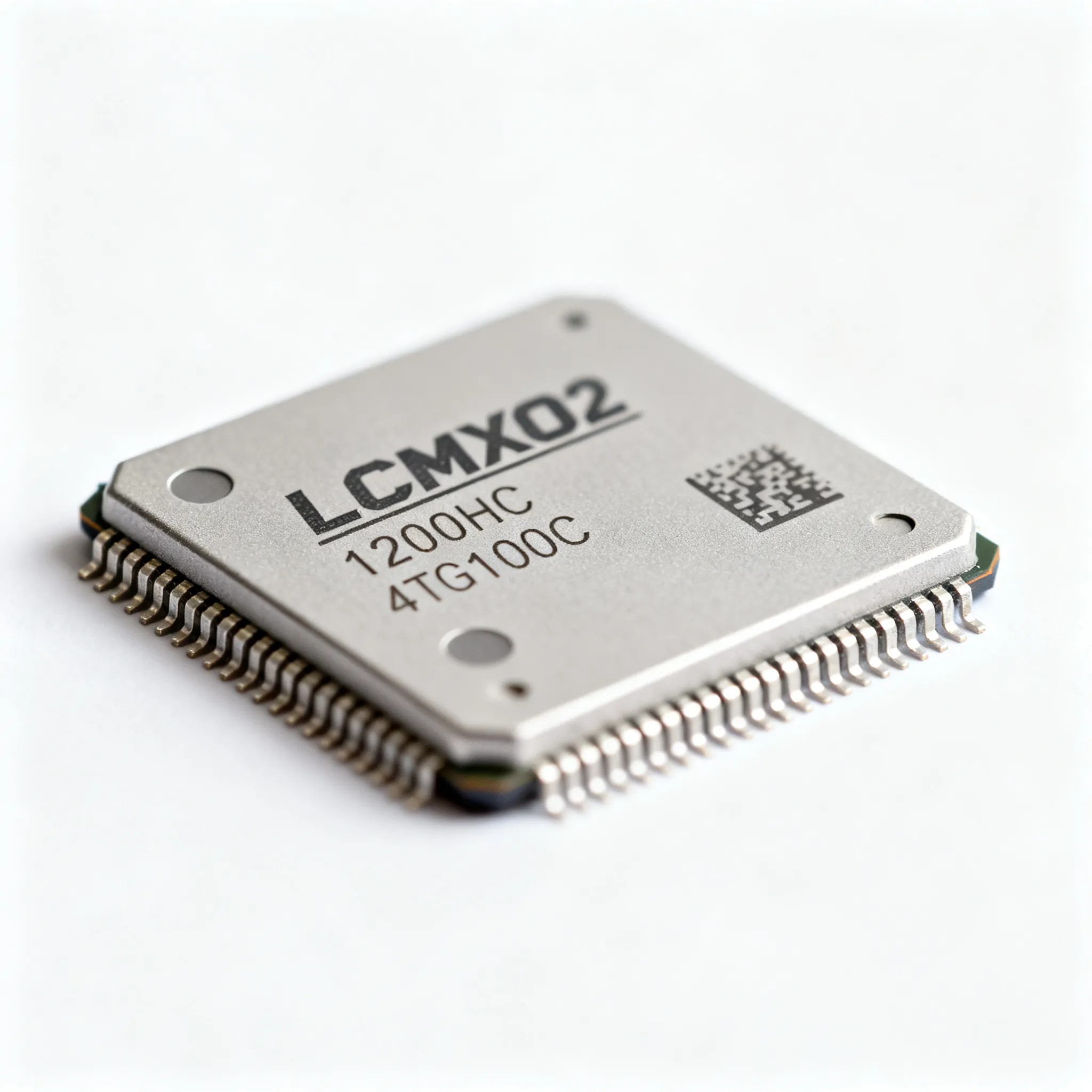
Why LCMXO2-1200HC-4TG100C Supply Risk Is a Board-Level Concern Now
Engineers and buyers who have managed FPGA sourcing through the last several allocation cycles know one thing: the components that quietly disappear are rarely the headline-grabbing 7 nm SoCs. They are the mature, low-density, non-volatile devices that sit in a corner of the board inside a 100-pin TQFP and run the power sequencer, the config I/O expander, or the glue logic that shipped in the original design a decade ago. LCMXO2-1200HC-4TG100C sits exactly in that intersection—small form-factor, embedded flash, single-supply operation—and that makes its supply profile uniquely sensitive to shifts in foundry allocation that never appear in flashy quarterly earnings reports.
Recent analysis from EE Times highlights a persistent structural issue: even mature semiconductor nodes face unexpected tightness when reshoring programs and automotive-qualified demand collide with legacy fab capacity that was never expanded. For programmable logic, the friction is compounded because a non-volatile FPGA like the MachXO2 family does not move easily. Its embedded flash macro requires a specific process recipe; you cannot simply re-spin a bitstream onto a SRAM-based alternative without a board change, and pin-compatible second sources do not exist. As a result, supply risk for LCMXO2-1200HC-4TG100C translates into board-level risk faster than many procurement teams anticipate.
This article is not a stock-status snapshot—those are best obtained via a real-time RFQ. Instead, we walk through the technical and supply-chain fundamentals that determine availability, compare functional alternatives with an honest eye on what “compatible” really means, and give you the five questions that separate informed allocation management from wishful quoting. By the end, you will be equipped to run a disciplined sourcing process on LCMXO2-1200HC-4TG100C and demand the data points that matter.
The LCMXO2-1200HC-4TG100C Under the Hood: Specs That Shape Availability
Before asking a supplier where the parts are, it helps to understand what physically constrains them. LCMXO2-1200HC-4TG100C is a member of Lattice's MachXO2 family, built on a 0.13 µm embedded flash process. Every one of its datasheet parameters carries a supply-chain implication. The table below maps the key technical characteristics to the conversations a buyer should be having with authorized distribution.
| Parameter | Datasheet Value / Feature | Supply & Allocation Implications |
|---|---|---|
| Logic Elements (LUTs) | 1200 4-input LUTs | Small die size; good die-per-wafer count, but yield allocation depends on overall fab loading. When the node is deprioritized, small-die parts can still suffer wafer start reductions. |
| Configuration Memory | Embedded Flash (on-chip, instant-on) | Non-volatile flash macro is specific to the 0.13 µm embedded-flash process. No drop-in FPGA family from another manufacturer shares this exact macro, creating a single-process node dependency. |
| Package | 100-pin TQFP (14 x 14 mm) | TQFP assembly is mature and widely available, but the mold compound and leadframe are tied to qualified assembly sites. Shifts in package capacity (e.g., towards QFN/BGA) can extend lead times if assembly lines are re-tooled. |
| Supply Voltage (VCC) | 2.375 to 3.465 V single-supply (internal regulator) | Eases board design, but the on-chip regulator adds a test insertion that depends on the same fab. No separate power-management IC risk, but no flexibility to move to a different voltage node if supply constraints hit. |
| I/O Count | Up to 80 user I/Os (depending on configuration) | High pin-to-logic ratio makes the part attractive for I/O expansion, widening its application base and demand. This can increase competition for allocation across industrial and communications segments. |
| Temperature Range | Commercial (0 to +85 °C) | Standard grade; reduces test house complexity versus industrial or extended range. Still, any priority given to automotive-grade variants can cannibalize commercial test capacity. |
| Configuration Speed | Instant-on from internal flash (<1 ms) | Helps eliminate external configuration memory from the BOM, which is a plus for availability. However, any silicon revision that alters the flash timing requires full requalification, potentially delaying shipments. |
| Speed Grade | -4 (standard commercial speed) | Most widely available bin; but if a new speed-grade sorting policy changes bin yields (e.g., more parts binned to -5 or slower), the availability of the -4 grade can fluctuate without overall wafer start changes. |
| Programmability Interface | JTAG / I²C / SPI for in-system programming | Field-upgradable, which means some buyers hold engineering stock for production programming. This can create moating behavior that distorts true consumption numbers, making it harder to forecast. |
Key takeaway: The same embedded flash that makes LCMXO2-1200HC-4TG100C attractive for instant-on, single-chip designs also creates a single-point-of-failure in the supply chain. Any supplier telling you that the part is “commodity” because it uses a mature node is missing that critical nuance. When you engage with a distributor, validate that their planning team can distinguish between a standard CMOS logic device and a non-volatile FPGA on a captive flash process.
How Alternative Low-Density FPGAs Compare in Supply Stability
When lead time signals turn red, the instinct is to find an alternative that you can drop onto the board with minimal change. For LCMXO2-1200HC-4TG100C, that exercise demands a clear separation between functional similarity and supply-chain independence. The table below compares the MachXO2 device against two families often raised in redesign discussions: Intel MAX 10 and Lattice iCE40. Note that none of these is a pin-compatible second source; each requires board rework and toolchain migration. The comparison therefore centers on supply stability factors that a buyer should verify before ordering engineering samples.
| Comparison Metric | LCMXO2-1200HC-4TG100C (Lattice MachXO2) | Intel MAX 10 (e.g., 10M08SAU169C8G) | Lattice iCE40LP1K-SWG16TR (example) | Selection Criteria & Failure Boundary |
|---|---|---|---|---|
| Logic capacity | 1200 LUTs | ~8000 LEs (comparable LUT count varies by architecture; higher density overall) | 1280 LUTs (iCE40LP1K) | Match logic utilization after place-and-route; density alone does not guarantee fit. Verify tool chain reports. |
| Configuration memory | Embedded flash (non-volatile, instant-on) | On-die flash (UFM) for user data; configuration from internal flash in some models (e.g., 10M08 has a Flash-based variant) | SRAM-based; needs external SPI flash or host configuration | If instant-on non-volatile is mandatory, MAX 10 flash models are the closer alternative, but package is different. iCE40 requires external memory, adding BOM risk. |
| Package & footprint | 100-pin TQFP (14x14 mm) | Typically 144-pin EQFP, 169-UBGA, or 256-FBGA; no 100-TQFP version | 16-pin WLCSP, 36-QFN, etc.; much smaller packages, no TQFP | All require board respin. TQFP-100 has no drop-in replacement; any migration must account for routing and I/O count. |
| Lifecycle commitment | MachXO2 family active; no LTB notice as of 2025. Verify with Lattice for specific packages. | MAX 10 family remains Intel's primary low-end FPGA; public road maps indicate long production life. | iCE40LP family active but targeted at consumer/edge; verify industrial availability and package longevity. | Check official product longevity documentation (Lattice MachXO2, Intel MAX 10). Ask for written commitment for the exact speed/package combination. |
| Lead-time parity (observed market patterns) | Mature 0.13 µm node; tightness depends on overall fab loading and flash allocation. | MAX 10 uses Intel's 55 nm embedded flash process; capacity has been under pressure due to auto/industrial pull, but Intel's ownership provides some control. | iCE40LP uses a low-power 40 nm LP process from TSMC; lead-time swings have been observed when consumer volumes spike. | Do not assume any family has better default lead times. Request allocation-backed lead time for the specific part number from authorized distributors at the time of RFQ. |
| Design tool migration effort | Lattice Diamond (free license) | Intel Quartus Prime Lite (free) | Lattice iCEcube2 or Diamond (iCE40 support via Diamond in newer versions) | Toolchain migration adds 4-12 engineering weeks depending on IP reuse. Factor this into qualification timelines before changing the approved vendor list. |
Note on manufacturing quality: When qualifying any FPGA alternative for production, insist that the assembly site and process align with recognized workmanship standards. For high-reliability boards, referencing IPC-A-610 Class 2 or Class 3 criteria (IPC Standards) provides a common framework for solder joint and cleanliness acceptance. This is not an FPGA-specific concern, but it becomes critical when a fast-tracked replacement part arrives from a different packaging house than the original.
The key message from the comparison is: look beyond the logic-cell number. Supply stability is driven by process node ownership, package subcon availability, and flash-macro dependency—not by LUT counts. Any supplier proposing an alternative part must answer the “wafer fab and assembly location” question first, and the “tool migration effort” question second.
Five Supplier Questions That Reveal Real Lead-Time Risk
Standard RFQs tend to generate standard answers: “lead time upon request,” “check with factory,” or “available from our hub.” For LCMXO2-1200HC-4TG100C, buyers need to dig deeper. The following five questions are designed to move a conversation from a generic availability check to an allocation risk assessment. Use them in your next RFQ, and insist on written, traceable responses.
- What is the allocation status of the embedded flash wafer start for this specific part number in the current quarter?
Because the MachXO2 family uses a bifurcated process—logic gates plus a flash macro on the same die—a blanket statement about “mature node capacity” is insufficient. Ask whether the flash macro is running on a shared line with other non-volatile products (e.g., CPLDs, secure MCUs) and if any line rebalancing has occurred that could shift starts away from the -HC variant. A supplier who can quote wafer-start priority by device family has real visibility; one who cannot is likely just reading a distributor portal. - Can you provide the last-time-buy (LTB) trigger window for the 100-pin TQFP package variant, and is there any package consolidation activity underway at Lattice’s assembly subcontractor?
Packages often go obsolete before the silicon. A part may be active on paper while the TQFP-100 assembly line is being phased down in favor of QFN or BGA. Ask for a specific LTB window—not just an EOL statement—and whether any alternate package codes for the same die (e.g., 100-CABGA) are being prioritized for new designs. If the answer is that the TQFP line is “maintained but under review,” treat that as a risk flag and model life-of-board stock requirements accordingly. - What is the outstanding backlog of unfilled orders for this SKU across your authorized network, and has that backlog been growing or shrinking over the past three months?
A single push-out date may be inventory rebalancing; a rising backlog that persists across multiple quarters indicates a structural fabrication constraint. Ask the distributor to show trend data for unfilled orders—not just current open backlog—and compare it against incoming shipments. If the gap is widening despite stable or increasing demand, you are looking at an allocation problem that no amount of expediting will fix. - Can you confirm testing flow and binning: does the -4 speed grade rely on a specific test insertion that could be delayed if hot-lot or priority test slots are reallocated?
Test capacity for commercial-grade FPGAs shares infrastructure with automotive and extended-temperature parts. A supplier who acknowledges that -4 speed-grade bins are tested on the same handler as higher-margin grades, and that commercial testing can be deferred when the automotive hot-lot load increases, is giving you honest supply-chain intelligence. If they insist “testing is never a bottleneck,” probe further about recent test-house utilization in their region. - What yield or re-spin activity has affected this device in the last 12 months, and is there any engineering change notice (ECN) pending that could temporarily halt shipments?
Silicon revisions happen, and an ECN can freeze shipments for weeks while documentation catches up. Ask directly whether any process change notice (PCN) or ECN has been issued for the MachXO2 family that affects the flash macro or the TQFP assembly. Even if the current batch is unaffected, a pending ECN can mean that future allocation will be diverted to the new revision, leaving old drawing-number stock constrained.
The table below summarizes the red flags that turn these questions from "nice to have" into a must-read report before you commit production volumes.
| Supplier Question Focus | Credible Answer Signal | Red Flag Response |
|---|---|---|
| Wafer start allocation (embedded flash) | Specific fab loading percentage for the flash macro; commitment by quarter. | “No allocation issues—it's a mature node” without flash-specific data. |
| Package LTB / consolidation | Written LTB window for the 100-TQFP; alternative package roadmap. | “Package availability is fine, but we recommend QFN for new designs” without a formal LTB notice. |
| Backlog trend across authorized channels | Data showing backlog vs. shipment over rolling 90-day periods. | “We can only see our own backlog, not the network.” |
| Test insertion and binning stability | Explanation of test flow and any hot-lot prioritization. | “Testing is always on time; that's a factory internal matter.” |
| ECN / PCN activity in the last 12 months | Copies of recent PCN documents; road map for silicon revision. | “No changes that affect you” without documentation. |
Incorporating these questions into your RFQ template transforms a purchase transaction into a risk dialogue. For a part like LCMXO2-1200HC-4TG100C, where no second source exists and the embedded flash process creates a captive supply, that dialogue is the difference between shipping product on time and scrambling for a substitute you never planned for.
Senior Engineer Q&A: LCMXO2-1200HC-4TG100C Sourcing Scenarios
Below are realistic scenarios that project leads and procurement professionals encounter when managing a design around LCMXO2-1200HC-4TG100C. Each answer draws on industry knowledge and verified manufacturer documentation, not on temporary market snapshots.
- Q: Is the LCMXO2-1200HC-4TG100C still in active production, and what is its expected product longevity?
A: Lattice Semiconductor has not issued a last-time-buy notice for the MachXO2 family, which remains active on its official product page. However, verify the specific speed grade and package combination directly with the manufacturer. Different package variants within the MachXO2 line do phase out at different cadences; a 100-TQFP part may diverge from the family-level longevity. Ask for a formal product lifecycle plan and confirm that LCMXO2-1200HC-4TG100C appears on the current road map, not just the general MachXO2 listing. Distributor product pages like Digi-Key or Mouser can provide current orderability, but lifecycle status should be confirmed through an authorized channel. - Q: What functional alternatives exist that can be considered without a full board respin?
A: No perfect drop-in exists because the MachXO2 uses non-volatile configuration and a proprietary architecture. Evaluate Lattice's own iCE40LP / iCE40HX devices for pure logic replacement, or Intel MAX 10 FPGAs if on-board flash is required. Both demand pinout rework and toolchain migration. The iCE40 family is SRAM-based and requires an external configuration memory, which adds BOM risk but may be acceptable in some designs. Intel MAX 10 offers on-die flash, but package footprints are entirely different. Verify the alternative's active status and lead-time parity before initiating any redesign, and consider booking prototype allocations early to avoid building a supply vulnerability into the new design. - Q: How do I distinguish between a transitory lead-time extension and a permanent allocation problem?
A: A single distributor push-out may be inventory rebalancing. Consistent 20+ week lead times across all authorized channels, combined with a refusal to commit to future shipments, signal allocation risk. Ask to see the supplier's backlog of unfilled orders for this SKU—a rising backlog without corresponding shipment increases usually indicates fabrication constraints, not logistics delays. For LCMXO2-1200HC-4TG100C, watch also for reallocation to higher-volume package variants (e.g., BGA). If BGA versions ship on-time while TQFPs slip, the fab is not the bottleneck; the assembly line and package material supply are—and that can become a permanent shift. - Q: What documentation should I request to verify the supply chain integrity of LCMXO2-1200HC-4TG100C batches?
A: Require full traceability: date code, assembly location, and authorized distribution verification. For high-reliability boards, ask for the conformity certificate referencing J-STD-020 moisture sensitivity levels and a manufacturing quality statement aligned with IPC-A-610 Class 2 or 3, as applicable. This helps screen out gray-market parts that mimic factory packaging. Additionally, request a copy of the distributor's incoming inspection report (if available) that confirms the parts were received directly from Lattice or from a Lattice-authorized stocking location. On IC-Online, you can specify these requirements in the RFQ remarks to pre-filter suppliers. - Q: Does this part’s small-geometry embedded flash process create any unique supply vulnerabilities?
A: Yes. The embedded flash macro used in the MachXO2 series is specific to Lattice’s chosen foundry process (a 0.13 µm embedded-flash node). If that foundry deprioritizes the node or shifts capacity to a different flash macro, alternative fabrication cannot be rapidly ported, creating a single-point-of-failure. In supply negotiations, probe whether Lattice has any backup fab qualification underway for this flash variant. The answer will tell you how seriously the manufacturer treats long-term continuity for the family. As of now, no public backup fab qualification has been announced, so treat the part as allocation-sensitive and plan buffer stock accordingly.
All these scenarios underscore one point: supply chain decisions for LCMXO2-1200HC-4TG100C must be based on verifiable documentation and direct manufacturer commitments, not on general market sentiment or a single distributor's stock check at 2 PM on a Tuesday.
Conclusion
Sourcing a mature, low-density FPGA should be straightforward, but the intersection of an embedded flash process, a TQFP package that is no longer the assembly industry's favorite, and a supplier landscape with no drop-in second source makes LCMXO2-1200HC-4TG100C a part that demands deliberate supply-chain questioning. You cannot treat it as a generic logic chip; the flash macro creates a captive allocation pool, and the package-specific lifecycle can diverge from the die-level longevity.
By applying the technical understanding from the spec table, the comparison framework for alternatives, and the five supplier questions, you move from reactive expediting to proactive risk management. When you send out your next RFQ, require answers about wafer start allocation, TQFP-100 packaging road map, backlog trends, test binning, and ECN activity. Use the documentation checklist to filter out unauthorized stock. And if a supplier cannot answer those questions with data, treat that silence as a risk signal.
To secure your allocation of LCMXO2-1200HC-4TG100C, request a quote via IC-Online today. The platform supports mixed BOMs, flexible MOQs, and enables you to specify documentation requirements upfront—so you can initiate a disciplined sourcing process immediately.
References & Further Reading
- EE Times — Electronics Engineering News — Ongoing coverage of semiconductor allocation and mature node capacity.
- IPC Standards — IPC-A-610 and related workmanship standards for electronics manufacturing.
- Lattice Semiconductor — MachXO2 Product Family — Official product page with datasheets and lifecycle status.
- Intel MAX 10 FPGA Family — Alternative non-volatile FPGA family for comparison.
- Digi-Key Product Listing: LCMXO2-1200HC-4TG100C — Current orderability and distributor inventory reference.
- Mouser Product Listing: LCMXO2-1200HC-4TG100C — Additional authorized distributor reference.
Related Articles
 Blog
How to Source and Inspect SK Hynix 24GB HBM2E Memory Stacks: An OEM Buyer’s Specification Checklist
How OEM buyers inspect suspect lots, request traceability, and escalate ERAI risk — a procurement checklist, not a hobby explainer.
 Blog
SR Latch Basics and Practical Applications
An SR latch is a basic memory element that stores one bit. It uses cross-coupled gates to set, reset, or hold state, and is key among latches types for debouncing and storage.
 Blog
Electronic Components Company Explained with Common Electronics Concepts
An electronic components company designs, manufactures, and distributes parts like transistors, resistors, and capacitors that power your phone, TV, and appliances.
 Blog
How to Discharge Capacitors in 3 Easy Steps
Learn how to discharge capacitors safely in 3 easy steps: isolate, use a bleeder tool, and verify with a multimeter. Essential for safe electronics repair.
 Blog
What Does MFD Stand for on a Multimeter
MFD on a multimeter means microfarads, the unit for capacitance. Learn how to use this setting to test capacitors and troubleshoot circuits safely.
 Blog
Specifying, Inspecting, and RFQing Components from Independent Distributors: An OEM Buyer’s Quality Checklist
Buyer-side specification, inspection, and RFQ checks on this technical topic. Not a hobby explainer. Request a quote on IC-Online.