AX5043-1-TW30 Sourcing Strategies: Reducing BOM Cost with Alternate Distributors and Bulk Orders
Expert guide on AX5043-1-TW30 Sourcing Strategies: Reducing BOM Cost with Alternate Distributors and Bulk Orders. Technical specs, applications, sourcing tips for engineers and buyers.
Why AX5043-1-TW30 BOM Costs Can Spike Without a Multi-Distributor Strategy
The AX5043-1-TW30 is a single-source onsemi sub‑GHz RF transceiver that often ends up locked into a narrow distribution channel. Many procurement teams default to one franchised distributor for all their onsemi needs, and that habit turns into a liability the moment lead times stretch or allocation hits. When a sole source dries up, the bill of materials (BOM) cost can jump 30–50 % overnight as buyers scramble for spot‑market inventory. Worse, the pressure to fill gaps fast opens the door to counterfeit or re‑marked parts that slip past incoming inspection.
The semiconductor industry has spent the last three years learning that single‑source dependency is the fastest way to inflate production costs. As the SupplyICs dual‑sourcing framework points out, even when a pin‑compatible second source doesn’t exist, the discipline of qualifying alternate supply paths and functionally equivalent devices is what separates a resilient BOM from a brittle one. For the AX5043-1-TW30, that means building a distributor strategy that goes beyond a single purchase order.
The table below breaks down the key drivers that push AX5043-1-TW30 BOM costs upward when procurement sticks to a one‑channel approach.
| Driver | Mechanism | Procurement Impact |
|---|---|---|
| Single‑source dependency | onsemi is the sole manufacturer; no pin‑compatible second source exists. | Any fab interruption or allocation decision immediately removes supply, forcing spot‑market purchases at 2–5× standard pricing. |
| Allocation & shortage cycles | When onsemi allocates capacity to higher‑volume customers, the open market tightens. | Lead times stretch from 4 weeks to 12+ weeks; authorized distributors raise prices on remaining stock. |
| Counterfeit infiltration | Desperate buyers turn to unvetted independent sources that may sell re‑marked or recycled ICs. | Counterfeit parts cause field failures, rework costs, and brand damage; incoming inspection overhead rises sharply. |
| MOQ & volume pricing barriers | Franchised distributors publish tiered pricing that rewards orders of 1,000+ pieces; small‑volume buyers pay a premium. | Projects with annual usage below 500 units see per‑unit costs 15–25 % higher than volume buyers, eroding margin. |
| Geopolitical & logistics disruptions | Tariff shifts, freight bottlenecks, or regional export controls can delay shipments. | Inventory held in transit ties up working capital; expedited shipping fees add 5–10 % to landed cost. |
Each of these drivers feeds the same loop: a single‑channel sourcing model leaves you reactive. The antidote is a multi‑distributor approach that layers authorized stock with carefully qualified independent sources, combined with bulk purchasing tactics that unlock volume breaks. The next sections map out exactly how to build that strategy for AX5043-1-TW30.
Inside the AX5043-1-TW30: Specs That Shape Your Sourcing Options
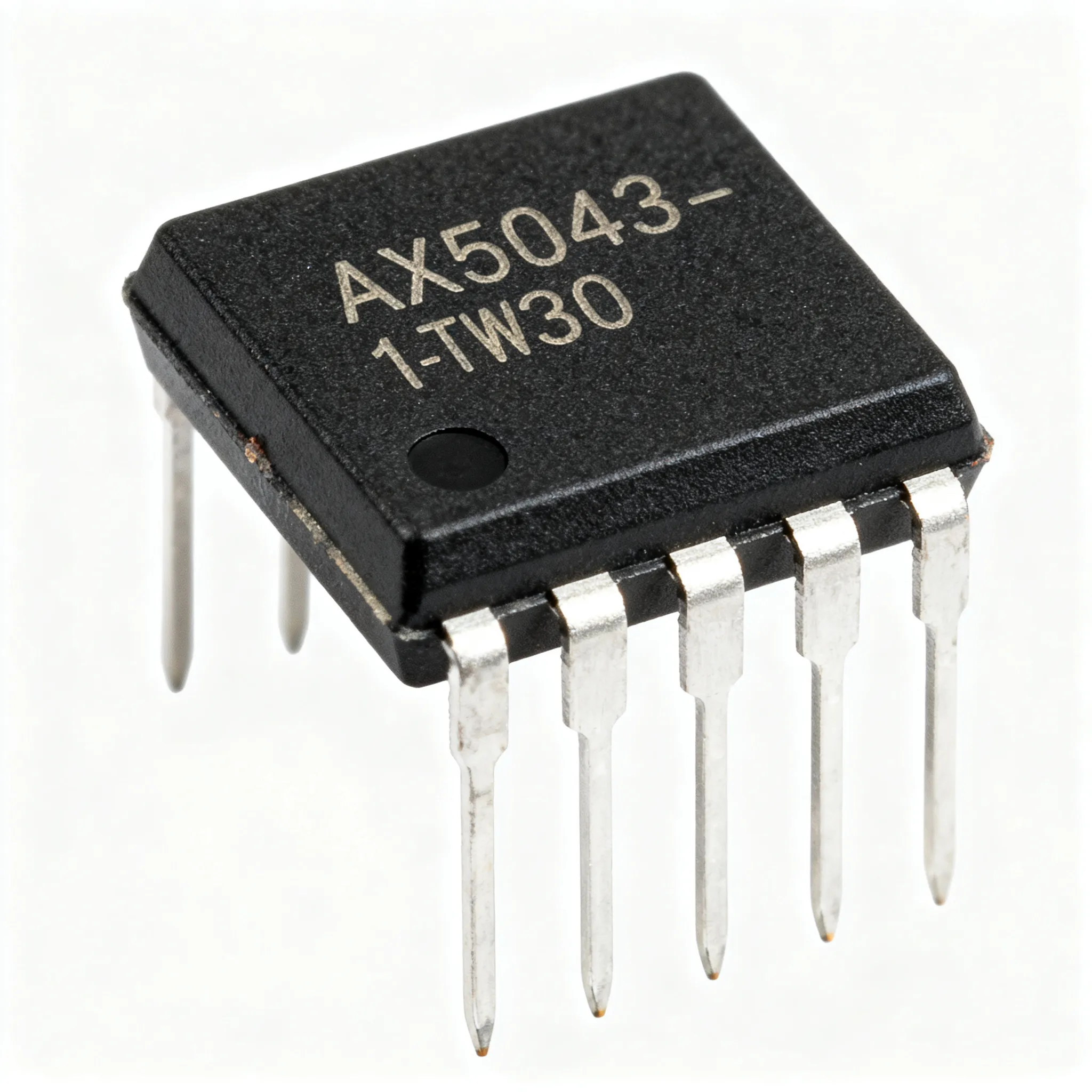
Before you can evaluate alternate distributors, you need a clear picture of what you’re buying. The AX5043-1-TW30 is a highly integrated RF transceiver designed for general ISM applications below 1 GHz. Its key parameters, drawn from the official datasheet available via Utmel and FindIC, define the boundaries of any sourcing decision:
- Frequency range: 27 MHz to 1050 MHz, covering all major sub‑GHz ISM bands.
- Receive sensitivity: –127 dBm at 1.2 kbps, enabling long‑range links in noisy environments.
- Output power: Up to 10 dBm, configurable in fine steps.
- RX current consumption: 15.4 mA, a critical figure for battery‑powered sensors.
- Modulation schemes: ASK, AFSK, FM, FSK, 4‑FSK, GFSK, GMSK, MSK, PSK — a broad set that makes a functional replacement extremely difficult to match without firmware changes.
- Package: 28‑pin QFN (5×5 mm), with a proprietary pinout and register map.
- Supply voltage: 1.8 V to 3.6 V, compatible with a wide range of system rails.
These specs matter for sourcing because they reveal why a true second‑source part doesn’t exist. The combination of the 28‑pin QFN footprint, the specific modulation engine, and the register‑level configuration is unique to onsemi. Any substitute transceiver — even one with a similar frequency range — would require a PCB redesign and a firmware port. That reality shifts the procurement focus away from finding a drop‑in replacement and toward securing a reliable, cost‑effective supply of the original AX5043-1-TW30 through multiple qualified distributors.
When you compare distributor offerings, you’re not just comparing price tags; you’re comparing the authenticity guarantees, traceability, and stock depth that protect the integrity of those specifications. The next section puts authorized and independent sources side by side.
Distributor Showdown: Authorized vs. Independent Sources for AX5043-1-TW30
Franchised distributors such as Mouser offer the gold standard: parts that come directly from onsemi with full traceability, date‑code verification, and manufacturer warranty. Independent wholesalers like Avaq can sometimes beat authorized pricing, especially on surplus inventory, but they demand rigorous incoming inspection to weed out counterfeits. The Octopart price comparison for AX5043-1-TW30 shows that bulk discounts from just two distributors can vary by 10–20 % at the 500‑piece level, and the gap widens when independent sources are added to the mix.
The table below captures the strategic options procurement teams have when sourcing AX5043-1-TW30 and how each affects BOM cost and risk.
| Segment / Option | Effect on BOM Cost & Risk | Notes |
|---|---|---|
| Authorized distributor (Mouser, Digi‑Key, etc.) | Highest authenticity guarantee; pricing follows published tier breaks. Lead times are predictable but can extend during allocation. | Ideal for production runs where traceability is mandatory. MOQ may be as low as 1 piece, but volume pricing kicks in at 100, 500, and 1,000 units. |
| Independent distributor (Avaq, brokers) | Often lower unit cost, especially on excess stock. Risk of counterfeit or re‑marked parts is real; inspection cost must be factored in. | Best used as a secondary source when authorized stock is unavailable. Always request lot code documentation and consider third‑party testing on a sample. |
| Blanket order with authorized distributor | Locks in a negotiated price for 12 months, shielding against spot‑market spikes. Requires a volume commitment. | Works well when you can aggregate demand across multiple projects. Requires accurate forecasting to avoid over‑commitment. |
| Spot buy from broker | Immediate availability but highest per‑unit cost; no long‑term price protection. | Emergency option only. Combine with incoming inspection protocols and limit to small quantities. |
Authorized channels remain the backbone of a stable AX5043-1-TW30 supply, but the data from Octopart shows that independent sources can play a complementary role when you need to fill a short‑term gap or negotiate a better blended price. The key is to qualify those sources before you need them, not during a shortage.
How to Lock In Lower AX5043-1-TW30 Pricing with Bulk Orders and Dual Sourcing
Shaving 15–25 % off the per‑unit cost of AX5043-1-TW30 isn’t about luck; it’s about applying a handful of procurement disciplines that turn a fragmented buy into a strategic lever. Here are the steps that senior buyers and engineers are using today.
Aggregate demand across multiple board designs. Many organizations use the AX5043-1-TW30 in several products — a wireless sensor node, a gateway, a handheld reader. By consolidating the annual volume of all those BOMs into a single purchase, you can reach the 1,000‑piece tier where authorized distributors offer their steepest discounts. Tools like Altium’s BOM Portal let you spot common parts across designs without needing CAD access, making it easy to build a consolidated demand picture.
Negotiate a blanket order with an authorized distributor. Instead of placing spot buys every quarter, commit to a 12‑month blanket order with scheduled releases. This gives the distributor visibility into your demand and often unlocks an additional 5–10 % discount beyond the published volume breaks. It also insulates you from mid‑year price increases.
Use BOM portal tools to identify alternate distributors with excess stock. Even within the authorized channel, inventory levels fluctuate. A distributor that is out of stock today may have a large reel arriving in two weeks. BOM portals that aggregate real‑time inventory from hundreds of sources help you spot those pockets of availability and negotiate before the market catches on.
Dual‑source your distributor relationships. The SupplyICs dual‑sourcing framework emphasizes that a second source doesn’t have to be a different manufacturer; it can be a second, qualified distributor. Maintain relationships with at least two authorized distributors and one vetted independent source. When one channel tightens, the others can absorb the demand without forcing a panic buy.
Qualify a functional alternative transceiver as a last resort. While no pin‑compatible replacement for AX5043-1-TW30 exists, transceivers like the Silicon Labs Si446x or Texas Instruments CC1120 offer similar sub‑GHz performance. The dual‑sourcing discipline from SupplyICs provides a framework for evaluating such alternatives: define the minimum viable performance envelope, run a side‑by‑side bench evaluation, and document the firmware changes required. This work is an insurance policy — you hope never to use it, but if the AX5043-1-TW30 goes on extended allocation, you have a qualified path forward that avoids a complete design halt.
Verify authenticity when buying from non‑franchised channels. If you source from an independent distributor, insist on a certificate of conformance and full traceability documentation. Check the lot code and date code against onsemi’s standard packing slip format. Perform visual inspection under a microscope for signs of re‑marking, and consider X‑ray or decapsulation testing on a sample lot. The cost of one counterfeit‑induced field failure dwarfs the inspection expense.
The table below summarizes the mitigation actions that directly reduce AX5043-1-TW30 BOM cost and supply risk.
| Action | When to Use | Trade‑off |
|---|---|---|
| Aggregate demand across multiple BOMs | When the same transceiver appears in 2+ products with combined annual volume above 500 units. | Requires cross‑team coordination and a shared forecasting process; may tie up inventory if forecasts are inaccurate. |
| Negotiate annual blanket order with authorized distributor | When you have stable, predictable demand and want to lock in pricing. | Commitment risk: if demand drops, you may be left with excess inventory. Build in flexible release windows. |
| Use BOM portal to identify alternate stock | When your primary distributor shows zero stock or extended lead time. | May require qualifying a new distributor relationship quickly; always verify authenticity before placing a large order. |
| Dual‑source distributor relationships | Proactively, before a shortage occurs. Maintain at least two authorized accounts and one vetted independent. | Higher administrative overhead; requires managing multiple POs and shipping schedules. |
| Qualify a functional alternative transceiver | As a contingency when AX5043-1-TW30 is on allocation for 12+ weeks and no stock is available. |
Significant engineering effort: PCB redesign, firmware port, and re‑certification. Only cost‑effective if the shortage is prolonged. |
Each of these actions shifts the procurement posture from reactive to strategic. The goal isn’t to eliminate all risk — that’s impossible with a single‑source IC — but to create enough supply options that a disruption in one channel doesn’t halt production.
AX5043-1-TW30 Sourcing FAQ: What Senior Engineers and Buyers Ask
Q: Can I replace the AX5043-1-TW30 with another sub‑GHz transceiver without a board spin?
Almost never. The 28‑pin QFN footprint and register set are proprietary to onsemi; no pin‑compatible second source exists. Any swap would require a PCB redesign and firmware porting, so securing reliable supply of the original AX5043-1-TW30 is the lower‑cost path.
Q: What minimum order quantity unlocks a meaningful bulk discount on AX5043-1-TW30?
Authorized distributors like Mouser often break price at 100, 500, and 1,000 pieces. Independent sources such as Avaq may offer steeper discounts at 1,000+ but always request a formal quote — prices on Octopart show indicative breaks, not final negotiated rates.
Q: How do I verify the authenticity of AX5043-1-TW30 from non‑franchised distributors?
Check the lot code and date code against onsemi’s packing slip format, perform visual inspection under a microscope for re‑marking, and consider X‑ray or decapsulation testing on a sample. Always insist on a certificate of conformance and full traceability documentation.
Q: What lead time should I budget for a volume order of AX5043-1-TW30?
As of mid‑2025, authorized stock on Mouser shows immediate availability for small quantities, but large reels can slip to 8–12 weeks. Independent brokers may have excess stock ready to ship, but lead times are unpredictable during allocation periods — dual‑source your distributor relationships to buffer against shortages.
Q: Is there a second‑source part that is functionally equivalent even if not pin‑compatible?
Transceivers like the Silicon Labs Si446x or Texas Instruments CC1120 offer similar frequency ranges and modulation schemes, but they require a full redesign. Use the dual‑sourcing qualification framework from SupplyICs to evaluate such alternatives only if the AX5043-1-TW30 becomes unobtainable for an extended period.
Q: How can I consolidate AX5043-1-TW30 purchases across multiple projects to drive down cost?
Aggregate demand from different BOMs into a single annual blanket order with an authorized distributor. Tools like Altium’s BOM Portal let you spot common parts across designs and negotiate volume pricing without needing CAD access, reducing per‑unit cost by 10–20 %.
The strategies outlined above — multi‑distributor sourcing, bulk aggregation, and proactive dual‑sourcing qualification — give engineering and procurement teams the leverage they need to keep AX5043-1-TW30 BOM costs under control. For mixed BOMs that combine RF transceivers with passives, connectors, and power management ICs, a platform that offers flexible minimum order quantities and consolidated logistics can further streamline the process. IC-Online provides exactly that: a single point of contact for mixed BOM procurement with the agility to adjust order sizes as demand shifts, helping you capture volume savings without over‑committing inventory.
References & Further Reading
- AX5043-1-TW30 on Octopart — Price comparison and datasheets
- AX5043-1-TW30 at Avaq — Original wholesale and inventory
- SupplyICs — Dual Sourcing and Second Source Qualification Framework
- Altium — Strategic Procurement with BOM Portal: Cost Optimization for Production BOMs
- Mouser — AX5043-1-TW30 product page and inventory
- Utmel — AX5043-1-TW30 datasheet and specifications
- FindIC — AX5043-1-TW30 datasheet PDF and pricing
- onsemi — AX5043 product family overview
- IC-Online — Mixed BOM procurement with flexible MOQ