Electronic Student ID Hardware: RFID/NFC Chips, MCUs, and Campus Device Sourcing
Electronic Student ID Hardware: RFID/NFC Chips, MCUs, and Campus Device Sourcing
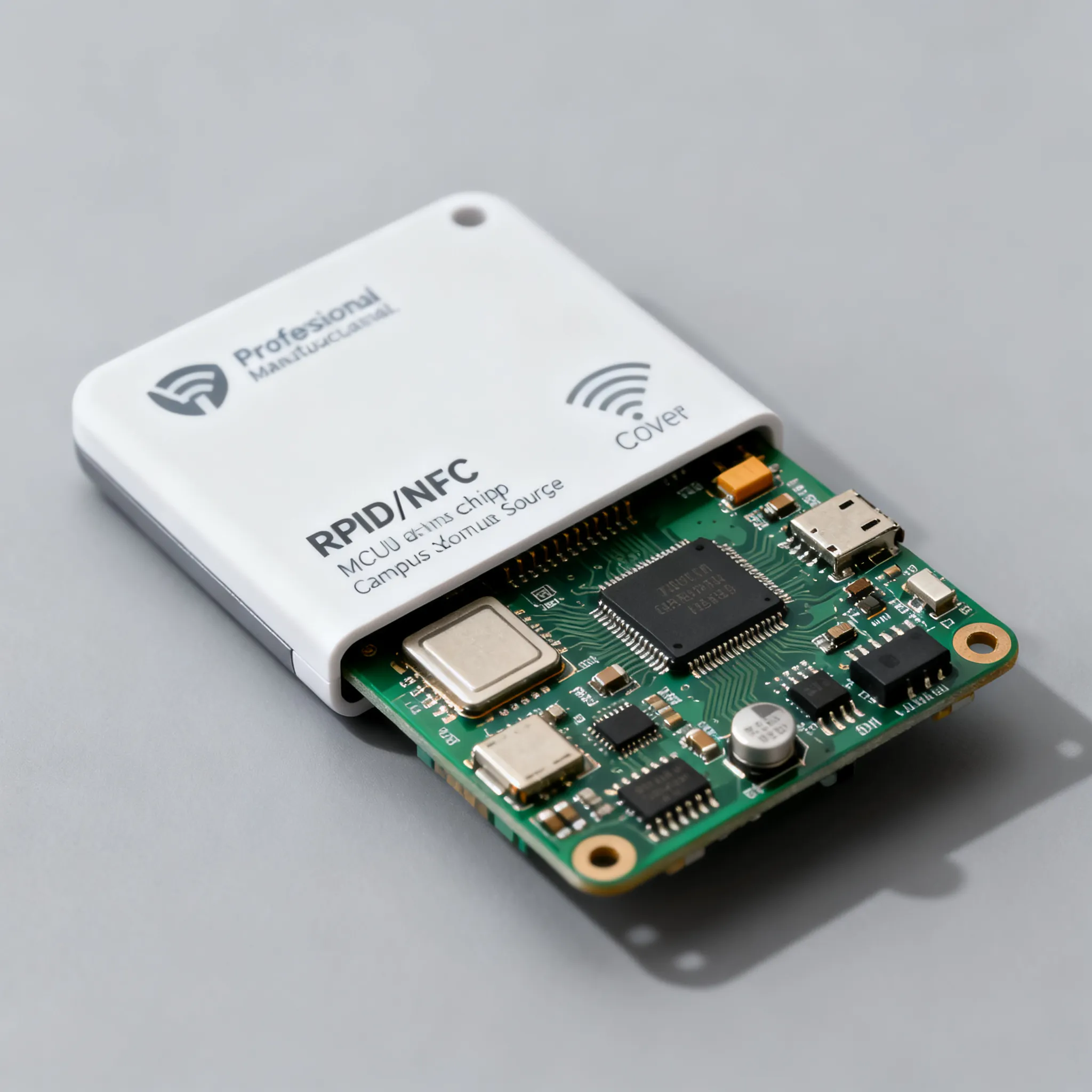
Campus ID Supply Chains Under Pressure: Why RFID and NFC Chip Shortages Matter Now
If you're sourcing silicon for electronic student ID systems, you've already felt the ground shift. The global semiconductor shortage that began in 2020 never fully receded for RFID and NFC components—it simply changed shape. What was once a broad-based allocation crisis has morphed into a targeted, mature-node squeeze that procurement teams at universities and system integrators are navigating daily.
The numbers tell a sobering story. RFID chip shortages have persisted for more than two years, with no clear endpoint in sight. The scarcity spans computer chips, automotive ICs, and critically for campus deployments, the RFID tag ICs and reader transceivers that form the backbone of student credential ecosystems. According to IDTechEx analysis reported by EE Times Asia, the chip shortfall was originally expected to endure until 2023 or early 2024, yet the reality has been far more persistent. Looking ahead, Suntsu Electronics forecasts a targeted semiconductor shortage for 2025–2026 that will specifically impact mature-node ICs—including the microcontrollers and analog front-end chips that power campus card readers.
Key Takeaway: The window for comfortable, just-in-time procurement of student ID hardware has closed. Lead times for MIFARE-family ICs, NTAG chips, and 13.56 MHz transceivers have stretched from 8–12 weeks to 26–52 weeks at various points over the past 18 months. Universities planning badge system rollouts, replacements, or campus-wide reader upgrades need to lock in forecasts and build buffer stock now—not when the 2025–2026 crunch hits.
What makes this shortage particularly painful for education-sector buyers is the fragmented nature of the supply chain. A single student ID card reader may contain an MCU from one vendor, an RF transceiver from a second, a secure element from a third, and passive tag ICs from yet another. Any one of those components going on allocation can stall an entire deployment. We've seen campus IT departments scramble when a security upgrade mandated MIFARE DESFire EV3, only to find 40-week lead times and non-cancellable order requirements from distributors.
The picture isn't uniformly bleak, but it demands strategic action. Manufacturers like WISekey and others in the RFID ecosystem are expanding capacity, but the ramp is slow and concentrated on higher-margin segments. The mature-node fabs that produce the bulk of 13.56 MHz tag ICs and low-cost reader MCUs face capital expenditure constraints that won't resolve quickly. For campus buyers, this means supplier diversification isn't just a best practice—it's a survival tactic.
How an Electronic Student ID Card Works: RFID/NFC Chips, Memory, and Security Primitives
Strip away the institutional branding and the photo layer, and an electronic student ID card is fundamentally a contactless smart card built around a passive RFID or NFC integrated circuit. When a student taps their card against a campus reader, energy from the reader's 13.56 MHz magnetic field powers the tag IC through inductive coupling. The chip wakes up, executes a command set, and modulates a response back to the reader—all within milliseconds. This same principle enables door access, cafeteria payments, library checkout, and attendance logging.
The tag IC itself is the heart of the system. Modern student ID chips fall into two broad architectural categories: memory-based tags and microcontroller-based secure elements. Memory tags like MIFARE Ultralight store data in organized pages with simple password protection, while secure microcontroller families such as MIFARE DESFire EV2/EV3 implement full AES-128 encryption, mutual authentication, and file-system-based data organization. The choice between these architectures determines everything from the per-card cost to the security posture of the entire campus.
On the reader side, a 13.56 MHz transceiver IC handles the analog modulation and demodulation, while a host microcontroller manages protocol parsing, cryptographic operations, and back-end communication—typically over Ethernet, Wi-Fi, or RS-485. Microchip's microID 13.56 MHz RFID System Design Guide provides a well-documented reference architecture that pairs a PICmicro MCU with an analog front-end for ISO 14443 and ISO 15693 compatibility. The TI TRF7970A multiprotocol transceiver IC offers a highly integrated alternative that handles NFC Forum tag types 1–5 in a single package.
Understanding the card hierarchy matters for sourcing. Lower-end ID cards with fixed UID-only operation lack the security primitives needed for payment or access control. Moving up the stack, IC cards with memory-based chips (like the FM11RF08 from Shanghai Fudan or compatible S50 variants from Infineon and ISSI) provide sector-based storage. At the top, CPU cards and secure NFC ICs integrate a full cryptographic processor capable of running authentication protocols and managing multiple applications in isolated memory domains.
The table below compares the chip families most relevant to student ID deployments, drawing on technical specifications from Shop NFC and vendor datasheets.
| Parameter | MIFARE DESFire EV2/EV3 | MIFARE Ultralight C | NTAG 213/215/216 | ST25TA Series |
|---|---|---|---|---|
| Operating Frequency | 13.56 MHz | 13.56 MHz | 13.56 MHz | 13.56 MHz |
| Standard Compliance | ISO 14443-A, NFC Forum Type 4 | ISO 14443-A, NFC Forum Type 2 | ISO 14443-A, NFC Forum Type 2 | ISO 14443-A, NFC Forum Type 4 |
| User Memory | 2–8 KB (flexible file system) | 144–192 bytes | 144–888 bytes | Up to 64 KB EEPROM |
| Security | AES-128, mutual authentication, CMAC | 3DES authentication | 32-bit password, optional AES on NTAG 424 DNA | AES-128, CC EAL5+ certified |
| Data Rate | Up to 848 kbps | 106 kbps | 106 kbps | Up to 848 kbps |
| Multi-Application Support | Yes—native file system with 28+ applications | No—linear memory map | No—NDEF message-based | Yes—configurable file system |
| Read Range (typical) | Up to 100 mm | Up to 100 mm | Up to 100 mm | Up to 100 mm |
| Per-Card Cost (volume, Qty 10k+) | $0.80–$1.50 | $0.25–$0.45 | $0.15–$0.35 | $0.50–$1.20 |
| Best Campus Use Case | Multi-function ID: access, payment, transit | Single-purpose: library checkout, basic attendance | Simple ID, event ticketing, NDEF-based apps | High-security access, government-linked student ID |
Tip: When evaluating chip families, don't just compare silicon cost. Factor in the development effort for reader-side firmware, the availability of cryptographic libraries, and the long-term roadmap for the chip family. MIFARE DESFire EV3, for instance, adds transaction MAC and improved proximity check, both valuable for campus payment applications—but the reader infrastructure must support these features. If you're deploying a mixed fleet of readers from different vendors, verify interoperability early in the sourcing cycle.
NFC vs RFID for Student Credentials: When to Choose Short-Range Security Over Long-Range Convenience
Campus planners face a genuine architectural decision when selecting the underlying technology for student ID systems. The choice isn't merely academic—it dictates reader placement, portal design, card cost, and the security model that protects student data and campus assets. The distinction between RFID and NFC is often blurred in procurement conversations, but the engineering realities are starkly different.
At its core, the decision revolves around range and intent. UHF RFID (typically 860–960 MHz) can read tags at distances of 3–10 meters, making it attractive for hands-free door access, vehicle gate entry, and automated attendance tracking where students simply walk through a portal. NFC, operating at 13.56 MHz with a designed read range of 2–10 centimeters, requires deliberate action—the student must physically tap their card or phone. This proximity constraint is actually a security feature, not a limitation. As Locaxion's analysis of industrial NFC vs RFID highlights, NFC chips are purpose-built for secure, bidirectional data exchange at very close range, while RFID chips excel at long-range passive detection at the cost of simpler security models.
For campus environments, the trade-offs become concrete quickly. A UHF-based student ID system can track movement through hallways and detect cards inside backpacks, but it's vulnerable to unauthorized scanning from greater distances. An NFC-based system ensures that every read is intentional, but it creates bottlenecks at high-traffic portals like dining halls during lunch rush. The table below puts these differences into numbers that matter for procurement.
| Comparison Metric | NFC (13.56 MHz, ISO 14443) | HF RFID (13.56 MHz, ISO 15693) | UHF RFID (860–960 MHz, EPC Gen2) | Selection Criteria & Failure Boundary |
|---|---|---|---|---|
| Typical Read Range | 2–10 cm | 50–100 cm | 3–10 m | Choose NFC for secure tap-to-access; UHF for hands-free portals. NFC range is a security feature, not a bug. |
| Data Rate | 106–848 kbps | 26–53 kbps | 40–640 kbps | NFC and UHF both support fast reads; HF lags. Sufficient for ID data, inadequate for large file transfers. |
| Security Model | AES-128, mutual authentication, secure channel | Password-based, optional encryption | EPC Gen2v2 adds authentication; basic tags are UID-only | UHF security is improving but lags NFC. Don't use basic UHF for payment or PII-bearing credentials. |
| Tag IC Cost (Qty 10k+) | $0.15–$1.50 | $0.20–$0.60 | $0.08–$0.40 | UHF tags are cheapest. NFC costs more but carries more security. Total system cost (readers, infrastructure) dominates. |
| Reader Cost Per Door | $30–$200 | $50–$150 | $200–$1,500 | UHF readers are expensive; NFC readers are commodity. For 100 doors, NFC saves $15K+ in reader hardware alone. |
| Multi-Card Reading | No (by design) | Yes (anti-collision) | Yes (hundreds/sec) | UHF wins for batch reading. NFC prevents accidental reads of nearby cards—better for payment terminals. |
| Smartphone Compatibility | Native on iOS/Android | Limited phone support | No native phone support | NFC enables mobile student ID on smartphones. UHF and HF cannot. This is a decisive factor for future-proofing. |
| Best Campus Application | Door access, payment, mobile ID, library | Book inventory, equipment tracking | Vehicle gates, hands-free attendance portals | Most campuses deploy NFC for student-facing transactions and UHF for asset tracking—not a single-technology choice. |
Note: Many campuses run a hybrid architecture. NFC handles all student-facing interactions—door access, cafeteria POS, library checkout—while UHF RFID is deployed in parallel for asset management, lab equipment tracking, and vehicle access control. The two systems coexist because they solve fundamentally different problems. When sourcing, don't force a single technology to cover every use case. Instead, design your reader infrastructure to accommodate both bands where needed, and let the application dictate the air interface.
The rise of mobile student ID—where credentials reside in Apple Wallet or Google Wallet—further tilts the balance toward NFC. Smartphones don't emit UHF RFID signals compatible with EPC Gen2 readers, but they do support NFC card emulation natively. If your campus plans to offer mobile credentials within the next 3–5 years, NFC reader infrastructure is a prerequisite. This isn't a speculative trend; it's already deployed at major universities across North America and Europe.
Sourcing Microcontrollers and Transceivers for Campus Badge Readers: Navigating Lead Times and Reference Designs
Building a campus badge reader that survives the 2025–2026 allocation cycle requires more than a solid BOM—it demands a sourcing strategy that treats component availability as a first-class design constraint. The MCU and RF transceiver that sit at the heart of every reader are precisely the mature-node ICs that Suntsu's shortage forecast flags as high-risk. Engineers and buyers need to approach this market with eyes wide open.
The reference design landscape offers a starting point. Texas Instruments' TRF7970A multiprotocol transceiver IC is one of the most thoroughly documented front-ends available, supporting ISO 14443 A/B, ISO 15693, and NFC Forum tag types 1–5 in a single package. Paired with an MSP430 or a 32-bit ARM Cortex-M4 MCU, it forms a reader that can handle virtually any 13.56 MHz credential a student might carry. The open-source NFC Reader Library provides firmware that dramatically reduces integration time—but it also locks you into TI's supply chain. When the TRF7970A goes on allocation, as it has periodically, buyers without a backup plan face line-down situations.
Microchip's microID 13.56 MHz RFID System Design Guide offers an alternative path, leveraging PICmicro MCUs with integrated or external analog front-ends. The PIC32 family paired with a CRYPT authentication engine provides hardware-accelerated AES for secure reader-card handshakes. Microchip's broader portfolio also means you can often find a pin-compatible alternate MCU within the same family if your primary choice goes on allocation. This multi-source optionality within a single vendor ecosystem is valuable, but it's not a substitute for true second-sourcing across manufacturers.
The RFID manufacturer landscape includes over two dozen credible vendors, but only a handful offer the combination of protocol breadth, security certification, and volume availability that campus deployments demand. NXP's PN5180 and STMicroelectronics' ST25R3916 are the other major players in the reader IC space, each with their own evaluation kits and reference firmware. The ST25R3916 is particularly noteworthy for its automatic antenna tuning and low-power card detection, features that matter for battery-powered or PoE-constrained reader installations.
The table below maps the most relevant reader-side IC combinations for campus deployments, with notes on supply risk and design flexibility.
| Reader Architecture | Transceiver / Front-End | Recommended MCU Pairing | Protocol Support | Supply Risk & Mitigation |
|---|---|---|---|---|
| TI Reference Design | TRF7970A | MSP430F5529 or TM4C123 | ISO 14443 A/B, ISO 15693, NFC Types 1–5 | Moderate. TI has periodic allocation but maintains direct stock. Second-source with ST25R3916. |
| Microchip microID | MFRC522 / MFRC630 | PIC32MX with CRYPT engine | ISO 14443 A/B, MIFARE Classic, DESFire | Low–Moderate. MFRC522 is commodity but NXP-sourced. PIC32 widely available from multiple distributors. |
| NXP High-Security | PN5180 | LPC1769 or i.MX RT | ISO 14443 A/B, ISO 15693, NFC Types 1–5, EMVCo L1 | Moderate–High. NXP prioritizes automotive and mobile. Lock in 12-month forecasts. Consider CLRC663 as backup. |
| ST Low-Power | ST25R3916 | STM32L4 / STM32F4 | ISO 14443 A/B, ISO 15693, NFC Types 1–5, auto antenna tuning | Low. ST has invested heavily in mature-node capacity. STM32 + ST25R combo is a credible single-vendor stack. |
| Discrete + FPGA (Custom) | Analog front-end (discrete) + FPGA | Any ARM Cortex-M7 | Fully customizable; all 13.56 MHz standards | Low for FPGA, moderate for discrete RF. High NRE but maximum supply chain independence. |
Tip: Design your reader PCB with a modular transceiver footprint. By laying out pads for both the TRF7970A and the ST25R3916 (which share similar QFN packages), you create a single-board design that can be populated with whichever IC is available at the time of manufacturing. The additional PCB area is negligible, and the firmware abstraction layer needed to support both transceivers is a one-time engineering investment that pays for itself the first time your primary IC goes on allocation. The RFID industry has learned hard lessons from the shortage, and dual-footprint designs are now standard practice among the most resilient system integrators.
When evaluating lead times, don't rely solely on distributor stock indicators. Call your manufacturer representatives directly and ask for allocation forecasts by part number. The 2025–2026 mature-node squeeze is expected to hit MCUs with geometries of 90 nm and above hardest—precisely the process nodes used for most reader-side controllers. If your design currently uses a 180 nm MCU, start qualifying a 55 nm or 40 nm alternative now, even if it means re-spinning firmware. The transition cost is small compared to the cost of being unable to ship readers for a semester.
Electronic Student ID Sourcing FAQ: Chips, Readers, and the Supply Chain
Q: Which NFC chip is the best fit for a tamper-resistant student ID: NTAG or MIFARE DESFire?
A: The answer depends on the threat model and the breadth of campus applications. MIFARE DESFire EV2/EV3 offers AES-128 encryption with mutual authentication, a true file system supporting up to 28 discrete applications, and features like transaction MAC and proximity check that are essential for stored-value e-purse applications. If your student ID handles door access, meal plan debit, and transit fare in a single card, DESFire is the appropriate choice—it provides cryptographic isolation between applications and prevents replay attacks. NTAG (NTAG 213/215/216) provides a lower-cost path with 32-bit password protection and NDEF messaging. It's suitable for basic attendance tracking, library checkout, and event ticketing where the financial exposure is limited and the security requirements are moderate. The NTAG 424 DNA variant adds AES authentication and bridges the gap, but at a price point that approaches DESFire. For most multi-function campus cards, DESFire's proven security architecture justifies the $0.50–$0.80 per-card premium over basic NTAG.
Q: What MCU specifications should I look for in a multi-protocol campus card reader?
A: Start with the transceiver interface. Your MCU must support SPI or parallel communication with a 13.56 MHz front-end IC. Beyond that, a 32-bit ARM Cortex-M3 or M4 core running at 72 MHz or higher is the practical minimum for parsing multiple protocol stacks (ISO 14443 A/B, ISO 15693, NFC Forum Types 1–5) simultaneously. Memory requirements are driven by the firmware footprint: plan for at least 512 KB Flash and 128 KB SRAM to accommodate protocol stacks, cryptographic libraries, and a TCP/IP stack for Ethernet-connected readers. Hardware crypto accelerators for AES and SHA are non-negotiable if you're handling DESFire or NTAG 424 authentication—software-only crypto on an M3 will create unacceptable transaction latency at the door. The TI TRF7970A paired with an MSP430 provides a well-documented reference design, but for production readers, an STM32F4 or NXP LPC1769 with a hardware crypto engine offers better headroom and broader availability. Factor in the secure element if your reader needs to store master keys.
Q: How can we mitigate the impact of RFID chip shortages in 2025–2026?
A: Mitigation requires action on three fronts simultaneously. First, diversify your approved vendor list. Don't single-source tag ICs from NXP alone—qualify STMicroelectronics (ST25TA) and Infineon (SLE series) as second sources for your card supply. The analog characteristics of these chips differ slightly, so you'll need to re-tune your reader antenna matching network, but the protocol compatibility at ISO 14443-A level is solid. Second, lock in 12–18 month volume forecasts with your distributors and be prepared to place non-cancellable, non-returnable orders to secure allocation. The cost of carrying inventory is lower than the cost of a stalled deployment. Third, design your readers with interchangeable transceiver modules. A modular architecture that accepts different RF front-end daughterboards lets you swap between NXP, TI, and ST transceivers without redesigning the baseboard. Consider dual-interface tag ICs that operate in both HF and UHF to hedge against allocation in one frequency band—though this adds cost and complexity.
Q: Are there open-source reference designs for campus card readers we can build on?
A: Yes, and they're more mature than many engineering teams realize. Microchip's microID reference design, documented in their 13.56 MHz RFID System Design Guide (AN1299), provides complete schematics, BOM, and firmware for a PICmicro-based reader supporting ISO 14443 and ISO 15693. The open-source NFC Reader Library for the TI TRF7970A is available on TI's website and includes protocol stacks for all NFC Forum tag types. NXP's PN5180 evaluation kit (OM5578) and ST's ST25R3916 discovery board (ST25R3916-DISCO) are both widely used as starting points for custom campus readers, with full hardware design files available. These aren't production-ready for campus deployment—you'll need to add enclosure design, environmental hardening, and back-end integration—but they eliminate 6–9 months of RF design and firmware development from your timeline.
Q: What is the typical BOM cost for an RFID/NFC reader at a student access point?
A: Costs scale with protocol support and security requirements. A basic HF reader built around a single-chip transceiver like the MFRC522 or PN532 paired with a low-cost MCU (STM32F0 or similar) can be built for $5–$10 in volumes of 1,000+, excluding the enclosure and power supply. This covers ISO 14443-A and MIFARE Classic/Ultralight but lacks the processing power for DESFire EV3 authentication or multi-protocol operation. A mid-range multi-protocol reader with a high-performance MCU (STM32F4 or equivalent), a hardware secure element for key storage, and PoE support typically runs $20–$40 in BOM cost at the same volumes. The card itself adds $0.50–$2.00 depending on the chip type (NTAG at the low end, DESFire EV3 at the high end), PVC/PET substrate, and full-color printing. Don't forget to factor in the per-door installation cost, which often exceeds the hardware cost for hardwired Ethernet readers.
Q: How do we ensure interoperability between student ID cards from different chip vendors?
A: Interoperability is a discipline, not a checkbox. Start by standardizing on ISO 14443-A and NFC Forum tag type definitions. This constrains the air interface and anti-collision behavior to a common baseline. Then, build a test suite that includes a representative sample of tag ICs from NXP (NTAG, MIFARE Classic, DESFire), ST (ST25TA), and Infineon (SLE). Test reader firmware against each tag type, paying particular attention to analog tuning margins—different tag ICs have different antenna parasitics, and a reader tuned only for NXP tags may fail to read ST tags at the edge of the operating envelope. Use the NDEF data format for common data structures like student ID numbers and expiration dates. For proprietary features like DESFire's file system, you'll need vendor-specific command sets in your reader firmware, but the lowest common denominator should be an NDEF record that any NFC Forum-compliant reader can parse. Perform regression testing with every new batch of cards, even from the same vendor, as manufacturing variations in antenna inductance and chip input capacitance can shift the resonance point.
Need components or PCBA support for Electronic Student ID products? IC-Online helps smart-device OEMs with sourcing and board-level supply — see our Smart Device Solutions or contact our team for a BOM review.
References & Further Reading
- How to Solve RFID Chips Shortage Problem? – RFIDHY
- 2026 Semiconductor Shortage: Risks & How to Prepare – Suntsu Electronics
- How the Semiconductor Shortage is Affecting the RFID Industry – EE Times Asia
- 26 RFID Manufacturers in 2026 – Metoree
- RFID vs. Traditional Student ID Cards – RFIDCard.com
- Technical Specifications of the Main NFC Chips – Shop NFC
- NFC vs RFID Systems: Differences, Applications, and Alternatives – Integra Sources
- RFID vs NFC Tags: Industrial Cost, Range & Use Cases – Locaxion
- What Differences Among ID/IC/CPU/RFID/NFC Cards/Modules? – HMIvision
- Technical Specifications of NXP RFID UHF ICs – RFID.it
- TRF7970A Multiprotocol Fully Integrated 13.56-MHz RFID and NFC Transceiver IC – Texas Instruments
- microID 13.56 MHz RFID System Design Guide – Microchip Technology
- IC-Online – Mixed BOM Sourcing with Flexible MOQ for Campus Reader Components
Sourcing electronic student ID hardware in the current climate demands a blend of engineering judgment and supply chain discipline. The chip families you choose for campus cards—whether MIFARE DESFire for multi-function credentials or NTAG for simpler applications—will lock in your security architecture and per-card cost for years. The reader platforms you design or buy today must accommodate multiple transceiver sources and MCU alternatives to survive the 2025–2026 mature-node squeeze. And the technology decision between NFC and UHF RFID shapes everything from portal design to smartphone compatibility. The campuses that navigate this successfully are the ones treating component sourcing as a strategic function, not a tactical afterthought. Lock in your supplier relationships, qualify second sources, and build modular reader hardware that can adapt to allocation shifts. For mixed BOM procurement and flexible minimum order quantities across the RFID and NFC component spectrum, visit IC-Online to explore current availability and pricing.