220 Ohm Resistor Color Code for Beginners and Circuit Designers
220 ohm resistor colour code: red-red-brown-gold (4-band) or red-red-black-black-gold (5-band). See uses in LED circuits, voltage dividers, and more.
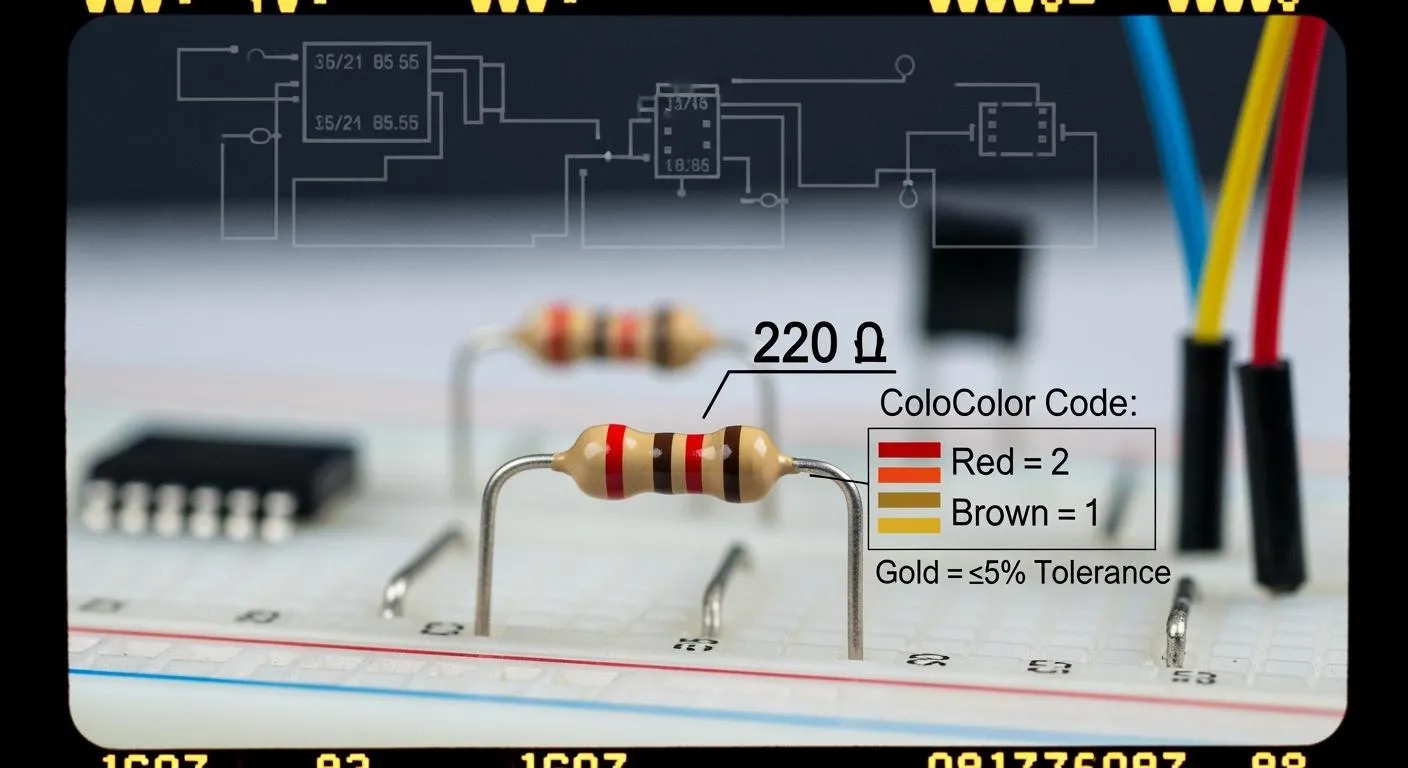
The 4-band and 5-band resistor color codes follow the internationally standardized resistor color coding defined by IEC 60062.
You will often see the 220 ohm resistor colour code as Red, Red, Brown, Gold in the 4-band format, and Red, Red, Black, Black, Gold in the 5-band format. A 220 ohm resistor controls the amount of current that flows through a circuit. You rely on the 220 ohm resistor colour code to select the correct resistor for your project. This prevents mistakes like misinterpreting colors or missing the tolerance band, which can cause circuit problems. You use a 220 ohm resistor to limit current for LEDs, divide voltage, or protect sensitive electronic parts.
Key Takeaways
- The 220 ohm resistor color code is Red, Red, Brown, Gold for 4-band resistors and Red, Red, Black, Black, Gold for 5-band resistors.
- A 220 ohm resistor limits current, protects LEDs, divides voltage, and safeguards sensitive components in circuits.
- The gold band on a resistor indicates a ±5% tolerance, meaning the actual resistance can range from 209Ω to 231Ω.
- You can verify a resistor's value using a digital multimeter, ensuring it matches the expected range for reliable circuit performance.
- Choose the right resistor by considering wattage, tolerance, and package type to ensure safety and compatibility with your project.
220 Ohm Resistor Color Code

Understanding the 220 ohm resistor color code helps you select the right resistor for your circuit. The color bands on a resistor follow the IEC 60062 standard. This system ensures you can identify resistor values quickly and accurately. You will see two main types: the 4 band resistor and the 5 band resistor. Each uses a different pattern to show the value and tolerance.
4-Band Color Code
You will often find the 220 ohm resistor in the 4-band format. The color bands appear in this order: red, red, brown, and gold. Each color represents a number or a multiplier. The first two bands show the significant digits. The third band is the multiplier. The fourth band shows the tolerance.
Here is a quick reference table for the 4-band color code:
| Band Position | Color | Value | Multiplier | Tolerance |
|---|---|---|---|---|
| 1st | Red | 2 | ||
| 2nd | Red | 2 | ||
| 3rd | Brown | 10 | ||
| 4th | Gold | ±5% |
To read a 220 ohm resistor in this format, start with the first band. Red means 2. The second band is also red, so you get another 2. The third band is brown, which means you multiply by 10. The gold band at the end shows the tolerance.
The fourth band, gold, indicates the tolerance. It represents a tolerance of ±5%. This means the actual resistance value of this resistor is acceptable within the range of 209Ω (220 - 5%) to 231Ω (220 + 5%).
5-Band Color Code
Some resistors use a 5-band color code for higher precision. The 5 band resistor for 220 ohms uses the colors red, red, black, black, and gold. The first three bands give you the significant digits. The fourth band is the multiplier. The fifth band shows the tolerance.
Here is a comparison of the 4-band and 5-band color codes for a 220 ohm resistor:
| Band | 5-Band Resistor | 4-Band Resistor |
|---|---|---|
| 1st | Red (2) | Red (2) |
| 2nd | Red (2) | Red (2) |
| 3rd | Black (0) | Brown (×10) |
| 4th | Black (×1) | Gold (±5%) |
| 5th | Gold (±5%) | N/A |
You read the 5-band code by combining the first three digits: 2, 2, and 0. The fourth band, black, means you multiply by 1. The gold band at the end shows a tolerance of ±5%. This format gives you a more precise value because it uses three significant digits.
| Resistor Type | Significant Digits | Tolerance Band | Accuracy Level |
|---|---|---|---|
| 4-band | 2 | Yes | Standard |
| 5-band | 3 | Yes | Higher Precision |
Tolerance and Gold Band
The gold band plays a key role in both formats. It tells you how much the actual resistance can vary from the stated value. For a 220 ohm resistor, the gold band means a tolerance of ±5%. This range allows for small differences in manufacturing. You can trust that a resistor with a gold band will stay close to its labeled value.
The gold band indicates a tolerance of ±5%. This means your 220 ohm resistor can measure anywhere from 209 ohms to 231 ohms and still meet the standard.
Quick Reference Chart
You can use this chart to identify a 220 ohm resistor quickly:
| Format | Color Sequence | Value Calculation | Tolerance |
|---|---|---|---|
| 4-band | Red, Red, Brown, Gold | 22 × 10 = 220Ω | ±5% |
| 5-band | Red, Red, Black, Black, Gold | 220 × 1 = 220Ω | ±5% |
- For a 4-band resistor, the color sequence is red, red, brown, and gold.
- For a 5-band resistor, the sequence is red, red, black, black, and gold.
- The gold band indicates a tolerance of ±5%.
The IEC 60062 standard guides all resistor color coding. This standard helps you avoid mistakes and ensures you use the correct resistor in your projects. When you understand the 220 ohm resistor colour code, you can work confidently with any circuit.
Reading and Identifying 220 Ohm Resistors

Color Band Reading Steps
You can identify a 220 ohm resistor by reading its color bands. Follow these steps to decode the resistor color code:
- Hold the resistor so the tolerance band (usually gold) is on the right.
- Read the bands from left to right.
- Write down the numbers for each color:
- Red = 2
- Red = 2
- Brown = multiplier of 10
- Gold = tolerance of ±5%
- Multiply the first two digits by the multiplier. For a 220 ohm resistor, you get 22 × 10 = 220 ohms.
- Check the gold band to confirm the tolerance.
Tip: Use a resistor color code chart for quick reference. This helps you avoid mistakes when identifying resistors.
SMD Markings
Surface-mount resistors use numbers instead of color bands. You often see three-digit or four-digit codes printed on the resistor body. For a 220 ohm resistor, the marking is usually "221".
- The first two digits show the significant numbers.
- The third digit tells you how many zeros to add.
- "221" means 22 followed by one zero, which equals 220 ohms.
| SMD Code | Value |
|---|---|
| 221 | 220Ω |
Note: SMD resistors are small. Use a magnifying glass to read the markings clearly.
Common Identification Tips
You can avoid errors by following these practical tips:
- Always check the resistor under good lighting.
- Compare the color bands with a chart before soldering.
- Use a multimeter to verify the value if you feel unsure.
- Store resistors in labeled containers to prevent mix-ups.
- Handle SMD resistors with tweezers to avoid damaging them.
You will find that careful identification prevents circuit problems and ensures your project works as expected. The 220 ohm resistor colour code helps you select the right resistor every time.
Verifying 220 Ohm Resistor Value
Multimeter Testing
You can check the value of a 220 ohm resistor using a digital multimeter. This tool helps you confirm that the resistor matches the expected value. Follow these steps to test your resistor:
- Turn off power to the circuit before removing the resistor.
- Set your multimeter to the resistance (Ω) mode.
- Connect the two probes to each end of the resistor.
- Read the value displayed on the screen.
If you see a value close to 220 ohms, your resistor works as expected. The reading may not be exactly 220 ohms because of the tolerance. For a resistor with a gold band, the value can range from 209 ohms to 231 ohms. You can use this method for both through-hole and SMD resistors. Always compare your reading with the value you calculated from the 220 ohm resistor colour code.
Tip: Hold the probes steady to get an accurate reading. Make sure your fingers do not touch both probes at the same time, as this can affect the measurement.
Troubleshooting Errors
Sometimes, your multimeter may show a value that does not match the expected range. Here are some common reasons and solutions:
- Dirty or corroded leads: Clean the resistor leads before testing.
- Incorrect multimeter setting: Double-check that you set the multimeter to the correct resistance range.
- Parallel paths in circuit: Remove the resistor from the circuit to avoid false readings from other components.
- Damaged resistor: If the value is far from 220 ohms, the resistor may be faulty. Replace it with a new one.
| Problem | Possible Cause | Solution |
|---|---|---|
| Reading too high/low | Damaged resistor | Replace resistor |
| No reading (infinite Ω) | Broken resistor | Use a new resistor |
| Fluctuating reading | Poor contact | Check probe connections |
You can avoid most errors by following these steps. Always verify the value of a 220 ohm resistor before using it in your project. This practice helps you prevent circuit failures and ensures your design works as planned.
Applications of 220 Ohm Resistors
You will find the applications of 220 ohm resistors in many electronic circuits. These resistors play a key role in protecting components, dividing voltages, and controlling current. You can use them in both simple and advanced designs. Below, you will learn how to use a 220 ohm resistor for LED protection, voltage dividers, and current limiting.
LED Protection
You often use a 220 ohm resistor as a current limiting resistor in LED circuits. LEDs need protection from high current. If you connect an LED directly to a power source, it can burn out quickly. The resistor limits the current, keeping the LED safe and bright.
- You can build a basic LED circuit with a power source, an LED, and a resistor in series.
- The resistor absorbs excess voltage and prevents the LED from overheating.
- In automotive circuits, you may see the resistor in parallel with the LED. This setup helps prevent hyper-flashing in turn signals by mimicking the power draw of traditional bulbs.
Tip: Always calculate the correct resistor value for your LED. For a 5V supply and a red LED (forward voltage ~2V, desired current 14mA), you can use a 220 ohm resistor.
Simple LED Circuit Example:
+5V ----[220Ω resistor]----|>|---- GND
                (LED)
This circuit keeps the LED safe and extends its lifespan. You can use this method in indicator lights, displays, and signal circuits.
Voltage Dividers
You can use a 220 ohm resistor in voltage divider circuits. A voltage divider lets you create a lower voltage from a higher one. This is useful when you need to power a sensor or provide a reference voltage to another part of your circuit.
- Combine the 220 ohm resistor with another resistor in series.
- Connect the two resistors between the supply voltage and ground.
- Take the output voltage from the point between the two resistors.
Note: This method works well for general use, but not for high-precision needs.
Voltage Divider Example:
Suppose you have a 5V supply and you want about 2V output. You can use a 220 ohm resistor and a 330 ohm resistor.
+5V ----[220Ω]----+----[330Ω]---- GND
                  |
               Output (~2V)
You can use this setup to power analog sensors, set reference voltages for comparators, or adjust signal levels.
Current Limiting
A current limiting resistor is essential in many circuits. You use a 220 ohm resistor to control the flow of current and protect sensitive components.
- In a basic LED circuit, the resistor limits current to the LED.
- In transistor circuits, you can use the resistor to set the base current. This controls the operation of the transistor and prevents damage.
- You can also use the resistor to protect integrated circuits and microcontrollers from excess current.
Current Limiting Example:
Microcontroller Output ----[220Ω resistor]---- Device (LED, transistor base, etc.)
This setup ensures that the connected device receives only the safe amount of current. You can prevent circuit failures and extend the life of your components.
Always check the power rating and voltage rating of your resistor. Make sure the resistor can handle the expected power without overheating. For best results, use a resistor rated for at least double the expected power.
| Safety Consideration | Description |
|---|---|
| Power Rating | Choose a resistor that can handle the power without overheating. |
| Voltage Rating | Make sure the resistor's voltage rating fits your application. |
| Safety Margin | Use a resistor with extra capacity for better reliability. |
| Temperature Coefficient | Know how resistance changes with temperature. |
| Voltage Coefficient | Be aware of resistance changes with voltage, especially in sensitive circuits. |
About Nova Technology Company (HK) Limited
Nova Technology Company (HK) Limited stands as a HiSilicon-designated solutions partner in the integrated circuit industry. You can rely on Nova for professional chip-level solutions, advanced system integration, and support for a wide range of semiconductor applications. Nova’s expertise covers everything from circuit protection using resistors to complex IC design and implementation. When you need reliable partners for your next electronic project, Nova Technology Company (HK) Limited delivers industry-leading support and innovation.
Choosing the Right 220 Ohm Resistor
Selecting the right 220 ohm resistor for your project ensures your circuit works safely and reliably. You need to consider wattage, tolerance, and package type. Each factor affects how the resistor performs in your application.
Wattage Selection
You must choose a resistor with the correct power rating. The wattage tells you how much power the resistor can handle before it overheats or fails. If you select a resistor with too low a wattage, it may burn out and damage other parts of your circuit.
- The power rating of a resistor is the maximum power it can safely dissipate.
- Calculate the actual power in your circuit using P = I² × R or P = V² / R.
- Pick a resistor with a power rating higher than your calculated value for safety.
Common wattage ratings include 1/4 watt for low-power circuits and 1/2 watt or 1 watt for higher power needs. Always provide a safety margin to prevent overheating. If you use a 220 ohm resistor in a circuit with high current or voltage, select a higher wattage to avoid failure.
If you choose the wrong wattage, the resistor can overheat and fail, which may harm other components.
Tolerance Considerations
Tolerance shows how much the actual resistance can vary from the labeled value. For most projects, a 220 ohm resistor with ±5% tolerance works well and keeps costs low. If your circuit needs precise values, use a resistor with ±1% tolerance.
- ±5% tolerance: Good for general electronics and hobby projects.
- ±1% tolerance: Best for precision circuits and measurement devices.
Think about your accuracy needs before you choose the resistor. For most LED circuits or voltage dividers, standard tolerance is enough.
Package Types
You can find 220 ohm resistors in different package types. The package affects how you mount the resistor and how much space it takes on your board.
| Package Type | Description | Applications |
|---|---|---|
| Axial | Two leads extend from each end. Used in through-hole circuits and breadboards. | Breadboard soldering, manual installation. |
| SMD | Small chips with no long leads. Mounted directly on the board. Sizes include 0805, 0603, 0402. | High-density boards, automated assembly. |
Choose axial resistors for DIY and prototyping. Use SMD resistors for compact, professional designs.
For harsh environments, select metal film or metal oxide resistors. These types resist heat and moisture better than standard carbon film resistors.
When you design advanced circuits or need chip-level solutions, you can rely on Nova Technology Company (HK) Limited. As a HiSilicon-designated solutions partner, Nova provides professional support in semiconductor system integration and IC applications. Nova’s expertise covers everything from selecting the right resistor to full system design for demanding electronic projects.
You gain confidence in electronics when you understand the 220 ohm resistor color code. This skill helps you identify resistor values and select the right component for your circuit. Accurate identification prevents mistakes and protects your devices.
- You use resistors to limit current, set voltage levels, and improve signal quality.
- Practice reading resistor color codes and try interactive tools to build your skills.
Keep learning about resistor applications. Each project helps you become a better circuit designer.
FAQ
What do the colors on a 220 ohm resistor mean?
You see colored bands that show the resistor’s value and tolerance. For 220 ohms, red-red-brown-gold (4-band) or red-red-black-black-gold (5-band) are common. Each color stands for a number or multiplier.
Can I use a 220 ohm resistor for any LED?
You can use a 220 ohm resistor for most standard LEDs with 5V supplies. Always check the LED’s voltage and current needs. Calculate the resistor value using Ohm’s Law to avoid burning out the LED.
How do I check if my resistor is really 220 ohms?
You use a digital multimeter. Set it to resistance mode, touch the probes to each end, and read the value. A 220 ohm resistor should show a value between 209Ω and 231Ω if it has a gold band.
What happens if I use the wrong resistor value?
If you use a resistor with too low a value, you risk damaging components from too much current. If the value is too high, your circuit may not work as expected. Always double-check the color code.
Are SMD resistors marked differently than through-hole resistors?
Yes. SMD resistors use numbers like “221” instead of color bands. “221” means 220 ohms. You read the first two digits, then add the number of zeros shown by the third digit.