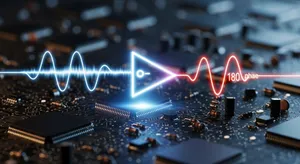
Amazon Unveils First Quantum Chip ‘Ocelot’, Reduces Quantum Error Correction Costs by 90%
Amazon Web Services (AWS) has officially introduced its first quantum chip prototype, Ocelot, marking a significant milestone in quantum computing. This breakthrough aims to test AWS’s novel quantum error correction (QEC) architecture, which reduces error correction costs by up to 90% compared to conventional methods.
Amazon Web Services (AWS) has officially introduced its first quantum chip prototype, Ocelot, marking a significant milestone in quantum computing. This breakthrough aims to test AWS’s novel quantum error correction (QEC) architecture, which reduces error correction costs by up to 90% compared to conventional methods.
Developed at the AWS Center for Quantum Computing at Caltech, Ocelot is a major step towards building a fault-tolerant quantum computer, a technology that could revolutionize problem-solving in scientific and commercial applications beyond the capabilities of traditional computers.
Tackling One of Quantum Computing’s Biggest Challenges
Quantum computing has long been hindered by its extreme sensitivity to environmental disturbances. Even the smallest vibrations, heat fluctuations, electromagnetic interference from Wi-Fi signals, or cosmic radiation can disrupt quantum states, leading to computational errors.
To mitigate these errors, quantum computers rely on quantum error correction (QEC), which encodes quantum information across multiple qubits to protect it from noise. However, traditional QEC methods are highly resource-intensive, significantly driving up the cost and complexity of quantum computing.
AWS’s Ocelot tackles this challenge through a revolutionary error-correction-first architecture, integrating cat qubits—a special type of qubit named after the famous Schrödinger’s cat paradox. These cat qubits are designed to naturally suppress certain types of errors, significantly reducing the overhead required for error correction.
Ocelot: A Scalable and Cost-Effective Quantum Chip
The Ocelot quantum chip brings a scalable design to the industry:
First successful integration of cat qubits with other QEC components on a manufacturable silicon microchip.
Compact design: The chip is just 1 cm² in size.
Uses superconducting materials, with circuits made from tantalum (Ta).
AWS scientists developed a novel process to enhance tantalum performance in silicon-based quantum chips.
By leveraging the advanced fabrication techniques of the semiconductor industry, AWS is bringing quantum computing closer to real-world deployment.
The Road to Fault-Tolerant Quantum Computing
AWS’s Oskar Painter, head of quantum hardware, emphasized the transformative impact of this innovation:
"With recent quantum research advances, the question is no longer ‘if’ we will achieve fault-tolerant quantum computing, but ‘when’. Ocelot is a crucial step toward this goal. Future quantum chips built on Ocelot’s architecture will drastically reduce error correction resources, cutting costs to just one-fifth of today’s levels. We believe this will accelerate the arrival of practical quantum computing—potentially by five years."
AWS’s commitment to quantum research positions Ocelot as a game-changing innovation in the race to develop scalable, reliable, and commercially viable quantum computers.
Key Takeaways
Amazon’s first quantum chip prototype, Ocelot, aims to revolutionize quantum computing.
Uses cat qubits for error suppression, drastically reducing quantum error correction costs.
1 cm² chip integrates superconducting circuits using tantalum for enhanced performance.
Could accelerate the arrival of fault-tolerant quantum computing by up to 5 years.
As the quantum computing race intensifies, Amazon’s latest breakthrough signals a major leap toward the next era of computational power.