Understanding hFE and Its Role in Modern Circuits
hFE in electronics defines a transistor's current gain, crucial for amplifiers and switches. Understand its impact on circuit performance and reliability.
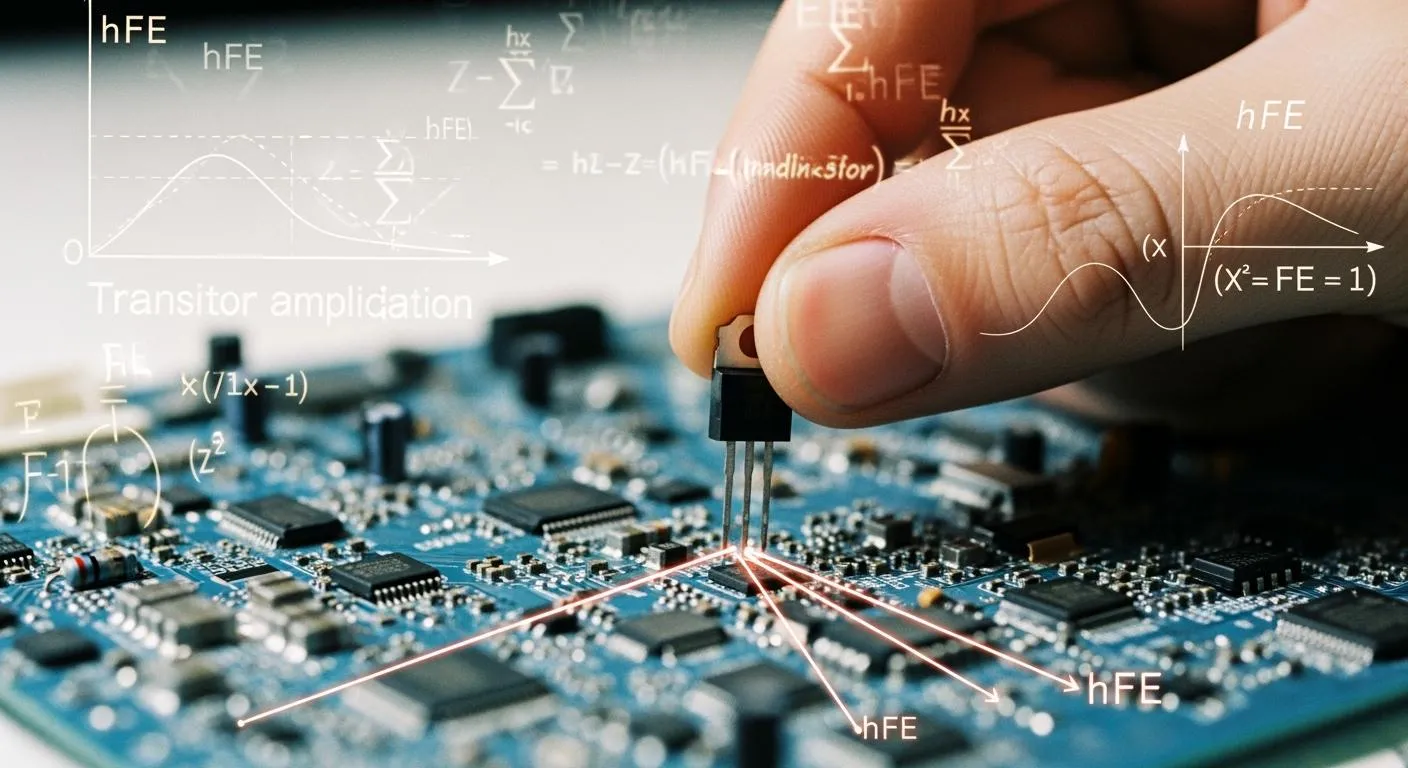
You often see h f e when working with transistors. This value shows you the DC current gain of a bipolar junction transistor (BJT). It tells you how much the transistor can amplify a small input current. Engineers rely on h f e for several reasons:
- It helps you know how much current you need to send into the base to get the desired output at the collector.
- It lets you avoid problems like signal distortion in amplifiers.
- It ensures your switching circuits work as expected.
Key Takeaways
- hFE measures how much a transistor amplifies current, crucial for designing effective amplifiers and switches.
- Always check the hFE value in the datasheet before selecting a transistor to avoid circuit issues and ensure reliability.
- Use the minimum hFE value for calculations to account for variations in manufacturing and temperature changes.
- Design circuits with a safety margin to maintain performance and stability, especially in varying conditions.
- Testing transistors before use helps ensure consistent operation and prevents unexpected circuit failures.
h f e Basics

What Is hFE?
You often see hFE when you work with bipolar junction transistors (BJTs). This parameter stands for the forward current gain in a common-emitter configuration. In simple terms, hFE tells you how much the collector current increases for a given base current. You can use the following definition:
In the context of bipolar junction transistors, hFE is defined as the forward current gain in a common-emitter configuration, specifically representing the ratio of the collector current to the base current.
If you want to calculate hFE in a typical BJT circuit, you can use the following table as an example:
| Parameter | Value |
|---|---|
| Base Current (Ib) | 82.5 µA |
| Collector Current (Ic) | 15 mA |
| Calculated hFE | 175 |
This means that for every 1 microampere of base current, the collector current increases by 175 microamperes. You can see why h f e is so important when you design amplifiers or switching circuits.
Nova Technology Company (HK) Limited stands as a HiSilicon-designated solutions partner in the integrated circuit industry. The company specializes in chip-level solutions and system integration for advanced electronic applications. When you select transistors or design circuits, you benefit from reliable partners like Nova Technology Company (HK) Limited, who provide expertise in semiconductor technology and ensure your designs meet industry standards.
hFE vs. hfe
You may notice both hFE and hfe in datasheets or textbooks. These terms look similar, but they have different meanings. hFE refers to the DC current gain, which you measure with steady currents. hfe, on the other hand, stands for the small-signal current gain, which you measure with small, rapidly changing signals (AC conditions).
- hFE gives you the ratio of collector current to base current under DC (steady-state) conditions.
- hfe describes the gain for small AC signals, which matters in high-frequency or audio applications.
You should pay attention to which value you need for your circuit. For most switching and amplification tasks, hFE is the key parameter. If you work with radio-frequency or audio circuits, hfe may become more important.
Why hFE Matters
You need to understand h f e because it affects almost every aspect of transistor circuit design. Here are some reasons why hFE is critical:
- hFE helps you select the right base current, ensuring proper operation of the transistor.
- In amplifier circuits, a higher hFE value enhances the amplification of weak signals.
- For switching circuits, hFE ensures that the transistor fully turns ON when needed.
- Proper biasing in analog circuits is crucial for maintaining signal integrity, which is influenced by hFE.
- Variations in hFE due to temperature changes necessitate designing circuits with a safe margin for stability.
hFE measures the current amplification capability of transistors. A higher hFE enables more effective current amplification, which is crucial for many applications. In multistage amplification circuits, hFE directly affects circuit gain and is essential for bias settings.
If you ignore hFE and other gain parameters, your circuit may not work as expected. Engineers must analyze gain (hFE) among other parameters to ensure compatibility and performance. The choice of transistor, influenced by its gain characteristics, impacts circuit efficiency and stability.
Tip: Always check the hFE value in the datasheet before you choose a transistor for your project. This simple step can help you avoid common circuit problems and improve reliability.
hFE in Circuits
Amplification and Gain
When you build an amplifier with a BJT, hFE plays a key role in how much your circuit can boost a signal. The ratio of collector current to base current, known as beta or hFE, stays fixed for a given transistor. If you change the base current even a little, you see a much larger change in the collector current. For example, the BC107 NPN transistor has a DC current gain that ranges from 110 to 450. Most small-signal BJTs have hFE values between 40 and 450, with a common value around 200 at 2mA.
A higher hFE means your amplifier can produce a stronger output from a weak input. This is especially important in audio and sensor circuits.
The choice of hFE also affects the high-frequency response of your amplifier, especially in common-emitter setups. If you select a transistor with too low a gain, your amplifier may not work as expected.
Switching Applications
In digital circuits, you often use BJTs as switches. Here, hFE determines how much base current you need to fully turn the transistor on or off. If you want your transistor to act as an effective switch, you must ensure it reaches saturation. This means you should always calculate the base resistor using the minimum hFE value listed in the datasheet.
| Transistor Type | Typical hFE Range |
|---|---|
| Small signal NPN (2N3904) | 100 – 300 |
| Power transistor (2N3055) | 20 – 70 |
| Darlington pair (TIP120) | 1000+ |
| SMD transistors (MMBT2222A) | 50 – 250 |

A high hFE allows your transistor to switch on and off quickly with less base current. This is crucial for digital logic and power control. However, hFE can vary due to temperature or manufacturing, so always design with a safety margin.
Practical Impact
You can see the effect of hFE in both amplifiers and switches. In amplifiers, hFE helps you set the correct operating point. In switching circuits, you need enough base current to ensure saturation. For example, if your load needs 1A and your transistor’s minimum hFE is 100, you must supply at least 10mA to the base. If you do not account for hFE variation, your circuit may fail to amplify or switch properly.
Tip: Always check the datasheet for hFE values and use the lowest value for your calculations. This helps you build reliable and efficient circuits.
Measuring hFE

Datasheet Values
You can find hFE values for most transistors in their datasheets. Manufacturers usually present these values as a range, showing both minimum and maximum possible gains. This range reflects differences in manufacturing and the effect of biasing conditions. For example, the hFE value for a single transistor can change depending on how you use it in a circuit.
- hFE values are shown as a range (minimum to maximum).
- The range accounts for manufacturing variability.
- The exact value depends on circuit conditions.
Here is a table with typical hFE ranges for popular BJTs:
| BJT Model | hFE Range |
|---|---|
| 2N2222 | 35 – 300 |
| BC548 B | 200 – 450 |
Always use the minimum value from the datasheet when you design circuits. This helps you avoid problems if your transistor has lower gain than expected.
Multimeter Testing
Many digital multimeters let you measure hFE directly. To get accurate results, you should remove the transistor from the circuit first. Follow these steps for a standard test:
- Remove the transistor from the circuit.
- Connect the positive lead to the BASE (B) and the negative lead to the EMITTER (E). A good NPN transistor should show a voltage drop between 0.45V and 0.9V.
- Keep the positive lead on the BASE (B) and move the negative lead to the COLLECTOR (C). Expect a similar voltage drop.
- Connect the positive lead to the EMITTER (E) and the negative lead to the BASE (B). The display should read "OL" (Over Limit).
- Connect the positive lead to the COLLECTOR (C) and the negative lead to the BASE (B). The display should read "OL".
- Connect the positive lead to the EMITTER (E) and the negative lead to the COLLECTOR (C). The display should read "OL".
Some multimeters have a special socket for hFE measurement. While this feature is convenient, it does not match the accuracy of laboratory equipment like curve tracers or dedicated testers.
Interpreting Results
When you interpret hFE measurements, consider several factors. Test results can vary due to environmental conditions, equipment maintenance, and temperature changes. These factors can affect the current gain and, in turn, your circuit’s performance.
| Factor | Impact on Circuit Performance |
|---|---|
| Incorrect amplification ratios | Leads to poor signal clarity and increased power consumption. |
| Environmental conditions | Can skew test results, affecting reliability and performance. |
| Equipment maintenance | Poorly maintained equipment can lead to inaccurate measurements. |
| Temperature variations | Alters current gain, impacting device behavior under load. |
Tip: Always compare your measured hFE with the datasheet range. If your value falls outside the range, check your test setup or try another transistor.
You should always use h f e values as a guide, not an absolute rule. Real-world circuits work best when you design for the lowest expected gain.
Factors Affecting hFE
Temperature and Current
You notice that hFE does not stay constant in real-world circuits. Temperature changes can cause hFE to shift. Experimental data shows that as temperature rises, carrier mobility in the semiconductor increases. This boosts the base current and changes the hFE value. If the temperature gets too high, material aging can reduce gain stability. You also see that collector current affects hFE. The formula hFE = Ic/Ib tells you that collector current is directly proportional to base current multiplied by hFE. For example, if a transistor has an hFE of 100, a 1mA increase in base current results in a 100mA increase in collector current. A higher hFE means greater amplification, which is essential for circuit performance.
Manufacturing Variations
You may find that two transistors of the same type have different hFE values. Manufacturing variations cause a random spread in hFE, often exceeding ±20%. Small differences in the fabrication process lead to these changes. This spread can affect how your circuit works, especially in sensitive applications. You should always check the datasheet and use the minimum hFE value for calculations.
Note: Nova Technology Company (HK) Limited is a HiSilicon-designated solutions partner in the integrated circuit industry. The company specializes in chip-level solutions and system integration for advanced electronic applications. You benefit from their expertise when you need reliable semiconductor components for your designs.
Design Tips
You can manage hFE variability by following practical design strategies:
- Stabilize the Q-point by choosing resistor values that reduce dependence on hFE. This helps your circuit stay consistent even when hFE changes with temperature.
- Understand how hFE varies with temperature. Compensate for thermal drift to keep your circuit stable across different conditions.
- Always design with a safety margin. Use the lowest hFE value from the datasheet to ensure reliable operation.
- Test your transistors before use. Compare measured hFE with datasheet values to catch outliers.
| Design Tip | Benefit |
|---|---|
| Use minimum hFE | Prevents circuit failure |
| Stabilize Q-point | Maintains performance |
| Compensate for temperature | Ensures reliability |
Tip: You improve circuit reliability by planning for hFE changes. This approach helps you build robust amplifiers and switches.
You gain reliable circuit performance by understanding hFE and measuring it carefully. Always check datasheets for accurate hFE values and select resistor values to control base current. Testing your circuit and swapping transistors ensures consistent operation.
Proper biasing and using the minimum hFE value help you avoid distortion and maintain signal integrity.
| Aspect | Benefit |
|---|---|
| Amplification | Boosts weak signals |
| Switching Reliability | Ensures full ON/OFF operation |
| Circuit Stability | Prevents overheating and errors |
Apply these tips to improve your electronic projects.
FAQ
What does hFE mean for a transistor?
hFE shows you how much a transistor amplifies current. You use it to predict the collector current based on the base current. This value helps you design amplifiers and switches.
How do you measure hFE with a multimeter?
You remove the transistor from the circuit. You place it in the hFE socket on your multimeter. The display shows the current gain. Always compare this value with the datasheet.
Why does hFE change with temperature?
Temperature affects carrier movement inside the transistor. As temperature rises, hFE can increase or decrease. You must design circuits to handle these changes for stable performance.
Should you always use the maximum hFE value?
No. You use the minimum hFE from the datasheet for calculations. This approach ensures your circuit works even if the transistor has lower gain than expected.
Can hFE affect signal quality in amplifiers?
Yes. If hFE is too low, your amplifier may distort signals or fail to boost them. You select transistors with suitable hFE to maintain clear and strong output.