How UPS Technology Evolved Through the Decades
Our world depends on constant electricity. A sudden power outage can stop everything. An uninterruptible power supply, or UP

Our world depends on constant electricity. A sudden power outage can stop everything. An uninterruptible power supply, or UPS, offers crucial backup power. This device ensures power reliability during power disruptions. The history of uninterruptible power supply shows its importance. The market for UPS technology is growing significantly.
| Attribute | Statistics |
|---|---|
| Market Size in 2024 | USD 8.51 Billion |
| Market Forecast in 2033 | USD 12.74 Billion |
| Market Growth Rate (2025-2033) | 4.35% |
A UPS acts as a silent guardian. It provides immediate protection against a power failure. This backup ensures reliability when power outages occur.
Key Takeaways
- Early UPS systems used big machines with spinning parts to store power.
- Modern UPS systems use electronic parts, making them smaller and quieter.
- The rise of computers made UPS devices important for homes and businesses.
- Today's UPS systems use smart batteries and connect to the internet.
- New UPS devices are more energy-efficient and help save power.
The Early History of Uninterruptible Power Supply (1930s-1960s)
The history of uninterruptible power supply begins long before the personal computer. Early concepts focused on keeping essential services running without any break in power. These foundational ideas paved the way for the advanced UPS technology we use today.
Foundational Patents and Concepts
The journey of the modern uninterruptible power supply started with a key invention. In 1934, John J. Hanley filed a patent for an "Apparatus for Maintaining an Unfailing and Uninterrupted Supply of Electrical Energy." His design was revolutionary for its time. The system could automatically switch to a battery backup if the main power failed. Once normal power returned, the system would recharge the battery.
Hanley's patent also included a clever feature: an audible warning signal. This alarm would alert operators that the commercial power circuit had failed, a basic but crucial element of early power monitoring.
The patent's diagram, known as 'Figure 5,' provided the first visual blueprint for what would become the UPS. This concept of an automatic switch to a temporary power source was the core idea that future UPS systems would build upon.
The Mechanical Flywheel Era
Before solid-state electronics, engineers used massive mechanical devices to provide backup power. These early UPS systems were known as rotary converters or motor-generator sets. They worked by using a motor to spin a heavy flywheel. This spinning motion stored kinetic energy. If the main power cut out, the flywheel's momentum would keep a generator turning, producing electricity for a short time.
These mechanical units were impressive feats of engineering but had significant downsides. They were enormous, noisy, and required constant maintenance. Their low efficiency meant a lot of energy was lost as heat. Because of their size and cost, their use was limited to critical applications. Telecommunications centers and other vital infrastructure relied on these machines to prevent service disruptions.
| Mechanical UPS | Characteristics |
|---|---|
| Pros | Provided a true "no-break" power transition. |
| Cons | Very large, low efficiency, noisy, and high maintenance. |
These early solutions highlight the long-standing need for a reliable backup, setting the stage for the next evolution in the history of uninterruptible power supply.
The Rise of the Static UPS (1970s-1980s)
The 1970s marked a major turning point in the history of uninterruptible power supply. The noisy, inefficient mechanical flywheels gave way to a new generation of devices. These new systems were smaller, quieter, and more reliable thanks to major breakthroughs in electronics. This era introduced the static uninterruptible power supply, laying the groundwork for modern UPS technology.
The Shift to Solid-State Electronics
The invention of solid-state components like the thyristor changed everything. Engineers could now replace large moving parts with silent, fast-acting electronic circuits. A static UPS uses these electronics to manage power flow and switch to backup batteries instantly. This shift made the UPS a more practical power protection device for a wider range of applications beyond just massive industrial sites. The delivery of the first thyristor-based static UPS was a key milestone.
| Year | Advancement |
|---|---|
| 1969 | Delivery of a static type UPS (thyristor inverter type) |
These new systems used rechargeable batteries for backup power. The solid-state design was far more efficient and required much less maintenance than its mechanical predecessors. This innovation made reliable backup accessible to more businesses.
The Birth of Modern Topologies
This new electronic foundation allowed engineers to design different types of UPS systems. Three core designs, or topologies, emerged during this period. Each offers a different level of protection. Understanding these types of UPS is key to choosing the right backup solution.
The three main topologies—Offline, Line-Interactive, and Online—became the industry standard. They remain the fundamental designs for nearly every UPS sold today.
- Offline/Standby UPS: This is the most basic type of UPS. It passes utility power directly to the equipment. During an outage, it quickly switches to its internal batteries. Its core circuit includes a transfer switch and a battery charger.
- Line-Interactive UPS: This UPS is a step up. It also switches to batteries during an outage but includes a transformer that corrects minor power fluctuations without using the batteries. This provides better protection.
- Online/Double-Conversion UPS: This is the most advanced of the three types of UPS. It constantly converts incoming AC power to DC to charge the batteries, then converts it back to clean AC power for the equipment. This process isolates the equipment from all power problems, offering the highest level of protection.
The Digital Boom and Mass Adoption (1990s-2000s)

The 1990s and 2000s saw technology explode into homes and businesses. The personal computer became a common tool. This digital revolution created a massive new market for power protection services. The uninterruptible power supply transitioned from a niche industrial device to an essential accessory for everyone. The reliability of a UPS became a key selling point.
The Mainstream Uninterruptible Power Supply
The rise of the personal computer drove the mass adoption of the UPS. A sudden power failure could erase hours of unsaved work. This risk made a backup solution necessary. Manufacturers responded by creating smaller, more affordable UPS units for desktops. These devices provided emergency backup power for sensitive devices in homes and small offices. The UPS offered peace of mind against unexpected power outages.
The goal was simple: give users enough backup power to save their work and shut down their computers safely. This basic protection prevented data loss and hardware damage.
The consumer-grade uninterruptible power supply became a common sight. Its presence ensured power reliability for millions of new computer users. The market for a personal UPS grew rapidly alongside PC sales.
Powering the First Data Centers
The internet boom created a different kind of power challenge. Companies built large data centers to host websites and manage corporate networks. These facilities required absolute reliability for their critical applications. A single moment of downtime could cost a business millions of dollars.
Large-scale UPS systems became the heart of these new data centers. They provided clean, consistent electricity around the clock. These powerful systems offered more than just a simple backup.
- They filtered electrical noise.
- They regulated voltage fluctuations.
- They delivered seamless backup power during any outage.
This level of protection was non-negotiable. The UPS guaranteed the continuous operation that the burgeoning digital economy demanded.
The Modern Smart UPS (2010s-Present)

The 2010s ushered in the era of the intelligent UPS. This period saw rapid innovation, transforming the UPS from a simple backup device into a smart, connected component of the IT infrastructure. These technological advancements focused on better batteries, smarter networking, and greater efficiency, enhancing power reliability for a new generation of technology.
Advanced Battery Technology
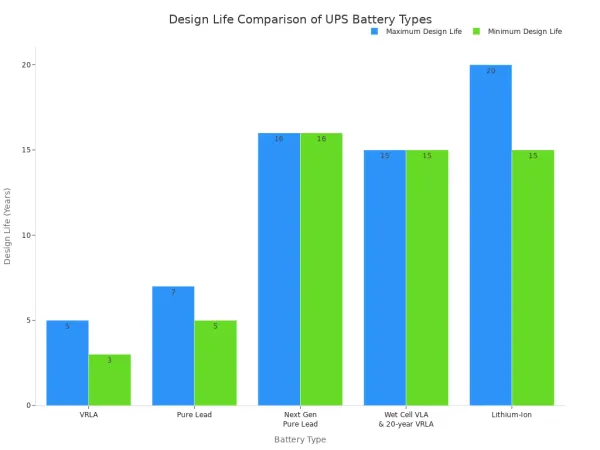
A major change in modern UPS technology is the shift in battery chemistry. Traditional lead-acid batteries are giving way to advanced Lithium-ion batteries. This change brings significant benefits for data centers and other critical environments. Lithium-ion batteries offer a much longer design life, often lasting the entire lifetime of the UPS itself.
A key advantage of Lithium-ion batteries is their smaller size and weight. They can reduce the physical footprint of a UPS system by 50-75% and are up to 70% lighter than their lead-acid counterparts. This provides greater flexibility in equipment placement.
The longer lifespan of these new batteries means fewer replacements, which improves reliability and reduces maintenance costs. This innovation in energy storage is a core part of modern UPS design.
Intelligent Network Connectivity
Modern UPS systems are now "smart" devices. They integrate with the Internet of Things (IoT) to provide a new level of control and insight. This connectivity allows for:
- Remote Monitoring: Operators can check UPS status from anywhere using cloud platforms or mobile apps.
- Predictive Maintenance: AI algorithms analyze performance data to predict potential failures before they happen, ensuring better power safety.
- Automated Shutdowns: An intelligent UPS can gracefully shut down connected servers during an extended outage to prevent data loss.
Companies like Nova Technology Company (HK) Limited, a HiSilicon-designated solutions partner, exemplify this trend by providing advanced solutions that leverage intelligent connectivity. This network integration is crucial for managing power in remote edge computing sites and large data centers, providing superior reliability and safety.
Efficiency and Sustainability
Recent UPS technology also focuses heavily on efficiency and sustainability. Modern transformerless designs have dramatically improved energy efficiency. Power losses have dropped from over 20% in older units to less than 3% in some new models. Many systems now feature an "ECO mode" that can achieve up to 99% efficiency by bypassing the main power conversion circuits when utility power is stable. This reduces energy consumption and cooling costs.
This focus on efficiency extends to sustainability. Green UPS systems can integrate with renewable energy sources like solar panels. During a power outage, a solar-integrated UPS can use the sun to recharge its batteries, providing a longer-lasting backup power source. This innovation makes the UPS a key part of a more resilient and eco-friendly energy strategy.
The history of uninterruptible power supply shows a clear evolution from huge mechanical flywheels to today's smart battery systems. This journey directly mirrors our society's growing dependence on constant, reliable electricity. The future of ups technology points toward an even more critical role in our infrastructure.
Future systems will manage high-density AI workloads and support massive edge computing power needs. They will also become bidirectional partners in the smart grid, feeding energy back to ensure stability for everyone. ⚡
FAQ
What is the main difference between UPS topologies?
The main difference is the level of protection. An Offline UPS offers basic backup. A Line-Interactive UPS corrects small power issues. An Online/Double-Conversion UPS completely isolates equipment from raw utility power, providing the highest level of protection against all power problems.
Why are Lithium-ion batteries becoming popular for UPS systems?
Lithium-ion batteries offer major advantages. They last much longer than traditional lead-acid batteries. They are also smaller and lighter, saving valuable space. This technology improves reliability and reduces the total cost of ownership over the UPS's lifetime.
What does a UPS protect against besides blackouts?
A UPS protects sensitive electronics from various power disturbances. These issues include:
- Power Surges: Sudden spikes in voltage.
- Voltage Sags: Short-term drops in voltage.
- Electrical Noise: Interference on the power line.
A quality UPS provides clean, stable power, which is essential for preventing hardware damage and data loss.
How does a modern UPS save energy?
Modern UPS systems have high-efficiency modes, often called ECO modes. These modes allow the unit to pass utility power directly to devices when the power is stable. This process can achieve up to 99% efficiency, significantly reducing electricity consumption and cooling costs. 💡