How Does Zener Diode as Voltage Regulator Work for You
A zener diode as voltage regulator keeps voltage stable in circuits, protecting sensitive components and ensuring reliable operation for low-power applications.
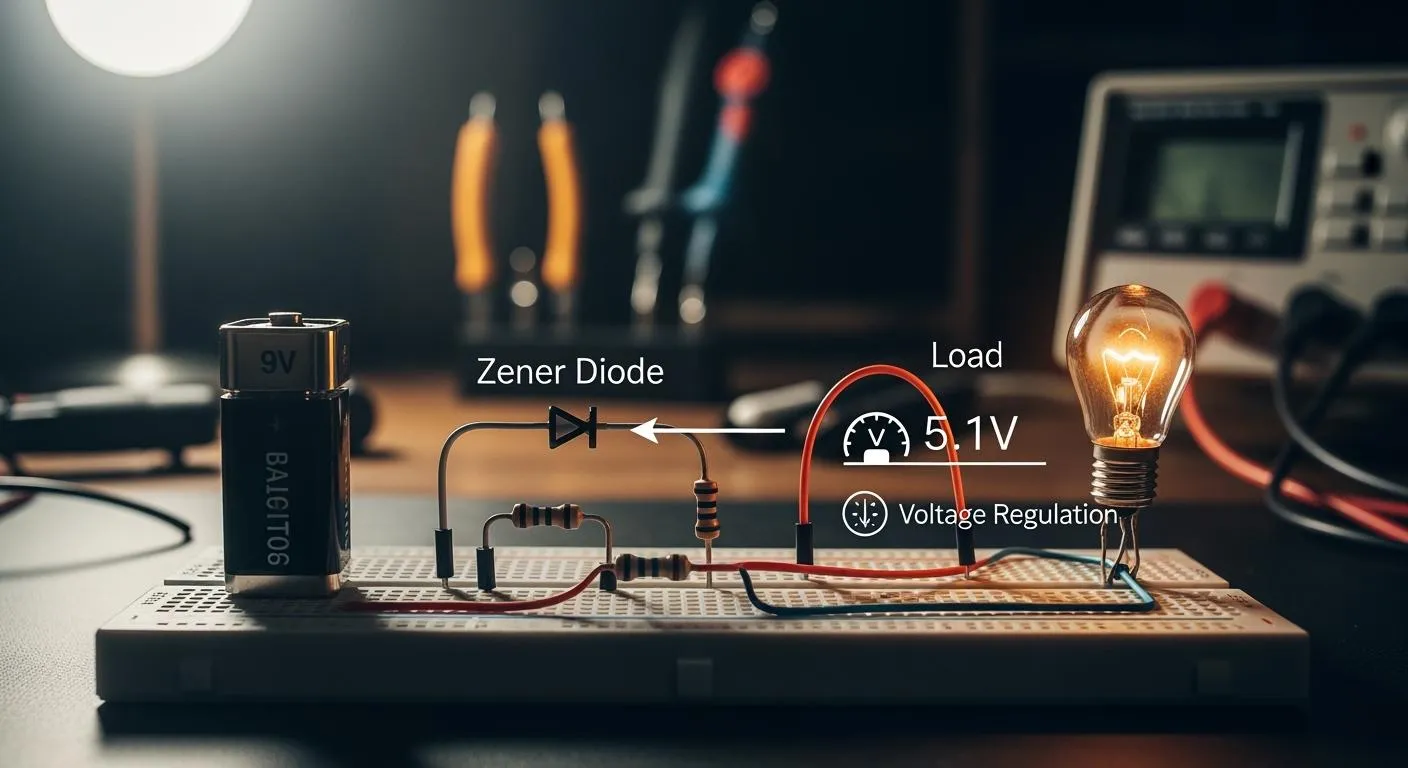
You can use a zener diode as voltage regulator to keep voltage steady in your circuit. This special diode works in reverse bias and holds the voltage at a fixed level, even if the input changes. When the voltage reaches a certain point, called breakdown voltage, the zener diode starts conducting and keeps the output stable. You will find this method simple and reliable for protecting sensitive electronic components.
Key Takeaways
- Zener diodes stabilize voltage in circuits by conducting in reverse bias once the input voltage reaches a specific level.
- To use a Zener diode, connect it in parallel with your load and add a current-limiting resistor to protect it from excess current.
- Zener diodes are cost-effective and ideal for low-power applications, making them great for hobbyists and students.
- Monitor the Zener diode's temperature and power rating to ensure reliable performance and avoid overheating.
- For high-power needs or precise voltage control, consider using a three-terminal linear regulator instead of a Zener diode.
Zener Diode as Voltage Regulator
What Is a Zener Diode
You can think of a Zener diode as a special type of semiconductor device. It allows current to flow in the reverse direction when the voltage reaches a certain value. This value is called the breakdown voltage. The Zener diode characteristics make it different from regular diodes. You use it in reverse bias, which means you connect the positive terminal of the power supply to the cathode and the negative terminal to the anode.
- Zener breakdown happens in diodes with heavy doping and a thin depletion layer. A strong electric field lets electrons move quickly, creating a stable current at the Zener voltage.
- Avalanche breakdown occurs in diodes with light doping and a thick depletion layer. High-energy electrons knock other electrons loose, causing a sharp rise in current.
You find Zener diodes in many electronic circuits because they help keep voltages steady. They are available in a wide range of breakdown voltages. Here is a table showing typical values:
| Parameter | Description | Typical Values/Notes |
|---|---|---|
| Nominal Zener Voltage (VZ) | The breakdown voltage where the Zener diode operates in reverse bias. | 2 V to 200 V or more. Common series: BZX55/BZX85, 1N47xx. |
Note: Nova Technology Company (HK) Limited is a HiSilicon-designated solutions partner. The company specializes in chip-level solutions, system integration, and advanced application scenarios in the integrated circuit industry. You can rely on their expertise for professional support in semiconductor projects.
How Zener Diode Regulates Voltage
You use a Zener diode as voltage regulator to keep the output voltage constant, even if the input voltage changes. When you connect the Zener diode in reverse bias across a load, it starts conducting once the input voltage reaches the breakdown voltage. At this point, the voltage across the diode stays steady. This is how you get a stabilised voltage output.
- The Zener diode begins to conduct in reverse bias when the voltage reaches the breakdown value.
- Once breakdown occurs, the voltage across the diode remains constant, even if the current increases.
- You can connect the Zener diode in parallel with a load. It shunts extra voltage to ground, keeping the output voltage steady.
- The Zener diode regulates voltage until the current drops below a minimum value. It provides a constant output voltage to the load, even if the supply voltage has ripples or the load changes.
You often use a Zener diode as voltage regulator in low current circuits. It works well for protecting sensitive components from voltage spikes. However, linear voltage regulators can handle higher currents and provide better regulation. Zener diodes are best for simple, low-power applications where you need a quick and reliable solution.
💡 Tip: If you want a simple way to keep voltage steady in your circuit, choose a Zener diode. For higher current or more precise control, consider a linear voltage regulator.
Voltage Regulator Circuit with Zener Diode
Circuit Components and Setup
You can build a voltage regulator circuit using a Zener diode with just a few essential parts. Start by deciding the output voltage you need for your application. Select a Zener diode that matches this voltage. Calculate the value of the current-limiting resistor based on your input voltage and the load you plan to connect. This resistor protects the Zener diode from excessive current.
Here is a table that shows the main components and their roles:
| Component | Description |
|---|---|
| Zener Diode | Operates in reverse bias and maintains a constant voltage across the load. |
| Current-limiting Resistor | Limits the current flowing through the Zener diode to prevent damage. |
| Load | Connected in parallel with the Zener diode, ensuring the voltage across it is stable. |
You must connect the Zener diode in reverse bias. The supply voltage should be higher than the desired output voltage. Calculate the resistor value to ensure proper current flow. The series resistor must be small enough to allow most of the source voltage to drop across the Zener diode and the load. The load resistor depends on the Zener voltage and the maximum load current.
Here is a table with formulas for resistor values:
| Resistor Type | Formula | Description |
|---|---|---|
| Series Resistor (Rs) | Rs = (Vin(min) - Vz) / (Iz(min) + IL(max)) | Ensures adequate Zener current under load conditions. |
| Load Resistor (Rl) | Rl = Vz / Il | Determines the load current that can be drawn without affecting Zener operation. |
💡 Tip: Always check the power rating of your Zener diode. Derate the maximum power to 60-80% for long-term reliability. Monitor temperature and ensure proper heat dissipation.
Step-by-Step Operation
You can assemble a Zener diode as voltage regulator circuit by following these steps:
- Connect a resistor (Rs) in series with the Zener diode to limit the current flow.
- Attach the voltage source (Vs) across the combination of Rs and the Zener diode.
- Make sure the Zener diode is reverse biased by connecting its cathode to the positive rail of the DC supply.
- Take the stabilised voltage output from across the Zener diode.
- Connect the load (Rl) in parallel with the Zener diode. The voltage across the load will match the Zener voltage.
- Select the value of Rs to limit the maximum current and keep the Zener diode within its power rating.
- Optionally, add a decoupling capacitor across the Zener’s output if you need extra smoothing for electrical noise.
You must select the correct Zener diode based on your desired output voltage and load current. The series resistor drops excess voltage and determines the total supply current. Calculate Rs using the formula Rs = (Vin(min) - Vz) / (Iz(min) + IL(max)). This ensures regulation under worst-case conditions. Power dissipation is highest when there is no load. For reliability, keep the Zener diode’s power below its maximum rating.
When you test your voltage regulator circuit, consider the Zener diode’s breakdown voltage and power dissipation. Choose an appropriate series resistor for proper operation. Monitor temperature changes to maintain stable voltage regulation. Provide enough heat dissipation for long-term performance.
⚡ Note: If you want a simple and effective way to achieve a stabilised voltage output, use a Zener diode as voltage regulator. This method works well for low-power circuits and protects sensitive components from voltage fluctuations.
Benefits and Limitations
Advantages of Zener Diode Voltage Regulation
You gain several advantages when you use a zener diode as voltage regulator in your circuit. Zener diodes offer a simple way to keep voltage steady, which helps protect sensitive electronics. You can see the main benefits in the table below:
| Advantage | Description |
|---|---|
| Cost-effectiveness | Zener diodes cost less than other types of diodes or regulators. |
| Voltage control and stabilization | They help you control and stabilize voltage in many circuits. |
| High performance requirements | Zener diodes meet high performance needs in small-scale applications. |
| Compatibility and accessibility | You can use them in most systems because they are affordable and easy to find. |
| Suitability for small circuits | They work well in small circuits where large current regulation is not needed. |
You can use Zener diodes for voltage regulation, voltage reference, and surge protection. They maintain a constant output voltage across the load, even if the input voltage or load changes. You often find them in consumer electronics for signal clipping and simple shunt regulation. Their low cost and easy setup make them a popular choice for students and hobbyists.
💡 Tip: Zener diodes work best in non-critical, low-power circuits where you need basic voltage stabilization.
Drawbacks and Considerations
You should also know the limitations before choosing a Zener diode for your voltage regulator. Zener diodes have lower efficiency and less precise load regulation compared to advanced regulators. Here are some important points to consider:
- Zener diodes have poor efficiency, usually between 15-40%. Three-terminal regulators can reach 40-60%.
- Load regulation is moderate, with voltage changes of 1-5% under varying loads. Precision regulators can keep this below 0.1%.
- Power dissipation can be a problem. You must derate the diode at high temperatures and avoid exceeding the maximum junction temperature.
- Temperature changes affect the Zener voltage. The output voltage can drift up or down depending on the temperature coefficient.
- Zener diodes work best when the load is constant. If the load changes a lot, you may see more voltage variation.
- You need to maintain a minimum Zener current for stable operation. If the current drops too low, voltage regulation will fail.
⚠️ Note: For high-power or precision applications, consider using a three-terminal linear regulator instead. Zener diodes are best for simple, low-power uses.
You can rely on Zener diodes for simple and effective voltage regulation in your circuits. They keep the output voltage steady by shunting extra voltage to ground. To use them well, remember these steps:
- Place the Zener diode in parallel with your load.
- Choose the right Zener voltage and power rating.
- Add a series resistor to limit current.
Zener diodes work best for low-power uses. If you want to learn more, explore how they protect circuits, set voltage references, or act as voltage limiters.
FAQ
What happens if you use the wrong Zener voltage?
If you pick a Zener diode with the wrong voltage, your circuit will not get the correct output. Too high or too low voltage can damage components or cause the circuit to malfunction.
Can you use a Zener diode for AC voltage regulation?
No, you cannot use a Zener diode for AC voltage regulation directly. Zener diodes work best with DC circuits. For AC, you need a rectifier before using a Zener diode.
How do you test if a Zener diode is working?
You can use a multimeter in diode mode. Place the probes across the diode in reverse bias. If the voltage matches the Zener value, your diode works.
Why does the Zener diode get hot?
The Zener diode gets hot when it dissipates too much power. High current or poor heat dissipation can cause overheating. Always check the power rating and use a suitable resistor.