SMAJ30CA-E3/61 Sourcing Guide: Cost-Saving Tips for TVS Diode Procurement Without Sacrificing Protection
Expert guide on SMAJ30CA-E3/61 Sourcing Guide: Cost-Saving Tips for TVS Diode Procurement Without Sacrificing Protection. Technical specs, applications, sourcing tips for engineers and buyers.
Why the SMAJ30CA-E3/61 Keeps Appearing on BOMs—and Where Supply Chains Have Stumbled
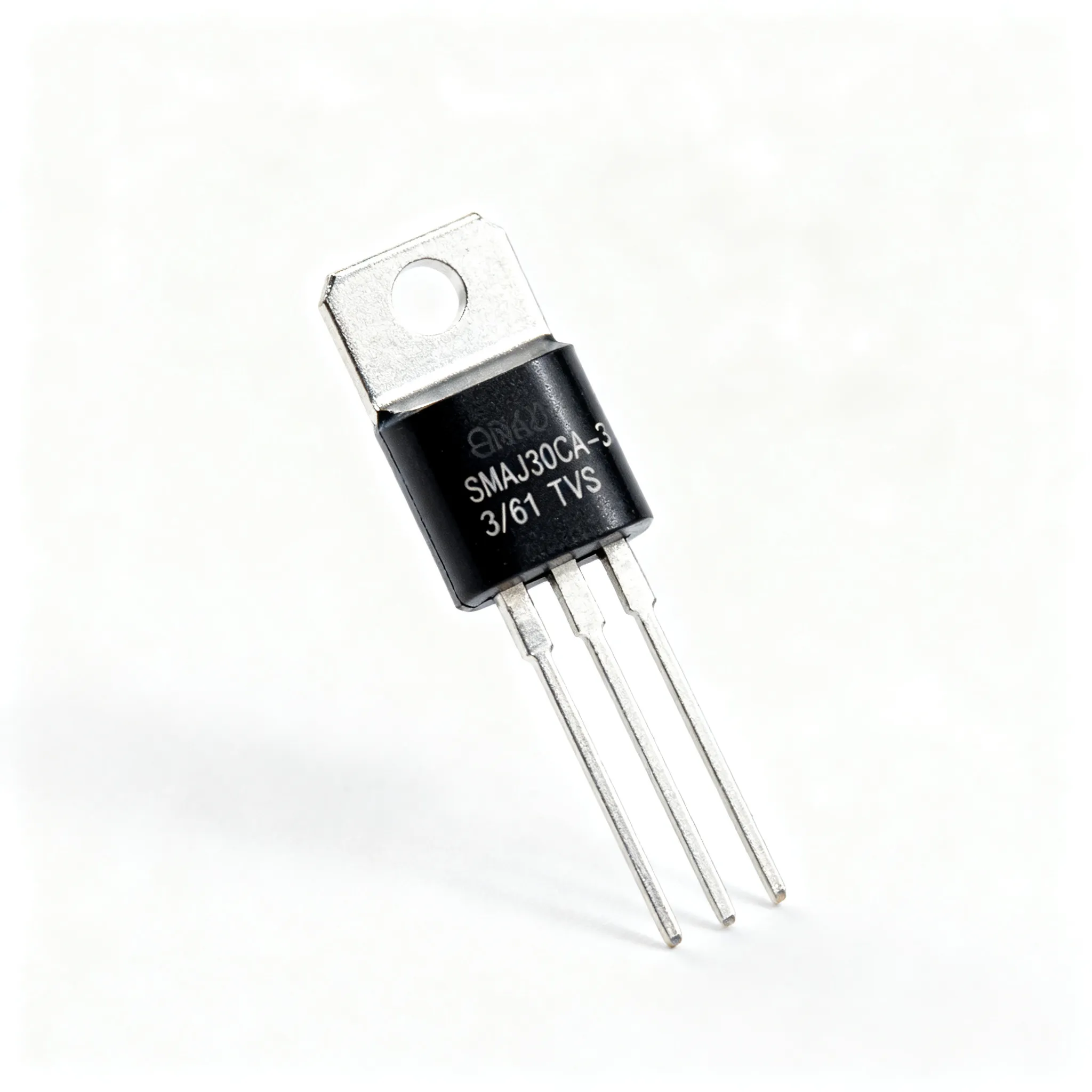
If you’ve designed a 24 V industrial sensor interface, a DC power input stage, or a fieldbus node that has to survive brutal transients, the SMAJ30CA-E3/61 has almost certainly landed on your bill of materials more than once. This bidirectional 400 W TVS diode from Vishay’s TransZorb® family has become a default choice for engineers who need compact, reliable surge clamping in a tiny DO-214AC (SMA) footprint. With an operating temperature range of -55 °C to +150 °C and a stand-off voltage of 30 V, it fits neatly into everything from 24 V PLC inputs to automotive sensor supplies.
That ubiquity, however, has also made the SMAJ30CA-E3/61 a bellwether for TVS diode supply chain stress. Over the past twelve months, procurement teams have watched lead times swing between 8 and 16 weeks, with occasional allocation events that forced buyers to scramble. A quick scan of distributor inventory pages tells the story: Future Electronics has periodically shown limited stock on full reels, while Arrow and Newark have both flagged the part as subject to market-driven lead time extensions. TME has managed to keep the diode in stock more consistently, but even there, pricing on small quantities reflects the underlying tightness.
The root cause isn’t a single fab fire or raw material shortage—it’s the sheer breadth of demand. The SMAJ30CA-E3/61 sits at the intersection of industrial automation, automotive electronics, and renewable energy, all sectors that have been running hot. When every motor drive and every EV charger needs a handful of these 30 V bidirectional clamps, the aggregated pull on Vishay’s SMAJ line becomes enormous. Understanding that dynamic is the first step toward building a procurement strategy that doesn’t leave your production line waiting for a reel.
Reading Between the Datasheet Lines: What the SMAJ30CA-E3/61 Specs Mean for Protection
On paper, the SMAJ30CA-E3/61 looks like any other 400 W TVS diode—until you examine the numbers that matter during a real surge event. The reverse stand-off voltage (VRWM) of 30 V means the diode stays essentially off during normal operation, drawing negligible leakage current even at elevated temperatures. When a transient hits, the device enters avalanche breakdown between 33.3 V and 36.8 V, then clamps the voltage to a maximum of 48.4 V while shunting up to 8.3 A of peak pulse current (10/1000 µs waveform). That clamping voltage is the figure that protects your downstream DC/DC converter or microcontroller—and it’s a parameter you cannot afford to compromise.
What separates the SMAJ30CA-E3/61 from a unidirectional alternative is the “CA” suffix: bidirectional construction. In a single DO-214AC package, two back-to-back junctions clamp both positive and negative transients. This is critical for any node that might see reverse battery conditions, AC-coupled ringing, or inductive kickback that swings below ground. The table below compares the bidirectional part with a typical unidirectional 30 V TVS to make the protection asymmetry crystal clear.
| Parameter | SMAJ30CA-E3/61 (Bidirectional) | Typical Unidirectional 30 V TVS (e.g., SMAJ30A) | What It Means for Your Circuit |
|---|---|---|---|
| Stand-off Voltage (VRWM) | 30 V | 30 V | Both allow normal 24 V rail operation with margin. |
| Breakdown Voltage (VBR) | 33.3–36.8 V | 33.3–36.8 V | Identical avalanche onset window. |
| Clamping Voltage (VC at IPP) | 48.4 V at 8.3 A | 48.4 V at 8.3 A (positive only) | Unidirectional part clamps only positive transients; negative swings forward-bias the diode at ~0.7 V, offering no surge protection. |
| Peak Pulse Current (IPP) | 8.3 A | 8.3 A | Same energy-handling capability, but the unidirectional device dissipates power asymmetrically. |
| Polarity Protection | Bidirectional (±48.4 V clamp) | Unidirectional (+48.4 V / –0.7 V) | Bidirectional is mandatory for AC signals, reverse-battery scenarios, and any line that can ring negative. |
| Package / Temperature | DO-214AC (SMA), –55 °C to +150 °C | DO-214AC (SMA), –55 °C to +150 °C | Mechanical and thermal footprint identical; drop-in replacement not possible without polarity redesign. |
Data for the SMAJ30CA-E3/61 is drawn from the DigiKey product page and TME specifications; the unidirectional comparison leverages the general TVS behavior documented in the Littelfuse SMAJ series datasheet. The takeaway is simple: if your design ever sees a negative voltage transient, the cost savings of a unidirectional part evaporate the moment a field failure occurs. Vishay’s TransZorb® technology further ensures that the clamping action is fast and repeatable, with a response time typically under 1 ps—though in practice the package inductance limits the real-world speed to a few nanoseconds.
For procurement, these parameters define the non-negotiable boundary. You cannot substitute a part with a higher clamping voltage without risking the protected IC, and you cannot drop the peak pulse current rating without reducing the surge survivability. The only degrees of freedom lie in packaging, qualification level, and supplier—which is exactly where smart sourcing saves money.
SMAJ30CA-E3/61 vs. Competitors: When a Different TVS Diode Is the Smarter Buy
The SMAJ30CA-E3/61 is not the only 30 V bidirectional TVS in an SMA package, and in certain situations, an alternative can reduce cost, improve availability, or add a qualification edge. The table below compares the Vishay part with its automotive-grade sibling, a higher-voltage cousin, and equivalent offerings from Littelfuse and Bourns—all real parts that engineers have used as second sources.
| Part Number | Stand-off Voltage | Breakdown Voltage (min/max) | Clamping Voltage (max) | Peak Pulse Current | Package | AEC-Q101 | Typical 1k Price (USD) |
|---|---|---|---|---|---|---|---|
| SMAJ30CA-E3/61 (Vishay) | 30 V | 33.3 V / 36.8 V | 48.4 V | 8.3 A | DO-214AC | No | $0.12 – $0.18 |
| SMAJ30CAHE3/61 (Vishay, Automotive) | 30 V | 33.3 V / 36.8 V | 48.4 V | 8.3 A | DO-214AC | Yes | $0.15 – $0.22 |
| SMAJ300CA (Vishay) | 300 V | 335 V / 371 V | 486 V | 0.82 A | DO-214AC | No | $0.14 – $0.20 |
| SMAJ30CA (Littelfuse) | 30 V | 33.3 V / 36.8 V | 48.4 V | 8.3 A | DO-214AC | No | $0.13 – $0.19 |
| SMAJ30CA (Bourns) | 30 V | 33.3 V / 36.8 V | 48.4 V | 8.3 A | DO-214AC | No | $0.12 – $0.18 |
Pricing data is aggregated from Octopart’s price comparison page, which shows the SMAJ30CA-E3/61 typically landing between $0.12 and $0.18 in 1,000-unit quantities, with full-reel pricing pushing toward the lower end. The automotive-grade SMAJ30CAHE3/61 commands a modest premium, as documented in the Ovaga comparison of these two parts. That comparison confirms the electrical specs are identical; the extra cost buys AEC-Q101 qualification and the associated paperwork trail.
The SMAJ300CA appears in the table not as a direct substitute, but as a reminder that voltage rating drives the protection profile. If your rail is 24 V, a 300 V stand-off part is useless—it won’t clamp until the transient reaches hundreds of volts. The Ovaga side-by-side specification comparison between SMAJ300CA and the SMAJ30CA-E3/61 highlights the dramatic difference in breakdown and clamping voltages, reinforcing that the 30 V variant is the correct choice for low-voltage DC lines.
Littelfuse and Bourns equivalents are electrically interchangeable with the Vishay part, making them viable second sources. However, subtle differences in dynamic resistance or lead finish can affect surge performance or solderability, so a quick bench evaluation is always wise before cutting over a high-volume BOM. For most procurement teams, the decision tree looks like this: if you need automotive paperwork, pay the premium for the SMAJ30CAHE3/61; if you’re purely cost-driven and the Vishay part is on allocation, qualify the Littelfuse or Bourns version; and if your design operates at higher voltages, you’re looking at an entirely different TVS family.
Procurement Playbook: Cost-Saving Tactics for SMAJ30CA-E3/61 Without Weakening Your Design
Cutting cost on a TVS diode is a delicate exercise—the moment you compromise on clamping voltage or peak pulse current, you’ve undermined the very protection you’re paying for. Fortunately, the SMAJ30CA-E3/61 offers several legitimate avenues for savings that leave the electrical performance untouched. The table below distills the most effective tactics, each with its trade-off clearly spelled out.
| Cost-Saving Tactic | How It Works | Trade-off / Risk |
|---|---|---|
| Buy full reels (1,800 pcs) instead of cut tape | Unit price drops by 15–30% compared to small quantities; reel packaging also reduces handling damage. | Higher upfront inventory cost; requires storage space and moisture sensitivity management (MSL 1, but still). |
| Qualify SMAJ30CAHE3/61 as an alternate part number | When the standard part goes on allocation, the automotive variant often has separate stock pools; you can switch without redesign. | ~20% price premium; may require updating internal part numbers and documentation. |
| Multi-source from at least three authorized distributors | Maintain accounts with Arrow, Newark, Future Electronics, and TME; when one has lead time spikes, pull from another. | Slightly higher administrative overhead; need to ensure reel traceability for each source. |
| Negotiate annual volume pricing based on Octopart trends | Use Octopart historical pricing to anchor negotiations; commit to a 12-month forecast for a locked-in price. | Forecast accuracy risk; if demand drops, you may carry excess inventory. |
| Avoid brokers and unauthorized marketplaces | Counterfeit TVS diodes are a real threat; buying only from Vishay-authorized channels eliminates the risk of substandard clamping performance. | Less price flexibility; you won’t capture spot-market bargains, but the cost of a field failure far outweighs any savings. |
None of these tactics touch the silicon. The SMAJ30CA-E3/61 remains a 30 V bidirectional, 400 W TVS diode with a 48.4 V clamp and 8.3 A surge rating regardless of which authorized distributor ships it. What changes is the logistics wrapper: reel size, supplier diversification, and the qualification paperwork you hold. For high-volume production, the single biggest lever is moving from cut tape to full reels. The Future Electronics listing for the SMAJ30CA-E3/61 in reel format shows exactly this dynamic—bulk packaging aligns with automated pick-and-place and slashes the per-unit cost.
Equally important is the discipline of sticking to authorized distribution. Vishay’s official partner network includes DigiKey, Mouser, Arrow, Newark, Future Electronics, and TME, among others. A quick check on the manufacturer’s website confirms authorization status. When lead times stretch, the temptation to buy from a broker can be strong, but TVS diodes are a prime target for counterfeiters because they are commodity parts with high markup potential. A fake SMAJ30CA-E3/61 might clamp at 60 V instead of 48.4 V, or fail short after a single surge—either outcome can destroy a PCB worth hundreds of dollars. The savings are never worth it.
Finally, pay attention to the ‘-E3’ suffix. It denotes RoHS compliance and a pure-tin lead finish. Substituting a non-E3 part like SMAJ30CA/61 could introduce lead into your process, violating environmental regulations and potentially causing solder joint reliability issues if your process is optimized for matte tin. Unless you have a documented exemption, stick with the E3 version.
SMAJ30CA-E3/61 Sourcing Questions Engineers and Buyers Ask Most
Q: Can I use a unidirectional 30 V TVS instead of the SMAJ30CA-E3/61 to cut cost?
No. A unidirectional TVS clamps only positive transients; negative voltage swings forward-bias the diode and offer no surge protection. The SMAJ30CA-E3/61 is bidirectional, clamping both polarities to ±48.4 V. If your circuit can experience reverse battery, inductive flyback, or AC-coupled noise, the unidirectional part leaves the negative rail exposed. The few cents saved will be dwarfed by the cost of a single field return.
Q: What is the actual lead time for SMAJ30CA-E3/61 in today’s market, and how can I avoid allocation?
Lead times have oscillated between 8 and 16 weeks based on distributor stock checks at Future Electronics and Arrow. To insulate yourself, qualify the automotive-grade SMAJ30CAHE3/61 as a drop-in alternative—it often sits in separate inventory pools—and maintain safety stock across multiple authorized distributors. A three-source strategy (e.g., Newark, TME, and Future Electronics) dramatically reduces the chance of a line-down situation.
Q: Is the SMAJ30CAHE3/61 pin-compatible and worth the price premium for non-automotive designs?
Yes, it’s functionally identical in the same DO-214AC package, as confirmed by the Ovaga specification comparison. The premium (roughly $0.03–$0.04 per unit in 1k volumes) buys AEC-Q101 qualification and the associated change-control documentation. For industrial designs where AEC-Q isn’t mandatory, the standard SMAJ30CA-E3/61 is perfectly adequate. The automotive part only makes financial sense if you need the paperwork for an end customer, or if the standard part is on allocation and the HE3 variant is available.
Q: How do I confirm a distributor is authorized for Vishay to avoid counterfeit SMAJ30CA-E3/61 parts?
Check Vishay’s official authorized distributor list on their website. Trusted partners include DigiKey, Mouser, Arrow, Newark, Future Electronics, and TME. Avoid brokers, independent marketplaces, and any source that cannot provide a full chain of custody back to Vishay. Counterfeit TVS diodes are a known problem; a simple DC test won’t reveal a compromised clamping voltage until a surge event occurs.
Q: What’s the typical price per unit for 1,000 pieces, and how does reel packaging affect cost?
According to Octopart’s price comparison, the SMAJ30CA-E3/61 ranges from $0.12 to $0.18 in 1k quantities. Full reel (1,800 pcs) pricing consistently hits the lower end of that range, while cut tape or small-quantity orders carry a 30–50% premium. If your annual usage exceeds 10,000 pieces, negotiating a reel-based contract can save hundreds of dollars with zero impact on protection performance.
Q: Does the ‘-E3’ suffix matter for my design, or can I use a non-E3 part?
The ‘-E3’ suffix indicates RoHS compliance and a pure-tin lead finish. Substituting a non-E3 part (e.g., SMAJ30CA/61) may introduce lead or non-RoHS materials, which could violate environmental regulations and cause solderability issues if your process is tuned for lead-free finishes. Unless you have a specific exemption—such as a military/aerospace application that still permits lead—stick with the E3 version to avoid compliance headaches and potential field reliability problems.
Smart sourcing of the SMAJ30CA-E3/61 ultimately comes down to separating the parameters you cannot change—clamping voltage, peak pulse current, bidirectional polarity—from the variables you can control: packaging quantity, supplier diversification, and qualification level. By buying full reels, qualifying a pin-compatible automotive alternate, and spreading demand across multiple authorized distributors, you can shave 15–25% off your landed cost without touching the silicon. For mixed-BOM environments where you’re procuring everything from TVS diodes to microcontrollers, a platform like IC-Online can help consolidate orders, negotiate flexible MOQs, and keep your production line humming even when individual component lead times fluctuate.
References & Further Reading
- SMAJ30CA-E3/61 on Future Electronics – reel packaging and temperature range details.
- SMAJ30CA-E3/61 on TME – bidirectional TVS diode specifications.
- SMAJ30CA-E3/61 on Arrow – product overview and stock status.
- SMAJ30CA-E3/61 on Newark – authorized distributor listing.
- Octopart price comparison for SMAJ30CA-E3/61 – distributor pricing spread and availability.
- Ovaga: SMAJ