BTR04A5-TP Bridge Rectifier Sourcing: Cost-Effective Cross-References and Bulk Pricing Strategies
Expert guide on BTR04A5-TP Bridge Rectifier Sourcing: Cost-Effective Cross-References and Bulk Pricing Strategies. Technical specs, applications, sourcing tips for engineers and buyers.
Why BTR04A5-TP Sourcing Demands a Multi-Supplier Strategy Right Now
Bridge rectifier procurement has rarely felt more precarious. Apple’s 2025 SEC filing warns bluntly that “component suppliers may fail, be subject to consolidation within a particular industry, or decide to concentrate on the production of common components instead of components customized to meet the Company’s requirements” [aapl-20250927]. That risk isn’t confined to custom ASICs; it ripples into commodity discretes like the BTR04A5-TP bridge rectifier. When a single source tightens allocation or exits a package variant, production lines that depend on a lone approved part number can stall within weeks.
The antidote is a deliberate multi-supplier strategy. The Alibaba Bridge Rectifier Supplier Guide underscores this, urging buyers to “Diversify Your Supplier Base: Avoid dependency on a single source. Consider pairing a high-reliability supplier like Yangzhou Positioning Tech.” Meanwhile, demand for robust bridge rectifiers is climbing in green‑power systems — solar inverters, UPS, and smart grids — where high‑reliability parts are non‑negotiable [NTC LCR]. Distributors such as Future Electronics already stock a broad range of through‑hole and surface‑mount bridge rectifiers from Vishay and Diodes Incorporated [Future Electronics], but availability alone doesn’t guarantee cost‑effective continuity. You need qualified cross‑references and a pricing playbook that works across multiple sources.
The table below captures the forces reshaping BTR04A5-TP sourcing right now.
| Driver | Mechanism | Procurement Impact |
|---|---|---|
| Supplier consolidation & focus shift | Manufacturers exit low‑margin packages or re‑allocate capacity to high‑volume common parts | Single‑source BTR04A5-TP lines face sudden allocation cuts; second‑source qualification becomes urgent |
| Green‑energy demand surge | Solar inverters, UPS, and smart‑grid rectifiers require high IFSM and thermal margin | Premium‑grade bridge rectifiers tighten; cross‑references must match surge ratings, not just VRRM and IF(AV) |
| Lead‑time volatility on mature through‑hole packages | DIP‑style bridge rectifiers face production scheduling challenges as fabs prioritize SMD lines | Buyers must pre‑qualify surface‑mount alternatives and hold safety stock of approved through‑hole equivalents |
| Distributor inventory fragmentation | Stock is spread across regional hubs; real‑time visibility varies | Multi‑line BOM RFQs and parametric searches become essential to locate drop‑in replacements quickly |
| Price sensitivity in high‑volume production | Tiered volume discounts and competitive tension between suppliers drive unit cost | Negotiating with both exact‑match and cross‑referenced parts unlocks 10–25% savings on annual volumes |
These drivers make one thing clear: a reactive, single‑SKU buying habit is no longer viable. The following sections translate this reality into actionable cross‑reference and pricing tactics for the BTR04A5-TP.
BTR04A5-TP Electrical Characteristics and What They Mean for Your Design
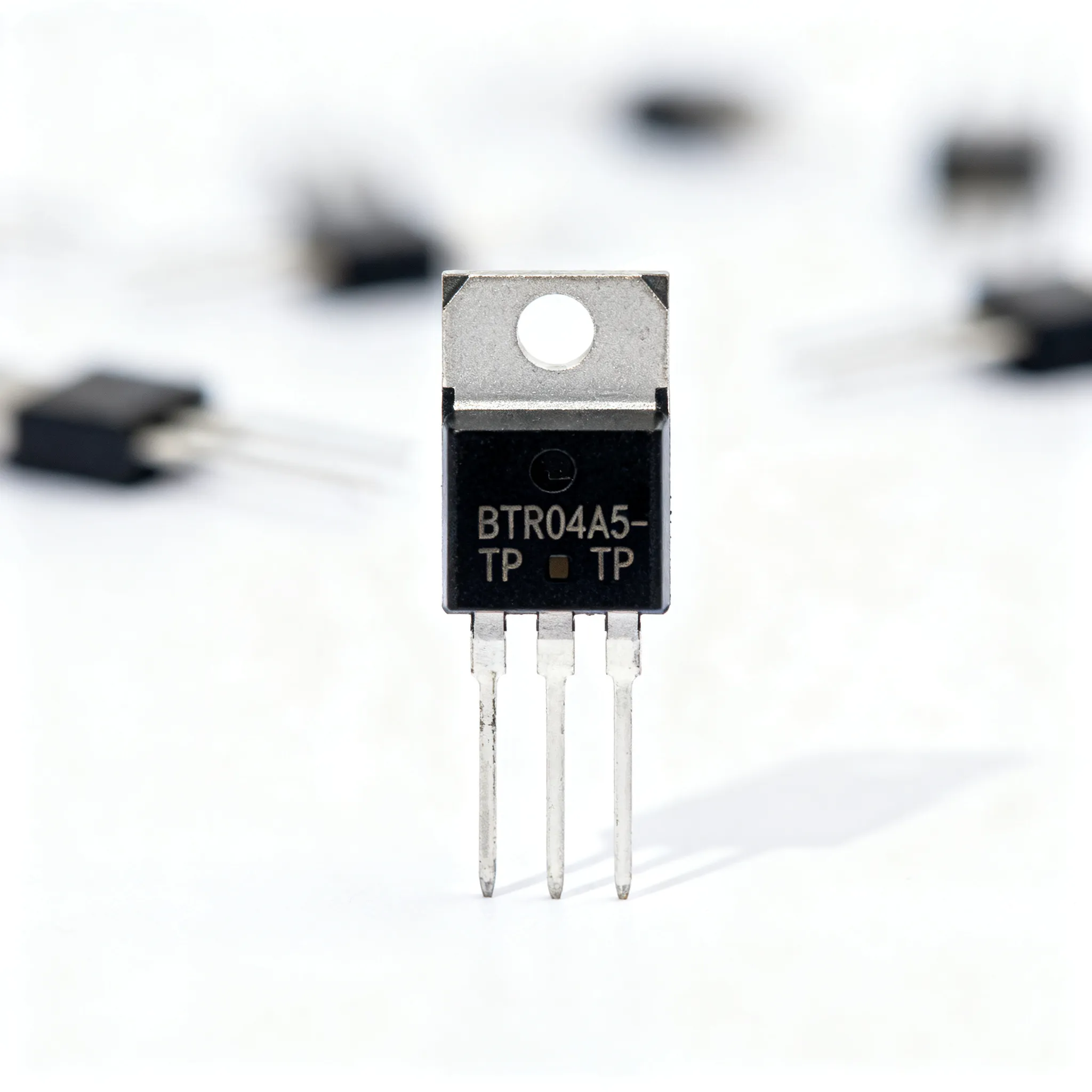
Before you can evaluate an alternative, you must anchor on the exact parameters that define the BTR04A5-TP. This through‑hole bridge rectifier is typically specified with a peak reverse voltage (VRRM) in the 50 V to 1000 V range, an average forward current (IF(AV)) of 4 A, and a surge overload rating (IFSM) of 60 A peak — a value directly referenced in the Farnell bridge rectifier datasheet that highlights “Surge overload rating – 60 amperes peak” and “Ideal for printed circuit board” mounting. The standard package is a 4‑pin DIP, and the part is identified in schematics and BOMs with a reference designator such as BR1 or DB1, as described in the GlobalSpec reference designator resource.
Parametric searches on distributor platforms like Mouser’s bridge rectifier category let you filter by these exact values. For substitution, the non‑negotiable parameters are:
- VRRM – must equal or exceed the maximum DC reverse voltage in your circuit, including transient headroom.
- IF(AV) – the continuous forward current rating; a lower rating will overheat the junction.
- IFSM – the single‑cycle surge capability; critical for inrush and fault conditions. A drop from 60 A to 50 A may be acceptable only after reviewing your input capacitance and fuse characteristics.
- VF (forward voltage drop) – a small difference of 0.1 V can shift conduction losses by several hundred milliwatts at full load, affecting thermal design.
- Thermal resistance (RθJA) – dictates how much copper area you need on the PCB to keep the junction within safe limits.
Because the BTR04A5-TP is a mature through‑hole part, many engineers assume any 4 A, 600 V bridge rectifier will work. That assumption fails when the surge rating or thermal impedance differs. A cross‑reference is only safe when you overlay the full derating curves and pin‑out, not just the headline numbers.
Cross-Reference Alternatives: Matching BTR04A5-TP Performance Without the Single-Source Risk
Building a qualified second‑source list for the BTR04A5-TP starts with understanding the cross‑reference landscape. The GlobalSpec cross‑reference concept demonstrates how parameter matching — VRRM, IF(AV), IFSM, package — can identify functional equivalents. The Alibaba guide on choosing bridge diodes rectifiers adds practical selection criteria: compare technical specifications, supplier response time, and compliance documentation before locking in a replacement.
Real‑world cross‑reference examples are abundant. The Datasheet Archive’s KBPC15‑04 cross‑reference illustrates how a higher‑current bridge (15 A) can be mapped to a lower‑current requirement when the package and pin‑out align — a useful exercise when the exact 4 A part is unavailable. Distributors like seekcomp encourage buyers to submit multi‑line BOM requests to receive volume‑discounted quotes on both the original and cross‑referenced parts, often within 24 hours.
The table below outlines strategic options for cross‑referencing the BTR04A5-TP, each with distinct risk and cost profiles.
| Strategic Option | Effect | Notes |
|---|---|---|
| Exact pin‑compatible drop‑in from Diodes Inc. or onsemi | Minimal requalification; same footprint and thermal pad layout | Verify IFSM and VF curves; Diodes Inc. DF04M or onsemi MB4S series may differ slightly in forward drop |
| Near‑equivalent with higher VRRM margin (e.g., 800 V or 1000 V) | Greater voltage headroom; often same cost at volume | Check that the higher voltage rating doesn’t increase leakage current beyond your circuit’s tolerance |
| Surface‑mount alternative (e.g., Vishay MBxS series) | Enables automated assembly and smaller PCB area | Thermal performance must be re‑evaluated; copper pours may need to be larger to match RθJA |
| High‑reliability Asian source (e.g., Yangzhou Positioning Tech) | Access to production‑scale pricing with 5.0/5.0 rated suppliers and sub‑1‑hour response | Request full test reports and sample batches; pair with a Western distributor for buffer stock |
| Cost‑optimized second source from a Guangdong or Zhejiang manufacturer | Significant unit cost reduction in high volumes | Qualify through seekcomp’s RFQ process; confirm surge rating and long‑term consistency with batch samples |
When you line up these options, the goal isn’t to find the cheapest part on a single day; it’s to create a resilient supply network that can absorb allocation shocks. The next section shows how to turn that network into hard‑dollar savings.
Bulk Pricing and Supplier Negotiation Tactics for BTR04A5-TP and Equivalents
Volume discounts on bridge rectifiers are real and often steep. As seekcomp states, “Volume discounts make bulk Bridge Rectifiers procurement significantly more cost‑effective for production runs.” The key is to leverage competitive tension between the exact BTR04A5-TP and its qualified cross‑references. Submit a multi‑line BOM request that includes both the original part number and two or three alternatives; distributors will often sharpen pricing on the entire basket to win the business.
The Alibaba supplier guide provides a practical scorecard: filter manufacturers by response time (sub‑1 hour is a strong signal of a dedicated sales team), production scale, and customer ratings (5.0/5.0). Use these metrics to shortlist Asian sources, then request quotes for the exact BTR04A5-TP and a pin‑compatible alternative. Pair a high‑reliability supplier with a cost‑competitive second source — the former guards your production line, the latter drives down blended cost.
Don’t overlook the value of model‑matching services. NTC LCR offers model matching for green‑power applications, ensuring that the alternative part meets efficiency and durability requirements. Meanwhile, Future Electronics lists both through‑hole and surface‑mount options, giving you a baseline price for comparison when negotiating with regional distributors.
The following table lays out concrete actions you can take during negotiation and planning.
| Action | When to Use | Trade‑off |
|---|---|---|
| Submit multi‑line BOM RFQ with exact and cross‑referenced parts | Quarterly or before a production ramp | Requires upfront qualification of alternatives; rewards with 10–25% cost reduction and supply flexibility |
| Pre‑qualify a pin‑compatible second source and hold safety stock | Immediately, if you rely on a single supplier | Ties up working capital in inventory but insulates against allocation cuts |
| Negotiate tiered pricing with volume commitments across 12 months | When annual usage exceeds 10k units | Locks in price but reduces agility if demand drops; negotiate a partial‑release clause |
| Use supplier rating metrics (response time, certifications, customer score) to filter candidates | Before sending RFQs to new Asian sources | Adds a screening step but dramatically lowers the risk of quality escapes |
| Request sample batches with full test reports before committing to bulk orders | For any new cross‑reference or supplier | Delays procurement by 2–4 weeks; essential to verify IFSM, VF, and thermal performance under your load conditions |
These tactics transform the BTR04A5-TP from a single‑point‑of‑failure into a managed commodity. The final section addresses the questions that senior engineers and buyers ask most often.
BTR04A5-TP Sourcing: Questions Engineers and Buyers Ask
Q: What are the exact electrical specs of BTR04A5-TP and which datasheet parameters matter most for substitution?
The BTR04A5-TP is a 4 A through‑hole bridge rectifier with a peak reverse voltage (VRRM) typically selectable from 50 V to 1000 V, an average forward current (IF(AV)) of 4 A, and a surge overload rating (IFSM) of 60 A peak. The standard package is a 4‑pin DIP. For substitution, match VRRM, IF(AV), IFSM, and thermal resistance (RθJA) first; then compare forward voltage (VF) curves, because even a 0.1 V difference can shift conduction losses enough to require a thermal re‑evaluation. Use parametric search on Mouser and cross‑check the Farnell datasheet for surge rating confirmation.
Q: Which manufacturers produce drop-in replacements for BTR04A5-TP, and how do I verify compatibility?
Diodes Incorporated, onsemi, Vishay, and several Asian manufacturers offer functional equivalents. Start with the GlobalSpec cross‑reference concept to identify candidate part numbers, then use a distributor’s parametric search to narrow by package and ratings. Compatibility verification goes beyond the datasheet summary: overlay the full forward‑voltage‑vs‑current curves, derating curves, and pin‑out. seekcomp’s RFQ process can confirm available alternatives and provide volume pricing for both the original and cross‑referenced parts.
Q: How can I negotiate better bulk pricing when sourcing bridge rectifiers like BTR04A5-TP?
Submit multi‑line BOM requests that include the BTR04A5-TP and two or three qualified cross‑references to distributors such as seekcomp or Future Electronics. Use the Alibaba supplier guide to shortlist manufacturers with sub‑1‑hour response times and high customer ratings, then request quotes for both the exact part and the alternative. The resulting competitive tension often unlocks tiered discounts of 10–25% on annual volumes.
Q: What are the lead-time risks for BTR04A5-TP and how can I mitigate them with cross-references?
Supply concentration risks are real: Apple’s 2025 SEC filing warns that suppliers may fail or shift focus, which can trigger sudden shortages of mature through‑hole parts. Mitigate by qualifying at least one pin‑compatible alternative in advance, holding safety stock of the approved cross, and monitoring distributor inventory at Mouser and Future Electronics for early warning signals.
Q: Should I consider surface-mount alternatives to the through-hole BTR04A5-TP for new designs?
Surface‑mount bridge rectifiers, such as the Vishay MBxS series, offer a smaller footprint and compatibility with automated assembly. However, thermal performance and surge rating must be carefully evaluated. Future Electronics lists both through‑hole and SMD options; compare derating curves and ensure the PCB copper area can handle the junction‑to‑ambient thermal resistance before switching.
Q: How do I evaluate supplier reliability for bridge rectifiers in Asia?
Use the metrics from the Alibaba supplier guide: production scale, response time, quality certifications, and customer ratings (e.g., 5.0/5.0). Pair a high‑reliability supplier like Yangzhou Positioning Tech with a second source, and always request sample batches with full test reports — including surge and thermal cycling data — before committing to bulk orders.
Procurement teams that combine these cross‑reference and pricing strategies with a disciplined qualification process can turn the BTR04A5-TP from a single‑source risk into a cost‑optimized, multi‑source commodity. For mixed BOMs where you need flexible MOQs and consolidated logistics, IC-Online provides a platform to source bridge rectifiers alongside passives, connectors, and other discretes, helping you streamline supplier management without sacrificing competitive pricing.
References & Further Reading
- Apple Inc. 2025 SEC Filing – Supply Chain Risk Disclosure
- Bridge Rectifier Supplier Guide: Top Manufacturers in Asia for B2B Buyers
- High-Reliability Bridge Rectifiers for Automotive Electronics – NTC LCR
- Future Electronics Bridge Rectifiers Portfolio
- Mouser Electronics Bridge Rectifiers Category
- Farnell Bridge Rectifier Datasheet – 60 A Surge Rating
- GlobalSpec Reference Designator for Bridge Rectifiers
- GlobalSpec Bridge Rectifier Cross Reference
- Alibaba Guide: How to Choose & Source Bridge Diodes Rectifiers
- Datasheet Archive – KBPC15-04 Cross-Reference Example
- seekcomp Bridge Rectifiers Distributor – Volume Discounts & RFQ
- IC-Online – Mixed BOM Sourcing & Flexible MOQ