STM32F103 vs STM32F407: Performance Comparison Guide
Expert guide on STM32F103 vs STM32F407: Performance Comparison Guide. Technical specs, applications, sourcing tips for engineers and buyers.
Introduction
In the rapidly evolving world of embedded systems, selecting the right microcontroller can significantly impact the performance, power consumption, and cost of your application. Two popular choices within the STM32 family, the STM32F103 and STM32F407, offer distinct advantages depending on the specific requirements of your project. This guide provides a comprehensive comparison between these two microcontrollers, focusing on their electrical specifications, thermal and mechanical properties, and application suitability. Understanding these differences is crucial for engineers aiming to optimize their designs for performance, efficiency, and cost-effectiveness.
Technical Overview
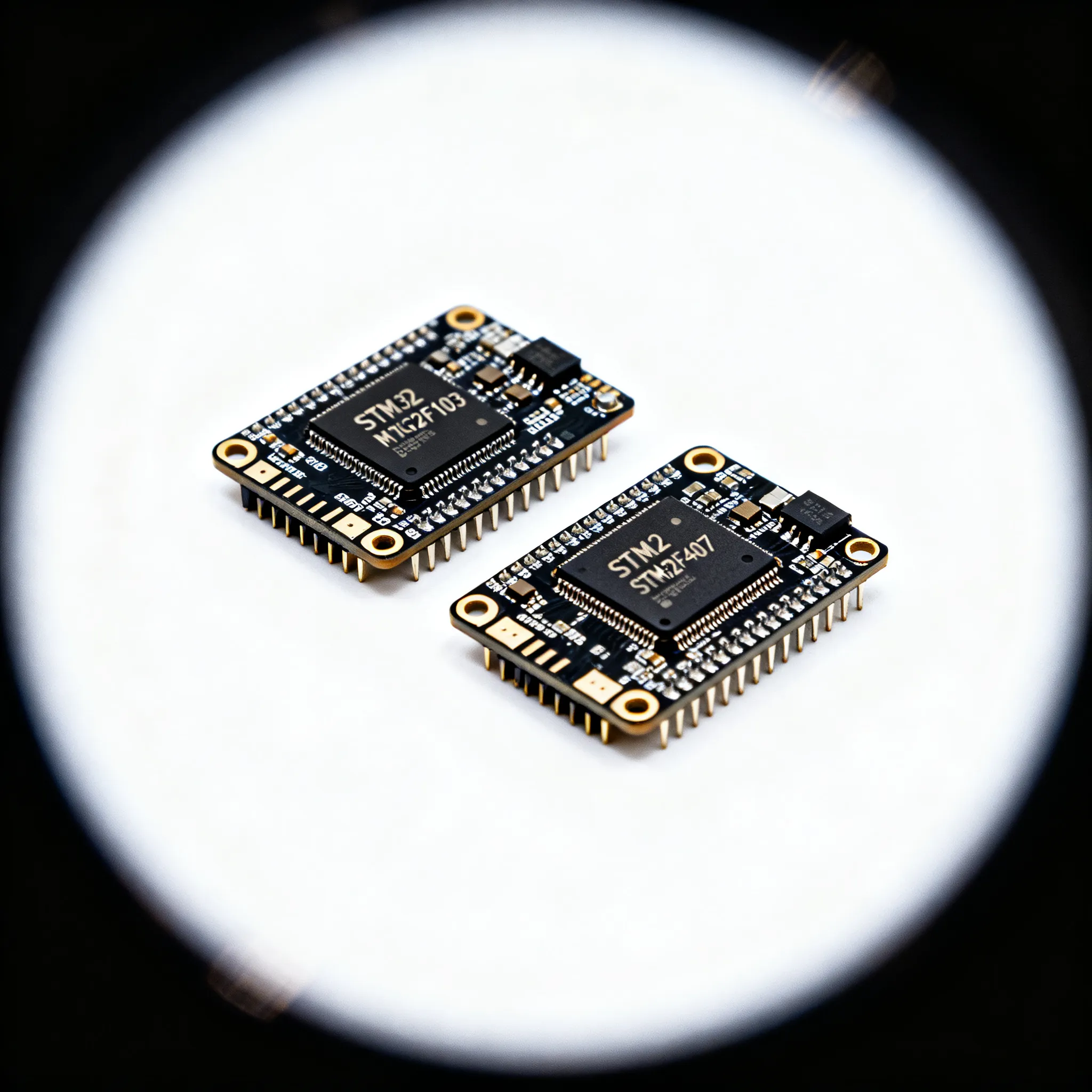
The STM32 family, developed by STMicroelectronics, is renowned for its high performance, low power consumption, and rich feature set. The STM32F103 belongs to the STM32F1 series, known for its balance between performance and cost, making it ideal for a wide range of applications, including industrial and consumer electronics. It is built around the ARM Cortex-M3 core, offering moderate processing power and a robust set of peripherals.
On the other hand, the STM32F407 is part of the STM32F4 series, which is designed for applications requiring higher computational power and advanced features. It utilizes the ARM Cortex-M4 core, which includes a floating-point unit (FPU) for enhanced processing capabilities, making it suitable for digital signal processing applications, advanced audio systems, and more.
Both microcontrollers offer extensive connectivity options, including USB, CAN, and Ethernet, as well as a variety of communication interfaces like SPI, I2C, and USART. However, the choice between them often hinges on the specific performance and feature requirements of the application.
Detailed Specifications
| Specification | STM32F103 | STM32F407 | Units | Notes |
|---|---|---|---|---|
| Core | ARM Cortex-M3 | ARM Cortex-M4 | - | Includes FPU in F4 |
| Flash Memory | 64-512 KB | 512 KB-1 MB | KB | Varies by model |
| RAM | 20-64 KB | 128-192 KB | KB | Higher capacity in F4 |
| Operating Voltage | 2.0-3.6 | 1.8-3.6 | V | Wider range in F4 |
| Max Clock Speed | 72 | 168 | MHz | Increased in F4 |
| GPIOs | 37-51 | 82-114 | - | More in F4 |
| ADC Channels | 10-16 | 16 | - | Higher precision in F4 |
| DAC Channels | 0 | 2 | - | Available in F4 |
| Timers | 7 | 14 | - | More in F4 |
| USB | 1x Full Speed | 1x Full Speed, 1x High Speed | - | HS available in F4 |
| CAN | 1 | 2 | - | More channels in F4 |
| Specification | STM32F103 | STM32F407 | Units | Notes |
|---|---|---|---|---|
| Package Types | LQFP, WLCSP | LQFP, UFBGA | - | Variety for different needs |
| Package Size | 7x7 to 14x14 | 10x10 to 17x17 | mm | Larger for more pins |
| Operating Temperature | -40 to 85 | -40 to 105 | °C | Extended range in F4 |
| Storage Temperature | -65 to 150 | -65 to 150 | °C | Same range |
| Power Dissipation | 150 | 250 | mW | Higher in F4 |
| ESD Protection | 2 | 2 | KV | Standard protection |
| Moisture Sensitivity Level | 3 | 3 | - | Same level |
| Thermal Resistance | 30 | 25 | °C/W | Lower in F4 |
| Pin Count | 48-100 | 64-144 | - | More in F4 |
| Application | STM32F103 | STM32F407 | Notes |
|---|---|---|---|
| Industrial Automation | Suitable | Highly Suitable | F4 preferred for complex tasks |
| Consumer Electronics | Widely Used | Used for Advanced Features | F4 for feature-rich devices |
| Automotive | Limited Use | Preferred | F4's extended temp range helps |
| Medical Devices | Common | Very Common | F4 for precision and reliability |
| IoT Devices | Common | Common | F4 for processing-intensive tasks |
Design Considerations
Selecting between the STM32F103 and STM32F407 requires a clear understanding of the application requirements. The STM32F103 is a cost-effective solution for applications where moderate processing power and connectivity are sufficient. Its lower power consumption and smaller package sizes make it ideal for battery-powered and space-constrained applications.
In contrast, the STM32F407 is suitable for applications demanding higher computational power, advanced peripherals, and extensive connectivity. Its ARM Cortex-M4 core, with an integrated FPU, is particularly advantageous for applications involving complex mathematical computations, such as audio processing and motor control.
Engineers should also consider the thermal and mechanical specifications. The STM32F407's ability to operate at higher temperatures and its lower thermal resistance make it a better choice for applications exposed to harsh environments. Additionally, its higher pin count and larger package provide more flexibility in design but require more PCB space.
Power considerations are also critical. The higher power dissipation of the STM32F407 necessitates careful power management and heat dissipation strategies, such as using heat sinks or thermal vias on the PCB. Lastly, availability and cost should be evaluated, using resources like IC Online to ensure the selected microcontroller meets budget constraints and delivery timelines.
Step-by-Step Guide
- Define Application Requirements: Start by listing the specific requirements of your application, such as processing power, connectivity, and power consumption.
- Compare Core Features: Analyze the core features of the STM32F103 and STM32F407 using datasheets and specification tables to identify the best fit for your needs.
- Evaluate Peripheral Needs: Determine the necessary peripherals like ADCs, DACs, and communication interfaces required for your application and compare the availability on both microcontrollers.
- Consider Environmental Conditions: Assess the environmental conditions the microcontroller will be exposed to, such as temperature and humidity, to ensure the selected MCU can operate reliably under these conditions.
- Design the PCB: Based on the selected microcontroller, design the PCB layout, ensuring adequate space for the MCU and associated components while incorporating thermal management solutions.
- Develop Software: Utilize development environments like STM32CubeIDE to write and test the software, leveraging libraries and example projects to accelerate development.
- Prototype and Test: Build a prototype to test the hardware and software integration, ensuring all system components work together seamlessly and meet performance expectations.
- Iterate and Optimize: Based on testing results, iterate on the design to address any performance or reliability issues, optimizing for cost and efficiency.
Common Issues & Solutions
When working with the STM32F103 and STM32F407 microcontrollers, engineers may encounter several common issues. Here are five potential problems and their solutions:
- Power Management: The STM32F407 can consume more power, leading to overheating. Solution: Implement power-saving modes and ensure adequate heat dissipation with heat sinks or thermal vias.
- Peripheral Conflicts: Limited GPIOs can lead to conflicts. Solution: Use multiplexing techniques or select a microcontroller variant with a higher pin count.
- Code Optimization: Complex applications may require more processing power. Solution: Optimize code for performance, leveraging the FPU in the STM32F407 for mathematical operations.
- Debugging Challenges: Debugging can be difficult without proper tools. Solution: Use advanced debugging tools like ST-LINK/V2 to facilitate efficient debugging and troubleshooting.
- Component Availability: Supply chain issues can delay projects. Solution: Plan ahead and use authorized distributors like IC Online to secure components early in the design phase.
Applications & Use Cases
The STM32F103 and STM32F407 are versatile microcontrollers used in a wide range of applications. The STM32F103's balance of performance and cost makes it suitable for consumer electronics, smart home devices, and basic industrial automation. Its low power consumption is ideal for battery-powered devices.
The STM32F407, with its enhanced processing power and peripherals, is often found in advanced applications such as digital signal processing, high-performance audio systems, and complex motor control systems. Its extended temperature range and robust features make it a preferred choice in automotive and industrial environments.
Selection & Sourcing Guide
Selecting the right microcontroller involves balancing performance, cost, and availability. Use resources like IC Online to compare prices, check stock levels, and find authorized distributors. This ensures you receive genuine components with reliable delivery timelines, crucial for maintaining project schedules and budgets.
FAQ
- What are the main differences between the STM32F103 and STM32F407? The primary differences are in processing power, peripherals, and temperature range, with the STM32F407 offering higher performance and more features.
- Which microcontroller is better for low-power applications? The STM32F103 is more suitable for low-power applications due to its lower power consumption.
- Can the STM32F407 handle complex mathematical computations? Yes, the STM32F407 has an integrated FPU that enhances its ability to handle complex computations.
- What development tools are available for STM32 microcontrollers? STM32CubeIDE and ST-LINK/V2 are popular tools for developing and debugging STM32 applications.
- How do I manage heat dissipation in high-power applications? Use thermal management solutions such as heat sinks and thermal vias to dissipate heat effectively.
- Are there any size constraints with these microcontrollers? Yes, the STM32F407 typically requires more PCB space due to its larger package size.
- Where can I source these microcontrollers? Authorized distributors like IC Online offer a range of STM32 microcontrollers.
- What is the operating temperature range for these microcontrollers? The STM32F103 operates up to 85°C, while the STM32F407 can handle up to 105°C, making it suitable for harsher environments.
- Can I use the STM32F407 for automotive applications? Yes, its extended temperature range and robust features make it suitable for automotive applications.
- What are common challenges in designing with STM32 microcontrollers? Challenges include power management, peripheral conflicts, and debugging, which can be mitigated with proper design and tools.
Conclusion
Choosing between the STM32F103 and STM32F407 depends on the specific needs of your application. While the STM32F103 offers a cost-effective solution for basic applications, the STM32F407 provides enhanced capabilities for more demanding tasks. Understanding the specifications, design considerations, and application contexts is crucial for making an informed decision. By leveraging resources like IC Online for sourcing, engineers can ensure they select the right microcontroller to optimize performance and cost-efficiency.