Smart Parcel Locker Electronics: Lock Controllers, Connectivity, and Component Sourcing
Smart Parcel Locker Electronics: Lock Controllers, Connectivity, and Component Sourcing
Why Lock Controller Availability Is Now the Gating Factor for Smart Parcel Locker Deployments
If you've tried to source a 24-channel TCP/IP relay board for a smart locker project in the last eighteen months, you already know the situation. What was once a commodity purchase—place the order, receive the boards in four weeks, move on—has become the single most unpredictable variable in deploying smart parcel locker infrastructure. The surge isn't theoretical. E-commerce parcel volume in North America crossed 23 billion units in 2024, and the pressure on last-mile delivery has pushed property managers, logistics operators, and postal services to accelerate locker deployments by an estimated 30–40% year-over-year. Lock controllers sit at the intersection of that growth and the component shortages that continue to ripple through MCU, relay, and connector supply chains.
Major deployments illustrate the scale. Pitney Bowes has expanded its Shipping 360® platform to integrate smart parcel lockers that connect delivery, storage, tracking, and secure access into a unified system—each locker bank relying on a central controller board to manage dozens of compartments simultaneously. Ricoh's intelligent digital smart locker rollout across corporate campuses and universities ties lock controllers directly into property management and access control software, meaning the controller isn't just a relay driver; it's a networked node that must authenticate users, log access events, and report door status in real time. The USPS Smart Locker program, aimed at reducing carrier wait times and missed deliveries, demands controllers that can survive unconditioned lobby environments and handle hundreds of daily unlock cycles without failure. Smartbox Lockers emphasizes tamper-proof, weatherproof compartments where the electronic lock is only as reliable as the controller driving it.
What changed? Three factors converged. First, the relay modules used in industrial lock controllers share fabrication capacity with automotive and appliance sectors, where demand recovered faster than expected. Second, the MCUs that handle TCP/IP stacks and encryption for networked controllers saw lead times stretch from 12 weeks to 26+ weeks across multiple suppliers. Third, the shift from standalone electronic lockers (simple keypad or RFID, no cloud integration) to fully networked smart locker banks means each deployment now requires a central controller board that is far more complex than a basic relay driver. That complexity multiplies the number of constrained components per board. The result: procurement teams that once treated lock controllers as a line-item BOM purchase are now treating them as a strategic sourcing decision requiring forecast commitment, multi-source qualification, and buffer inventory planning.
Key Takeaway: Lock controller availability is no longer an afterthought. It is the critical path for smart locker deployments. If your sourcing strategy hasn't been updated since 2023, you're carrying supply risk you may not see until the production schedule slips.
How a 24-Channel TCP/IP Relay Board Becomes the Brain of a Smart Locker Bank
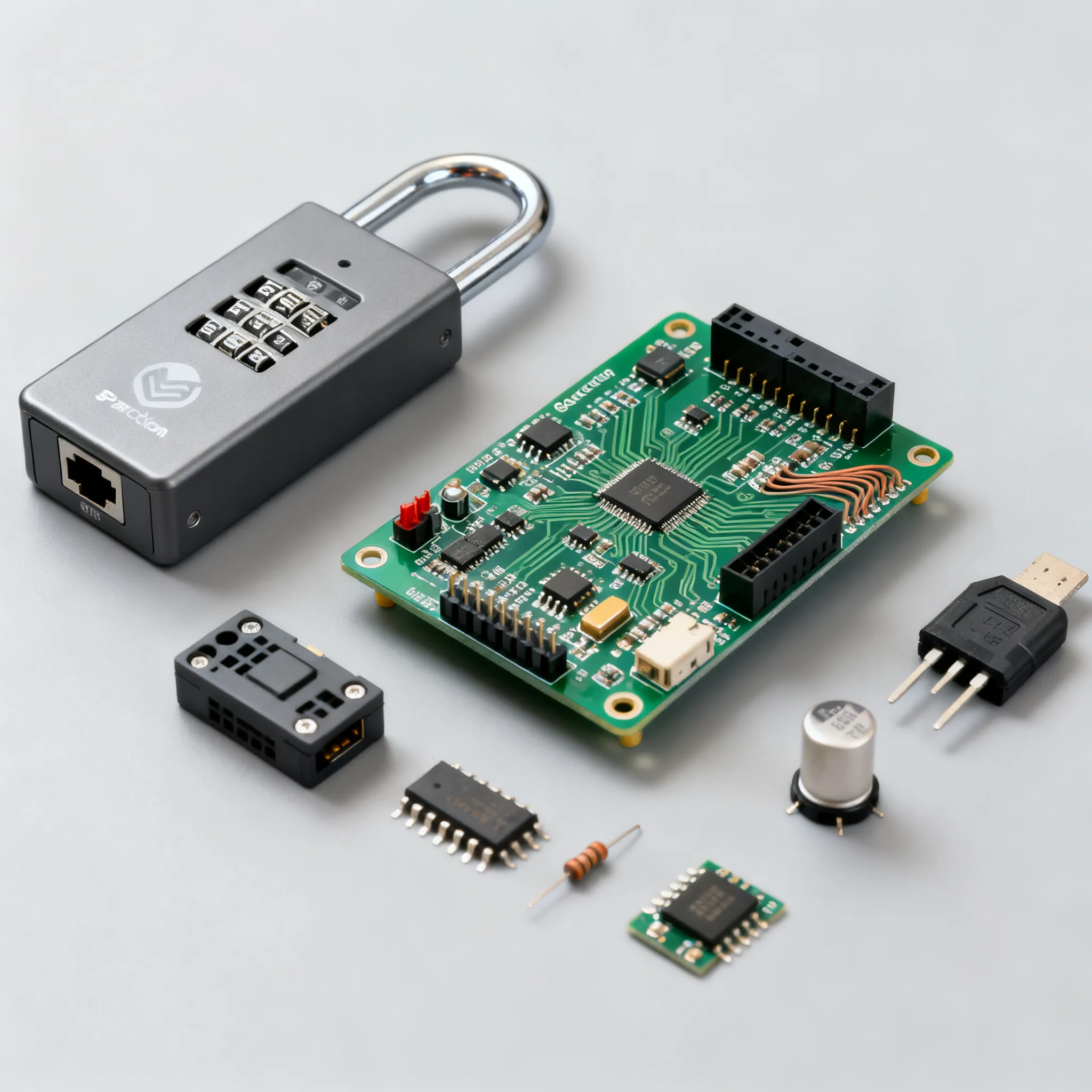
At the heart of every multi-compartment smart parcel locker is a controller board that does far more than close a relay. The AL2445 TCP/IP relay board from eboxlock is a representative example: a 24-channel controller that communicates over Ethernet, drives solenoid or motorized locks at 12V or 24V DC, reads door position sensors, and reports status back to the cloud management platform. Understanding its architecture clarifies what you're actually buying when you specify a lock controller.
The board architecture typically includes four functional blocks. The communication interface—usually a 10/100 Ethernet PHY with an embedded TCP/IP stack—handles command reception and status reporting to the locker management software. The MCU processes commands, manages timing, monitors watchdog timers, and handles encryption keys for secure access. The relay driver stage converts low-voltage logic signals into the current needed to actuate solenoid locks (typically 1.5–3 A per channel for a 12V lock with a 200–500 ms pulse). The sensor input block reads door open/closed switches, lock state feedback, and optionally temperature or tamper sensors. Smartbox describes this as the central nervous system of the locker bank, and Lockourier reinforces that the quality of the controller—particularly the relay ratings and the environmental hardening of the PCB—determines whether the system survives year three of operation without nuisance failures.
The table below captures the key specifications engineers evaluate when selecting a lock controller for a smart parcel locker bank.
| Parameter | Typical Range / Value | Unit / Notes |
|---|---|---|
| Channel count | 8–48 channels per board | 24-channel boards most common for mid-size locker banks; daisy-chainable for larger installations |
| Lock voltage | 12V DC or 24V DC | 12V dominates North America; 24V preferred in EU for longer cable runs |
| Per-channel current | 2–3 A peak (pulse) | Solenoid inrush; duration typically 200–500 ms; continuous rating 0.5–1 A |
| Communication protocol | TCP/IP (Ethernet), RS485, CAN | Ethernet is standard for cloud-connected lockers; RS485 for sub-controller daisy-chaining |
| MCU architecture | ARM Cortex-M4 / M7 | Required for TLS encryption and real-time command processing |
| Relay cycle life | 100,000–200,000 cycles (mechanical) | Must match or exceed lock solenoid rating; tested at rated load |
| Operating temperature | -25°C to +70°C | Extended range required for outdoor or unconditioned installations |
| Watchdog timer | Hardware WDT, 1–2 sec timeout | Critical for unattended recovery from lockup; must reset the board without human intervention |
| Sensor inputs | Door status, lock state, tamper, temperature | Typically opto-isolated or filtered GPIO; 2–4 inputs per channel |
| Enclosure protection | IP65 (controller enclosure) if exposed | Conformal coating on PCB is minimum for outdoor/humid environments |
What the table doesn't show is the integration burden. A 24-channel board like the AL2445 must handle simultaneous unlock commands—think of a delivery driver depositing parcels into twelve compartments during a single stop. The MCU must sequence relay actuation to avoid a current spike that would sag the power supply rail, and the firmware must debounce door sensor inputs to avoid false "door open" alarms that trigger unnecessary service calls. Lockourier notes that steel construction and UL-certified electronics are foundational, but the controller's software reliability—specifically its ability to recover gracefully from network interruptions—is what separates a system that generates support tickets from one that runs quietly for years.
Tip: When evaluating a controller board, ask the supplier for the relay datasheet (not just the board-level spec). The relay manufacturer's rated cycle life at the actual load current and temperature is the number that matters. A board claiming 200,000 cycles with relays rated for 100,000 at 3A is a field failure waiting to happen.
Parcel Locker vs. Smart Locker: When to Upgrade from Standalone Electronic Locks to Networked Controllers
Not every locker deployment needs a 24-channel TCP/IP controller. The decision to move from traditional mechanical parcel lockers to standalone electronic lockers, and then to fully networked smart lockers, is fundamentally an economic one—and the breakpoint has shifted as controller costs have stabilized and cloud management platforms have matured. National Mailboxes provides a clear baseline: parcel lockers (mechanical key or combination) are less expensive upfront, with simpler installation and little to no ongoing cost. But that simplicity comes with zero visibility into package status, no remote management, and a user experience that requires physical key handoff. Parcel Pending draws the line between electronic and smart lockers more sharply: electronic lockers are standalone units with no ability to integrate with property management software, no remote reconfiguration, and no expansion path. Smart lockers, by contrast, integrate with access control systems, property management platforms, and cloud-based parcel tracking.
The table below maps the key differences across the three locker categories, with sourcing implications for each.
| Comparison Metric | Mechanical Parcel Locker | Standalone Electronic Locker | Networked Smart Locker |
|---|---|---|---|
| Access control | Physical key or combination lock | Keypad PIN, RFID card, or Bluetooth (local only) | Cloud-managed PIN, mobile app, QR code, or API integration with delivery platforms |
| Management software | None | None or basic on-device logging | Full cloud dashboard: user management, access logs, package tracking, remote unlock |
| Integration capability | None | None—standalone operation only | Integrates with property management, access control, and carrier APIs (Pitney Bowes, USPS, etc.) |
| Scalability | Add more lockers (independent) | Add more lockers (independent) | Daisy-chain controller boards; central management of 100+ compartments |
| Per-locker hardware cost | $150–$400 (lock + compartment) | $400–$900 (lock + basic controller) | $900–$2,500 (lock + networked controller + sensors) |
| Installation complexity | Low—bolt to floor/wall | Medium—requires power, basic wiring | High—Ethernet cabling, power, controller mounting, network configuration |
| Ongoing costs | Key replacement, rekeying | Battery replacement (if wireless), minimal | Cloud subscription, network maintenance, firmware updates |
| Package visibility | None | None—no network connection | Real-time: package delivered, waiting, picked up, overdue |
| Failure mode | Lost key, jammed lock | Dead battery, failed keypad | Network outage, controller failure, power supply failure |
Granite State Specialties notes that the total cost of a smart locker system varies significantly based on locker size, storage capacity, software features, and access control requirements, and that properties should evaluate both upfront costs and long-term operational savings. ParcelHive provides a manufacturing cost baseline of €4,000–€7,000 for a custom smart locker configuration built in the EU, with industrial-grade components designed for a 10+ year operational lifecycle—including electronic locks tested to 100,000+ cycles and weatherproof housings rated from -25°C to +70°C.
The upgrade decision hinges on three factors. First, package volume: if your facility handles more than 50 parcels per week, the labor cost of manual key management and package logging erases the upfront savings of mechanical lockers within 12–18 months. Second, user experience: tenants, employees, and customers now expect mobile notification and keyless pickup; a mechanical locker with a physical key feels archaic. Third, carrier integration: major carriers are building APIs that talk directly to smart locker platforms—if your locker can't accept a carrier's digital access code, you'll be bypassed. The controller is the component that makes all three possible.
Sourcing Lock Controllers: Voltage, Channel Count, and Protocol Choices That Avoid Field Failures
Selecting a lock controller isn't a datasheet comparison exercise. It's a field-reliability decision that plays out over years of daily cycling in environments that range from climate-controlled corporate lobbies to unshaded outdoor kiosks in Arizona or Minnesota. The following guidance draws on the technical references cited throughout this article and on the failure patterns that service teams see most often.
Lock Voltage: 12V vs. 24V. The choice isn't arbitrary. In North America, 12V DC solenoid locks dominate because they're widely available, inexpensive, and compatible with a broad range of power supplies. However, 12V locks draw higher current for the same mechanical force, which means voltage drop becomes a problem on cable runs longer than 3–4 meters. If your locker bank spans 20 compartments across a 6-meter-wide installation, the locks at the far end may see 10.5V instead of 12V—enough to cause sluggish or intermittent actuation. In that scenario, 24V locks are the better choice: half the current, half the voltage drop, and much more forgiving of long wiring harnesses. The AL2445 controller supports both voltages, but the power supply and relay ratings must be matched accordingly.
Channel Count and Current Budgeting. A 24-channel board sounds generous until you realize that a single delivery event can trigger ten or more simultaneous unlocks. Each solenoid lock draws 2–3A for 200–500 ms. Ten locks firing simultaneously means 20–30A of instantaneous current draw. If your power supply is sized for average load rather than peak, the voltage will sag, some locks won't fire, and the controller may brown out. The fix is straightforward: size the power supply for the worst-case simultaneous unlock scenario, and verify that the controller board sequences relay actuation in firmware to stagger the inrush by 50–100 ms per channel. Ask the controller supplier for the sequencing behavior—not all boards do it.
Communication Protocol: TCP/IP, RS485, and When Wi-Fi Fails. ParcelPort's definitive guide emphasizes that the software layer is what makes a locker "smart"—automated notifications, cloud-based management, carrier integration. The physical communication link between the controller and that cloud layer is what keeps the system alive. The table below summarizes the practical trade-offs.
| Protocol | Best Application | Limitations | Sourcing Implication |
|---|---|---|---|
| TCP/IP over Ethernet | Primary backhaul for cloud-connected locker banks; 10/100 Mbps | Requires wired Ethernet infrastructure at each locker location | Industrial standard; most controller suppliers offer this; look for boards with PoE option to simplify power |
| RS485 | Sub-controller daisy-chaining; long cable runs (up to 1,200 m) | Lower bandwidth; requires a gateway to reach the cloud | Good fallback when Ethernet cabling is impractical; multi-source available from industrial automation suppliers |
| CAN bus | Deterministic, low-latency sub-controller communication | Less common in locker applications; limited ecosystem | Niche; consider only if your MCU platform already supports CAN and you have in-house protocol expertise |
| Wi-Fi (2.4/5 GHz) | Convenience installs where Ethernet is impossible | Interference, congestion, and range issues in metal locker enclosures | Avoid as sole backhaul; acceptable as secondary/fallback if the controller supports it |
Environmental Hardening. Lockourier stresses durable materials—steel construction and UL-certified electronics—but the controller's environmental resilience deserves equal scrutiny. Even if the controller is mounted inside the locker shell, condensation from temperature cycling can corrode relay contacts and PCB traces. Specify conformal coating on the controller PCB as a minimum. For outdoor installations, require an IP65-rated controller enclosure, sealed relays, and an extended temperature range of -25°C to +70°C. Ask for thermal cycling and humidity test reports—reputable suppliers will have them.
Sourcing Pitfalls to Avoid. Here are the four most common mistakes procurement teams make when sourcing lock controllers, distilled from field failure analysis and supplier debriefs:
- Buying on per-channel price alone. A $12/channel board with relays rated for 50,000 cycles at 2A will fail in year two of a high-traffic locker. The replacement cost—labor, shipping, downtime, customer complaints—dwarfs the $3–$5/channel savings over a properly rated board.
- Ignoring the power supply. The controller and the power supply are a system. Undersizing the PSU or using a consumer-grade supply without hiccup protection (brownout recovery) causes intermittent failures that are nearly impossible to diagnose remotely.
- Single-sourcing a proprietary controller. If the controller uses a proprietary communication protocol or a locked bootloader, you're tied to that supplier for the life of the deployment. Insist on open protocols (TCP/IP, RS485 with documented command sets) and a second-source qualification plan.
- Skipping firmware update testing. A controller that works perfectly on firmware v2.1 may develop timing issues on v2.3. Always regression-test new firmware on a representative locker bank—not just a bench setup—before deploying to the field.
Tip: When qualifying a new controller supplier, request a sample board and run it through 10,000 consecutive unlock cycles at the rated load and maximum ambient temperature. Most failures that escape factory testing will surface within the first 5,000 cycles. This is a weekend test that saves months of field headaches.
Smart Parcel Locker Lock Controller Q&A: What Senior Engineers and Procurement Leads Ask
The following questions represent the real concerns that come up in design reviews and sourcing negotiations—not the FAQ-level queries answered in a supplier's product brochure. Each answer is grounded in the technical references and field experience cited throughout this article.
Q: What is the typical lifecycle of an electronic lock in a parcel locker, and how does it influence controller selection?
Commercial-grade electronic locks used in smart parcel lockers are tested to 100,000–200,000 mechanical cycles. A lock cycling 50 times per day in a busy apartment building will reach 100,000 cycles in about five and a half years. The controller must match or exceed that endurance, and—critically—it must provide feedback that enables predictive maintenance. Door open/closed detection, lock state monitoring, and cycle counting in the controller firmware allow the management platform to flag a lock that is approaching its rated life before it fails in the field. A controller without per-channel sensor inputs is blind to lock wear, and you'll only discover the problem when a tenant can't retrieve a package. Choose controllers with at least two sensor inputs per channel (door status and lock state) and firmware that exposes cycle count data through the API.
Q: How do I ensure my lock controller can handle peak delivery surges without missed unlocks?
Peak surge—a carrier delivering to 15 compartments in a single stop—tests three things: the controller's ability to process simultaneous commands, the per-channel current capacity, and the power supply's headroom. Look for controllers with a hardware watchdog timer that can recover the board without human intervention if a lock actuation hangs the firmware. Verify that the per-channel driver can deliver 2–3 A per lock for the full pulse duration (typically 200–500 ms). Most importantly, test the controller under simultaneous unlock conditions: a 24-channel relay board like the AL2445 can actuate all locks at once if the power supply is sized correctly and the firmware sequences inrush current intelligently. The test should be part of your qualification process—not a discovery during the first holiday peak.
Q: Which communication protocol is most reliable for locker banks with hundreds of compartments?
TCP/IP over Ethernet is the industrial standard for large installations. It supports daisy-chaining of multiple controller boards through a single network switch, offers deterministic latency for command-response cycles, and integrates natively with cloud management platforms. RS485 is a strong alternative for sub-controller communication when cable runs exceed Ethernet's 100-meter limit—RS485 can reach 1,200 meters with proper termination. Avoid Wi-Fi as the sole backhaul for any locker bank with more than 20 compartments unless the installation site guarantees interference-free coverage and you've validated the metal locker enclosure's effect on signal strength. In practice, most large deployments use Ethernet as the primary link and cellular (4G LTE) as a failover for critical locations.
Q: Should we buy an off-the-shelf controller board or design a custom PCB for our lockers?
Off-the-shelf boards like the eboxlock AL2445 reduce time-to-market, carry proven field reliability, and shift the burden of firmware maintenance, certification, and component lifecycle management to the supplier. For volumes below 10,000 units, the engineering cost of a custom design—schematic capture, PCB layout, firmware development, EMC testing, safety certification, and ongoing component obsolescence management—rarely breaks even against the per-unit cost of a commercial board. Custom designs make economic sense above 10,000 units where integration with a proprietary MCU and sensor suite can lower the per-unit BOM cost. Even then, factor in at least 12–18 months of development time and a dedicated firmware team to maintain the codebase over the deployment's 10-year lifecycle. Many teams that start down the custom path ultimately return to off-the-shelf controllers after discovering the hidden cost of firmware maintenance.
Q: What are the current lead times for industrial-grade relay boards used in smart lockers?
Lead times for 24-channel TCP/IP lock controllers have stretched from the historical 4–6 weeks to 10–14 weeks as of mid-2025, driven by MCU and relay shortages that continue to affect the industrial automation sector. Some suppliers are quoting 16+ weeks for boards with specific MCU configurations. Buyers should secure allocation with a rolling 12-month forecast and consider qualifying a second-source compatible board—particularly one using an RS485 interface with a documented command set—to avoid single-source risk. The boards don't need to be pin-compatible; they need to be protocol-compatible. A controller that speaks the same command language over the same physical interface can be swapped with minimal firmware changes.
Q: How do I verify that a lock controller can withstand outdoor or unconditioned environments?
Specify controllers with conformal coating on the PCB, an extended temperature range of -25°C to +70°C, and an IP65-rated enclosure if the electronics are not inside a weatherproof locker shell. Ask the supplier for environmental test reports: thermal cycling (-40°C to +85°C, minimum 100 cycles), humidity exposure (85% RH at 85°C, minimum 500 hours), and vibration testing if the locker is installed in a high-traffic or vehicle-adjacent area. Verify that the relays are sealed types—open-frame relays will corrode in humid environments within months. The ParcelHive manufacturing specification for weatherproof housings rated from -25°C to +70°C is a good baseline reference for what the complete system—controller, locks, and enclosure—should withstand.
Need components or PCBA support for Smart Parcel Locker products? IC-Online helps smart-device OEMs with sourcing and board-level supply — see our Smart Device Solutions or contact our team for a BOM review.
References & Further Reading
- Pitney Bowes — Smart Parcel Locker Solutions
- Ricoh USA — Intelligent Digital Smart Locker Systems
- USPS — Smart Locker FAQ
- Smartbox Lockers — Components of a Smart Parcel Locker System
- eboxlock — Smart Locker Control System / AL2445 Controller
- Lockourier — Essential Smart Locker Component Guide
- ParcelPort — The Definitive Guide to Smart Lockers
- National Mailboxes — Parcel Lockers vs. Smart Lockers
- Parcel Pending — Electronic vs. Smart Lockers: Key Differences
- Granite State Specialties — What Is a Smart Parcel Locker?
- ParcelHive — Smart Locker Pricing 2026: Custom Configuration
For procurement teams managing mixed BOMs across lock controllers, power supplies, connectivity modules, and enclosure electronics, IC-Online offers flexible MOQ sourcing and cross-reference support for industrial-grade electronic components—helping you qualify second sources and manage lead-time risk without overcommitting to a single supplier's forecast.