A Practical Guide to Power MOSFET Datasheet Features and Specifications
Expert guide on A Practical Guide to Power MOSFET Datasheet Features and Specifications. Technical specs, applications, sourcing tips for engineers and buyers.
Introduction
The world of electronics is constantly evolving, with power efficiency and miniaturization playing critical roles in modern design. Power MOSFETs (Metal-Oxide-Semiconductor Field-Effect Transistors) are integral components in this landscape, known for their efficient switching and amplification capabilities. As the semiconductor market continues to grow, reaching an estimated $595.2 billion by 2026, understanding the intricacies of MOSFET datasheets becomes crucial for engineers and designers. This guide delves into the features and specifications of power MOSFETs, providing a comprehensive overview for those looking to optimize their applications.
Technical Overview
Power MOSFETs are semiconductor devices used for switching and amplifying electronic signals. They are widely used in applications ranging from power supplies to motor controllers due to their high efficiency and fast switching capabilities. The basic principle of a MOSFET involves the modulation of a channel's conductivity using an electric field applied to a gate terminal. This allows control over a larger current between the source and drain terminals.
Key parameters in MOSFET datasheets include threshold voltage, on-resistance, and maximum current capacity. Understanding these parameters is essential for selecting the right MOSFET for a given application. Additionally, the thermal performance and packaging type can significantly impact the device's reliability and efficiency. As technology advances, newer MOSFET models offer improved performance, making datasheet literacy an indispensable skill for engineers.
Detailed Specifications
| Parameter | Value | Units | Notes |
|---|---|---|---|
| Drain-Source Voltage (VDS) | 600 | V | Maximum voltage between drain and source |
| Gate-Source Voltage (VGS) | ±20 | V | Maximum voltage between gate and source |
| Continuous Drain Current (ID) | 30 | A | Current under continuous operation |
| Pulsed Drain Current (ID Pulsed) | 120 | A | Peak current in pulsed mode |
| Gate Threshold Voltage (VGS(th)) | 3 | V | Minimum gate-source voltage to turn on the MOSFET |
| On-Resistance (RDS(on)) | 0.05 | Ω | Resistance between drain and source when MOSFET is on |
| Total Gate Charge (Qg) | 50 | nC | Charge required to fully turn on the MOSFET |
| Input Capacitance (Ciss) | 2000 | pF | Capacitance between gate and source |
| Output Capacitance (Coss) | 300 | pF | Capacitance between drain and source |
| Reverse Transfer Capacitance (Crss) | 150 | pF | Capacitance between gate and drain |
Thermal & Mechanical Specifications
| Parameter | Value | Units | Notes |
|---|---|---|---|
| Junction-to-Case Thermal Resistance (RθJC) | 1.0 | °C/W | Heat dissipation ability from junction to case |
| Junction-to-Ambient Thermal Resistance (RθJA) | 62.5 | °C/W | Heat dissipation ability from junction to ambient |
| Operating Junction Temperature (TJ) | -55 to 150 | °C | Temperature range for safe operation |
| Storage Temperature Range (Tstg) | -55 to 150 | °C | Temperature range for storage |
| Soldering Temperature | 260 | °C | Maximum temperature for soldering |
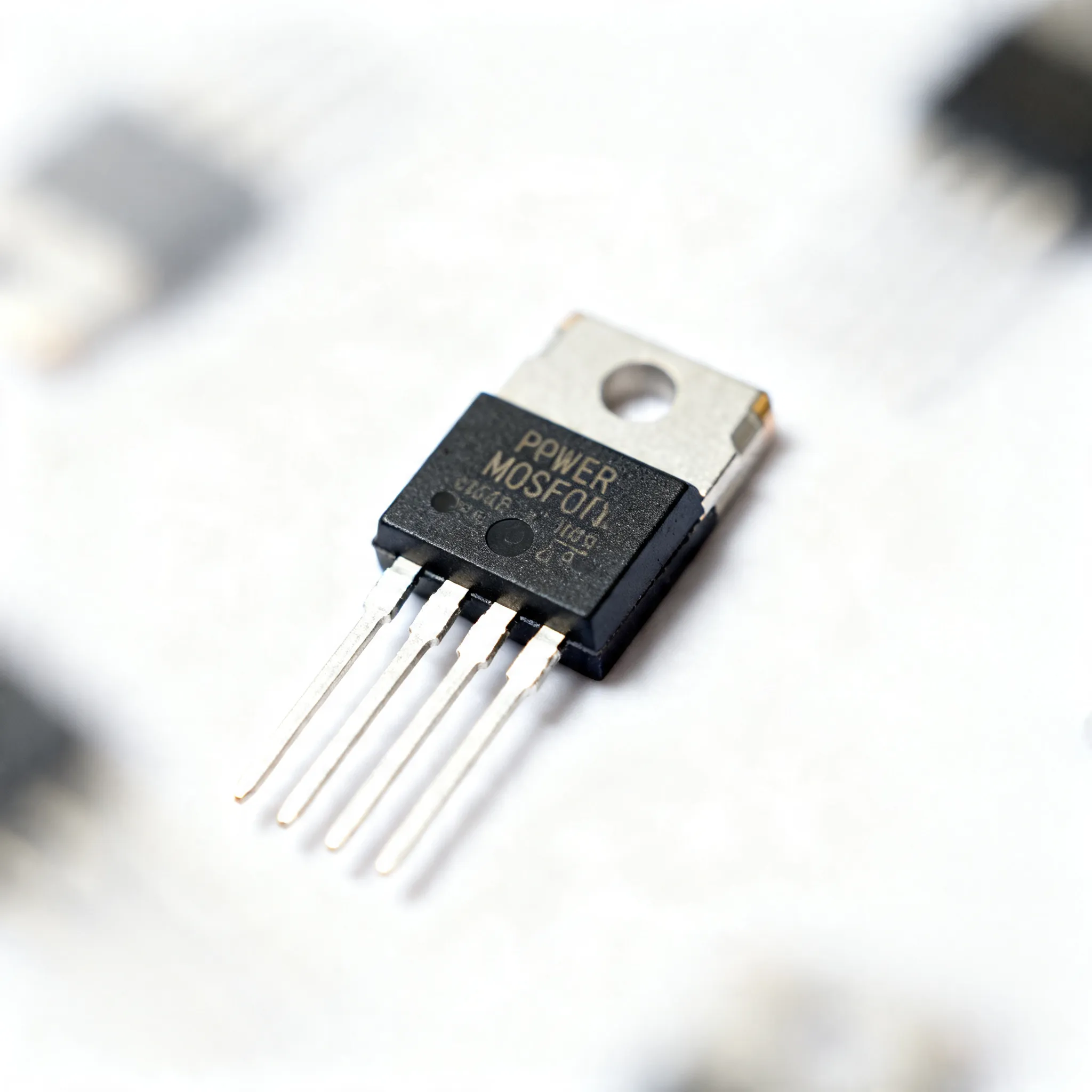
| Package Type | TO-220 | Common package for power MOSFETs | |
| Lead Material | Copper | Material used for leads | |
| Mounting Style | Through Hole | Method of mounting the component |
Application Comparison
| Application | Recommended MOSFET | Notes |
|---|---|---|
| DC-DC Converter | IRF3205 | High efficiency for buck converters |
| Motor Control | IRF540 | Suitable for medium power motors |
| Power Supply | IRF840 | Commonly used in SMPS |
| Audio Amplifier | IRF530 | Low distortion for audio applications |
| Inverter | IRFP460 | High voltage tolerance for inverters |
Design Considerations
When designing circuits with power MOSFETs, several factors must be considered to ensure optimal performance and reliability. First, the voltage and current ratings of the MOSFET must match the application's requirements. Exceeding these ratings can lead to device failure. It's also crucial to consider the thermal management of the MOSFET. Efficient heat dissipation can be achieved using heat sinks or thermal pads, preventing overheating and extending the device's lifespan.
Another critical aspect is the gate drive circuitry. The gate of a MOSFET requires a specific voltage level to turn on fully. Insufficient gate voltage can increase on-resistance, leading to higher power dissipation. Therefore, choosing an appropriate gate driver and ensuring low gate-source resistance is vital. Additionally, the switching speed of the MOSFET should align with the application's frequency requirements. Faster switching reduces energy loss but may require careful management of electromagnetic interference (EMI).
Finally, the packaging type can impact the design, especially in space-constrained applications. Surface-mount devices (SMDs) offer compact solutions but may require additional considerations for thermal management compared to through-hole packages.
Step-by-Step Guide
- Identify the Application Requirements: Begin by determining the voltage, current, and frequency requirements of your application. This will guide you in selecting the appropriate MOSFET specifications.
- Select the MOSFET: Use datasheets and parametric search tools from distributors like DigiKey Electronics to find MOSFETs that meet your specifications.
- Design the Gate Drive Circuitry: Ensure that the gate drive voltage is sufficient to fully turn on the MOSFET. Consider using a dedicated gate driver IC for high-speed applications.
- Implement Thermal Management: Design the PCB layout to include heat sinks or thermal vias to manage the heat dissipation effectively. This step is crucial for maintaining the reliability of the MOSFET.
- Simulate the Circuit: Use simulation software to model the circuit behavior under various conditions. This helps in identifying potential issues before prototyping.
- Build and Test the Prototype: Construct a prototype of your circuit and perform tests to verify its performance against the design specifications. Pay attention to thermal behavior and switching performance.
- Optimize the Design: Based on test results, make necessary adjustments to the circuit design, such as component values or layout changes, to enhance performance.
- Finalize the Design: Once the prototype meets all requirements, finalize the design for production, ensuring all documentation and component selections are up to date.
Common Issues & Solutions
Designing with power MOSFETs can present several challenges. Here are some common issues and their solutions:
- Overheating: If the MOSFET overheats, check the thermal management system. Ensure that heat sinks or thermal pads are properly installed and that there is sufficient airflow.
- Insufficient Gate Drive: If the MOSFET does not turn on fully, verify the gate drive voltage. Using a gate driver IC can provide the necessary voltage and current to the gate.
- High EMI: Fast switching can lead to EMI issues. To mitigate this, use snubber circuits or ferrite beads to reduce noise.
- Parasitic Oscillations: These can occur due to the inductance in the circuit. Adding a gate resistor can dampen these oscillations and stabilize the circuit.
- Short Circuit Protection: Implementing overcurrent protection can prevent damage in the event of a short circuit. Consider using current sense resistors and protection ICs.
Applications & Use Cases
Power MOSFETs are versatile devices used in various applications. In DC-DC converters, they enable efficient power conversion with minimal losses. For motor control, MOSFETs provide precise control over motor speed and direction, crucial for applications like robotics and electric vehicles. In audio amplifiers, they offer low distortion and high fidelity, enhancing audio quality. Additionally, MOSFETs are essential in power supplies and inverters, where their high voltage and current handling capabilities are critical.
Selection & Sourcing Guide
When selecting and sourcing power MOSFETs, it's essential to use reliable distributors that offer a wide range of components and detailed datasheets. IC Online is an excellent resource for finding authorized distributors and competitive pricing. Ensure you have all the necessary specifications and datasheets before making a purchase to ensure compatibility with your design.
FAQ
- What is the main advantage of using a MOSFET over a BJT? MOSFETs offer higher efficiency and faster switching speeds compared to BJTs, making them suitable for high-frequency applications.
- How do I calculate the power dissipation in a MOSFET? Power dissipation can be calculated using the formula P = ID² * RDS(on), where ID is the drain current and RDS(on) is the on-resistance.
- Can a MOSFET be used as a linear amplifier? Yes, MOSFETs can be used in linear amplification applications, but they are more commonly used in switching applications due to their efficiency.
- What is the significance of the gate threshold voltage? The gate threshold voltage is the minimum voltage required at the gate to turn the MOSFET on. It is crucial for designing the gate drive circuitry.
- How can I protect a MOSFET from overvoltage? Overvoltage protection can be implemented using transient voltage suppressors (TVS) or zener diodes across the MOSFET terminals.
- What is the role of the body diode in a MOSFET? The body diode provides a path for current during reverse conduction, which is useful in applications like synchronous rectification.
- How do I choose the right MOSFET for my application? Consider the voltage, current, and switching frequency requirements, as well as the thermal and mechanical specifications, to select the appropriate MOSFET.
- What are the common package types for MOSFETs? Common package types include TO-220, TO-247, and D2PAK for through-hole, and SOIC and QFN for surface-mount applications.
- Can MOSFETs handle AC signals? Yes, MOSFETs can handle AC signals, but the design must account for the bidirectional nature of AC currents.
- What is the impact of temperature on MOSFET performance? Higher temperatures can increase on-resistance and reduce the overall efficiency of the MOSFET, making thermal management crucial.
Conclusion
Understanding power MOSFET datasheets is essential for designing efficient and reliable electronic circuits. By comprehending the electrical, thermal, and mechanical specifications, engineers can make informed decisions in selecting the right components for their applications. With the continuous advancements in semiconductor technology, staying updated with the latest datasheet features and specifications is vital for optimizing performance and ensuring the success of electronic designs.