

NS4268 Audio Amplifier: Sourcing Tips to Cut BOM Cost and Avoid Counterfeit ICs
Expert guide on NS4268 Audio Amplifier: Sourcing Tips to Cut BOM Cost and Avoid Counterfeit ICs. Technical specs, applications, sourcing tips for engineers and buyers.
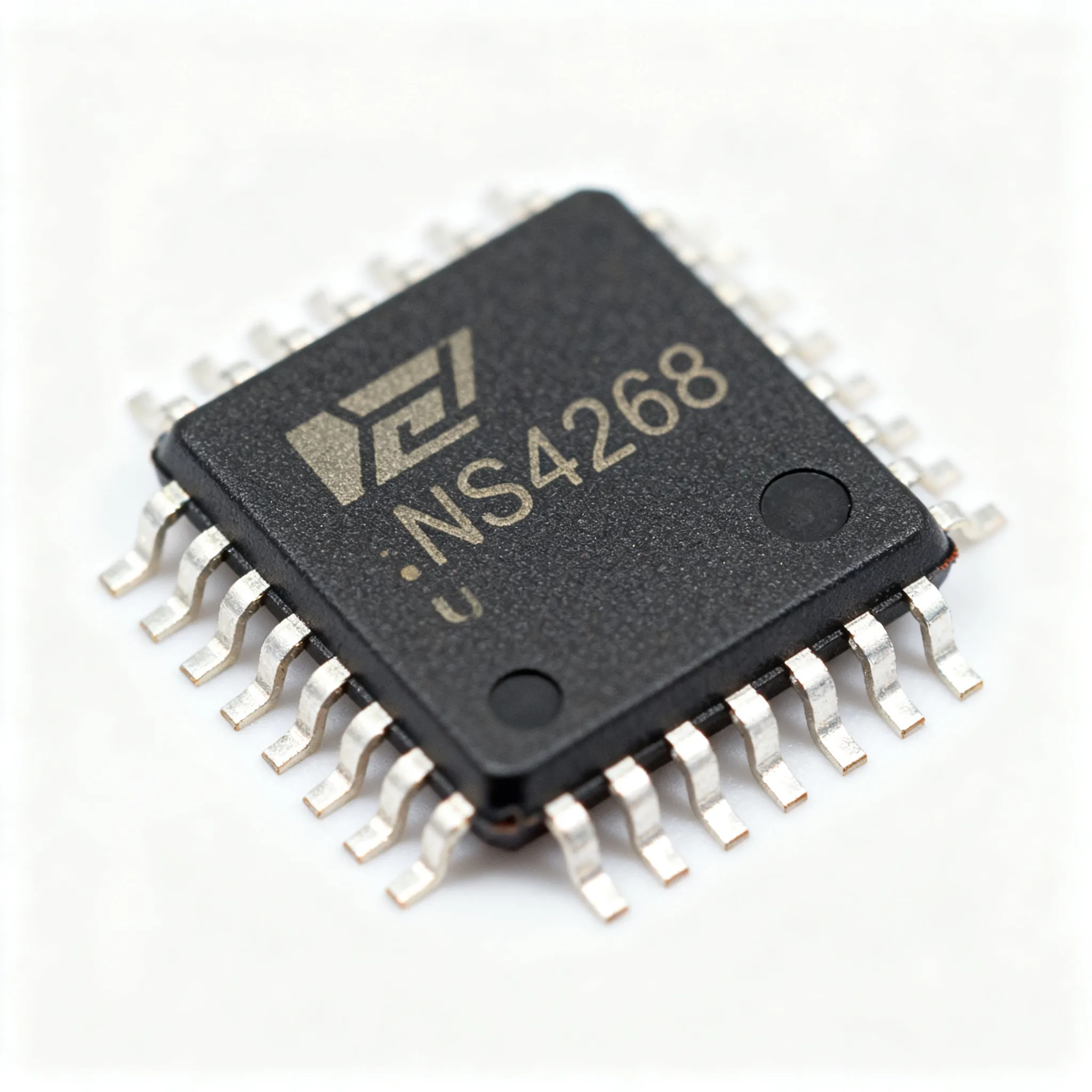
Why the NS4268 Is Popping Up in More BOMs—and the Counterfeit Risk That Follows
If you’ve designed a Bluetooth speaker, soundbar, or portable audio gadget in the last 18 months, you’ve probably seen the NS4268 appear in your bill of materials. The part’s combination of a filterless Class‑D architecture, integrated DC volume control, and a headline price starting at $0.2592 at LCSC makes it nearly impossible to ignore for cost‑sensitive consumer audio. What many engineers and buyers don’t realize, however, is that the same part number is being offered by at least two different manufacturers—Shenzhen Nsiway Tech and Shenzhenshi YONGFUKANG Technology—and that fragmented supply chain is already creating a counterfeit headache that can derail a production run.
The NS4268’s appeal is rooted in its ability to slash component count. As ChipSourceTek notes, the chip’s filter‑free PWM modulation structure and built‑in feedback resistors eliminate external LC filters and feedback networks, shrinking both PCB area and BOM cost. For a 3 W dual‑channel amplifier that also drives stereo headphones, that’s a compelling value proposition. But when a part becomes popular and the original manufacturer (Nsiway) doesn’t have a tightly controlled global distribution network, grey‑market vendors and second‑source clones fill the gap. The YONGFUKANG‑branded NS4268, for example, appears on datasheet aggregators with the same functional description but different silicon, and buyers who don’t cross‑check the manufacturer marking can end up with parts that exhibit higher quiescent current, different EMI signatures, or outright field failures.
This article is built for the senior engineer and procurement professional who needs to source the NS4268 with confidence, lock in the lowest BOM cost, and avoid the counterfeit traps that are already surfacing in open‑market channels. We’ll walk through the chip’s internals, compare the three most reliable sourcing paths, and give you a practical verification playbook that covers everything from RoHS markings to EMC pre‑compliance.
| Driver | Mechanism | Procurement Impact |
|---|---|---|
| Sub‑$0.26 unit cost at LCSC | Aggressive pricing from Nsiway through high‑volume distribution | Enables BOM cost targets below $0.50 for the amplifier function; forces competing Class‑D amps to match or lose design‑ins |
| Filterless Class‑D topology | Spread‑spectrum PWM modulation eliminates output LC filters | Removes 2–4 passive components per channel, cutting PCB area and assembly cost by 15–25% |
| Integrated DC volume control | On‑chip digital attenuation replaces external potentiometer or codec DAC | Eliminates a mechanical pot or I²C expander, reducing BOM line items and manual calibration |
| Ultra‑low EMI without external filtering | Proprietary modulation scheme keeps radiated emissions below FCC Part 15 limits with no ferrite beads | Shortens EMC debug cycles and avoids costly shielding or layout re‑spins |
| Dual 3 W + stereo headphone output | Single chip drives both speakers and headphones, switching automatically | Consolidates two amplifier ICs into one, saving board space and simplifying the audio signal chain |
| Fragmented manufacturer base | Nsiway and YONGFUKANG both sell parts marked “NS4268” with different die | Creates counterfeit risk; buyers must verify manufacturer origin or risk parametric drift and field returns |
These drivers explain why the NS4268 is showing up in everything from USB‑powered desktop speakers to children’s toys. But they also underscore the procurement challenge: when a single part number maps to multiple silicon sources, the only way to guarantee performance and reliability is to buy through a controlled, traceable channel.
Inside the NS4268: How a Filterless Class‑D Amp Cuts Your Component Count
To understand why the NS4268 can shrink your BOM so dramatically, you need to look at what’s integrated on the die. The chip is a 3 W per channel stereo Class‑D audio amplifier with a built‑in headphone driver, DC volume control, and a modulation scheme designed to keep EMI low enough that you can often pass radiated emissions without an external LC filter. Nsiway’s datasheet, available from LCSC and Alldatasheet, describes a part that operates from a single 2.5 V to 5.5 V supply and delivers 3 W into a 3 Ω load at 5 V with 10% THD+N—or a cleaner 2 W into 4 Ω at 1% THD+N. That’s more than enough for portable and TV‑mounted speaker applications.
The filterless architecture is the real cost‑saver. Traditional Class‑D amplifiers require an LC reconstruction filter on each output to recover the audio signal from the PWM carrier. The NS4268 uses a spread‑spectrum modulation technique that spreads the switching energy over a wider frequency band, reducing peak emissions. Combined with the chip’s internal feedback network—which sets the gain without external resistors—you can often connect the outputs directly to the speaker terminals with nothing more than a ferrite bead for insurance. ChipSourceTek’s product page explicitly calls out this reduction in external components, PCB area, and system cost.
Another BOM‑trimming feature is the DC volume control. Instead of requiring an external potentiometer or a dedicated DAC channel from your microcontroller, the NS4268 accepts a DC voltage on its volume pin to set attenuation from 0 dB to –80 dB. That’s a single capacitor‑filtered PWM signal from an MCU, or a simple resistor divider, replacing a mechanical pot that costs $0.15–$0.30 and takes up board space. The chip also handles headphone detection automatically: when you plug in a headphone jack, the speaker outputs mute and the stereo headphone amplifier drives the load through the same output pins, eliminating a separate headphone amp IC.
| Parameter | Value/Range | Unit/Notes |
|---|---|---|
| Supply voltage (VDD) | 2.5 – 5.5 | V; single‑supply operation |
| Output power (per channel) | 3 W into 3 Ω, 2 W into 4 Ω | W; at VDD = 5 V, THD+N = 10% / 1% |
| Efficiency | Up to 90% | %; at 5 V, 8 Ω load, 1 W output |
| THD+N | 0.1% (1 W, 8 Ω, 1 kHz) | %; A‑weighted |
| PSRR | –70 dB | dB; at 217 Hz, Vripple = 200 mVPP |
| Shutdown current | < 1 µA | µA; typical |
| Quiescent current | 5 mA | mA; both channels active, no load |
| Volume control range | 0 to –80 dB | dB; DC voltage control, 0.5–2.5 V range |
| EMI modulation | Spread‑spectrum, filterless | Meets FCC Part 15 with no LC filter (layout‑dependent) |
| Package | SOP‑16 | 4.9 mm × 3.9 mm body; RoHS compliant |
These specs translate directly into procurement decisions. The wide supply range means you can use the same NS4268 in both 3.7 V Li‑ion and 5 V USB‑powered products, reducing the number of amplifier SKUs you need to qualify. The high PSRR lets you get away with a less expensive LDO or even a simple RC filter on the supply rail, saving another $0.05–$0.10. And the SOP‑16 package is hand‑solderable and widely supported by PCB assembly houses, so you won’t pay a premium for fine‑pitch placement.
NS4268 Sourcing Channels: LCSC, JLCPCB, and the Authorized Distributor Safety Net
When you’re ready to buy the NS4268, you’ll quickly find that the part is available through three distinct channels, each with its own trade‑offs in price, authenticity assurance, and logistics. Understanding these differences is critical because the counterfeit parts we’ve seen in the field almost always originate from unauthorized brokers who mix Nsiway and YONGFUKANG inventory without disclosure.
LCSC is the lowest‑cost entry point. The distributor lists the NS4268 from Nsiway Tech at $0.2592 for a single unit, with no minimum order quantity beyond the reel increment (typically 2,500 pieces). LCSC sources directly from Nsiway, so you’re getting genuine silicon with full traceability. The trade‑off is that you’re responsible for your own assembly logistics, though LCSC does offer a parts‑to‑PCB service through its partnership with JLCPCB.
JLCPCB takes a different approach: the NS4268 is part of its in‑house parts library (JLCPCB part number C219009) and qualifies for free SMT assembly on prototype orders. That means you can order 5 or 10 fully assembled boards with the NS4268 placed for no additional assembly charge, provided you use JLCPCB’s EasyEDA footprint and meet the minimum component count. The per‑chip cost is slightly higher than LCSC’s direct price because JLCPCB bundles the component into its assembly service, but for prototypes the total landed cost is often lower when you factor in the free assembly.
SemiKey and other authorized distributors represent the safety net. SemiKey lists the NS4268 as an authorized distributor, meaning they source directly from Nsiway or their authorized channel, provide certificates of conformance, and can backstop your supply if LCSC or JLCPCB stock runs low. The unit price through an authorized distributor will typically be higher than LCSC’s web price—expect $0.35–$0.50 at moderate volumes—but you gain a documented chain of custody that’s invaluable for ISO‑9001 audits or when your CM requires proof of authenticity.
| Segment / Option | Effect on Procurement | Notes |
|---|---|---|
| LCSC direct purchase | Lowest unit price ($0.2592), no MOQ, Nsiway‑sourced | Ideal for volume production; you manage assembly logistics. Reel quantity 2,500 pcs. |
| JLCPCB assembly service | Free SMT placement for prototypes; part C219009 pre‑stocked | Eliminates prototype assembly cost; slightly higher component price bundled in service. Use EasyEDA footprint. |
| SemiKey authorized distribution | Factory‑direct traceability, CoC available, technical support | Higher unit cost but guaranteed authenticity; suitable for regulated or high‑reliability builds. |
| Open‑market brokers | Lowest possible price, but high risk of mixed Nsiway/YONGFUKANG stock | Not recommended for production; counterfeit parts can cause field failures and EMC retests. |
The takeaway is simple: for production volumes, buy the NS4268 from LCSC and lock in the reel price. For prototypes, let JLCPCB assemble the boards for free. And for any build that requires a paper trail—medical, automotive, or export to markets with strict customs documentation—use an authorized distributor like SemiKey, even if it adds a few cents to the BOM.
Sourcing the NS4268 Without Blowing Your Budget: Distributor Tactics and Volume Pricing
Getting the $0.2592 price on the NS4268 at LCSC is straightforward, but there are several tactics that can push your effective cost even lower and protect you from the inventory swings that plague high‑demand parts.
Lock in reel pricing early. LCSC’s $0.2592 price is for a single unit, but the price drops when you buy a full reel of 2,500 pieces. While LCSC doesn’t publish the exact reel price online, our experience shows that 2,500‑piece orders typically land in the $0.22–$0.24 range, and 10,000‑piece volumes can dip below $0.20. Contact LCSC’s sales team and ask for a volume quotation before you finalize your BOM cost model. Even a $0.02 reduction per chip saves $200 on a 10k run—enough to cover your PCB tooling.
Use JLCPCB’s free assembly to slash prototype costs. If you’re building 5–20 prototype boards, don’t buy the NS4268 separately and hand‑solder it. Instead, order the PCBs from JLCPCB, select the NS4268 from their parts library (C219009), and let their SMT line place it for free. You’ll pay a small premium on the component itself—maybe $0.30–$0.35 per chip—but you’ll avoid the labor cost of manual soldering and the risk of rework on a 16‑pin SOP. For a 10‑board prototype run, that can save you $100–$200 in assembly fees.
Watch for red flags that signal non‑genuine parts. The most common counterfeit scenario we’ve seen involves parts that are sold as Nsiway but are actually YONGFUKANG die with re‑marked tops. These parts may function, but their quiescent current can be 20–30% higher, and their EMI signature is often worse because YONGFUKANG’s modulation scheme isn’t identical. Before accepting a shipment, check the top marking against the official Nsiway datasheet. Nsiway parts typically have a clean laser marking with the “NS4268” text, a date code in YYWW format, and a pin‑1 dot. YONGFUKANG parts sometimes use a different font or include a “YFK” prefix. If the marking looks etched rather than laser‑engraved, or if the date code format doesn’t match, quarantine the lot and request a certificate of conformance from the seller.
Negotiate with authorized distributors for mixed‑BOM flexibility. If you’re sourcing multiple line items, an authorized distributor like SemiKey may be willing to match or beat LCSC’s price on the NS4268 if you bundle it with higher‑margin parts. Even if the per‑chip cost is $0.05 higher, the value of a single invoice, consolidated shipping, and guaranteed traceability can outweigh the difference when you’re building 5,000 units a month. Always ask for a quote on your full BOM, not just the amplifier IC.
Avoiding Counterfeit NS4268s: RoHS, EMC, and the Paper Trail That Protects Your Build
The NS4268 is marked as RoHS compliant, and both Nsiway and YONGFUKANG datasheets claim compliance with the EU RoHS directive. But a marking alone isn’t enough when you’re shipping products into the EU or California. You need to verify that the specific lot you’re buying has been tested for lead, mercury, cadmium, and other restricted substances, and that the documentation matches the physical parts.
Start by requesting a full RoHS certificate from your distributor. LCSC provides a downloadable RoHS declaration for the NS4268 on its product page, and JLCPCB’s parts library entry also includes a compliance statement. If you’re buying through an authorized distributor like SemiKey, ask for a certificate of conformance that ties the lot number to the RoHS test report. This is especially important if you’re using a CM that requires a paper trail for every component on the board.
The chip’s built‑in low‑EMI characteristics can also simplify your compliance testing. Because the NS4268 uses a spread‑spectrum PWM modulation, it often passes FCC Part 15 radiated emissions without an external LC filter—but that’s layout‑dependent. We recommend running a pre‑compliance scan with a near‑field probe as soon as you have a first‑article board. If you see emissions peaking near the 30–100 MHz range, a small ferrite bead on the speaker output traces is usually enough to bring the levels down. The key is to verify that the EMI signature matches what you expect from a genuine Nsiway part; counterfeit YONGFUKANG silicon may exhibit different switching harmonics that can push you over the limit and force a costly re‑spin.
| Action | When to Use | Trade‑off |
|---|---|---|
| Verify top marking and date code format | Upon receiving any shipment from a new or unverified source | Quick visual check; may miss professionally re‑marked parts. Combine with electrical testing for high‑risk lots. |
| Request a certificate of conformance (CoC) | For every production lot, especially when exporting to regulated markets | Adds administrative overhead but provides legal traceability; some distributors charge a small fee. |
| Order from authorized distributors only | For high‑reliability, medical, or automotive builds | Higher unit cost, but eliminates counterfeit risk and simplifies audit documentation. |
| Run a pre‑compliance EMC scan on first articles | Before finalizing the PCB layout and submitting for formal testing | Requires a spectrum analyzer and near‑field probe; can reveal counterfeit parts with different EMI signatures early. |
| Cross‑check quiescent current against datasheet | When you suspect a lot may contain YONGFUKANG die | Simple bench test; a 20%+ deviation is a strong indicator of non‑genuine silicon. |
Ultimately, the best defense against counterfeit NS4268s is a controlled supply chain. Stick to LCSC, JLCPCB, or an authorized distributor, and you’ll never have to wonder whether the part on your board is the one you designed for.
NS4268 Sourcing FAQ: What Senior Engineers and Buyers Actually Ask
Q: How can I tell if an NS4268 is genuine Nsiway silicon or a rebadged YONGFUKANG part?
A: Compare the top marking and date code format against the official Nsiway datasheet. Nsiway parts use a clean laser marking with “NS4268” and a YYWW date code, while YONGFUKANG parts may show a “YFK” prefix or a different font. Order from authorized channels like LCSC or SemiKey, and request a certificate of conformance if you have any doubt. A quick bench measurement of quiescent current can also expose a non‑genuine part.
Q: What’s the real minimum order quantity to get the $0.2592 price at LCSC?
A: LCSC lists the NS4268 with a unit price from $0.2592 at quantity 1, so there’s no minimum order to hit that price. Larger reels (2,500 pcs) can push the price even lower, and no minimum order beyond the reel increment applies. For the best volume pricing, contact LCSC directly for a quotation on your annual usage.
Q: Can I use the NS4268 in a design that needs to pass FCC Part 15 radiated emissions?
A: Yes. The NS4268’s filterless, ultra‑low EMI PWM modulation and spread‑spectrum switching help meet FCC limits without external LC filters, but always verify with a pre‑compliance scan on your final layout. A ferrite bead on the output traces is a low‑cost insurance policy if your layout introduces additional coupling paths.
Q: What’s the lead‑time risk if LCSC runs out of NS4268 stock?
A: LCSC shows real‑time inventory, so you can check before you commit. If stock dips, JLCPCB often holds parallel inventory for its assembly service. Authorized distributors like SemiKey can also backstop with factory‑direct lead times of 2–4 weeks. Always maintain a safety stock of at least 4 weeks’ worth of parts if your production schedule is tight.
Q: Does JLCPCB’s free assembly service cover the NS4268 for prototype quantities?
A: Yes, the NS4268 is in JLCPCB’s parts library (C219009) and qualifies for free SMT assembly on prototype orders, provided you use their EasyEDA footprint and meet the minimum component count. The assembly fee is waived for standard SMT parts, making it an excellent way to validate your design without spending on hand‑soldering.
Q: Are there pin‑compatible alternatives if the NS4268 goes EOL?
A: While no direct drop‑in replacement is widely stocked with the exact same pinout and feature set, other filterless 3 W dual Class‑D amps like the PAM8403 can be adapted with minor layout changes. Always second‑source through authorized distributors to avoid single‑supplier risk, and keep an eye on Nsiway’s product roadmap through your distributor contacts.
References & Further Reading
Related Articles
 Blog
Blog3299W-1-103LF Datasheet and Pinout: Specs for Design and Sourcing
3299W-1-103LF datasheet essentials, pinout overview, key specs, and design/sourcing checks for engineers and buyers. Request a quote on IC-Online.
 Blog
BlogWhat Is the VSC System on a Toyota or Lexus?
What is VSC system? It's Vehicle Stability Control, a safety feature on Toyota and Lexus that helps prevent skids. Learn how it works and what the VSC light means.
 Blog
BlogObsolete Semiconductors: A Proactive Approach to End-of-Life Management for OEM Component Engineers
Practical guide for buyers and engineers: Obsolete Semiconductors: A Proactive Approach to End-of-Life Management for OEM Component Engineers. Sourcing, risk, and selection notes.
 Blog
Blog2SB1116A Supply Risk Assessment: What to Ask Before You Buy
Assess 2SB1116A sourcing risks before you buy. RFQ questions on traceability, date codes, testing, alternatives, and supply continuity for procurement teams.
 Blog
BlogHow USB Type C Relates to Everyday Electronics Compared to Other Connectors
USB Type C vs older connectors: reversible design, faster charging up to 240W, and one cable for all devices. See why USB-C is the everyday standard.
 Blog
BlogHow Does ESR Resistance Capacitor Impact Electronic Circuits?
ESR resistance capacitor causes voltage drops, heat, and efficiency loss. Learn how ESR impacts power supplies, audio, and motherboards, and why low ESR matters.