EPROM Technology's Place in Today's Industrial IoT
Many consider EPROMs obsolete relics of a bygone era. This view overlooks the vital role of erasable programmable

Many consider EPROMs obsolete relics of a bygone era. This view overlooks the vital role of erasable programmable read-only memory in today's Industrial IoT. The sector's rapid growth is clear.
| Metric | Value |
|---|---|
| Market Value (2022) | $124.7 billion |
| Projected Market Value (2028) | $391.8 billion |
| CAGR (2023-2028) | 21.6% |
The one-time programmable (OTP) EPROM is a perfect example of this relevance. This non-volatile EPROM finds specific applications where data must never change. An EPROM permanently secures boot processes and safeguards encryption keys. The unchangeable nature of this non-volatile memory is precisely what makes the EPROM ROM indispensable for high-stakes functions. This erasable memory technology has found its niche. ⚙️
Key Takeaways
- EPROMs are important for Industrial IoT because they keep data safe in harsh places.
- One-Time Programmable (OTP) EPROMs store data that cannot change. This makes them very secure.
- EPROMs help devices start safely and protect important information like passwords.
- EPROMs are cheaper for simple devices. They also make devices more reliable and secure.
- EPROMs are like a permanent record. EEPROMs are like a notepad you can change.
Why EPROMs Persist in Harsh Environments

Industrial settings are unforgiving. They expose electronics to extreme temperatures, vibrations, and electrical noise. In these conditions, data integrity is not just important; it is essential for safety and operational continuity. This is where the unique physical properties of EPROMs shine.
Unmatched Long-Term Data Retention
Modern memory types like EEPROM (electrically erasable programmable read-only memory) and Flash store data as electrical charges. These charges can degrade over time, a process accelerated by harsh environments. An EPROM, however, stores data physically. This structure gives the EPROM its high reliability. The data inside an erasable programmable read-only memory chip can last for decades without power.
This permanence makes the EPROM an ideal choice for storing information that must never be lost or corrupted. The erasable programmable read-only memory is a fortress for critical data.
This long-term stability is a key reason why the EPROM continues to be designed into rugged industrial equipment. The non-volatile memory ensures that a device's core programming remains intact, no matter the external conditions.
The Role of One-Time Programmable (OTP) Memory
The One-Time Programmable (OTP) EPROM is a specialized version of this technology. As the name implies, you can program this memory only once. This "write-once" feature is not a limitation but a powerful security asset. The programming process involves permanently altering the memory cells. One method uses fuses that are physically "blown," an irreversible change that locks in the data. Another advanced method, anti-fuse OTP, creates a conductive path without leaving a visible mark, making it extremely difficult to reverse-engineer. This makes the OTP EPROM ROM inherently tamper-resistant.
This unchangeable nature of the ROM is perfect for storing permanent device identifiers or security keys. Leading manufacturers recognize the value of this technology for the industrial market.
- Microchip Technology Inc. is a dominant force in the OTP EPROM space.
- Analog Devices, Inc.
- Nordic Semiconductor ASA
These companies provide the essential non-volatile memory chip solutions that secure countless IIoT devices. The erasable nature of older EPROMs is gone, replaced by the permanent security of OTP.
Core IIoT Applications for EPROM
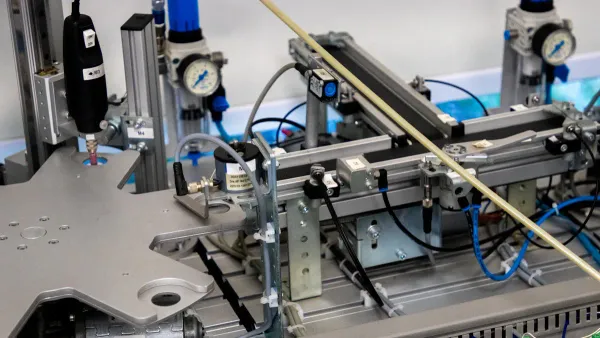
The physical resilience of EPROMs makes them ideal for specific, high-stakes jobs in the IIoT. These core applications leverage the technology's permanence to ensure security and reliability. The unchangeable nature of an OTP EPROM is its greatest strength in these contexts.
Secure Bootloaders and Root of Trust
A secure boot process is the first line of defense for any connected device. It ensures the device only loads authentic, authorized firmware. An OTP EPROM is the foundation for this process, creating a hardware "Root of Trust." The boot code stored in the EPROM is the first software to run. Its permanence guarantees this initial code is uncorrupted.
This secure bootloader then verifies the next piece of software in the boot chain. This chain of verification continues until the main operating system is loaded. Any unauthorized modification to the firmware will break this chain, and the device will refuse to boot. This prevents attacks that try to install malicious software.
Real-World Implementation: Securing a Device The process of securing a device like a Raspberry Pi 4 for an industrial role shows the EPROM in action. The proprietary EEPROM binary first authenticates the boot stages. Developers can then take steps to permanently lock the device.
- A configuration file is modified to enable secure boot.
- This file is signed with a unique customer key.
- The new, signed bootloader configuration is generated.
- Finally, the OTP memory is fused. This action permanently writes a public key hash into the EPROM, locking the device to only run firmware signed with the corresponding private key.
This process makes the EPROM an immutable anchor for device security. Companies specializing in chip-level system integration are critical for implementing such robust security. For example, Nova Technology Company (HK) Limited, a HiSilicon-authorized solutions partner, has expertise in building these secure, chip-level systems. They help integrate technologies like the OTP EPROM to create a secure foundation for IIoT devices.
Permanent Configuration and Calibration Data
Many industrial devices require permanent settings to function correctly. These settings are programmed at the factory and must never change. An OTP EPROM is the perfect storage solution for this critical information. Unlike an EEPROM, where data can be rewritten, the data in an OTP EPROM is locked in forever.
Common applications include:
- Factory Calibration: A pressure sensor or a robotic arm is precisely calibrated before it leaves the factory. The EPROM stores these unique calibration values. This ensures the device remains accurate throughout its service life.
- Network Identifiers: Every device on a network needs a unique MAC address. Storing this address in an OTP EPROM ensures it cannot be accidentally erased or maliciously changed.
- Device Personality: An erasable programmable read-only memory can hold parameters that define the device's core function or model number. This allows a single hardware design to serve multiple purposes, with its identity permanently set by the EPROM ROM.
Using an EPROM for this purpose simplifies device management and enhances reliability. The data is safe from software bugs or unauthorized access.
Holding Encryption Keys and Security IDs
Secure communication is essential in the IIoT. Devices must authenticate themselves and encrypt their data. The security of the entire system depends on protecting the encryption keys and unique security IDs. Storing these secrets in standard flash memory makes them vulnerable to sophisticated attacks that can read or alter the memory contents.
The OTP EPROM provides a much safer home for this sensitive data. The physical process of programming an OTP ROM, such as blowing a fuse or creating an anti-fuse link, is irreversible. This makes it extremely difficult for attackers to extract the keys. The erasable nature of older EPROMs is gone, replaced by a permanent and secure vault. Once a key is written to the OTP EPROM, it is physically locked in. This provides a high degree of confidence that a device's identity and its cryptographic secrets will remain confidential and intact, even in a hostile environment.
EPROM vs. Modern Memory in IIoT
Choosing the right memory technology is a critical design decision. While modern options like EEPROM and Flash are common, the EPROM holds a strategic advantage in specific scenarios. Understanding the trade-offs between these technologies reveals why the "old-school" EPROM remains indispensable.
EPROM vs. EEPROM: A Critical Distinction
At first glance, EPROM (erasable programmable read-only memory) and EEPROM (electrically erasable programmable read-only memory) seem similar. Both are non-volatile memory types. However, their core functions and underlying electronics are fundamentally different. The key distinction lies in how they are programmed and erased. An OTP EPROM is a "Write-Once, Read-Many" (WORM) device. Its data is permanent. An EEPROM, on the other hand, is designed for limited rewritability.
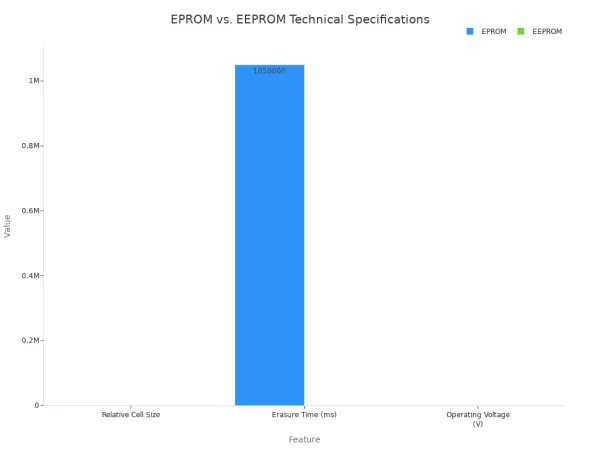
This table breaks down the technical differences:
| Feature | EPROM | EEPROM |
|---|---|---|
| Erasure Method | UV light | Electric signals |
| Physical Casing | Rock crystal window at the top | Wholly sheathed in an opaque plastic case |
| Relative Cell Size | 1 | 3 |
| Programming Technique | Hot electron injection | Tunnel effect |
| Erasure Time | 15 to 20 minutes | 5 milliseconds |
| Operating Voltage (Transistor) | 12.5 volts | 5 volts |
| Reprogramming Context | Chip must be removed from the circuit | Chip can be erased and reprogrammed within the circuit |
The electrically erasable programmable read-only memories (EEPROM) are perfect for data that changes occasionally. An industrial-grade EEPROM can endure at least 1,000,000 write cycles. This makes it the ideal choice for:
- Event logs in industrial systems
- Fault history storage in embedded systems
- Device settings and user-configurable parameters
- Sensor data logging, where a chip like the
24C08EEPROM is a suitable choice
In short: Use an EPROM for data that must never change after leaving the factory. Use an EEPROM for data that might need to change during the device's operational life. The erasable nature of EEPROM provides flexibility, while the permanent nature of an OTP EPROM provides security.
When to Choose EPROM Over Flash Memory
Flash memory is the dominant technology for data storage in consumer electronics and computers. It offers high capacity and is rewritable. So why would an IIoT designer choose an EPROM instead? The answer comes down to purpose and security.
Flash memory is designed for bulk storage. It holds operating systems, applications, and large data logs. An OTP EPROM, by contrast, is designed for storing small, critical pieces of information that act as the device's foundation. Think of the EPROM as the device's engraved birth certificate, while Flash is its rewritable diary.
The primary reason to choose an EPROM over Flash for certain tasks is security. Storing a root encryption key in an OTP EPROM physically locks it into the hardware. It is not just erasable; it is unchangeable. Extracting this key is incredibly difficult. Storing the same key in Flash memory leaves it vulnerable to sophisticated software attacks that could read or alter it. The simplicity of the EPROM becomes its greatest security strength.
Cost-Benefit Analysis for IIoT Nodes
In the world of high-volume IIoT deployments, every cent matters. For countless simple devices with a fixed function—like a basic temperature sensor or a smart valve actuator—the flexibility of an EEPROM or Flash is unnecessary. This is where the OTP EPROM provides a significant cost advantage.
The benefits are twofold:
- Lower Unit Cost: The OTP EPROM chip itself is simpler in design than an EEPROM. This results in a lower per-unit cost, which adds up to substantial savings across millions of devices.
- System Simplicity: Using an EPROM removes the need for circuitry that manages in-field reprogramming. This simplifies the overall board design, reducing component count and potential points of failure. This simplicity also contributes to better energy efficiency. A low voltage EEPROM offers great energy efficiency, but a simpler overall system with an EPROM can also lead to lower power consumption.
For a device that will perform one specific job for its entire 10-to-20-year lifespan, the most cost-effective and reliable solution is the one that does only that job. The OTP EPROM delivers this focused efficiency.
The final analysis goes beyond the bill of materials. The permanence of the EPROM ROM enhances device reliability and security. This reduces long-term costs associated with field failures, firmware corruption, and security breaches. For fixed-function IIoT nodes, the EPROM offers the best balance of cost, security, and long-term dependability. The erasable programmable read-only memory has evolved into a permanent, cost-effective security tool.
EPROM technology has not vanished; it has secured a high-value niche in IIoT applications. Its strengths are unparalleled data permanence and reliability. This makes the erasable programmable read-only memory a secure choice over a rewritable electrically erasable programmable read-only memory (EEPROM). The unique, unchangeable nature of the EPROM ROM ensures its continued relevance and efficiency.
For critical functions like device identity and root of trust, the EPROM provides permanent security. This simple memory offers great efficiency and energy efficiency where data must never be altered. The erasable nature of other memory is a risk the EPROM eliminates.
FAQ
Why use old EPROM tech instead of modern Flash memory?
OTP EPROMs offer superior security for small, critical data like encryption keys. Their physical permanence makes them tamper-resistant. Flash memory is better for large, rewritable storage but is more vulnerable to software-based attacks.
What is the simplest way to think about EPROM vs. EEPROM?
Think of an OTP EPROM as a permanent engraving for factory data that must never change. An EEPROM is like a whiteboard. It stores data that might need occasional updates, like user settings or error logs.
Are new EPROMs still being made today?
Yes. Major manufacturers produce modern OTP EPROMs. These chips are not the old UV-erasable type. They are advanced, secure components designed specifically for high-reliability industrial and security applications in the IIoT.
Can the data on an OTP EPROM be changed? 🔐
No. OTP stands for One-Time Programmable. The data is physically and permanently locked into the memory cells. This "write-once" feature is its greatest security strength, as the data cannot be altered or erased.