10K Ohm Resistor Color Code Guide for Beginners
10k ohm colour code: Brown, Black, Orange, Gold for 4-band, Brown, Black, Black, Red, Gold for 5-band resistors. Identify values easily.
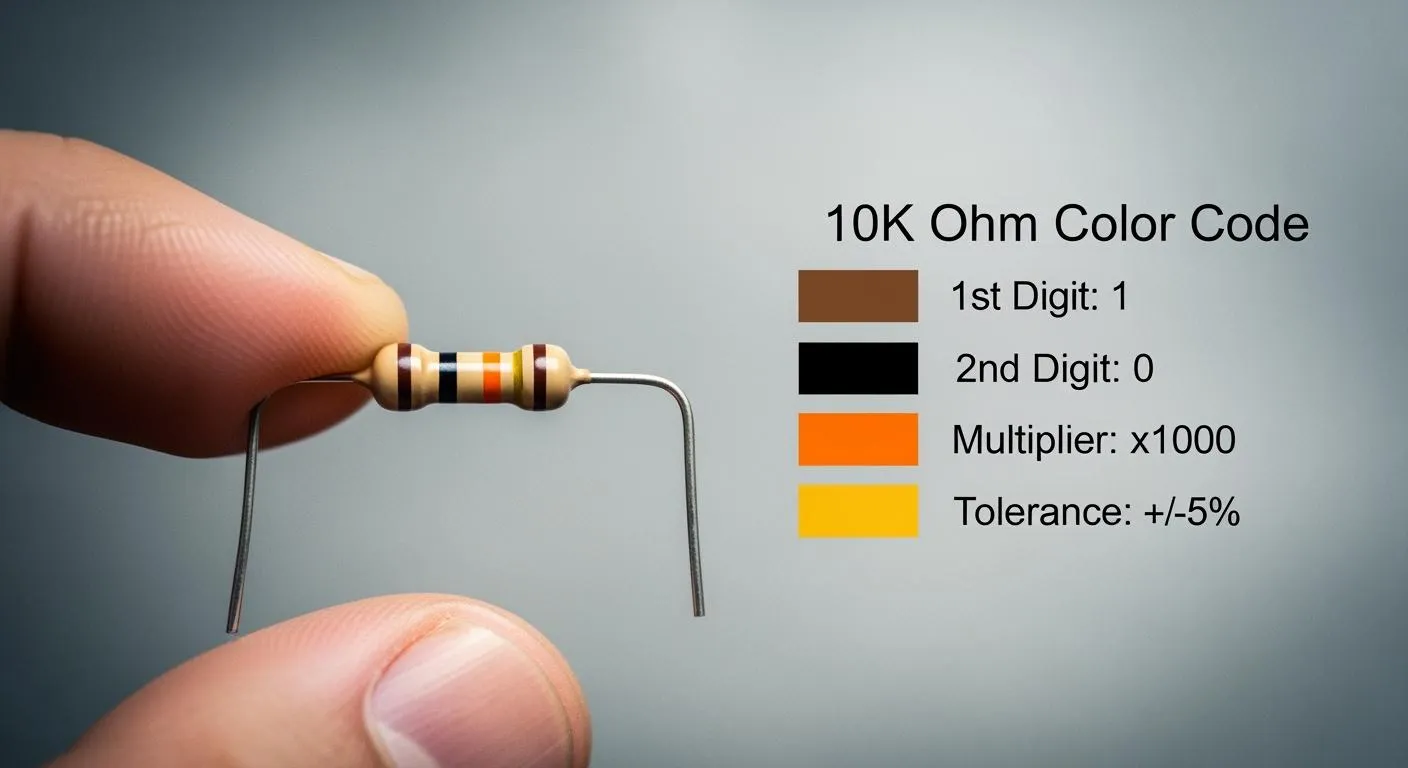
You often see resistors with colored bands. The standard 10k ohm color code for a 4-band resistor is Brown, Black, Orange, Gold. For a 5-band resistor, you should look for Brown, Black, Black, Red, Gold. See the table below for quick reference:
| Band Type | Color Code | Resistance Calculation | Tolerance | Applications |
|---|---|---|---|---|
| 4-Band | Brown + Black + Orange + Gold | 10kΩ | ±5% | Consumer electronics, DIY projects |
| 5-Band | Brown + Black + Black + Red + Gold | 10kΩ | ±1% | Industrial control, medical equipment |
Understanding the resistor color code helps you identify values quickly. You gain a fundamental skill for circuit design and embedded systems. You can avoid mistakes and work confidently with hardware.
Key Takeaways
- Learn the 10k ohm resistor color code: Brown, Black, Orange, Gold for 4-band and Brown, Black, Black, Red, Gold for 5-band.
- Use 10k ohm resistors in various applications like current limiting, voltage dividers, and pull-up/pull-down circuits.
- Always read the resistor from the band closest to the edge to avoid mistakes in identification.
- Choose resistors with a power rating higher than your circuit needs to prevent overheating.
- Practice reading color codes and use memory aids to build confidence in identifying resistor values.
What Is a 10K Ohm Resistor?
A 10k ohm resistor is a passive electronic component with a resistance value of 10,000 ohms. You use it to control the flow of electric current and manage voltage levels in electronic circuits. This resistor helps protect sensitive components, set operating points for transistors, and divide voltages for sensors or microcontrollers. When you see the resistor color code on a component, you can quickly identify if it is a 10k ohm resistor and use it correctly in your project.
Basic Properties of 10K Ohm Resistors
You will find that 10k ohm resistors come in different types, each with specific properties. The table below shows the main characteristics you should know:
| Property | Description |
|---|---|
| Tolerance | Usually ±1%, ±2%, or ±5%. This tells you how much the actual resistance can vary from 10k ohms. |
| Power Rating | Shows the maximum power the resistor can handle without overheating. |
| Temperature Coefficient | Expressed in ppm/°C. Lower values mean the resistor stays more stable as temperature changes. |
Tip: Always choose a resistor with a power rating higher than what your circuit needs. This helps prevent overheating and damage.
Common Uses in Circuits
You will see 10k ohm resistors in many types of circuits. Here are some of the most common uses:
- Current limiting: Protects LEDs and other components from too much current.
- Voltage dividers: Scales down voltages for sensors and analog-to-digital converters.
- Pull-up and pull-down resistors: Stabilizes signals in digital circuits.
- Biasing: Sets the correct operating point for transistors and amplifiers.
- RC filters: Works with capacitors to filter signals in audio and communication circuits.
| Application Type | Example Use Cases |
|---|---|
| Voltage Dividers | Scaling sensor voltages for microcontrollers, potentiometer circuits |
| Transistor Biasing | Controlling base current in amplifiers |
| RC Filter Circuits | Creating low-pass filters for audio or signal processing |
| Current Limiting | Pull-up/pull-down resistors in logic circuits, protecting microcontroller pins |
| Temperature Sensing | Used with thermistors in digital thermometers and HVAC systems |
You will often choose a 10k ohm resistor because it balances current limiting and voltage drop. It is a standard value for general-purpose use in both analog and digital circuits.
10K Ohm Colour Code Basics

Understanding the 10k ohm color code helps you identify resistors quickly and accurately. The color bands on a resistor give you all the information you need to know its value, tolerance, and sometimes even its reliability. This system has been used for decades because it works well for small components where numbers would not fit.
4-Band 10K Resistor Color Code
You will see the 4-band 10k resistor color code on most general-purpose resistors. Each band has a specific meaning:
| Band Position | Color | Value/Meaning |
|---|---|---|
| 1st | Brown | 1 |
| 2nd | Black | 0 |
| 3rd | Orange | Multiplier (×1000) |
| 4th | Gold | Tolerance (±5%) |
To read the value, start from the end opposite the gold band. The first band (brown) stands for 1, the second band (black) stands for 0, and the third band (orange) means you multiply by 1,000. The fourth band (gold) tells you the resistor’s tolerance, which is ±5%. So, the 10k ohm color code for a 4-band resistor is brown, black, orange, gold.
Tip: Always read the resistor from left to right, starting with the band closest to the edge. The gold band should be on the right.
5-Band 10K Resistor Color Code
Precision resistors use the 5-band 10k resistor color code. This version adds an extra digit for more accuracy. Here is how it works:
| Resistor Type | Number of Value Bands | Tolerance | Accuracy |
|---|---|---|---|
| 4-Band | 3 | 1 | ±5% |
| 5-Band | 4 | 1 | ±1% |
For a 10k ohm resistor, the 5-band color code is brown, black, black, red, gold. The first three bands (brown, black, black) give you the digits 1, 0, and 0. The fourth band (red) is the multiplier, which means you multiply by 100. The fifth band (gold) shows a tighter tolerance of ±1%. This higher resolution makes the 5-band 10k resistor color code ideal for circuits that need precise values.
- The extra band in the 5-band code increases the accuracy of the resistor.
- You will find these resistors in measurement equipment, medical devices, and other high-precision applications.
SMD Markings for 10K Ohm Resistors
Surface Mount Device (SMD) resistors use numbers instead of color bands. You will often see these codes on small, rectangular resistors in modern electronics. The most common SMD markings for a 10k ohm resistor are:
| Marking | Interpretation |
|---|---|
| 103 | 10 × 10³ = 10,000Ω (10kΩ) |
| 1002 | 100 × 10² = 10,000Ω (10kΩ) (±1% tolerance) |
| 000 | Zero-ohm resistor (short jumper) |
If you see "103" on an SMD resistor, it means 10 followed by three zeros, or 10,000 ohms. The "1002" marking means 100 followed by two zeros, also 10,000 ohms, but usually with a tighter tolerance. Be careful not to confuse "000" with a 10k resistor. "000" is a zero-ohm jumper, which acts as a wire.
Note: Always double-check SMD codes with a chart if you are unsure. Mixing up a zero-ohm jumper with a 10k ohm resistor can cause circuit problems.
The 10k ohm color code system follows international standards. Organizations like the Radio Manufacturers Association (RMA), International Electrotechnical Commission (IEC), and Electronic Industries Association (EIA) have all helped create and maintain these codes. The system started in the 1920s to make resistor values easy to read on small parts. It remains popular because it is reliable and works well for both through-hole and surface-mount resistors.
How to Read Resistor Color Code

Step-by-Step Identification Guide
You can read a resistor color code by following a clear process. This method works for a 10k ohm resistor and most other standard values:
- Find the First Band: Look for the band closest to the edge. This is the first digit. For a 10k ohm resistor, brown means 1.
- Check the Second Band: The next band gives the second digit. Black stands for 0.
- Identify the Multiplier: The third band shows how many zeros to add. Orange means you multiply by 1,000.
- Read the Tolerance Band: The last band, often gold, tells you the tolerance. Gold means ±5%.
So, brown (1), black (0), orange (×1,000), and gold (±5%) give you 10,000 ohms with a 5% tolerance.
Tips and Tricks for Beginners
You can use memory aids to remember the order of colors and their values. The table below helps you match each color to its number:
| Color | Number | Mnemonic to Remember |
|---|---|---|
| Black | 0 | B = 0 |
| Brown | 1 | B = 1 |
| Red | 2 | R = 2 |
| Orange | 3 | O = 3 |
| Yellow | 4 | Y = 4 |
| Green | 5 | G = 5 |
| Blue | 6 | B = 6 |
| Violet | 7 | V = 7 |
| Gray | 8 | G = 8 |
| White | 9 | W = 9 |
A popular mnemonic is:
"BB ROY Great Britain Very Good Wife"
This phrase helps you remember the order: Black, Brown, Red, Orange, Yellow, Green, Blue, Violet, Gray, White.

You can also use tools like ResistorScan Pro or ColorCode Calculator to check values quickly.
Common Mistakes to Avoid
Many beginners make similar errors when reading resistor color codes. You can avoid these mistakes by following these tips:
- Use good lighting to see colors clearly.
- Always read from the band closest to the edge.
- Do not forget the tolerance band, usually gold or silver.
- Double-check with a multimeter if you are unsure.
- Sort and label resistors to prevent mix-ups.
- Watch out for colors that look similar, such as brown and red or blue and violet.
- Verify suspicious or faded resistors before using them.
By practicing these steps, you will read resistor values accurately and avoid common problems with a 10k ohm resistor.
Applications and Replacement Tips
Real-World Uses for 10K Ohm Resistors
You encounter the 10k ohm resistor in many practical circuits. It plays a key role in voltage divider networks, which help scale sensor outputs for microcontrollers. You use it as a pull-up or pull-down resistor to stabilize digital signals in logic circuits. In audio electronics, you often see it in RC filter circuits to shape sound frequencies. You also find it in biasing circuits for transistors, ensuring reliable operation in amplifiers.
Tip: Always check your schematic before installing a resistor. Using the wrong value can cause circuit instability or malfunction.
Choosing the Right Tolerance and Wattage
When you select a replacement resistor, you must consider several factors:
- Type of Resistor: Choose from carbon film, metal film, carbon composition, or wire-wound. Each type offers unique performance for different applications.
- Power Rating: Common ratings include 1/4 watt (0.25W) and 1/2 watt (0.5W). Make sure the resistor can handle the expected power dissipation.
- Tolerance: Precision matters. Select ±1% for measurement circuits or ±5% for general use.
- Temperature Coefficient: Lower values mean better stability in changing temperatures.
If you use an incorrect resistor value or tolerance, you risk incorrect voltage levels and excessive current draw. For example, replacing a 10k ohm resistor with a 220 ohm resistor can cause overheating and component failure. Using a 100k ohm resistor may limit current too much, leading to unreliable signals.
| Factor | Why It Matters |
|---|---|
| Power Rating | Prevents overheating and damage |
| Tolerance | Ensures circuit precision |
| Material Type | Affects reliability and performance |
Safe Replacement Practices
You must follow safety practices when replacing resistors:
- Properly mount resistors for secure placement.
- Manage heat to prevent overheating and failure.
- Allow free circulation of cooling air around resistors.
- Use heat sinks for power resistors.
- Position resistors so heat exhausts quickly.
- Consider cooling fans for high-power applications.
Note: Always calculate the correct value using Ohm's Law. Check the new resistor's power rating and tolerance before installation.
Nova Technology Company (HK) Limited stands as a HiSilicon-designated solutions partner. You benefit from their expertise in chip-level solutions and system integration for the IC industry. Their advanced semiconductor services support applications in consumer electronics, industrial automation, and smart devices.
You now know how to identify and use the 10k ohm resistor color code. Remember these key points:
- Start reading from the band closest to the pins.
- Use the spacing and color of the last band to spot tolerance.
- Follow the sequence: significant digits, multiplier, then tolerance.
- Avoid common mistakes like reading backwards or confusing similar colors.
Reading resistor color codes accurately keeps your circuits safe and reliable. Practice with real resistors and use memory tricks to build confidence. For more learning, explore guides that explain resistor color codes, tolerances, Ohm’s law, and practical circuit examples.
FAQ
What does the color code Brown, Black, Orange, Gold mean?
This code shows a 10k ohm resistor with ±5% tolerance. Brown stands for 1, black for 0, orange means you multiply by 1,000, and gold shows the tolerance.
Can I use a 10k ohm resistor in place of a 1k ohm resistor?
No, you should not. A 10k resistor limits current much more than a 1k resistor. This change can cause your circuit to stop working as designed.
How do I check a resistor’s value if the colors are hard to see?
You can use a digital multimeter. Set it to measure resistance, then touch the probes to each end of the resistor. The display will show the value in ohms.
What does the tolerance band mean?
The tolerance band tells you how much the actual resistance can vary from the stated value. For example, gold means the resistor can be 5% higher or lower than 10k ohms.
Why do some resistors have five color bands?
Five-band resistors give you more precise values. You use them in circuits that need high accuracy, such as measurement tools or medical devices.