Microcontroller Applications Showdown: ARM Cortex-M4 vs. RISC-V Performance Benchmarks in IoT Nodes
Expert guide on Microcontroller Applications Showdown: ARM Cortex-M4 vs. RISC-V Performance Benchmarks in IoT Nodes. Technical specs, applications, sourcing tips for engineers and buyers.
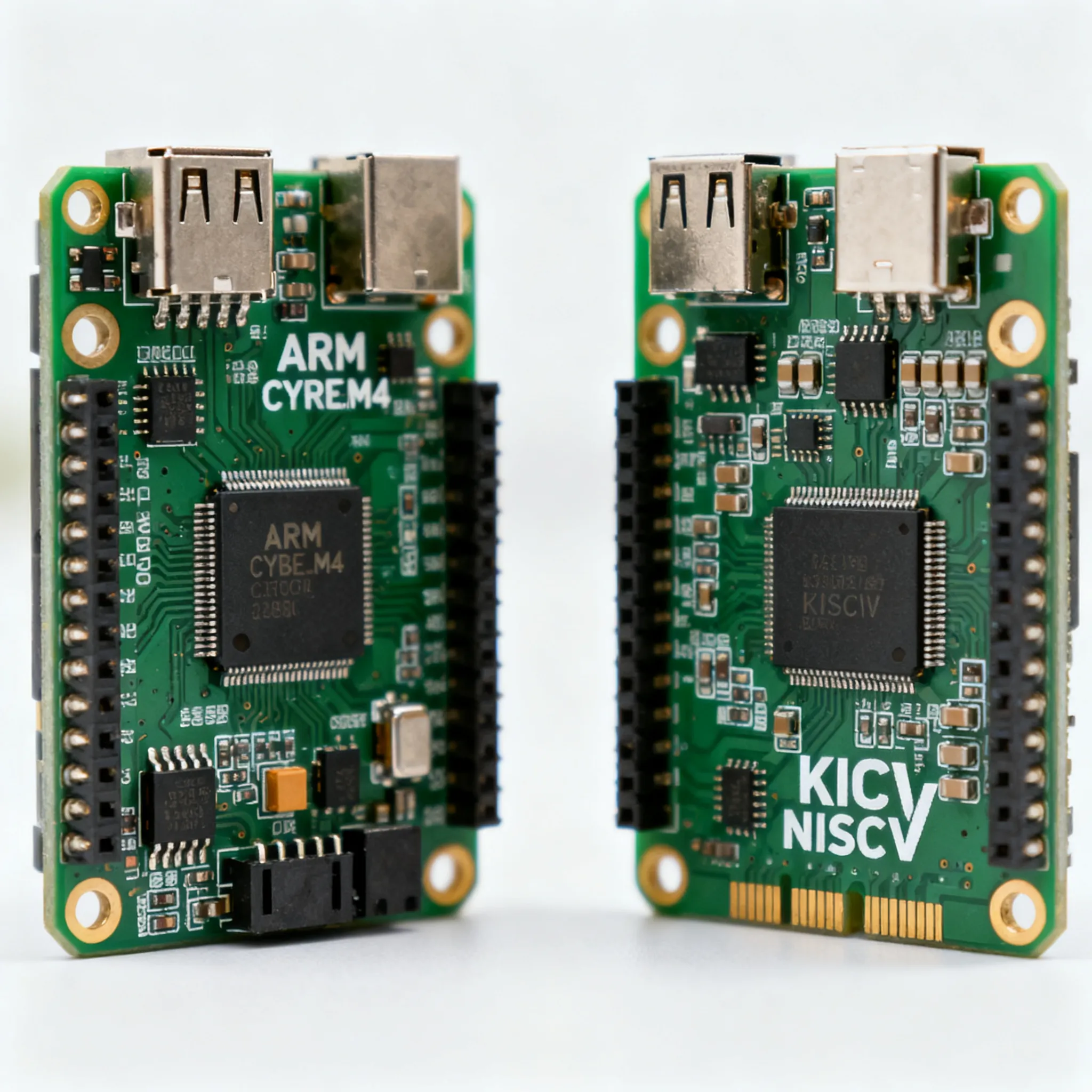
Microcontroller Showdown: ARM Cortex-M4 vs. RISC-V Performance Benchmarks for IoT Nodes
Why IoT Node Designers Are Revisiting MCU Architecture Choices in 2025
The microcontroller landscape for IoT edge nodes hasn’t seen this much genuine disruption since the arrival of the ARM Cortex-M3. For over a decade, the Cortex-M4 has been the default compute engine for connected sensors, industrial monitors, and battery-powered data loggers. Its combination of a hardware floating-point unit (FPU), DSP extensions, and a mature ecosystem made it hard to displace. But in 2025, three forces are pushing engineering teams and procurement buyers to take a hard second look at the RISC-V alternative: open-ISA flexibility, supply chain diversification mandates, and the growing availability of real-world benchmarks that go beyond datasheet marketing.
The shift isn’t theoretical. The ThinkRobotics analysis of RISC-V vs. ARM through 2025 highlights how RISC-V’s royalty-free model and custom extension capability are reshaping procurement strategies, especially for high-volume IoT products where every cent of BOM cost matters. At the same time, the ARM ecosystem is fighting back with expanded support and hardened supply chains—something that became a critical boardroom topic after the multi-year semiconductor allocation crunch. The EngineerACar beginner’s guide to MCU architectures reminds us that two cores implementing the same ISA can have vastly different microarchitectures, which means a simple ISA comparison is never enough. You need workload-level benchmarks and a clear-eyed view of toolchain maturity.
ARM’s own Cortex-M4 product support page underscores the depth of documentation, middleware, and third-party tools that have accumulated over 15 years. That ecosystem inertia is real, and it still gives Cortex-M4 a measurable time-to-market advantage for many designs. Yet, as the Wevolver comprehensive comparison notes, RISC-V is no longer a curiosity; it’s appearing in production IoT devices ranging from smart sensors to home automation hubs, often with competitive or superior performance per watt. The question for engineers and buyers in 2025 isn’t “which ISA is better?” but “which architecture delivers the right mix of performance, power, tooling, and supply assurance for my specific IoT node?”
This showdown examines that question through the lens of real benchmarks, application fit, and sourcing realities—so you can make a decision grounded in data, not hype.
Architecture Face-Off: Cortex-M4 DSP and FPU vs. RISC-V Extensions in Real Workloads
At the ISA level, the Cortex-M4 implements the ARMv7E-M profile with a single-precision FPU and a rich set of DSP instructions—single-cycle 32×32 MAC, saturated arithmetic, and SIMD operations for 8/16-bit data. RISC-V takes a modular approach: the base RV32I or RV32E integer ISA can be extended with standard “M” (multiply/divide), “F” (single-precision FP), “D” (double-precision FP), and the draft “P” (packed SIMD/DSP) extensions, plus vendor-defined custom extensions. That modularity means a RISC-V core can be tuned precisely for a workload, but it also means you can’t assume feature parity across different RISC-V MCUs without careful datasheet scrutiny.
To ground the comparison, we’ve assembled benchmark data from multiple industry sources. The Wevolver architecture comparison confirms the Cortex-M4’s 1.25 DMIPS/MHz and hardware FPU, while Inovasense’s embedded benchmarks provide real-world CoreMark and power figures for both architectures. The Stromasys cost and performance analysis adds a procurement perspective, and IC Online’s own architecture guide offers a side-by-side engineering view. Official ARM documentation—the Cortex-M4 product page and the Cortex-M4 Processor Datasheet—provides the authoritative feature list, while the DSP instruction set reference details the single-cycle MAC and SIMD operations that make the M4 a signal-processing workhorse.
| Metric | Cortex-M4 (Typical: STM32G474 @ 170 MHz) | RISC-V (SiFive E31 / GD32VF103 @ 108–150 MHz) | Selection Note |
|---|---|---|---|
| CoreMark/MHz | 3.5–4.0 | 2.8–3.5 (basic RV32IMC); up to 4.2 with custom extensions | CoreMark favors M4 out of the box; RISC-V closes gap with tuned libraries or hardware accelerators. |
| DMIPS/MHz | 1.25 (official ARM figure) | 1.1–1.3 (implementation-dependent) | M4’s deterministic pipeline gives it a slight edge in control code. |
| Hardware FPU | Single-precision (IEEE 754 compliant) | Optional RVF extension; many IoT-targeted cores include it | Verify FPU presence on RISC-V; not all MCUs include it. M4 always has it. |
| DSP Capability | Single-cycle 32-bit MAC, 8/16-bit SIMD, saturated math | Draft P extension or vendor-specific DSP; often requires library abstraction | M4’s CMSIS-DSP library is mature; RISC-V DSP is still fragmented. |
| Interrupt Latency | 12 cycles (deterministic, NVIC) | 6–10 cycles (basic CLINT); <10 cycles with CLIC | RISC-V can be faster in simple implementations, but latency varies by vendor. |
| Active Power (µA/MHz) | ~100 (STM32G4, from DC-DC) | ~90–110 (GD32VF103, SiFive E31) | Comparable; system-level power depends on peripherals and voltage scaling. |
| Deep-Sleep Current | <1 µA with RTC (STM32L4 series) | <1 µA achievable, but fewer low-power IP options | M4 has a broader portfolio of ultra-low-power MCUs with multiple stop modes. |
| Toolchain Maturity | Keil MDK, IAR EWARM, GCC (ARM Embedded) | GCC (RISC-V), LLVM, vendor IDEs (e.g., Nuclei Studio) | ARM toolchains offer better debug and trace; RISC-V is catching up fast. |
Key Takeaway: The Cortex-M4’s fixed, well-documented DSP and FPU block gives it a predictability that many IoT teams still value. RISC-V’s modularity can yield higher performance in specific signal-processing pipelines—provided you invest in optimizing the software stack. For general-purpose IoT control and sensor fusion, the M4 remains the safer, faster-to-market choice. For high-volume, cost-sensitive nodes where you can amortize custom extension development, RISC-V becomes compelling.
Where Each Architecture Shines: Sensor Fusion, Edge AI, and Low-Power Data Logging
IoT nodes are not a monolithic workload. A vibration sensor on a pump, a voice-activated smart speaker, and a soil moisture logger each stress the MCU in different ways. Understanding where the Cortex-M4’s hardwired DSP and the RISC-V’s extensibility deliver real advantages lets you match the architecture to the application—not the other way around.
For sensor fusion and real-time DSP, the Cortex-M4’s single-cycle MAC and the CMSIS-DSP library are tough to beat. The Cortex-M4 datasheet details the SIMD instructions that accelerate FIR and IIR filters, FFTs, and matrix operations common in 6-axis IMU fusion. A typical vibration monitoring node running a 1 kHz FFT on three axes can see a 30–40% cycle reduction compared to a pure integer RISC-V core without DSP extensions. RISC-V can match this with the P extension or a custom hardware accelerator, but the software ecosystem isn’t as turnkey. Inovasense’s benchmarks show that a RISC-V core with a custom MAC unit can outperform the M4 in filter throughput, but only after significant library porting effort.
Edge AI inference (keyword spotting, anomaly detection) is an area where RISC-V’s custom extensions shine. A RISC-V core can be paired with a tightly coupled vector unit or a custom neural network accelerator that shares the same ISA namespace. This avoids the overhead of offloading to a separate accelerator chip and can reduce power by keeping data local. The Wevolver IoT examples highlight RISC-V designs in smart sensors that run TinyML models with lower energy per inference than an equivalent Cortex-M4 using CMSIS-NN. However, if you’re leveraging ARM’s extensive model zoo and the CMSIS-NN library, the M4 still offers a faster path to deployment.
For ultra-low-power data logging (e.g., a BLE-connected temperature sensor that wakes once per minute), both architectures can achieve sub-µA stop currents. The Cortex-M4’s advantage lies in the breadth of MCU options with multiple sleep modes, autonomous peripheral operation, and well-characterized power profiles. ST’s STM32L4 family, for instance, offers shutdown currents as low as 30 nA with wake-up from an RTC. RISC-V MCUs like the GigaDevice GD32VF103 can hit similar deep-sleep numbers, but the selection of low-power IP (e.g., ultra-low-power UART, capacitive touch) is narrower. The ARM Cortex-M4 technical reference documents the sleep modes and wake-up interrupt controller that make power budgeting straightforward. For RISC-V, you’ll need to scrutinize each vendor’s implementation of the privileged architecture and power management unit.
| IoT Node Application | Cortex-M4 Strengths | RISC-V Strengths | Recommendation |
|---|---|---|---|
| Vibration / condition monitoring | CMSIS-DSP, single-cycle MAC, deterministic interrupt latency | Custom DSP accelerators can reduce power; open-source DSP libraries emerging | M4 for fast time-to-market; RISC-V for high-volume cost optimization with dedicated DSP IP. |
| Voice activation front-end | Hardware FPU for audio feature extraction, mature audio libraries | Custom vector extensions for beamforming; lower clock speed possible | M4 if using standard audio pipelines; RISC-V if designing a custom audio DSP. |
| Battery-powered environmental sensor | Extensive low-power MCU portfolio, multiple stop modes, autonomous peripherals | Competitive deep-sleep currents; growing low-power IP ecosystem | M4 for lowest risk and fastest design; RISC-V for cost-sensitive, high-volume nodes. |
| TinyML anomaly detection | CMSIS-NN, model zoo, wide community support | Custom NN accelerators, lower energy per inference with tightly coupled memory | RISC-V if you can invest in custom hardware; M4 for standard CNN/LSTM models. |
| Industrial sensor gateway (Ethernet/CAN) | Rich peripheral set, proven RTOS support (FreeRTOS, Zephyr) | Growing RTOS support, but fewer integrated communication stacks | M4 for complex connectivity; RISC-V for simpler sensor aggregation. |
The application matrix above isn’t static. As RISC-V’s software ecosystem matures and more vendors release application-specific standard products (ASSPs) with integrated accelerators, the gap will narrow. For now, the M4’s strength is its turnkey nature; RISC-V’s is its headroom for differentiation.
Sourcing and Design Pitfalls: What Engineers and Buyers Need to Verify Before Committing
Choosing an MCU architecture in 2025 is as much a supply chain decision as a technical one. The allure of a royalty-free ISA can quickly fade if you’re stuck with a single-source vendor, an immature toolchain, or a six-month lead time. Here’s what to verify before you commit silicon to a new IoT node design.
Toolchain and middleware readiness. The Cortex-M4 enjoys broad support from Keil MDK, IAR EWARM, and GCC, with extensive debug and trace capabilities through ARM’s CoreSight technology. ARM’s developer ecosystem includes CMSIS-DSP, CMSIS-NN, and a wealth of RTOS ports. RISC-V development is largely GCC/LLVM-based, with vendor IDEs like Nuclei Studio or SiFive Freedom Studio. While the open-source toolchain is improving rapidly, you may encounter gaps in advanced debugging (ETM trace) or middleware (TCP/IP stacks, file systems) that require additional integration effort. The IC Online architecture comparison notes that peripheral library completeness—HAL vs. bare-metal—can be a hidden time sink on RISC-V platforms.
Licensing and total cost of ownership. ARM charges an upfront license fee for the core IP and a per-chip royalty, which can add $0.10–$0.50 to each MCU depending on volume and core complexity. RISC-V eliminates those fees, but the cost savings can be offset by higher NRE for custom extension design, verification, and software porting. The Stromasys cost analysis breaks down the trade-offs: for a 100k-unit IoT node run, the royalty savings might be $10k–$50k, but custom DSP accelerator development can easily consume $100k in engineering time. Do the math for your volumes and timeline.
Multi-source availability and lead-time risk. The Cortex-M4 is manufactured by STMicroelectronics, NXP, Microchip, Texas Instruments, and a dozen others, often with pin-compatible alternatives. This second-source depth gives buyers leverage and supply assurance. RISC-V MCUs are currently more fragmented: GigaDevice, WCH, SiFive, and Andes are the primary vendors, but pin-compatible drop-in replacements are rare. The ThinkRobotics market outlook predicts consolidation and more multi-source RISC-V offerings by 2026, but for now, you’re likely betting on a single vendor’s roadmap. Always check allocation history and ask for committed lead times before designing in a RISC-V MCU.
| Sourcing Criteria | Cortex-M4 Ecosystem | RISC-V Ecosystem | Buyer Action |
|---|---|---|---|
| Licensing model | Royalty per chip + possible upfront license | Open ISA, no royalties; NRE for custom extensions | Calculate 5-year TCO including engineering porting costs. |
| Multi-source vendors | ST, NXP, Microchip, TI, Renesas, Infineon | GigaDevice, WCH, SiFive, Andes; limited pin-compatible options | Qualify at least two vendors if supply assurance is critical. |
| Typical lead times (2025) | 8–16 weeks for mainstream parts | 12–20 weeks; smaller vendors may have longer cycles | Buffer inventory and negotiate VMI with distributor. |
| Toolchain cost | Free (GCC) to $5k/seat (Keil/IAR) | Mostly free (GCC/LLVM); commercial support emerging | Factor in debug probe and trace tool costs. |
| RTOS / middleware | FreeRTOS, Zephyr, ThreadX, embOS—mature ports | FreeRTOS, Zephyr, RT-Thread; fewer turnkey middleware stacks | Verify TCP/IP, BLE, and file system stack availability early. |
| Longevity / roadmap | 15+ year commitment from ARM and silicon vendors | Growing; RISC-V International ensures ISA stability | Review vendor product longevity programs. |
Tip: Before locking in a RISC-V MCU, prototype a representative signal-processing chain using the vendor’s GCC toolchain and available DSP libraries. Measure not just CoreMark, but the actual filter execution time and power. Compare that against an off-the-shelf STM32G4 or NXP LPC54S00x board. The results often reveal gaps that datasheets alone won’t show.
Cortex-M4 vs. RISC-V for IoT Nodes: Questions Engineers and Buyers Ask
Q: How do real-world CoreMark scores compare between typical Cortex-M4 and RISC-V MCUs?
A: Cortex-M4 implementations like the STM32G4 at 170 MHz consistently achieve 3.5–4.0 CoreMark/MHz, thanks to a mature, highly optimized pipeline. RISC-V cores such as the SiFive E31 or Andes N22 typically deliver 2.8–3.5 CoreMark/MHz with the base RV32IMC ISA. However, when vendors add custom extensions or tightly coupled memories, RISC-V can close the gap and even exceed 4.0 CoreMark/MHz in specific workloads. Always request vendor-specific CoreMark scores at your target clock frequency and compiler flags.
Q: What are the hidden costs of switching to a RISC-V platform?
A: Beyond the silicon unit price, you’ll face toolchain qualification, retraining your firmware team, limited middleware availability, and potential need for custom driver development. While the open ISA eliminates ARM royalties, the NRE for integrating and validating a new toolchain and for writing or porting DSP libraries can easily reach $50k–$150k depending on complexity. Factor in longer debug cycles and the risk of discovering a peripheral erratum without a large community knowledge base.
Q: Can I reuse my existing ARM CMSIS-DSP code on a RISC-V core?
A: Not directly. CMSIS-DSP is tightly coupled to ARM’s intrinsics and the Cortex-M4’s SIMD instruction set. Some RISC-V vendors offer compatible DSP libraries that mimic the CMSIS API, but porting often requires rewriting low-level functions in portable C or using RISC-V-specific intrinsics. This can impact performance if the RISC-V core lacks the same single-cycle MAC or SIMD capabilities. A safer path is to abstract your DSP algorithms behind a hardware abstraction layer from the start.
Q: Which architecture offers better ultra-low-power sleep modes for battery-powered sensors?
A: Both can achieve sub-µA stop currents with RAM retention and RTC wake-up. Cortex-M4 MCUs, particularly the STM32L4 and L5 lines, have a decade of low-power IP refinement: multiple stop modes, autonomous DMA, and peripherals that operate in sleep. RISC-V MCUs are catching up—GigaDevice’s GD32VF103, for example, offers a deep-sleep mode below 1 µA—but the breadth of low-power peripherals (e.g., ultra-low-power UART, comparator) is still narrower. A detailed datasheet comparison of sleep currents, wake-up times, and available peripherals in stop mode is essential before choosing RISC-V for a coin-cell application.
Q: Are there second-source options for RISC-V MCUs comparable to the STM32 ecosystem?
A: Not yet at the same scale. The ARM ecosystem allows you to source pin-compatible Cortex-M4 MCUs from ST, NXP, Microchip, and others, often with minimal firmware changes. RISC-V is more fragmented: GigaDevice, WCH, and SiFive offer parts, but they are rarely pin-compatible, and peripheral sets differ significantly. This increases supply risk and makes dual-sourcing difficult. If supply assurance is a top priority, the Cortex-M4’s multi-vendor ecosystem remains a significant advantage.
Q: How does the interrupt latency of Cortex-M4 compare to popular RISC-V cores?
A: The Cortex-M4’s Nested Vectored Interrupt Controller (NVIC) delivers a deterministic 12-cycle latency from interrupt assertion to the first instruction of the handler. RISC-V cores using the basic CLINT can achieve 6–10 cycles in simple implementations, but latency can vary with the number of pending interrupts and the specific hardware design. The newer Core-Local Interrupt Controller (CLIC) specification aims to provide low, deterministic latency and can match or beat the M4’s 12 cycles. Always request vendor-specific interrupt latency measurements under your expected interrupt load, and verify tail-chaining behavior if you use nested interrupts heavily.
References & Further Reading
- Microcontroller Architectures for Beginners: ARM Cortex-M vs. RISC-V
- RISC-V vs. ARM: The Future of Microcontrollers in 2025 – ThinkRobotics
- Cortex-M4 Product Support – ARM Developer
- RISC-V vs ARM: A Comprehensive Comparison of Processor Architectures – Wevolver
- RISC-V vs ARM: Complete Architecture Comparison Guide 2026 – Stromasys
- <