How Zener diodes stabilize voltage in electronic circuits
Zener diode as voltage regulator working: ensures stable output by maintaining constant voltage across loads, even with input or load current changes.
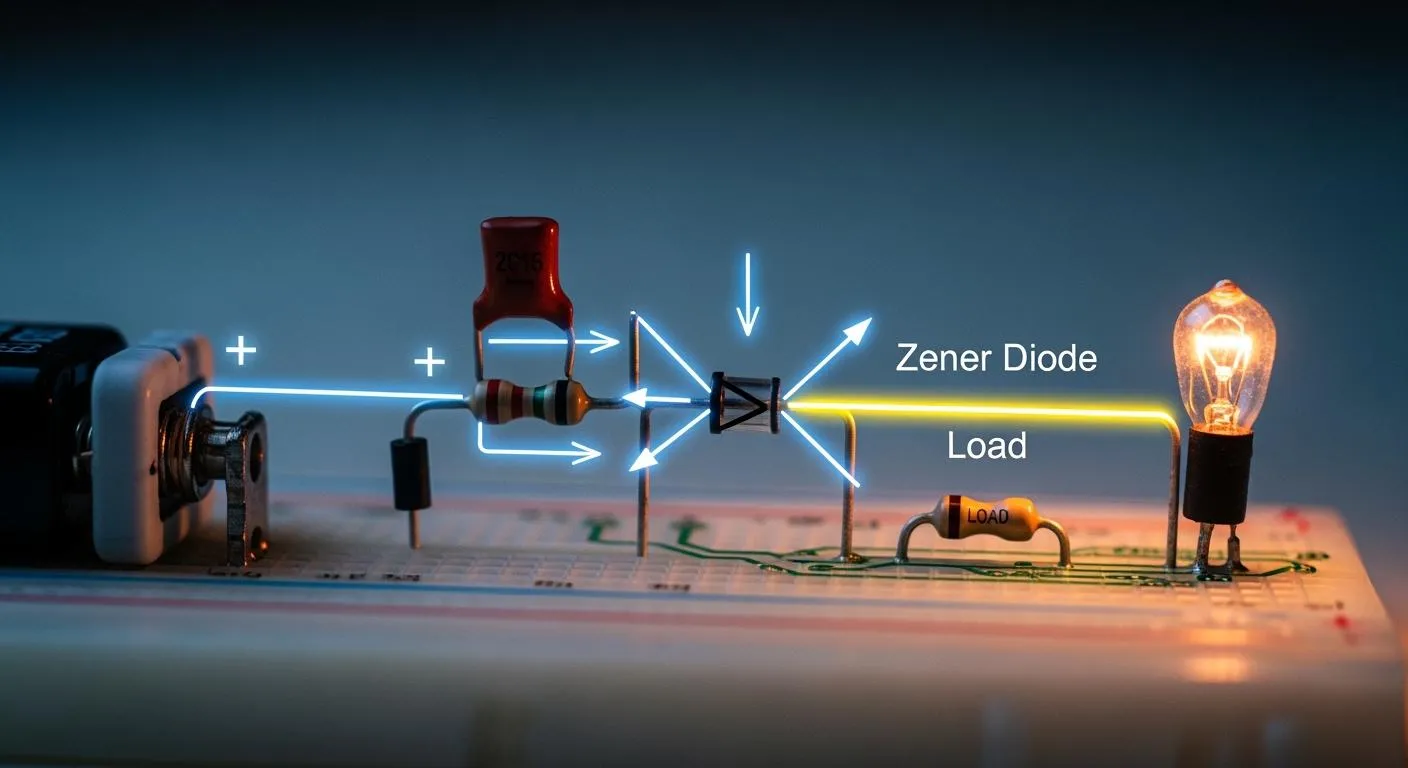
You can stabilize the voltage in your electronic circuits by using a zener diode. When you connect a zener diode in reverse bias, it maintains a constant output voltage across the load, even as the input voltage or load current changes. This unique property comes from the diode’s ability to operate in the breakdown region, where the output voltage stays fixed at the zener voltage. The zener diode as voltage regulator working principle ensures that the output remains steady. In diodes with voltages below 5 V, zener breakdown dominates, while above 5 V, avalanche breakdown takes over. This lets you achieve reliable voltage regulation for sensitive devices.
Key Takeaways
- Zener diodes stabilize voltage by maintaining a constant output across the load, even when input voltage changes.
- Connect the zener diode in reverse bias to utilize its breakdown voltage for effective voltage regulation.
- Choose the right zener diode and resistor values to ensure stable output and prevent overheating.
- Zener diodes are ideal for low-power applications, providing reliable voltage reference and protection against surges.
Zener diode basics

Structure and operation
You can find the zener diode at the heart of many voltage regulation circuits. This special diode has a P-N junction, just like a regular diode, but with a twist. Manufacturers design the zener diode with a carefully controlled doping process. This process changes the number of impurities in the semiconductor material. By adjusting the doping concentration, you can set the breakdown voltage of the zener diode to a precise value.
- The design of the P-N junction is critical for zener diode performance.
- Controlling doping concentrations allows for precise tuning of breakdown voltages.
- Higher doping concentrations lead to sharper knee characteristics in the breakdown behavior.
When you increase the doping concentration, you boost the number of charge carriers in the zener diode. This strengthens the electric field inside the P-N junction. A stronger electric field means the zener diode needs a higher voltage to reach breakdown. This feature lets you pick a zener diode with the exact voltage you need for your circuit.
Forward and reverse bias
You can use the zener diode in two ways: forward bias and reverse bias. In forward bias, the zener diode acts like a regular diode. It starts to conduct when the voltage across it goes above about 0.7 volts. Most of the time, you use the zener diode in reverse bias. Here, the zener diode blocks current until the reverse voltage reaches the breakdown voltage. At this point, the zener diode starts to conduct, and the voltage across it stays nearly constant. This property makes the zener diode perfect for voltage regulation.
- In forward bias, the zener diode conducts when the voltage exceeds 0.7 volts.
- In reverse bias, the zener diode conducts only when the voltage reaches the breakdown voltage.
- The voltage across the zener diode remains almost unchanged in the breakdown region, even if the current changes a lot.
The reverse breakdown voltage of the zener diode is much higher than the forward voltage drop. You use the reverse breakdown voltage for voltage regulation, while the forward voltage drop matters only when the zener diode conducts in the forward direction. Most zener diodes have breakdown voltages from 2.4 volts up to about 200 volts. This wide range gives you flexibility in choosing the right zener diode for your application.
Zener diode as voltage regulator working
Breakdown region and voltage regulation
You can use the zener diode as voltage regulator working principle to achieve a stabilised voltage output in your circuit. When you connect the zener diode in reverse bias, it stays off until the voltage across it reaches the breakdown voltage. At this point, the diode enters the breakdown region. The breakdown region is where the zener diode starts to conduct in reverse, allowing current to flow through the diode. This action keeps the voltage across the diode nearly constant, even if the input voltage changes.
The physical mechanism behind the zener breakdown effect involves band-to-band tunneling in a heavily doped PN junction. You can see the characteristics of this effect in the table below:
| Characteristic | Description |
|---|---|
| Mechanism | Band-to-band tunneling in heavily doped PN junctions |
| Voltage Range | Typically below 6V |
| Temperature Coefficient | Negative, VZ decreases ~-2mV/°C |
| Breakdown Knee | Predictable, sharp |
| Dynamic Resistance at Breakdown | Low |
When the reverse voltage exceeds the zener voltage, the diode conducts and shunts excess current away from the load. This process stabilizes the output voltage and protects sensitive components. You can rely on the zener diode as voltage regulator working principle to maintain a constant voltage across the load, even if the input voltage rises above the breakdown voltage.
Tip: Always check the breakdown voltage of your zener diode before using it as a voltage regulator. This value determines the stabilised voltage output you will get in your circuit.
Constant voltage output
You can depend on the zener diode as voltage regulator working to provide a constant voltage output. Once the input voltage exceeds the zener voltage, the diode maintains a steady voltage across its terminals. This regulation ensures that the output remains stable, even when the load current changes.
- The zener diode is connected in reverse to the input voltage source.
- The voltage across the diode stays constant at its breakdown voltage (VZ).
- The output voltage remains stable as long as the current through the diode stays within the breakdown region.
You will notice that the zener diode as voltage regulator working principle produces low ripple and high stability under varying load conditions. The diode conducts sufficient current to keep the voltage drop equal to the zener voltage. This behavior guarantees a constant DC output voltage, which is essential for many electronic devices.
- The diode remains off when the input voltage is below the zener voltage.
- Once the input voltage exceeds the zener voltage, the diode enters breakdown and maintains a constant voltage across its terminals.
- This ensures a stable output voltage applied to the load.
You can use the zener diode as voltage regulator working principle in low-power applications. The regulator responds quickly to changes in input voltage, but it becomes less efficient at higher currents. Compared to linear and switching regulators, the zener diode may not maintain voltage stability as effectively under fluctuating load conditions. For small circuits and reference voltage needs, the zener diode as voltage regulator working principle offers a simple and reliable solution.
Note: The zener diode as voltage regulator working principle is ideal for low-current applications. For higher currents or more demanding voltage regulation, you may need to use other types of regulators.
Zener diode regulator in circuits
Simple regulator circuit
You can build a basic zener diode regulator using just a diode and a resistor. This simple circuit helps you keep the output voltage steady, even if the input voltage changes. You connect the zener diode in reverse bias across the output terminals. The series resistor sits between the supply voltage and the output. This setup is common in practical electronics because it is easy to design and works well for low-power applications.
- The zener diode maintains the output voltage at its breakdown value.
- The series resistor limits the current through the diode and the load.
- This configuration handles changes in input voltage or load current.
Here is a table that shows typical values for zener diode regulator circuits:
| Parameter | Description | Typical Values/Notes |
|---|---|---|
| Nominal Zener Voltage (VZ) | The breakdown voltage where the zener diode operates in reverse bias. | 2 V to 200 V or more. Common types: BZX55/BZX85, 1N47xx. |
You can also connect zener diodes in series to get different reference voltages. Make sure the supply voltage is higher than the highest output voltage you need.
Tip: Always check the datasheet for your zener diode to find the correct breakdown voltage and current ratings.
Choosing Zener and resistor values
Selecting the right zener diode and resistor is important for a stable output. You need to follow a few steps to make sure your zener diode regulator works well:
- Choose the zener voltage: Decide the maximum voltage you want for your circuit. Pick a zener diode with a breakdown voltage that matches or is just above this value.
- Calculate the load and bias current: Add the current needed by your load to the minimum current required for the zener diode to stay in regulation.
- Check the power rating: Multiply the zener voltage by the total current to find the power the diode must handle. Choose a diode with a higher power rating for safety.
- Find the resistor value: Subtract the output voltage from the supply voltage. Use Ohm’s Law (R = (Vsupply - Voutput) / Itotal) to calculate the resistor value.
Changes in load resistance affect how the current splits between the load and the zener diode. If the load resistance drops, more current goes to the load, and the output voltage may fall below the zener voltage. If the load resistance rises, extra current flows through the diode, which can cause overheating. You must select the zener diode and resistor carefully to keep the output voltage stable under different load conditions.
Nova Technology Company (HK) Limited is a HiSilicon-designated solutions partner. The company specializes in chip-level solutions and system integration for the integrated circuit industry. You can use their expertise for advanced IC applications, including voltage regulation and circuit design.
Limitations and considerations
Power rating and safe use
You must pay close attention to the power rating when you use a zener diode for voltage regulation. The maximum power rating tells you how much power the diode can handle before it overheats. If you exceed this rating, the diode can fail due to excessive heat. Most zener diodes have power ratings from 500mW up to 50W. You should always select a diode with a power rating higher than the expected power in your circuit.
- Always use a current-limiting resistor in series with the zener diode. This resistor protects the diode from too much current and power.
- Good thermal management is important. If the diode gets too hot, it can stop working.
- Manufacturing differences can affect the voltage tolerance, so check the datasheet for precise values.
Tip: Never let the cathode temperature of your zener diode go above the maximum value listed in the datasheet.
Temperature effects
Temperature changes can affect the voltage regulation of your zener diode. The temperature coefficient shows how much the zener voltage shifts with each degree Celsius. For low-voltage zener diodes (less than 5 V), the voltage drops as temperature rises. For high-voltage types (more than 5 V), the voltage increases with temperature. These shifts can change the output voltage and reduce accuracy.
- Low-voltage zener diodes have a negative temperature coefficient.
- High-voltage zener diodes have a positive temperature coefficient.
- Large temperature swings can make the output voltage less stable.
You should consider the operating temperature range of your circuit to keep the output steady.
When not to use Zener regulators
Zener diodes do not work well in every situation. You should avoid using them for high-current or high-voltage regulation. The table below shows the main drawbacks:
| Drawback | Description |
|---|---|
| Limited Power Handling Capacity | Zener diodes cannot handle high power levels. |
| Poor Efficiency in High Current Applications | Zener diodes waste energy in high current circuits. |
| Temperature Sensitivity | Zener diodes change performance with temperature. |
| Performance Degrades with Increased Voltage | Zener diodes lose regulation ability at high voltages. |
You should use a zener diode for low-power, low-current applications where you need a simple and reliable voltage reference. For demanding circuits, choose other voltage regulation methods to get better efficiency and stability.
You can count on a zener diode to keep the output voltage steady in your electronic circuits. Zener diodes offer excellent voltage regulation, high reliability, and fast response speed. You will find them easy to use and cost-effective for many applications. When you understand how a zener diode works and its limits, you can choose the right diode for your needs.
- Zener diodes work best for low-current, fixed-voltage output.
- They serve as voltage references, protect circuits from surges, and stabilize power supplies.
| Factor | Why It Matters for Zener Diodes |
|---|---|
| Zener Voltage | Sets the output voltage level |
| Power Rating | Prevents overheating and failure |
| Temperature Stability | Keeps output voltage accurate |
You should use a zener diode when you need a simple, reliable way to keep the output voltage constant in small devices, power supplies, or surge protectors.
FAQ
What is the main function of a zener diode in a circuit?
You use a zener diode to keep the voltage across a load steady. This diode works by allowing current to flow in reverse when the voltage reaches a set value. It helps protect sensitive electronic parts from voltage spikes.
How does a zener diode differ from a regular diode?
A regular diode lets current flow in one direction and blocks it in the other. A zener diode, however, allows current to flow in reverse once the voltage hits its breakdown point. This makes it ideal for voltage regulation.
Can you use a zener diode for high voltage applications?
You should not use a zener diode for high voltage or high current circuits. The diode works best in low voltage, low power situations. Using it beyond its rated voltage can cause failure or overheating.
Why do you need a resistor with a zener diode?
You need a resistor to limit the current through the zener diode. Without this resistor, the diode could draw too much current when the voltage rises, which may damage the diode and affect voltage stability.
What happens if the input voltage drops below the zener voltage?
If the input voltage falls below the zener voltage, the diode stops conducting in reverse. The voltage across the load will then drop, and the circuit will lose its regulated output.