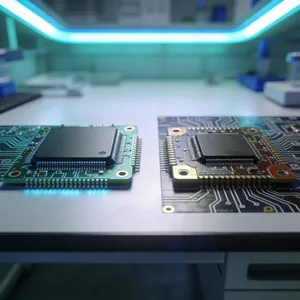
China Successfully Tests Third-Generation Semiconductor Power Devices in Space
China has successfully validated the use of third-generation semiconductor materials, particularly silicon carbide (SiC) power devices, in space, marking a major milestone for next-generation aerospace power systems. This breakthrough is expected to drive the transition of China's space power technology while reinforcing the nation’s advancements in semiconductor manufacturing.
China has successfully validated the use of third-generation semiconductor materials, particularly silicon carbide (SiC) power devices, in space, marking a major milestone for next-generation aerospace power systems. This breakthrough is expected to drive the transition of China's space power technology while reinforcing the nation’s advancements in semiconductor manufacturing.
SiC Power Devices: The Heart of Space Power Systems
According to Liu Xinyu, a researcher at the Institute of Microelectronics of the Chinese Academy of Sciences (CAS), power devices play a crucial role in energy conversion and control, often regarded as the "heart" of power electronics systems. These components are essential for applications across various industries, including aerospace, automotive, and renewable energy.
With silicon-based power devices reaching their performance limits, SiC-based semiconductors have emerged as the next-generation solution due to their higher efficiency, compact size, and reduced weight—critical factors for space power applications. SiC's unique properties allow it to function under extreme space conditions, making it a strategic technology for China's future aerospace missions.
Successful On-Orbit Testing with Tianzhou-8 Cargo Spacecraft
On November 15, 2024, a team led by Liu Xinyu and Tang Yidan from the CAS Institute of Microelectronics, in collaboration with Liu Yanmin’s team from the CAS Space Applications Engineering and Technology Center, successfully launched a SiC-based payload system aboard China’s Tianzhou-8 cargo spacecraft.
The mission's primary objective was to conduct in-space verification of high-voltage, radiation-resistant SiC power devices and evaluate their performance within aerospace power systems. Additionally, researchers conducted comprehensive radiation effect studies, aiming to enhance China's digital space power technology and pave the way for kilowatt-class power modules in future spacecraft.
Key Findings from Space Testing
After over a month of in-orbit operations, the SiC power system performed successfully:
400V high-voltage SiC power devices functioned as expected.
Static and dynamic performance parameters met all mission requirements.
The SiC payload system withstood space radiation exposure, confirming its reliability for future deep-space missions.
These results validate that SiC power devices can significantly improve the efficiency and resilience of space power systems, offering a lightweight, high-performance alternative to traditional silicon-based components.
Strategic Impact on China’s Space Exploration
Experts believe this successful in-orbit SiC validation represents a major leap forward for China’s aerospace power technology. The ability to manufacture and deploy radiation-resistant SiC power devices will accelerate China’s ambitions in lunar exploration, crewed Moon landings, and deep-space missions.
The integration of SiC technology into China’s space power systems aligns with its long-term strategic goals, positioning the country at the forefront of third-generation semiconductor applications in aerospace. With this breakthrough, China is expected to develop more advanced, high-efficiency space power solutions, ensuring sustained energy supply for next-gen spacecraft and planetary exploration missions.