Induction Motors Explained
Induction motors use electricity and magnetism to create motion. You see their work everywhere, from home applianc
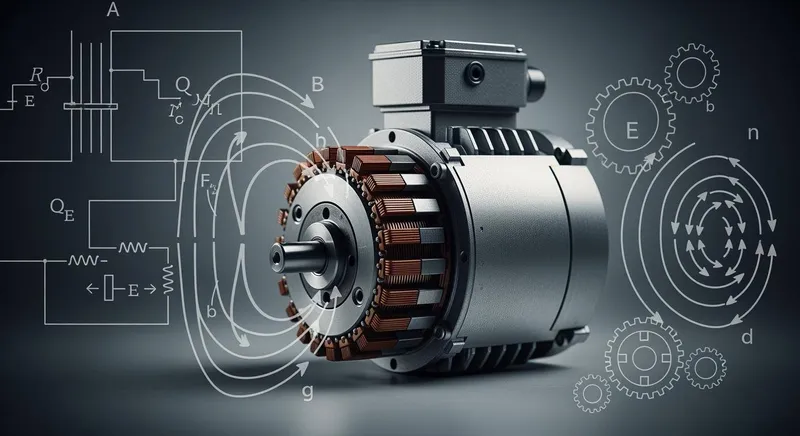
Induction motors use electricity and magnetism to create motion. You see their work everywhere, from home appliances to industrial machines.
- These motors power about 45% of the world’s electricity use.
You rely on induction motors every day, often without even noticing their presence.
Key Takeaways
- Induction motors are essential in daily life, powering appliances like fans and refrigerators, and they account for about 45% of global electricity use.
- These motors are efficient and reliable, with a simple design that reduces energy consumption by up to 30% compared to older models.
- Understanding the components and operation of induction motors can help you appreciate their role in modern technology and energy savings.
Induction Motors Overview
What Are Induction Motors
You can think of induction motors as the workhorses of modern technology. These machines use the principles of electromagnetism to convert electrical energy into mechanical motion. When you connect an ac electric motor to a power supply, current flows through the stator windings. This creates a rotating magnetic field. The rotor, sitting inside the stator, responds by generating its own current and magnetic field, which causes it to spin and produce torque.
Here’s a quick look at the main parts and their functions:
| Component | Function |
|---|---|
| Stator | Generates a rotating magnetic field through windings when AC flows through them. |
| Rotor | Interacts with the magnetic field to produce torque and drive movement. |
| Frame | Provides mechanical support and protects internal components. |
| Bearings | Allow smooth, low-friction rotation of the shaft. |
| End Covers | Hold bearings in place and protect the rotor from dust. |
| Shaft | Transfers mechanical power to connected equipment. |
| Cooling Fan | Circulates air to manage heat during operation. |
| Terminal Box | Organizes connections for the external power supply. |
Why Induction Motors Matter
You rely on induction motors every day, often without realizing it. These motors do not need brushes or commutators, which means less friction and higher efficiency. Their simple design makes them durable and reliable, even in tough environments. Industries choose induction motors because they reduce energy consumption by up to 30% compared to older models. Many governments now require energy-efficient motors to cut down on power waste. With induction motors powering about 45% of the world’s electricity use, their impact on global energy savings is huge.
Common Uses
You find induction motors in both homes and industries. In your home, they run fans, refrigerators, washing machines, and air conditioners.
| Appliance Type | Description |
|---|---|
| Fan Motors | Used in ceiling and table fans for air circulation. |
| Refrigerator Motors | Essential for the cooling mechanism in refrigerators. |
| Washing Machines | Powers the drum and agitator for washing clothes. |
| Air Conditioner Motors | Drives the compressor and fan in air conditioning units. |
In industry, induction motors power equipment in mining, healthcare, construction, food processing, textiles, and energy sectors. Their versatility and reliability make them the preferred choice for countless applications. You can count on an ac electric motor to deliver consistent performance wherever mechanical movement is needed.
How Induction Motors Work

Electromagnetic Induction Principle
You see the heart of induction motors in the principle of electromagnetic induction motor operation. This principle comes from Faraday's law. When you change the magnetic flux through a conductor, you induce voltage in that conductor. In induction motors, you use this effect to generate torque. The stator creates a rotating magnetic field. The rotor sits inside and responds by generating its own current and magnetic field. This interaction produces the force that turns the rotor and drives mechanical movement.
The principle of electromagnetic induction is based on Faraday's law, which states that a changing magnetic flux through a conductor induces voltage in that conductor. In induction motors, this principle is utilized to generate torque through the interaction of the stator's rotating magnetic field and the induced current in the rotor.
You can find experimental evidence supporting this principle:
- A novel experimental apparatus was developed to investigate unipolar induction, revealing insights into the behavior of magnetic fields in relation to moving conductors.
- The experiments indicated that the closing wire must be considered in the analysis of unipolar induction, which helps resolve the associated paradox.
- Results from a twin-disc setup showed that the induced voltages supported the conclusion that the magnetic field remains stationary when the magnets are rotated.
Main Components
You rely on several key parts to make an electromagnetic induction motor work efficiently. The stator acts as the stationary outer component. Manufacturers use laminated steel sheets to minimize energy loss. The stator contains windings that create a rotating magnetic field when alternating current flows through them. The rotor sits inside the stator and rotates in response to this magnetic field, generating torque for mechanical movement. The air gap between the stator and rotor is crucial for efficiency. A smaller gap enhances magnetic coupling and reduces magnetizing current. A larger gap can lead to decreased efficiency.
The stator is the fixed part of the motor. It features a cylindrical frame that houses the rotor's core and includes slotted stampings for three-phase windings. The rotor, which is the moving part, consists of laminated slots with conductors that facilitate its rotation. The stator supports the rotor's core and features slotted stampings that accommodate three-phase windings, which are essential for generating the magnetic field. The rotor rotates within the stator and is designed with laminated cylindrical slots that contain conductors, enabling it to interact with the magnetic field effectively.
You often encounter the squirrel-cage rotor in general-purpose induction motors. This design uses simple, rugged construction and requires minimal maintenance. You can compare it to the wound-rotor design using the table below:
| Characteristic | Squirrel-Cage | Wound-Rotor |
|---|---|---|
| Construction | Simple, rugged | Complex, slip rings |
| Cost | Lower (baseline) | 2-3× higher |
| Maintenance | Minimal | Brush replacement |
| Starting torque | 100-200% of rated | Up to 300% of rated |
| Speed control | Via VFD only | External resistance or VFD |
| Applications | General purpose | High-inertia starts (cranes, mills) |
Nova Technology Company (HK) Limited is a HiSilicon-designated solutions partner in the integrated circuit industry. You benefit from their expertise in chip-level solutions and system integration, especially in applications that require reliable and efficient electromagnetic induction motor control. Their advanced semiconductor technology supports the development of high-performance induction motors for industrial automation, smart appliances, and energy management systems.
Rotating Magnetic Field
You create a rotating magnetic field in an electromagnetic induction motor by energizing the stator windings with alternating current. The three windings are physically displaced 120° around the stator. The currents in these windings are also 120° out of phase in time. This combination results in a magnetic field that rotates smoothly around the stator bore.
- When an AC power source is connected to the motor, current flows through the stator’s windings.
- This generates a rotating magnetic field around the stator.
- Three-phase AC supply energizes the stator winding.
- The three windings are physically displaced 120° around the stator.
- The currents in these windings are also 120° out of phase in time, creating a smoothly rotating magnetic field.
The rotating magnetic field plays a vital role in the operation of induction motors:
- AC supply to stator: Three-phase current creates electromagnets arranged around the stator bore.
- Rotating field formation: Phase differences between windings cause the net magnetic field to rotate at synchronous speed.
- Flux cutting: The rotating field cuts across the stationary rotor conductors.
- EMF induction: Changing flux through each rotor bar induces voltage (Faraday’s law).
- Rotor current: Induced voltage drives current through the short-circuited rotor bars.
- Rotor magnetic field: Current in rotor bars creates the rotor’s own magnetic field induced by the stator.
- Torque production: Magnetic force between stator’s rotating field and rotor field creates electromagnetic torque.
- Rotation: The rotor turns in the same direction as the stator’s rotating magnetic field, trying to 'catch up'.
Speed and Slip
You determine the speed of an electromagnetic induction motor by the frequency of the power supply and the number of poles in the stator. The synchronous speed formula is:
Synchronous Speed (rpm) = (120 × Frequency) / Number of Poles
You can see how speed changes with different pole counts and frequencies in the table below:
| Number of Poles | Speed at 50 Hz (rpm) | Speed at 60 Hz (rpm) |
|---|---|---|
| 2 | 3000 | 3600 |
| 4 | 1500 | 1800 |
| 6 | 1000 | 1200 |
| 8 | 750 | 900 |
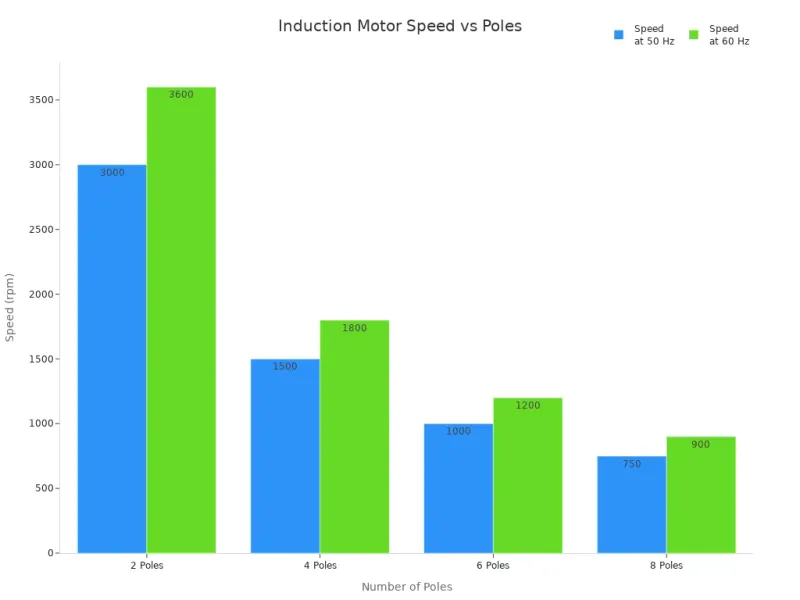
You notice that the rotor never quite reaches synchronous speed. The difference between the synchronous speed and the actual rotor speed is called slip. Slip is essential for torque production in induction motors. You calculate slip using the formula:
s = (ns − n) / ns
- Slip is defined as the difference between synchronous speed and actual rotor speed.
- At no load, slip is minimal (0.5-2%).
- As load increases, slip increases to induce more rotor current.
- At rated load, slip typically ranges from 2-5% for general-purpose motors.
You can see typical slip values for different induction motor types in the table below:
| Motor Type | Typical Slip |
|---|---|
| Large high-efficiency (>100 kW) | 1-2% |
| Medium industrial (10-100 kW) | 2-3% |
| Small commercial (1-10 kW) | 3-5% |
| Fractional horsepower | 5-8% |
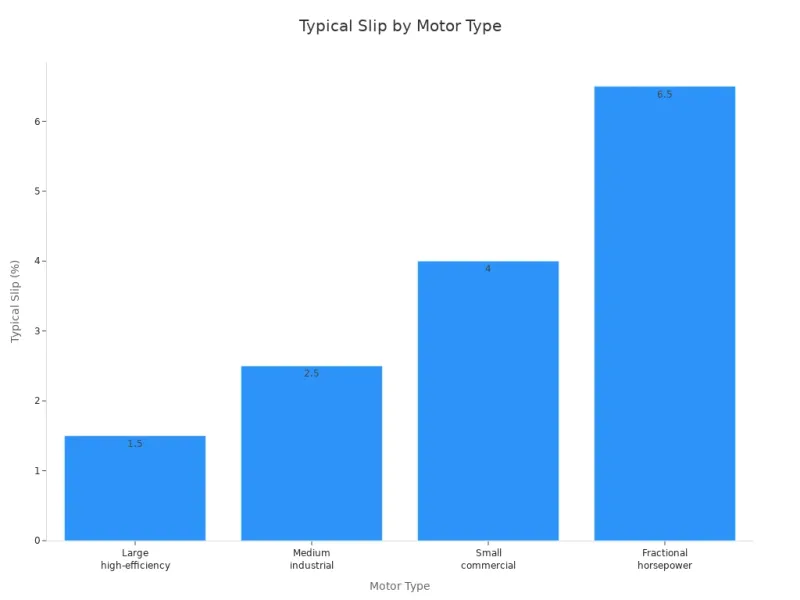
Higher slip results in increased rotor current and torque. You also see higher I²R losses in the rotor conductors, which manifest as heat. High-efficiency induction motors operate with lower slip at rated load to minimize energy loss and maximize performance.
You now understand how the electromagnetic induction motor uses its main components, rotating magnetic field, and slip to deliver reliable mechanical power for countless applications.
Types and Performance
Nova Technology Company (HK) Limited stands out as a HiSilicon-designated solutions partner in the semiconductor industry. You benefit from their expertise in chip-level solutions and system integration, which supports advanced induction motors in industrial automation, smart appliances, and energy management. Their integrated circuit technology ensures reliable performance and efficient control for both single phase induction motors and three phase induction motors.
Single-Phase vs Three-Phase
You encounter two main types of induction motors: single phase induction motors and three phase induction motors. The table below highlights their differences:
| Feature | Single-Phase Induction Motors | Three-Phase Induction Motors |
|---|---|---|
| Applications | Household applications (fans, refrigerators, etc.) | Industrial applications |
| Starting Torque | Low starting torque required | High starting torque, suitable for heavy loads |
| Magnetic Field | Pulsating magnetic field, approximates rotating field | True rotating magnetic field due to three-phase supply |
| Initial Movement | Requires external assistance to start | Self-starting due to balanced phases |
| Construction | Simpler design with fewer components | More complex design with three-phase windings |
Applications by Type
You see induction motor applications everywhere. Single phase induction motors power household appliances like fan motors, refrigerator motors, washing machines, and air conditioner motors. Three phase induction motors drive industrial machinery, pumps, conveyors, compressors, and other heavy-duty equipment. You also find wound rotor designs in cranes, hoists, and elevators, where variable speed and high starting torque are essential. Linear induction motors move maglev trains and automated material handling systems.
- Small fans
- Hair driers
- Gramophones
- Tape recorders
- Slide projectors
Three phase induction motors achieve maximum efficiency at 75% of their rated load. You notice efficiency drops below 50% load, so choosing the right motor size prevents energy loss.
Advantages
You gain several benefits from induction motors:
- Efficient and reliable operation
- Low maintenance requirements
- Versatility for various tasks
- Rugged construction and excellent speed regulation
- Compact and lightweight design
- Energy-efficient models save facilities thousands of dollars annually
- Wound rotor motors offer variable speed control for demanding applications
Automated lubrication systems and sealed bearings extend service intervals, often exceeding 10,000 operational hours.
Limitations
You face some challenges with induction motors:
| Limitation Type | Description |
|---|---|
| Speed Control Challenges | Speed is tied to supply frequency; fine control needs VFDs, adding cost |
| Efficiency Drops | Efficiency decreases at very low or high speeds |
| Starting Considerations | High starting current can cause voltage dips |
| Single-Phase Limitations | Lower efficiency and power factor; max ratings around 2-3 kW |
| Starting Components | Requires starting components that can fail |
Wound rotor motors require regular brush replacement and slip ring maintenance, which increases upkeep compared to squirrel cage designs.
You see induction motors drive progress in electronics and industry.
- Induction motors save energy and reduce costs for facilities.
- Induction motors use IoT sensors for predictive maintenance.
- Induction motors shape modern technology with advanced control and smart monitoring.
| Future Trend | Impact |
|---|---|
| Induction motors with VFDs | Lower energy usage |
| Induction motors with new materials | Higher efficiency |
Induction motors improve your daily life and power the world.
FAQ
What is the main difference between an induction motor and a synchronous motor?
You see induction motors run slightly slower than the power supply’s rotating field. Synchronous motors match the field speed exactly.
How do you control the speed of an induction motor?
You adjust the speed by changing the frequency of the AC power supply. Variable frequency drives (VFDs) make this possible.
Why do induction motors not need brushes?
You do not need brushes because the rotor current comes from electromagnetic induction. This design reduces maintenance and increases reliability.