How Beginners Can Learn the 100k Resistor Color Code
The color code for 100k resistor is brown, black, yellow, gold (4-band) or brown, black, black, orange, brown (5-band). Identify values easily with these tips.
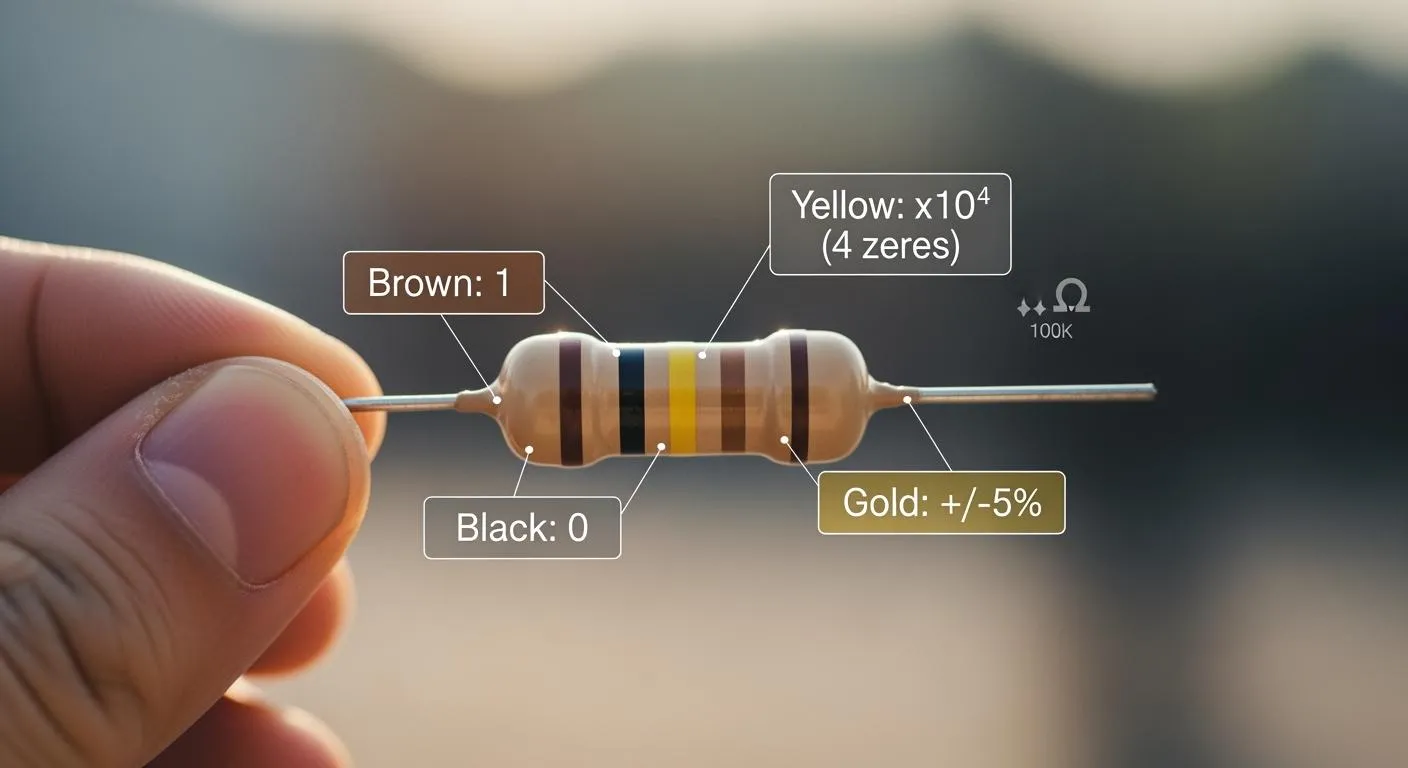
You will often see the color code for 100k resistor as Brown, Black, Yellow, Gold in the 4-band format, and Brown, Black, Black, Orange, Brown in the 5-band format. Each color stands for a specific digit, multiplier, or tolerance. If you misidentify resistor values, you may face issues like:
- Excessive current flow
- Damage to sensitive components such as LEDs
- Poor circuit performance or safety risks
Understanding the color bands helps you select the right resistor quickly and avoid costly mistakes.
Key Takeaways
- Learn the 4-band color code for a 100k resistor: Brown, Black, Yellow, Gold. This helps you quickly identify resistor values.
- Use good lighting when reading resistor bands. Proper lighting prevents confusion between similar colors.
- Double-check your readings with a multimeter. This tool ensures accuracy and builds confidence in your resistor identification.
- Avoid common mistakes like reading bands in the wrong direction. Always start with the band closest to the edge.
- Practice using mnemonics to remember the color code. Creative phrases make it easier to recall the order of colors.
Color Code for 100k Resistor

When you work with electronic circuits, you need to identify resistors quickly and accurately. The color code for 100k resistor helps you do this by using colored bands to show the value and tolerance. You will see these codes in different formats, such as 4-band, 5-band, and 6-band resistors. Each format gives you important information about the resistor’s value and how much it can vary.
Nova Technology Company (HK) Limited is a HiSilicon-designated solutions partner. The company specializes in chip-level solutions, advanced system integration, and application scenarios for industrial, automotive, and consumer electronics. Their expertise ensures reliable support for engineers working with integrated circuits and electronic components.
4-Band Color Code Explained
You will find the 4-band color code for 100k resistor in many commercial electronics. The first two bands show the digits, the third band is the multiplier, and the fourth band is the tolerance. Here is a clear breakdown:
| Band Number | Function | Color | Value/Meaning |
|---|---|---|---|
| 1 | 1st Digit | Brown | 1 |
| 2 | 2nd Digit | Black | 0 |
| 3 | Multiplier | Yellow | × 10,000 |
| 4 | Tolerance | Gold | ±5% |
You read the first two bands as the digits “1” and “0.” The yellow band means you multiply by 10,000. The gold band shows a tolerance of ±5%. This means the resistor value is 100,000 ohms, or 100k ohms, and the actual resistance can range from 95,000 to 105,000 ohms.
5-Band and 6-Band Variations
Some resistors use a 5-band or 6-band color code for 100k resistor, especially in precision circuits. The 5-band code adds a third digit for more accuracy. Here is how you read it:
| Band Number | Function | Color | Value/Meaning |
|---|---|---|---|
| 1 | 1st Digit | Brown | 1 |
| 2 | 2nd Digit | Black | 0 |
| 3 | 3rd Digit | Black | 0 |
| 4 | Multiplier | Orange | × 1,000 |
| 5 | Tolerance | Brown (±1%) or Gold (±5%) | ±1% or ±5% |
You read the first three bands as “1,” “0,” and “0.” The orange band means you multiply by 1,000. The fifth band shows the tolerance. If it is brown, the tolerance is ±1%, which means the resistor value can range from 99,000 to 101,000 ohms. If it is gold, the tolerance is ±5%.
A 6-band resistor uses the same color code as the 5-band version but adds a sixth band. This band shows the temperature coefficient. The temperature coefficient tells you how much the resistance changes when the temperature changes. This is important for high-precision or temperature-sensitive circuits.
Tolerance Bands Meaning
The tolerance band is the last color band on the resistor. It tells you how much the actual resistance can vary from the stated value. You will see these common tolerance bands:
- Gold: ±5% tolerance. The resistor value can be 5% higher or lower than 100k ohms.
- Silver: ±10% tolerance. The resistor value can be 10% higher or lower than 100k ohms.
- Brown: ±1% tolerance. The resistor value can be 1% higher or lower than 100k ohms.
Tip: For precision circuits, always choose a resistor with a lower tolerance, such as ±1%. This ensures your circuit works as expected.
You can now see how the color code for 100k resistor helps you pick the right part for your project. By understanding the meaning of each band, you avoid mistakes and build reliable circuits.
How to Read and Identify 100k Resistors

Step-by-Step Reading Guide
You can read the color code for 100k resistor easily by following a few simple steps. This process helps you avoid mistakes and ensures you pick the right component for your project.
- Place the resistor under good lighting. Bright light helps you see the colors clearly and prevents confusion between similar shades like brown and green.
- Hold the resistor so that the color bands are on the left side, starting with the band closest to the edge.
- Read the bands from left to right. The first two or three bands show the digits, the next band is the multiplier, and the last band is the tolerance.
- Identify the tolerance band. It usually appears as gold or silver and sits slightly apart from the other bands.
- Use a color code cheat sheet or a free online tool like a 4-Band Resistor Color Code Calculator to double-check your reading.
- Organize and label your resistors after reading them. This practice prevents mix-ups and saves time during circuit assembly.
Tip: Always check your resistor values with a multimeter if you have one. This tool gives you extra confidence in your readings.
Quick Identification Tips
You can quickly spot a 100k resistor by looking for specific color patterns. For a 4-band resistor, look for brown, black, yellow, and gold. For a 5-band resistor, search for brown, black, black, orange, and brown or gold.
Proper lighting makes a big difference. Good lighting makes red bands look brighter and brown bands appear darker. This helps you distinguish between colors that might look similar in poor light.
You can also use these tools and tricks:
- Use a 4-Band Resistor Color Code Calculator to check your answer.
- Keep a printed color code chart at your workspace for fast reference.
- Group resistors by value and label them clearly.
Here is a quick reference table for common band colors and their meanings:
| Color | Significant Digit | Multiplier | Tolerance |
|---|---|---|---|
| Brown | 1 | x10 | ±1% |
| Black | 0 | x1 | |
| Yellow | 4 | x10,000 | |
| Gold | ±5% | ||
| Orange | 3 | x1,000 |
By practicing these steps, you will become faster and more accurate at identifying the color code for 100k resistor in any project.
Easy Ways to Remember the Color Code
Mnemonics and Memory Tricks
You can make learning the resistor color code much easier by using mnemonics and memory aids. These tools help you remember the order of colors and their values. Many electronics students and instructors use creative phrases where each word’s first letter matches a color in the code. For example, the color code sequence is: Black, Brown, Red, Orange, Yellow, Green, Blue, Violet, Gray, White.
Here are some popular mnemonics:
- Big Boys Race Our Young Girls But Violet Generally Wins
- Bad Boys R(avage) Our Young Girls But Violet Gives Willingly
- Better Be Right Or Your Great Big Plan Goes Wrong
- ROY G BIV (for the rainbow, omitting indigo)
These phrases turn a list of colors into a memorable sentence. You can also create your own version that makes sense to you. Some students use rhymes or songs to help the sequence stick. Visualization tricks, like picturing each color as a vivid object, also work well. Chunking the colors into smaller groups can make them easier to recall.
| Mnemonic Example | Description |
|---|---|
| Big Boys Race Our Young Girls But Violet Generally Wins | Commonly taught in technical schools |
| Bad Boys Rape Our Young Girls But Violet Gives Willingly | Learned from family, reflects historical usage |
Tip: Try saying your chosen mnemonic out loud several times. This repetition helps your brain remember the pattern.
Avoiding Common Mistakes
When you read resistor color codes, you may run into some common pitfalls. Knowing these mistakes helps you avoid them:
- Confusing orange and yellow bands, which can lead to mixing up 10k and 100k resistors.
- Reading the bands in the wrong direction. Always start with the band closest to the edge and finish with the tolerance band.
- Ignoring the tolerance band, especially in voltage divider circuits, which can cause big changes in output.
- Misinterpreting colors in poor lighting. Red and orange or green and blue can look similar. Always check under good lighting.
- Forgetting about extra bands, like the temperature coefficient on 6-band resistors.
To avoid these errors:
- Read from the correct end, starting with the band nearest the edge.
- Use a multimeter to double-check resistor values.
- Work in a well-lit area to see colors clearly.
Note: Careful reading and double-checking prevent costly mistakes in your circuits.
You now know how to read and remember the 100k resistor color code. Practice helps you spot mistakes and builds your confidence. When you identify resistors correctly, you avoid voltage drops and signal distortion. You also make better choices for DIY kits and repairs.
- Accurate identification supports reliable circuit performance
- Mastering color codes encourages learning and reduces e-waste
- Helpful resources include online guides and quick reference PDFs
Keep practicing with real resistors and use these methods for fast, accurate results in your projects.
FAQ
What does each color band mean on a 100k resistor?
Each band shows a digit, multiplier, or tolerance. Brown and black are digits. Yellow is the multiplier. Gold or brown shows tolerance. You read the bands from left to right.
How can I quickly check if a resistor is 100k?
Look for brown, black, yellow, and gold bands. Use a color code chart or calculator. You can also check with a multimeter for extra accuracy.
Why is tolerance important in resistors?
Tolerance tells you how much the resistor’s value can change. Lower tolerance means more precise performance. You should use low-tolerance resistors for sensitive circuits.
What tools help me read resistor color codes?
You can use a printed color code chart, online calculators, or a multimeter. Good lighting helps you see colors clearly. Organize resistors by value for easy identification.
Can I use a 100k resistor in any circuit?
You must check your circuit’s requirements. Using the wrong value can cause errors or damage. Always match the resistor value to your project’s needs.