
Counterfeit IC Risk Mitigation for Procurement Teams: Authenticity, Inspection, and Traceability
Procurement checklist: authenticity, traceability, and quality documentation to request with your component RFQ.
Why the Cheapest Quote Rarely Reflects the Real Cost of ICs
Procurement teams that chase the lowest unit price often inherit a far bigger bill. A counterfeit IC that passes initial electrical test can still fail weeks later under thermal cycling, or worse, lies dormant until the end customer experiences a field failure. The rework, recall, and reputational damage easily erase any $0.15 saving on a microcontroller. Starting with total cost of ownership—not just price—turns authenticity from a quality-department afterthought into a buying requirement that shapes every RFQ.
Suspicious pricing is one of the earliest and clearest signals. An offer 30% or more below the authorized channel, combined with a lead time that looks too good to be true, should trigger an automatic hold. Industry experience shows that unusually low price indicates elevated risk. Behind that bargain quote may be sanded‑off original markings, thinner bond wires, or salvaged dice enclosed in new packages. Even high‑end counterfeiters have learned to use cheaper, smaller silicon dies inside standard packages, and a simple milligram‑scale check can expose the ruse (weight discrepancies explained). When the economics of a deal don’t align with the reality of genuine component shortages and allocation‑backed lead times, the most cost‑effective decision is to walk away before the P.O. is signed.
Several structural forces keep the counterfeit threat alive, and understanding them helps procurement teams anticipate when risk spikes. The table below maps the key drivers, underlying mechanisms, and how each one hits the procurement workflow.
| Driver | Mechanism | Procurement Impact |
|---|---|---|
| Component allocation and extended lead times | When authorized channels cannot fill demand, buyers turn to independent distributors and spot markets where traceability is weaker | Pressure to accept non‑authorized sources without rigorous vetting; counterfeit parts easily infiltrate BOM gaps |
| Obsolescence and EOL notices | Discontinued parts with shrinking stock invite last‑time‑buy scrambles and grey‑market harvesting | EOL cycles force procurement to source from brokers, risking remarked or substandard devices |
| Cost‑reduction targets | Aggressive savings goals push teams to entertain the lowest quote, even when it deviates from historical pricing | Price becomes the sole decision metric, sidelining authorized‑source verification and test requirements |
| Fragile supplier qualification | Many organizations lack a structured process for vetting independent distributors against AS6081 or similar frameworks | Procurement relies on verbal commitments instead of documented anti‑counterfeit policies and test reports |
| Globalized, multi‑tier supply chains | Sub‑tier assembly houses, contract manufacturers, and consolidators obscure the physical path of components | Lot traceability breaks down; suspect parts can enter without detection until field failures mount |
| Sophisticated counterfeiting techniques | Laser re‑marking, copper wire bond substitution, and mechanical refurbishing make visual screening alone insufficient | Requires lab‑level authentication that many procurement teams have not budgeted for or contracted in advance |
Each of these drivers moves the risk dial when procurement is under the most pressure. Recognizing them early gives you the language to push back on “urgent” spot buys and to insist on the authentication ladder described next. Without that foundation, even a well‑priced IC can become the most expensive component on the board.
Authentication Ladder: Visual, X‑Ray, and Destructive Inspection Side by Side
No single inspection technique catches every counterfeit, but combining them in a tiered workflow—non‑destructive screening first, lab‑level authentication as the final gate—gives teams a defensible chain of evidence. The right step depends on the commodity level of the part, its end application, and the degree of supply chain trust.
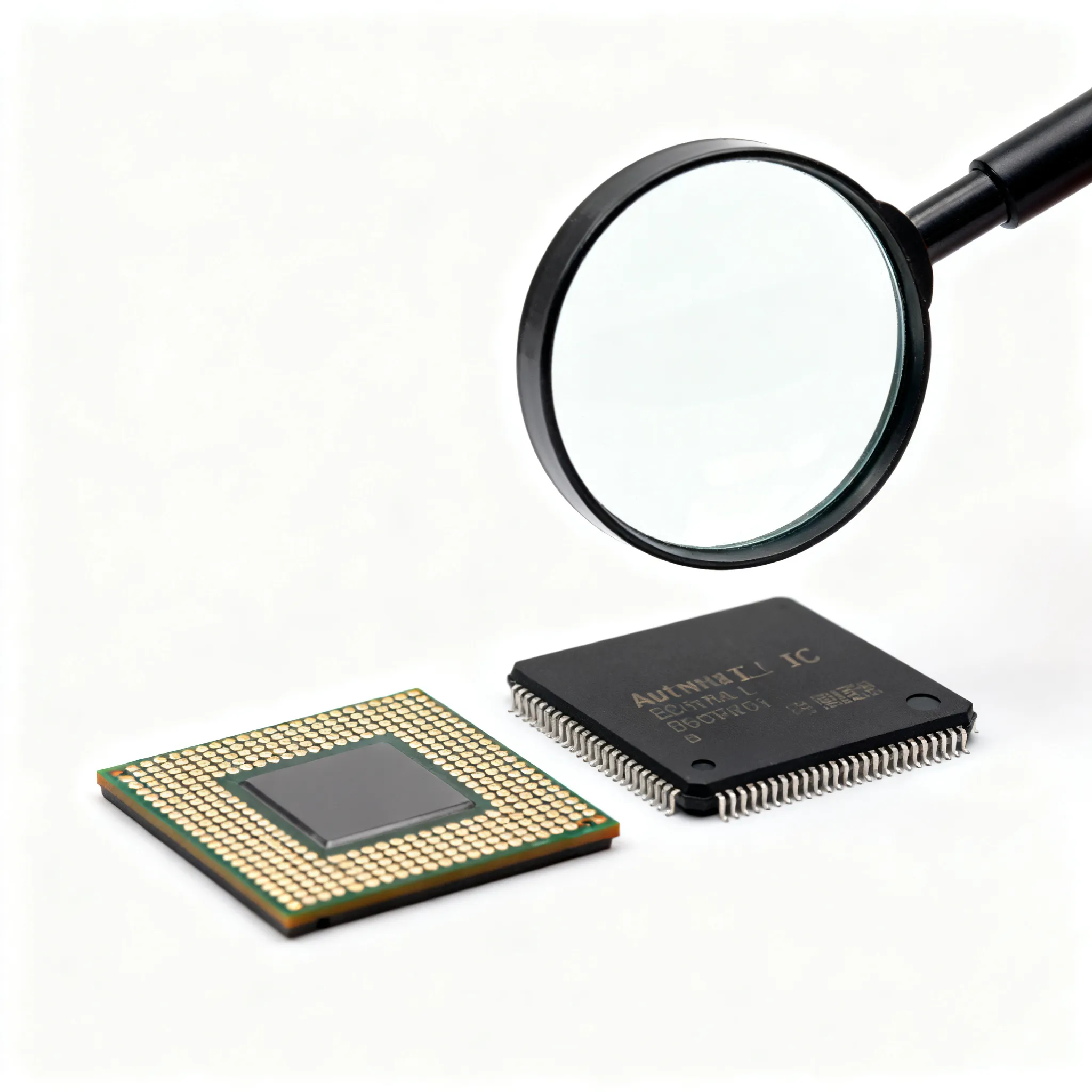
External visual inspection remains the workhorse for incoming goods. Under 10–40× magnification, an experienced inspector can spot sanding marks, inconsistent surface texture, pin‑1 indent variations, and label anomalies that differ from the OEM’s known good samples. Solvent and rub‑testing check marking permanency; re‑marked packages usually fail within seconds. These steps are fast and non‑destructive, but they cannot expose what sits inside the molding compound. That’s where precision weighing and X‑ray enter. Precision weighing compares the actual mass of a component against the OEM’s published specification on a milligram scale—hollow packages, undersized dies, or missing heat sinks produce a measurable discrepancy. X‑ray imaging goes further, revealing bond‑wire anomalies, missing wirebonds, or a die significantly smaller than the cavity.
For high‑stakes components, however, only destructive decapsulation provides absolute confidence. Decapsulation with fuming nitric acid etches away the epoxy so that a microscope can verify die markings, silicon revision codes, and fab‑origin logos. Laser decapsulation is an alternative for copper wire bond devices where acid may attack the bonds. Decap is destructive—the part is sacrificed—but it remains the definitive test when a single counterfeit could compromise a medical device, satellite, or flight‑critical system. The table below maps the most common inspection levels to their practical place in a procurement team’s escalation protocol.
Mitigation Actions: When to Use Each Inspection Level
| Action | When to Use | Trade‑off |
|---|---|---|
| External visual + marking permanency test | All incoming lots; 100% sample for suspect sources | Quick, low cost, non‑destructive; misses internal tampering, re‑die without re‑mark |
| Precision weight inspection (mg scale) | High‑volume batches or when visual check flags a possible resin difference; compare against OEM published weight | Non‑destructive, flags hollow/flipped packages; advanced counterfeiters can match weight with filler |
| X‑ray imaging | When weight discrepancy exists, or before design‑in of parts from untested channels; useful for lot sampling | Shows die size, bond wire count and orientation; cannot read die markings, silicon revision, or fab logos |
| Solvent / acetone rub + marking durability | Whenever a part lot is deemed high‑risk or fails initial suspect criteria | Non‑destructive, quickly reveals re‑mark; OEM markings may still be faint; skilled counterfeiters use epoxy‑based marks |
| Chemical decapsulation | Mission‑critical aerospace, medical, or defense devices; lot acceptance for high‑reliability contracts | Definitive die inspection; destroys component, cost $200–$600 per sample, requires controlled lab |
| Laser decapsulation | Copper‑wire‑bond devices where acid may corrode bonds; same criticality as chemical decap | Clean opening for copper bond verification; specialized equipment, higher per‑sample cost |
These actions are not mutually exclusive; a best‑practice flow starts with visual, then scales to weighing and X‑ray, reserving decap for the final audit. Specifying the required level in the purchase order—with a pre‑agreed cost split if destructive testing is needed—prevents delays later. The next section unpacks the industry standards that codify exactly how to execute each step and what documentation to demand.
How AS6081, AS6171, and DFARS Reshape Procurement’s Day‑to‑Day
Counterfeit mitigation standards have moved far beyond vague “trust your supplier” slogans. For electronics that flow into aerospace, defense, and medical platforms, AS6171 specifies a complete chain of test sequences—from visual and X‑ray to solvents and decapsulation—along with acceptance criteria and reporting formats. Meanwhile, AS6081/AS6171 authentication applies to critical programs where a single substandard die can cascade into a safety issue. Even when your end product sits outside the regulated domain, these frameworks provide a ready‑made playbook for supplier qualification and part acceptance.
DFARS clause 252.246‑7007 brings a hard legal edge. It requires contractors to source electronic parts from the original manufacturer or an authorized distributor—and when that isn’t possible, to apply risk‑appropriate test methods, maintain traceability, and report suspect product through the Government‑Industry Data Exchange Program (GIDEP). Procurement teams that integrate these requirements into their standard terms see dual benefit: they shield the organization from non‑compliance costs and they create a documented trail that can be invaluable if a counterfeit lot is later discovered.
Supplier management checklists distill the principles into a manageable routine: verify authorized status, request ISO/AS quality certificates, require a signed anti‑counterfeit policy, and perform periodic audits. Table 3 illustrates how different industry segments feel the weight of these standards, and why procurement practices must adapt accordingly.
| Segment / Stakeholder | Effect of Counterfeit IC Risk | Notes |
|---|---|---|
| Aerospace & defense primes | Single failure can ground fleets or cause mission loss; DFARS and AS6171 are mandatory, not optional | Procurement must enforce full traceability, authorized‑source preference, and GIDEP reporting |
| Medical device OEMs | Patient safety risk, FDA field actions, and recall expense; ISO 13485 and risk management plans require supplier controls | Need documented incoming inspection; decap and X‑ray used for life‑sustaining devices |
| Automotive Tier‑1 and Tier‑2 | PPAP and IATF 16949 demand stringent component traceability; counterfeit ICs can lead to stop‑ship and massive warranty costs | Procurement teams add PCN and EOL monitoring, plus 24‑month minimum traceability beyond final assembly |
| Industrial automation & IoT | False uptime, safety system malfunction; no single mandated standard, but growing customer audits | Adopt AS6081‑style incoming inspection voluntarily; use ERAI/GIDEP data to vet independent distributors |
| Broker‑dependent EMS companies | Price‑driven sourcing multiplies counterfeit exposure; one bad reel can halt an entire SMT line | Must implement independent lab agreements in advance; basic X‑ray and visual screening insufficient for high‑risk buys |
Even for commercial‑grade products, embedding these standards into your procurement playbook reduces variability. When you can show a supplier that your receiving process mirrors AS6171 test sequences, the conversation shifts from “just trust us” to “here is the documented evidence we need.” The next section turns that philosophy into day‑by‑day tactical rules.
From Purchase Order to Incoming Receipt: Six Hard‑Won Rules for Procurement Teams
Mitigation that exists only in a quality manual rarely stops a counterfeit reel from hitting the production floor. The most resilient organizations bake authenticity gates into every phase—from supplier selection to lot disposal—and treat the data generated as a living feedback loop. Here are six rules drawn from years of after‑action reviews across high‑reliability supply chains.
- Make authorized‑source verification non‑negotiable. Before cutting a P.O., require written proof that the supplier is a franchised or authorized distributor for the specific manufacturer and part number. If a part must come from the independent channel, mandate a certificate of conformance tied to the lot and a third‑party test report dated within 90 days of shipment.
- Bake pre‑agreed test triggers into the contract. Define exactly what conditions—price deviation, lead‑time anomaly, unknown lot code, or a new supplier without an active ISO 9001:2015 certificate—automatically escalate the lot to X‑ray or decap. Specify who pays for the test, how sampling is done, and the acceptance criteria. Do this before the purchase order, not during incoming inspection.
- Insist on full lot traceability and unbroken chain‑of‑custody documentation. Acceptable records include the original manufacturer’s assembly lot, date code, country of origin, and every intermediate packaging and storage step. Reject any lot that arrives with a “customer ref” label that obscures factory markings or that lacks a readable 2D matrix when the OEM normally supplies one.
- Train receiving inspectors to spot nuances, not just gross damage. Visual concerns that warrant escalation include inconsistent texture, ghosting beneath laser marking, shallow indents, or missing chamfer edges. Keep a golden sample library for your most‑used ICs and compare every suspect lot against it under controlled magnification.
- Close the loop with industry reporting. The moment a counterfeit lot is confirmed, quarantine it and stop shipment to production. Notify the original component manufacturer, then share the manufacturer, lot codes, and supplier information with ERAI and GIDEP. Proactively alert any customers who may have received the same material. Transparency isn’t a liability—it’s a shield that prevents the same bad lot from reappearing under a different broker label.
- Treat part integrity as a procurement KPI, not a quality‑department metric. Supplier management should measure on‑time delivery and cost alongside a “counterfeit risk score” per supplier. Scorecards that include AS6081/AS6171 compliance, audit results, and incident history push category managers to prioritize integrity as highly as price—and that shift alone can stop the most damaging counterfeits before they reach your dock.
These rules aren’t academic; they’re the practical output of programs that learned the hard way that a $5,000 decap budget is trivial compared to the seven‑figure cost of a single recall event. The final section answers the questions procurement and engineering leads ask most frequently when they’re standing at the receiving counter with a suspicious tray of ICs.
Questions Senior Engineers and Buyers Ask About Counterfeit IC Mitigation
Q: What red flags in pricing and lead times should trigger an automatic authenticity review?
A quoted unit price 30–50% below authorized distributor levels—or a lead time measured in weeks when the open market quotes 26+ weeks—should be treated as suspicious. Skepticism of abnormally low prices and lead times is a core defense; combine it with a formal supplier‑risk assessment before placing the order. No legitimate channel consistently beats the manufacturer’s direct price by a wide margin, especially during an allocation cycle.
Q: How do I justify the cost of destructive testing like decapsulation to management?
A single decap test might cost a few hundred dollars, while one counterfeit‑induced field failure can trigger a recall costing tens of thousands—and that’s before the brand damage. A lower purchase price can become extremely expensive if the components are defective or counterfeit. Frame the test as insurance against that hidden cost. For high‑stakes parts, decap provides the highest confidence in die authenticity—evidence that protects the organization whether the answer is “it’s genuine” or “it’s a fake.”
Q: Can X‑ray inspection replace decapsulation for final acceptance?
X‑ray excels at spotting missing or undersized die, wire‑bond quality, and lead‑frame inconsistencies, but it cannot verify die markings, silicon revision, or subtle laser‑etch alterations. For mission‑critical components, chemical or laser decapsulation remains the only conclusive step. Think of X‑ray as a powerful screening filter—if it catches an anomaly, the part is suspect; if it passes, the part still hasn’t proven its identity.
Q: When does a procurement team need to invoke AS6171 rather than standard visual inspection?
If the device goes into an avionics, implantable medical, or satellite system—or any contract that flows down DFARS 252.246‑7007—AS6171 test sequences become mandatory. Even for industrial products, specifying AS6171‑level screening from the start creates a defensible, documented chain of evidence if a suspect lot is later discovered. Don’t wait for a failure to upgrade your protocol; the contract language you write today defines your options when a suspect part is on the bench.
Q: What should I do immediately after confirming a counterfeit lot in my inventory?
Quarantine the entire lot, stop shipment to production, and notify the original component manufacturer. Then report the lot specifics (manufacturer, date/lot codes, supplier) to industry clearinghouses like ERAI and GIDEP, and proactively share that information with any customer who may have received the same suspect material. A transparent reporting cycle limits further spread and helps the wider supply chain tighten its filters. Keeping the incident internal only guarantees the same counterfeit will resurface at another unsuspecting buyer.
References & Further Reading
- Counterfeit Electronic Components Detection Methods and Supply Chain Best Practices — Masline
- Electronic Component Sourcing Guide: Avoid Counterfeits in 2026 — ElectricalFlux
- Counterfeit Electronic Component Detection 2026: AS6081, IDEA-STD-1010 & MIL-STD-883 Guide — SupplyICs
- Counterfeit Parts Guide — DFARS Detection, Prevention & Quality Requirements — GovCon Giants
- Counterfeit Mitigation: Protecting Mission Critical Supply Chains — AAA
- COUNTERFEIT PARTS CHECKLIST CPC-JAN20 — NQA
- The Evolution of the Counterfeit Electronic Parts Threat — SMT Corp
Stopping counterfeits isn’t about a single perfect test—it’s about building a procurement discipline where authenticity is priced into every decision. The standards, inspection ladder, and reporting loops described here give your team a coherent, auditable method to catch fakes before they land on a pick‑and‑place machine. When the next “unbelievable deal” lands in your inbox, you’ll have the framework to evaluate it against real risk, not just unit cost.
For your next BOM with mixed‑sourcing challenges, use IC-Online’s RFQ and BOM upload tools to reach vetted distributors with clear authenticity requirements—no generic promises, just documented traceability and flexible MOQs that match your production reality.