Microcontroller vs Microprocessor: 2026 Market Trends and Engineer’s Buying Guide
Expert guide on Microcontroller vs Microprocessor: 2026 Market Trends and Engineer’s Buying Guide. Technical specs, applications, sourcing tips for engineers and buyers.
Why the MCU vs MPU Decision Matters More in 2026: Supply, Growth, and Real‑World Pressure
If you are designing a motor controller, a battery management system, or an edge AI node in 2026, the choice between a microcontroller (MCU) and a microprocessor (MPU) is no longer a simple technical preference. It’s a supply‑chain decision with hard cost, lead‑time, and lifecycle consequences. The numbers behind this shift are impossible to ignore. The global MCU market, valued at USD 36.23 billion in 2025, is forecast to jump to USD 40.48 billion in 2026 and surge toward USD 107.99 billion by 2035, expanding at a CAGR of 11.54 % from 2026 to 2035 (Precedence Research). At the same time, the microprocessor market alone is expected to reach around USD 91.6 billion by 2026, fueled by automation, IoT, and smart‑device proliferation (Verified Market Reports). Together, the combined microcontroller and microprocessor market is projected to grow at a 7.9 % CAGR from 2025 to 2035, climbing from roughly USD 34.9 billion to USD 75 billion by 2035 (WiseGuyReports).
This explosive growth is not evenly distributed. The Asia‑Pacific region, led by China’s massive electronics manufacturing base and booming automotive sector, dominates MCU consumption and production (Verified Market Research). Industrial automation and the Industry 4.0 push demand real‑time control systems that only advanced MCUs can deliver, while electric vehicles (EVs) and autonomous driving platforms pull high‑performance MPUs into the same supply chain. For engineers and procurement buyers, the message is clear: treating MCU and MPU selections as interchangeable is a recipe for missed deadlines, bloated BOMs, and single‑source vulnerabilities. The 2026 landscape demands a structured, evidence‑based approach to architecture selection—one that weighs processing requirements against market realities, lead‑time trends, and emerging ISA shifts.
MCU and MPU Architectures: Where Integration Meets Processing Power
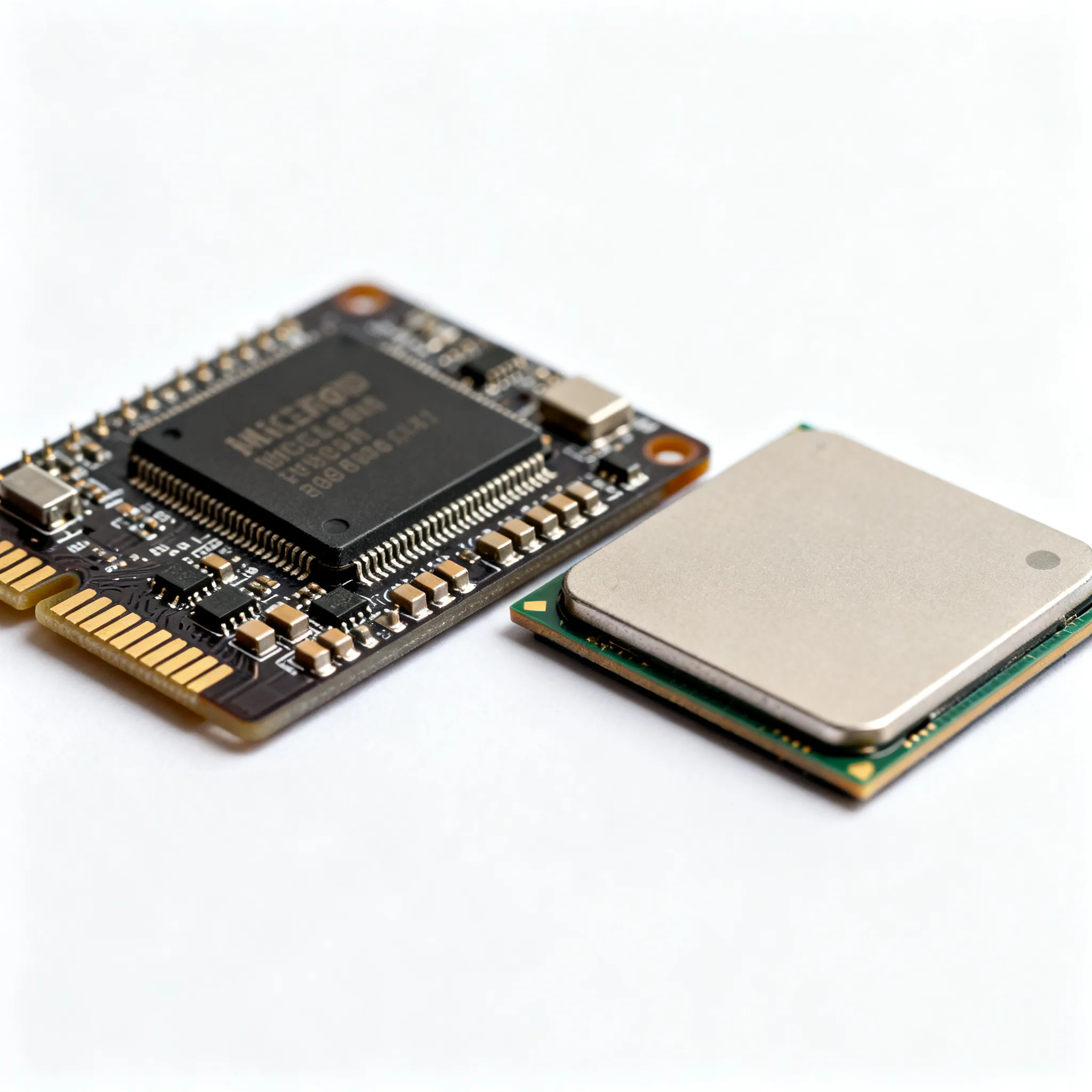
At the silicon level, the difference between an MCU and an MPU is a study in integration versus raw throughput. An MCU packs a processor core, on‑chip flash and SRAM, a rich set of peripherals (timers, ADCs, communication interfaces), and often power management onto a single die. This integration yields deterministic, low‑latency control with minimal external components, making MCUs the workhorse of real‑time embedded systems. An MPU, by contrast, strips away on‑chip non‑volatile memory and most peripherals, relying on external DRAM and flash to run a full operating system such as Linux. The result is vastly higher processing headroom for multi‑tasking, complex user interfaces, and data‑intensive applications—but at the expense of higher power consumption, larger PCB footprint, and a more complex boot sequence.
The table below captures the typical parametric boundaries that matter when you start a new design.
| Parameter | Typical MCU (ARM Cortex‑M4/M33) | Typical MPU (ARM Cortex‑A53/A55) | Engineering Impact |
|---|---|---|---|
| Core complexity | Single‑core, deterministic pipeline | Multi‑core, superscalar, out‑of‑order | MCU guarantees interrupt latency; MPU requires OS scheduling |
| On‑chip Flash / SRAM | 64 KB – 2 MB Flash, 16 KB – 1 MB SRAM | Typically no on‑chip Flash; small boot ROM + SRAM | MCU stores firmware internally; MPU needs external non‑volatile memory |
| External memory interface | Rare (some Cortex‑M7 parts support SDRAM) | DDR3/DDR4/LPDDR4 controller standard | MPU BOM grows with DRAM and eMMC; MCU keeps BOM lean |
| Power consumption (active) | 30 µA/MHz – 150 µA/MHz | 200 mW – 5 W (system level) | Battery‑operated designs strongly favor MCU |
| Real‑time capability | Hard real‑time: deterministic interrupt response (12–20 cycles) | Soft real‑time: jitter depends on OS and cache misses | Motor control, safety loops need MCU |
| BOM cost (processor + memory + PMIC) | $1.50 – $8.00 (single chip) | $12 – $60+ (chipset with DRAM, PMIC, eMMC) | Volume products tip toward MCU; feature‑rich HMI demands MPU |
Architectural trends are reshaping these boundaries. In 2025, the ARM architecture held the largest revenue share of the MCU market, while TriCore emerged as the fastest‑growing segment, driven by automotive safety applications (Grand View Research, MCU report). RISC‑V is accelerating from niche to mainstream, particularly in MCUs where vendors now offer pin‑compatible alternatives to ARM cores, a shift that Mordor Intelligence identifies as a key driver alongside edge AI and cybersecurity mandates (Mordor Intelligence). Integration is also deepening: Texas Instruments’ SimpleLink MCUs already embed wireless connectivity and hardware‑based security features, setting a baseline that many IoT buyers now expect as standard (Grand View Research, US MCU report). For procurement, this means the “MCU vs MPU” line is blurring, but the fundamental trade‑off between deterministic control and OS‑driven flexibility remains the anchor of any selection.
When to Choose an MCU Over an MPU: A Side‑by‑Side Decision Framework
The decision matrix that follows is built from real design constraints, not academic abstraction. Automotive systems offer the clearest illustration. Battery management systems (BMS) and traction motor inverters demand hard real‑time control loops with microsecond‑level determinism—a domain where sophisticated MCUs with hardware safety monitors excel. Infotainment head units and ADAS central compute, on the other hand, juggle multiple high‑bandwidth camera streams, AI inference, and rich graphical stacks, pushing designers toward heterogeneous MPUs or even dedicated SoCs. The Society of Automotive Engineers (SAE) continues to promote standards that reinforce the role of MCUs in safety‑critical paths, while the MPU ecosystem races to deliver the R&D‑heavy innovation needed for autonomous driving (WiseGuyReports).
Beyond automotive, the same logic applies. The MCU market is characterized by a high degree of innovation and fierce competition, with ARM‑based parts dominating unit volumes. The microprocessor market, while growing at an accelerating pace, is even more R&D‑intensive, and providers are locked in a race to differentiate through performance, power efficiency, and software ecosystems (Grand View Research, MPU report). The table below maps common application needs to the architecture that fits best in 2026.
| Application Need | Recommended Architecture | Rationale & 2026 Trend |
|---|---|---|
| Sensorless FOC motor control (sub‑50 µs loop) | MCU (Cortex‑M4/M7, TriCore) | Hard real‑time interrupt latency required; integrated ADC and PWM timers reduce BOM |
| Automotive BMS with ASIL‑D | MCU (TriCore, ARM Cortex‑R) | Lockstep cores and hardware safety mechanisms; TriCore fastest‑growing MCU segment |
| Smart thermostat with touch display and Wi‑Fi | MCU with integrated graphics + wireless | Single‑chip MCU (e.g., TI SimpleLink) lowers cost and simplifies certification |
| Industrial gateway running Linux and containerized apps | MPU (Cortex‑A, x86) | OS and multi‑tasking demands exceed MCU capability; external DRAM essential |
| ADAS central compute (sensor fusion + AI) | MPU / heterogeneous SoC | High‑throughput vision pipelines and AI accelerators; MPU market R&D intensity supports roadmap |
| Battery‑powered edge AI sensor (always‑on keyword spot) | MCU with NPU (Cortex‑M55 + Ethos‑U) | Sub‑mW inference keeps BOM and power budget low; RISC‑V alternatives emerging |
Tip: When your design needs both a rich UI and a hard real‑time control loop, resist the temptation to force everything onto one MPU. A small, dedicated MCU handling the real‑time task and communicating with a low‑cost MPU over SPI or I²C often yields a more robust, easier‑to‑certify system—and in 2026, the BOM delta for that extra MCU is often less than the cost of debugging Linux real‑time patches.
2026 Buying Signals: Lead Times, RISC‑V Shifts, and Procurement Must‑Knows
Procurement professionals who lived through the 2021–2023 semiconductor shortage know that architecture selection is only half the battle. In 2026, the supply picture has improved, but it is far from uniform. Popular 32‑bit ARM MCU families—STM32, NXP i.MX RT, Microchip SAM—still move in 16‑ to 26‑week lead‑time windows, and allocation remains tight for automotive‑qualified variants. This is where the growing maturity of RISC‑V MCUs becomes a strategic lever. Mordor Intelligence highlights RISC‑V adoption as a key driver of MCU market growth, and several vendors now offer drop‑in replacements for mainstream ARM cores, giving buyers genuine second‑source options that reduce single‑architecture lock‑in (Mordor Intelligence).
Cybersecurity is another factor that has moved from “nice‑to‑have” to “must‑have.” The US MCU market report from Grand View Research notes that MCUs with advanced security features—hardware crypto, secure boot, and tamper detection—became standard in 2024, and in 2026 any IoT edge node without them is a liability (Grand View Research, US MCU report). For buyers, this means that specifying a generic part number without security hardening can lead to costly redesigns when end‑customers demand PSA Certified or SESIP compliance.
On the MPU side, the high R&D intensity of the market means that vendor roadmaps are critical. Grand View Research’s MPU report emphasizes that microprocessor providers are pouring resources into next‑generation nodes and AI acceleration, and the pace of innovation is accelerating (Grand View Research, MPU report). Aligning your product lifecycle with a vendor’s long‑term roadmap—especially for industrial and automotive MPUs with 10‑ to 15‑year longevity requirements—is not optional. Meanwhile, the Asia‑Pacific region’s dominance in MCU manufacturing means that regional supply dynamics, including export controls and fab allocation, can affect availability faster than many Western buyers expect (Verified Market Research).
The table below distills actionable procurement moves that engineers and buyers should evaluate now.
| Action | When to Use | Trade‑off / Risk |
|---|---|---|
| Qualify a RISC‑V MCU as a second source for ARM‑based designs | When your BOM relies on a single ARM MCU family with lead times >20 weeks | RISC‑V toolchain and software ecosystem still maturing; may require extra firmware porting effort |
| Evaluate TriCore MCUs for safety‑critical automotive functions | New EV BMS, inverter, or steering designs requiring ASIL‑D | Narrower supplier base (Infineon‑dominated); higher unit cost but proven safety case |
| Lock in annual volume contracts for automotive‑grade MCUs by Q1 | Programs ramping in late 2026 with AEC‑Q100 requirements | Forecast accuracy risk; non‑cancellable orders tie up budget but guarantee allocation |
| Use distributor non‑cancellable, non‑returnable (NCNR) orders with guaranteed allocation | When spot‑buying is unreliable and you need firm delivery dates for production | Limited flexibility if demand shifts; negotiate partial reschedule rights |
| Align MPU selection with vendor’s published longevity program and AI roadmap | Industrial HMI, medical, or automotive MPU designs with >7‑year lifecycles | May limit performance headroom if vendor roadmap lags; consider socket‑compatible alternatives |
Key takeaway: In 2026, the most resilient BOMs are those that treat architecture as a supply‑chain variable, not a fixed design choice. Qualifying a RISC‑V or TriCore alternative alongside your primary ARM MCU, and aligning MPU selection with a vendor’s R&D trajectory, can mean the difference between shipping on time and scrambling for allocation.
What Senior Engineers and Buyers Ask About MCU vs MPU Selection in 2026
Q: How do I decide between an MCU and an MPU when my design needs both real‑time control and a rich user interface?
A: Evaluate whether the real‑time task can be offloaded to a dedicated MCU while a low‑cost MPU runs the UI stack. In 2026, heterogeneous SoCs and MCUs with integrated graphics controllers are blurring the line, but the key metric is deterministic latency. If your control loop requires hard real‑time guarantees—sub‑100 µs jitter, predictable interrupt response—a separate MCU is still the safer bet. The extra BOM cost is often offset by reduced software complexity and faster safety certification.
Q: What impact is RISC‑V having on MCU and MPU sourcing in 2026?
A: RISC‑V is moving from niche to mainstream, especially in MCUs where vendors are offering pin‑compatible alternatives to ARM cores. This gives buyers leverage on pricing and reduces single‑architecture lock‑in, a trend confirmed by market analysis highlighting RISC‑V as a key growth driver (Mordor Intelligence). For MPU‑class devices, however, the RISC‑V ecosystem is still behind ARM and x86 in terms of software maturity and available silicon, so it remains a mid‑term play rather than a drop‑in replacement for complex Linux‑based designs.
Q: Are lead times for 32‑bit ARM‑based MCUs still a concern, and how can I mitigate risk?
A: Lead times have improved since the acute shortages, but popular families from STM32 to NXP i.MX RT still see 16‑ to 26‑week windows. Mitigation includes qualifying RISC‑V or TriCore second sources, maintaining buffer stock of critical SKUs, and working with distributors on non‑cancellable orders with guaranteed allocation. Automotive‑grade parts remain the tightest segment, so early annual contract negotiation is essential.
Q: Which architecture—ARM, TriCore, or RISC‑V—offers the best long‑term supply stability?
A: ARM has the broadest supplier base, making it resilient against single‑vendor disruptions. TriCore is deeply entrenched in automotive safety and has strong backing from Infineon, but its ecosystem is narrower, which can concentrate supply risk. RISC‑V’s open ISA reduces IP dependency, yet supply stability depends entirely on the specific vendor’s manufacturing scale and commitment. For most general‑purpose designs, a multi‑sourced ARM MCU with a qualified RISC‑V alternative provides the best balance of stability and flexibility.
Q: How do automotive electrification and EV trends affect MCU requirements and availability?
A: EVs demand significantly more MCUs per vehicle for battery management, motor control, on‑board chargers, and safety systems, pushing up volumes and tightening supply for automotive‑grade parts. The SAE’s continued emphasis on standards and the rapid growth of the TriCore architecture reflect this shift (WiseGuyReports). Engineers should expect longer qualification cycles and prioritize MCUs with AEC‑Q100 qualification and ASIL‑D support, while buyers should lock in annual contracts early and monitor Asia‑Pacific fab allocation closely.
Choosing between an MCU and an MPU in 2026 is as much about supply‑chain resilience as it is about clock speeds and memory maps. The market data is unambiguous: MCU demand is accelerating at a double‑digit CAGR, the MPU market is racing ahead on R&D, and architectural diversity—ARM, TriCore, RISC‑V—is expanding your options while adding complexity. The engineers and buyers who thrive will be those who treat architecture selection as a continuous, cross‑functional process, not a one‑time design decision. For mixed BOMs that combine MCUs, MPUs, and the passives and connectors that support them, a platform that offers flexible MOQs and multi‑source aggregation can simplify the procurement puzzle. Explore how IC-Online can help you balance technical requirements with real‑world availability.
References & Further Reading
- Precedence Research – Microcontroller (MCU) Market Size, Share and Trends 2025‑2035
- Verified Market Reports – Microcontroller and Microprocessor Market Size, Insights, Dynamics & Forecast 2033
- WiseGuyReports – Microcontroller and Microprocessor Market Sector Growth 2035
- Verified Market Research – Microcontroller Market Size, Share, Trends, Scope & Forecast
- Grand View Research – Microcontroller Market Size and Share Report, 2026‑2033
- Grand View Research – Microprocessor Market Size, Share & Trends Report, 2030
- Mordor Intelligence – Microcontroller Market Size, Share & Growth Trends 2031
- Precision Business Insights – Microcontroller Market Size, Share, Growth, Report 2032
- Grand View Research – U.S. Microcontroller Market Size, Industry Report, 2030
- IC-Online – Electronic Components Sourcing & Procurement Platform