Microcontroller vs Microprocessor: A Case Study in Selecting the Optimal Core for an Automotive Gateway
Expert guide on Microcontroller vs Microprocessor: A Case Study in Selecting the Optimal Core for an Automotive Gateway. Technical specs, applications, sourcing tips for engineers and buyers.
Microcontroller vs Microprocessor: A Case Study in Selecting the Optimal Core for an Automotive Gateway
Why Automotive Gateway Designers Are Rethinking the Core Decision
The modern vehicle gateway is no longer a simple CAN-to-CAN bridge. It now aggregates traffic from multiple domain controllers, enforces cybersecurity policies, hosts over-the-air (OTA) update managers, and often runs intrusion detection algorithms. This shift is forcing engineering teams to revisit a foundational question: should the gateway’s central compute be a microcontroller (MCU) or a microprocessor (MPU)?
A degree project from KTH Royal Institute of Technology underscores that choosing the right MCU for an ECU revolves around satisfying both functional and non-functional requirements—real-time deadlines, power budget, and long-term availability. Meanwhile, the IoT Insider MCU selection guide lists core, clock frequency, memory size, I/O, power modes, communication protocols, and security as the essential parameters. For a gateway, these criteria collide with the need to run complex networking stacks, support AUTOSAR (Classic or Adaptive), and maintain deterministic latency for safety-critical messages.
Ten years ago, the answer was almost always an MCU—a single-chip device with integrated flash, RAM, and CAN controllers. Today, however, the availability of automotive-qualified MPUs with hardware virtualization, Gigabit Ethernet, and PCIe interfaces is blurring the line. The decision now hinges on a careful analysis of real-time performance, software ecosystem, BOM cost, and supply chain resilience. This case study walks through that analysis, providing a framework you can apply directly to your next gateway design.
Inside the Automotive Gateway: How MCU and MPU Architectures Shape Real-Time Performance
To understand the trade-offs, it helps to look at the on-chip resources of two representative devices: an automotive MCU from the NXP S32K family and a gateway-class MPU such as the i.MX 8M Plus. The table below compares typical specifications that matter for a central gateway.
| Parameter | NXP S32K344 (MCU) | NXP i.MX 8M Plus (MPU) | Notes |
|---|---|---|---|
| Core | Arm Cortex-M7 (lockstep option) | Quad Arm Cortex-A53 + Cortex-M7 | MCU: single-core real-time; MPU: application + real-time core |
| Max Clock | 160 MHz | 1.8 GHz (A53), 800 MHz (M7) | MPU offers 10× higher throughput |
| Embedded Flash | Up to 8 MB | None (external eMMC/QSPI) | MCU flash is deterministic; MPU relies on external memory |
| On-Chip RAM | Up to 1 MB SRAM | External LPDDR4 (up to 8 GB) | MCU RAM is tightly coupled; MPU uses DRAM with cache hierarchy |
| CAN FD Interfaces | Up to 6 | 0 (requires external controller) | MCU integrates CAN FD natively; MPU needs SPI/CAN bridge |
| Ethernet | 10/100 Mbps (TSN-capable) | Gigabit Ethernet with TSN, PCIe | MPU supports higher bandwidth and PCIe for Wi-Fi/5G modules |
| Hardware Security Module | HSE (dedicated security core) | Arm TrustZone + CAAM | MCU has integrated HSM; MPU uses TrustZone with crypto accelerator |
| Typical Power | <1 W | 3–8 W (depending on load) | MCU fits passive cooling; MPU may need heat sinking |
| AEC-Q100 | Grade 1 (−40 to +125°C) | Grade 2/3 (depending on package) | MCU available in wider temperature range |
Reading a datasheet effectively is a skill that pays dividends when comparing such devices. The All About Circuits tutorial on reading microcontroller datasheets explains how to extract critical parameters like I/O drive strength, supply voltage ranges, and peripheral mapping. Take the NXP MC9S08SC4 datasheet as an example: its electrical specifications table immediately reveals the operating voltage and I/O characteristics that determine whether the part can interface directly with 5 V sensors. For a gateway MCU, you would perform a similar exercise on the S32K3 datasheet, focusing on CAN FD timing parameters, flash wait states, and the security module’s cryptographic performance.
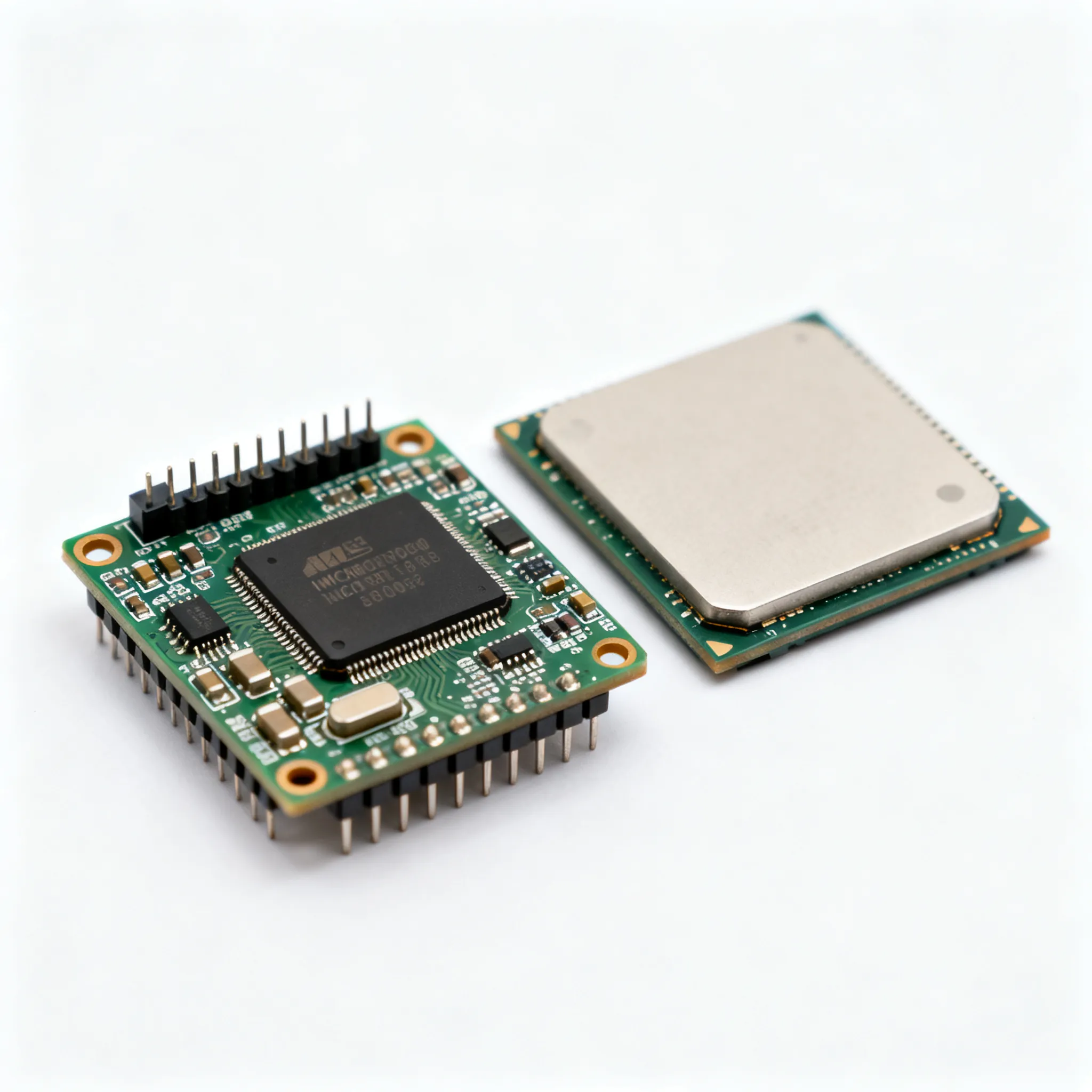
The fundamental architectural difference is that an MCU keeps everything on one die—CPU, non-volatile memory, RAM, and peripherals—yielding deterministic access times and low-latency interrupt handling. An MPU, by contrast, decouples the CPU from memory and peripherals, relying on external DRAM and flash. This gives it immense compute headroom but introduces cache misses and DRAM refresh jitter that can complicate hard real-time tasks. For a gateway that must guarantee a 10 ms CAN message latency under all conditions, that jitter matters.
Side-by-Side: MCU vs MPU for Gateway Functions — A Feature-by-Feature Case Study
To make the comparison concrete, consider a mid-range automotive gateway with the following workload: routing of 4 CAN FD buses and 2 LIN channels, Ethernet communication to a domain controller, OTA update handling, and basic intrusion detection. The table below presents a decision matrix that weighs the key selection criteria, drawing on insights from several industry analyses.
| Decision Metric | MCU (e.g., S32K3) | MPU (e.g., i.MX 8M Plus) | Selection Criteria & Failure Boundary |
|---|---|---|---|
| Deterministic Latency | Excellent: single-cycle I/O access, predictable interrupt latency | Good only with real-time core (Cortex-M7); main A53 cores subject to OS scheduling jitter | If safety-critical messages require <1 ms jitter, an MCU or a hybrid with a dedicated real-time core is mandatory. Microchip USA’s comparison notes that MCUs excel in real-time control. |
| AUTOSAR Stack Compatibility | Classic AUTOSAR runs natively on single/multi-core MCUs | Adaptive AUTOSAR targets MPUs; Classic requires a hypervisor or companion MCU | If the gateway must run Classic AUTOSAR for CAN/LIN routing, an MCU is the path of least resistance. MoldStud’s automotive technology comparison highlights the software ecosystem as a decisive factor. |
| Power Budget | <1 W, single supply rail | 3–8 W, multiple voltage rails, PMIC required | In a thermally constrained ECU, the MCU’s lower dissipation avoids active cooling. Exceeding the power envelope forces a redesign. |
| BOM Cost | Single chip + passive components | MPU + DRAM + eMMC + PMIC + Ethernet PHY + CAN controller | Total BOM for an MPU solution can be 2–3× higher. IC Online’s benchmarking article emphasizes that component count directly impacts reliability and procurement complexity. |
| Security Hardware | Integrated HSM with dedicated core, secure boot, hardware crypto | Arm TrustZone, CAAM, optional external secure element | An integrated HSM simplifies certification. If the gateway requires EVITA-Full or ISO 21434 compliance, the MCU’s self-contained security module may reduce audit scope. |
| Software Complexity | Bare-metal or RTOS (FreeRTOS, SafeRTOS) | Linux/Yocto, Adaptive AUTOSAR, hypervisor | An MPU demands a larger software team and longer maintenance cycle. PCBOnline’s MCU comparison reminds us that CAN and real-time control are native to MCUs, reducing software overhead. |
| Supply Chain Flexibility | Multiple vendors with Cortex-M7/M33 cores (ST, NXP, Renesas, Infineon) | Fewer automotive MPU suppliers; deeper ecosystem lock-in | An MCU design can be re-targeted to a different vendor’s pin-compatible part more easily. For MPUs, the board and software are tightly coupled to the SoC family. |
The matrix reveals that an MCU remains the optimal choice for a gateway whose primary role is deterministic CAN/LIN routing with a lightweight RTOS and hard real-time deadlines. However, once the gateway must host a rich OS, manage multiple high-bandwidth interfaces, or run compute-intensive security algorithms, the MPU’s headroom becomes compelling. Many Tier-1 suppliers are adopting a hybrid architecture: an MPU for the application processor and a safety MCU as a companion for critical CAN tasks and system monitoring.
Practical Selection Framework: Matching Core Complexity to Gateway Requirements
Rather than starting with a part number, begin by mapping your gateway’s functional and non-functional requirements to the core attributes that drive the MCU/MPU decision. The IoT Insider selection guide and the KTH thesis on ECU MCU selection both stress that non-functional requirements—such as power, temperature range, and long-term availability—are just as critical as functional ones. The table below provides a structured way to align gateway requirements with the appropriate core type.
| Gateway Requirement | Key Parameter | MCU Suitability | MPU Suitability | Selection Guidance |
|---|---|---|---|---|
| CAN/LIN routing with <10 ms latency | Interrupt latency, CAN controller integration | High: native CAN FD, deterministic timing | Low: needs external controller, OS jitter | Choose an MCU unless the MPU includes a real-time core with direct CAN access. |
| Gigabit Ethernet backbone, PCIe for telematics | Interface bandwidth, DMA channels | Limited: 100 Mbps Ethernet, no PCIe | High: native GbE, PCIe Gen3 | An MPU is justified if Ethernet throughput exceeds 100 Mbps or PCIe is needed. |
| OTA update with A/B partition | Memory size, flash write speed | Moderate: up to 8 MB embedded flash; external QSPI possible | High: large eMMC, fast file system | MCU can handle OTA with external flash; MPU simplifies large image management. |
| Intrusion detection / deep packet inspection | CPU throughput, crypto acceleration | Moderate: Cortex-M7 at 160 MHz with HSE | High: multi-core A53 at 1.8 GHz with CAAM | If IDS requires line-rate Ethernet inspection, an MPU is safer. For CAN-level IDS, an MCU suffices. |
| ASIL B / ASIL D safety goal | Lockstep core, ECC, safety documentation | High: lockstep Cortex-M7, ASIL D certified | Moderate: safety MPUs exist but require external MCU for ASIL D | For ASIL D, an MCU or a safety MCU companion is the proven path. |
| Low power, always-on operation | Static current, wake-up time | Excellent: <100 µA standby, instant wake | Poor: high DRAM refresh current, long boot | MCU wins for battery-backed or ignition-off operation. |
| Software team size and expertise | OS, middleware, toolchain | Small team, RTOS, bare-metal | Larger team, Linux, Yocto, security patches | Honestly assess your team’s capacity to maintain an MPU-based system over the vehicle’s lifetime. |
Tip: Avoid over-specifying the core. A common pitfall is selecting an MPU “just in case” future features require more compute. This inflates BOM cost, PCB complexity, and software effort. Instead, partition the gateway functions: use a multi-core MCU for the real-time domain and add a lightweight application processor later if needed. Many modern MCUs, such as those with Cortex-M33 or Cortex-M7 cores, include hardware accelerators for cryptography and Ethernet TSN, closing the gap with entry-level MPUs.
When evaluating long-term availability, look for manufacturers with published product longevity programs. NXP, for example, guarantees 15-year availability for its S32K family. Check AEC-Q100 qualification and, for MPUs, ask about the planned lifecycle of the associated PMIC and DRAM. From a procurement perspective, an MCU sourced from a broad portfolio gives you more second-source options than a proprietary MPU ecosystem. Distributor networks like IC-Online can help you monitor allocation trends and lead-time signals across multiple franchises, allowing you to de-risk the BOM early.
Gateway Core Selection FAQ: Questions Engineers and Buyers Ask Before Finalizing the BOM
Q: When does an automotive gateway genuinely need an MPU instead of an MCU?
Typically when the gateway must run a rich OS (e.g., Linux) for complex networking stacks, host multiple high-bandwidth interfaces like Gigabit Ethernet and PCIe, or perform computationally heavy tasks such as intrusion detection. An MCU remains sufficient if the workload is primarily CAN/LIN routing with a lightweight RTOS and hard real-time deadlines. The tipping point often comes when the software stack requires a POSIX-compliant environment or when the gateway must manage a large file system for OTA images and data logging.
Q: How do real-time constraints and AUTOSAR influence the core choice?
Classic AUTOSAR runs efficiently on single- or multi-core MCUs with tightly coupled memory and deterministic interrupt handling. Adaptive AUTOSAR, designed for high-performance computing, leans toward MPUs. The gateway’s mix of classic and adaptive stacks often dictates whether a hybrid approach or a single powerful MPU with a safety MCU companion is optimal. If your gateway must simultaneously route CAN messages with microsecond-level jitter and serve diagnostic requests over Ethernet, a dual-chip architecture gives you clean separation between real-time and application domains.
Q: What are the hidden costs of moving from an MCU to an MPU in a gateway design?
Beyond the higher chip price, MPUs require external DRAM and flash, a more complex PCB layout (impedance-controlled DDR routing, more layers), a power management IC, and a larger software team for OS maintenance and security patching. Licensing costs for commercial RTOS/OS and longer boot times can also impact the total cost of ownership. Don’t overlook the cost of regulatory recertification if you change the OS or add new open-source components during the vehicle’s lifecycle.
Q: How do I evaluate long-term availability and supply chain risks for automotive-grade cores?
Check the manufacturer’s product longevity program (e.g., NXP’s 15-year availability), AEC-Q100 qualification, and second-source options. For MPUs, consider the ecosystem lock-in; MCUs from multiple vendors often share ARM Cortex-M cores, offering more fallback alternatives. Procurement should also monitor allocation trends and lead-time signals through distributor networks. Engaging with a distributor that offers flexible MOQs and mixed BOM support, such as IC-Online, can help you secure allocation without over-committing inventory.
Q: Can a multi-core MCU handle gateway tasks that traditionally required an MPU?
Yes, modern multi-core MCUs with Cortex-M7 or Cortex-M33 cores, large embedded flash (up to 8 MB), and hardware accelerators for cryptography and Ethernet can handle many gateway functions, including some OTA and security workloads, without an MPU. The decision hinges on whether the software stack needs a full OS environment or can be partitioned across RTOS domains. For example, a dual-core MCU can run CAN routing on one core and an Ethernet stack on the other, with a hypervisor ensuring freedom from interference.
Q: What hardware security features should I compare between an MCU and an MPU for a connected gateway?
Look for a hardware security module (HSM) or secure element, secure boot, cryptographic accelerators (AES, SHA, ECC), and a true random number generator. MCUs often integrate these in a single package with a dedicated security core; MPUs may rely on an external secure element or an on-chip security enclave like Arm TrustZone, which adds complexity but also flexibility. For ISO 21434 compliance, an integrated HSM with a certified crypto library can reduce the attack surface and simplify the security case.
Selecting the optimal core for an automotive gateway is not a one-size-fits-all decision. It demands a clear-eyed assessment of your real-time requirements, software roadmap, power budget, and supply chain strategy. By using the frameworks and comparisons in this case study, you can avoid over-engineering while ensuring your gateway meets both current and future vehicle architectures. For mixed BOM procurement and flexible minimum order quantities that adapt to your design’s lifecycle, visit IC-Online to explore a wide range of automotive-grade MCUs and MPUs from leading manufacturers.
References & Further Reading
- Degree Project in Electrical Engineering, specializing in Embedded Systems – KTH Royal Institute of Technology
- MCU Selection Guide: What to Look for in a Microcontroller – IoT Insider
- How to Read a Microcontroller Datasheet: Introduction and First Steps – All About Circuits
- MC9S08SC4 Data Sheet – NXP Semiconductors
- Choosing the Right Technology for Automotive Applications – MoldStud
- Microcontrollers vs. Microprocessors – Microchip USA
- Top 6 Popular MCU Microcontrollers and Their Comparison – PCBOnline
- Comparative Analysis of Microcontrollers: Benchmarking Performance Metrics – IC Online
- NXP S32K Automotive MCUs
- NXP i.MX 8 Series Applications Processors
- IC-Online – Electronic Components with Flexible MOQ