SKKD380/16 Dual Diode Module: A Practical Selection Guide for High-Power Rectifier Designs
Expert guide on SKKD380/16 Dual Diode Module: A Practical Selection Guide for High-Power Rectifier Designs. Technical specs, applications, sourcing tips for engineers and buyers.
Why the SKKD380/16 Remains a Workhorse in Industrial Rectifier Stacks
When you open the maintenance panel of a 500 kW motor drive, a 1000 A welding rectifier, or a double-conversion UPS, you are almost certain to find large dual diode modules bolted to a forced-air heatsink. Among the most frequently specified parts in these high-current rectifier stages is the SKKD380/16 from Semikron. Despite the availability of newer silicon and silicon-carbide technologies, this module continues to appear on new BOMs and service replacement lists for a simple reason: it delivers predictable, rugged performance in a package that thousands of design teams already understand.
The sustained demand for the SKKD380/16 is not nostalgia. In industrial drives, battery chargers, and electrolysis power supplies, the rectifier stage must handle continuous currents of several hundred amps while surviving line transients and overloads. The module’s 1600 V blocking voltage and 380 A average forward current rating fit neatly into the 690 V AC mains environment that dominates heavy industry. Moreover, many OEMs have qualified their entire product lines around this specific module; a change would trigger costly requalification, updated safety certifications, and mechanical redesign. As a result, procurement teams keep the SKKD380/16 on the approved vendor list year after year.
Availability is the other half of the equation. The global power semiconductor market has seen repeated lead-time fluctuations over the past 18 months, with some module families stretching to 20 weeks or more. In this climate, a module that can be sourced from multiple independent distributors becomes a strategic asset. AS ENERGI, for example, maintains stock of the SKKD380/16 and ships from European warehouses, offering a buffer against regional shortages [1]. Engineers and buyers who lock in their supply chain early – checking inventory at several authorized sources – avoid the painful situation of having a production line halted for want of a single rectifier module. The SKKD380/16 may not be the newest device on the market, but its combination of field-proven reliability and broad distribution keeps it firmly in the “workhorse” category.
Decoding the SKKD380/16: Key Ratings and Thermal Limits
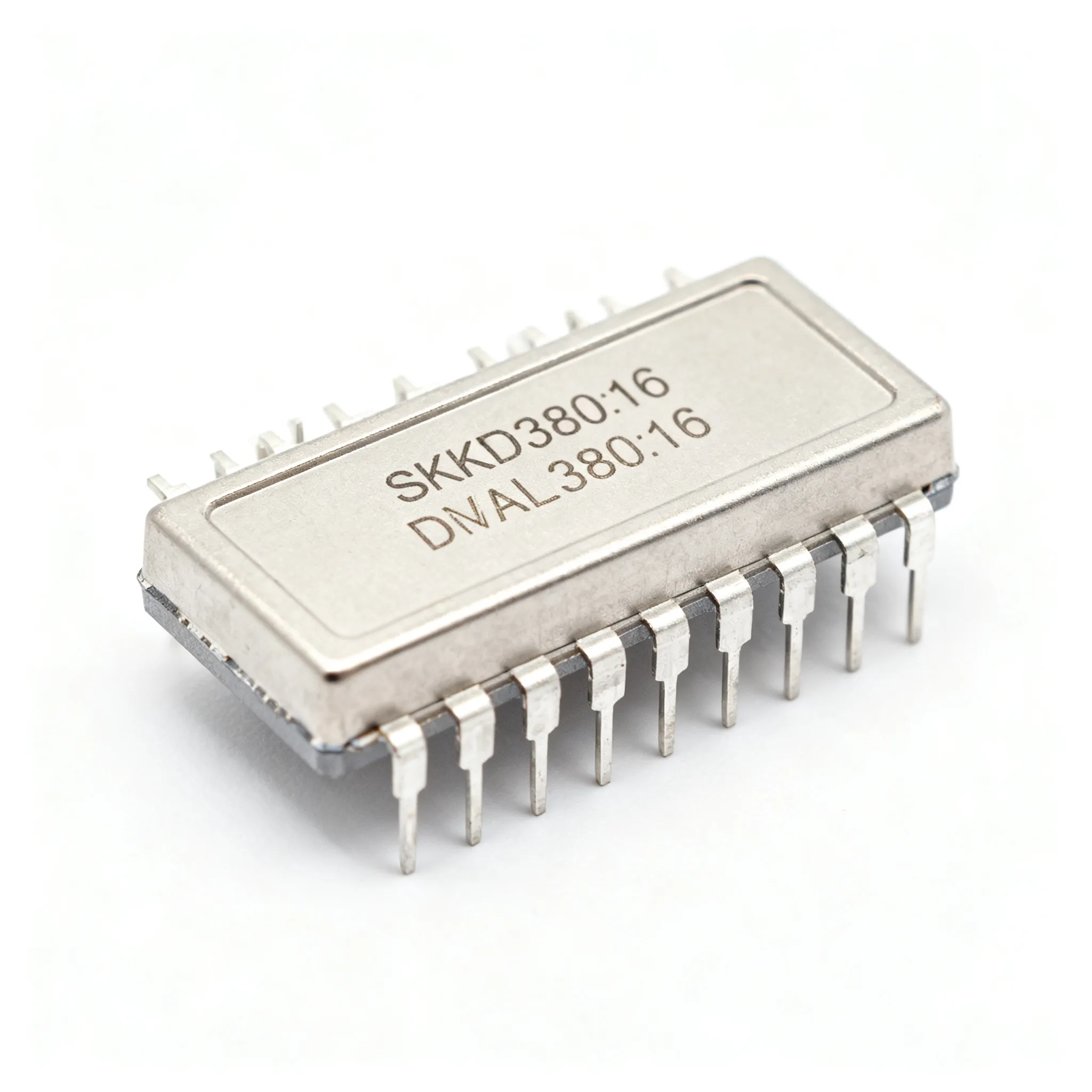
Inside the familiar SEMIPACK 2 package, the SKKD380/16 houses two independent power diodes arranged in a common-cathode configuration. The isolated baseplate allows direct mounting to a grounded heatsink without additional insulation, simplifying mechanical assembly. Each diode is a large-area silicon junction optimised for 50/60 Hz rectification, where reverse recovery charge is less critical than forward voltage drop and surge robustness.
The table below summarises the headline parameters you need for a first-pass thermal and electrical design. All values are drawn from the official Semikron datasheet [2] and the Iconopower product page [3].
| Parameter | Value | Unit / Conditions |
|---|---|---|
| Average forward current (IFAV) | 380 | A (sinusoidal 180°, Tc = 85 °C) |
| Repetitive peak reverse voltage (VRRM) | 1600 | V |
| Non-repetitive surge current (IFSM) | 11 000 | A (10 ms half-sine, Tj = 25 °C) |
| Forward voltage drop (VF) | 1.35 | V (at IF = 380 A, Tj = 25 °C) |
| Thermal resistance, junction to case (Rth(j-c)) per diode | 0.085 | K/W |
| Maximum junction temperature (Tjmax) | 150 | °C |
| Isolation voltage (VISOL) | 2500 | V AC (1 min, 50 Hz) |
| Package / footprint | SEMIPACK 2 | 94 × 34 mm baseplate |
Why 1600 V? A 690 V AC three-phase supply has a peak line-to-line voltage of approximately 975 V. Adding a 20 % safety margin for mains tolerance and a further allowance for switching overvoltages pushes the requirement comfortably above 1200 V. The 1600 V rating of the SKKD380/16 provides headroom for regenerative energy, lightly damped line transients, and the inevitable ringing that appears on the DC bus of a high-power rectifier. If your design is fed from a 400 V mains, a 1200 V module may suffice, but for 690 V industrial networks the 1600 V class is the default choice.
Thermal design is where most field problems originate. With an Rth(j-c) of 0.085 K/W per diode, a single SKKD380/16 conducting 380 A dissipates roughly 510 W. Keeping the junction below 150 °C demands a heatsink with a thermal resistance from case to ambient well under 0.1 K/W – a value that typically requires forced-air cooling or liquid cooling in compact enclosures. Always derate the current when ambient temperature inside the cabinet exceeds 40 °C; the datasheet provides a derating curve that you should treat as a hard limit, not a suggestion.
SKKD380/16 vs. Alternatives: When to Look Beyond the Semikron Module
No component is perfect for every design, and the SKKD380/16 is no exception. Three alternatives frequently appear in cross-reference searches: the lower-current SKKD 260/16 from the same Semikron family, the DD380N16K from Infineon, and the MDD380-16N1 from IXYS (now Littelfuse). Each has a legitimate place, but the choice depends on your current margin, mechanical constraints, and supply chain realities.
| Comparison Metric | SKKD380/16 (Semikron) | SKKD 260/16 (Semikron) | DD380N16K (Infineon) | MDD380-16N1 (IXYS) | Selection Criteria |
|---|---|---|---|---|---|
| IFAV (Tc=85 °C) | 380 A | 260 A | 380 A | 380 A | Current headroom needed |
| VRRM | 1600 V | 1600 V | 1600 V | 1600 V | Mains voltage class |
| VF (max at rated IF) | 1.35 V | 1.35 V | 1.31 V | 1.30 V | Conduction losses |
| Rth(j-c) per diode | 0.085 K/W | 0.11 K/W | 0.075 K/W | 0.080 K/W | Thermal budget |
| Package footprint | SEMIPACK 2 (94×34 mm) | SEMIPACK 2 | 62 mm module (similar) | SOT-227B (miniBLOC) | Mechanical drop-in |
| Typical distribution | Broad, multiple sources | Common | Good, regional | Good, alternative supply | Lead time risk |
If your design can live with 260 A, the SKKD 260/16 is a natural cost-down option that shares the same mounting footprint. Where every watt of loss matters – for example, in a passively cooled outdoor rectifier – the Infineon DD380N16K offers a slightly lower VF and thermal resistance, which can reduce heatsink size and improve efficiency by a few tenths of a percent. The IXYS MDD380-16N1 is electrically very close to the Semikron part but uses the SOT-227B package; it is not a mechanical drop-in replacement. You will need to redesign the busbar layout and possibly the heatsink drilling pattern. Avaq’s cross-reference tool [4] can help you identify equivalent modules, but always verify the mechanical drawings before committing to an alternative.
From a procurement standpoint, the SKKD380/16 benefits from being a widely stocked item. However, during periods of tight supply, an equivalent from Infineon or IXYS may be available with shorter lead times in your region. The pragmatic approach is to qualify one primary source and at least one pin-compatible alternative, then let the purchasing team decide based on real-time inventory.
Sourcing and Designing with the SKKD380/16: Mounting, Snubbers, and Pitfalls
Getting the SKKD380/16 to survive a decade of industrial service is as much about mechanical assembly and protection circuits as it is about the silicon inside. The following recommendations are distilled from field experience and Semikron application notes.
Verify authenticity. Counterfeit power modules are a real risk, especially when buying from non-authorized brokers. Stick to established distributors such as AS ENERGI and Iconopower, or buy directly through Semikron’s channel. A module with a suspiciously low price or laser marking that rubs off easily should be rejected immediately.
Thermal interface. The baseplate of the SKKD380/16 must mate with a heatsink surface that is flat to within 0.05 mm over the entire footprint. Use a high-quality thermal paste applied in a thin, even layer (around 50 µm). Excessive paste acts as an insulator; too little creates air gaps. After mounting, measure the case temperature near the centre of the baseplate under load to confirm that the thermal resistance is within expectations.
Mounting torque. Over-tightening is a common mistake that cracks the ceramic isolation substrate. Semikron specifies 6–8 Nm for M8 busbar terminal screws and 3–5 Nm for M6 baseplate mounting screws. Use a calibrated torque wrench and tighten in a cross pattern in two or three steps.
Snubber protection. The stray inductance of DC busbars, typically 50–200 nH, stores energy that can generate destructive voltage spikes when diodes turn off. An RC snubber placed directly across each diode – or across the DC bus close to the module – clamps these transients. A common starting point is a 0.22 µF polypropylene film capacitor in series with a 10 Ω, 10 W wire-wound resistor. The exact values depend on your layout; measure the ringing frequency with a high-voltage differential probe and adjust the snubber to critically damp the oscillation. Never omit the snubber, even if the simulation says the voltage margin is sufficient.
| Design Parameter | Recommendation | Notes |
|---|---|---|
| Heatsink flatness | ≤ 0.05 mm | Measured over module footprint |
| Thermal paste thickness | ~50 µm | Use a stencil or calibrated dispenser |
| M8 terminal torque | 6–8 Nm | Clean, dry threads; no lubricant |
| M6 baseplate torque | 3–5 Nm | Cross-tighten in steps |
| RC snubber (per diode or DC bus) | 0.22 µF + 10 Ω (typical) | Adjust based on measured ringing |
| Parallel module derating | 15–20 % current reduction | Match VF; use symmetric busbars |
| Ambient derating above 40 °C | Linear derate per datasheet | Monitor Tc in final enclosure |
Common pitfalls. Insufficient clamping force leads to high thermal resistance and premature failure. Ignoring derating at elevated ambient temperatures – common when a cabinet is placed in a sunny outdoor location – can push the junction beyond 150 °C even though the average current is within rating. Using long, unshielded busbars increases stray inductance and makes snubber design more difficult. Finally, assuming that a module rated for 380 A can carry 380 A in a 50 °C ambient without forced cooling is a recipe for field returns. Always build a thermal prototype and validate with thermocouples.
Before freezing your BOM, check real-time stock at multiple vendors. AS ENERGI and Iconopower both carry the SKKD380/16, and their inventory levels can differ significantly from week to week [1] [3]. A few minutes of verification can prevent a costly line-down situation later.
Frequently Asked Questions from Field Engineers and Buyers
Q: What is the maximum non-repetitive surge current (IFSM) for the SKKD380/16?
A: The official Semikron datasheet specifies IFSM at 11 000 A for a 10 ms half-sine pulse with the junction at 25 °C. This is a single-event rating. If your application subjects the diode to repetitive surges – for example, during transformer inrush or capacitor bank charging – you must derate the surge current according to the curves in the application note. Always use the value from the manufacturer’s latest datasheet revision; do not rely on third-party summaries.
Q: Can I parallel two SKKD380/16 modules for higher current?
A: Yes, but successful parallel operation demands careful current sharing. The forward voltage drop of each diode must be matched as closely as possible – ideally within 50 mV at the operating current. Use a symmetrical busbar layout with equal path lengths, and consider adding small individual AC-line inductors if the layout cannot be perfectly balanced. Derate the total current by 15–20 % to account for the inevitable imbalance. Thermal coupling must also be managed; mount both modules on the same heatsink or ensure that their case temperatures track each other.
Q: What are the recommended mounting torque values for busbar and heatsink connections?
A: Semikron recommends 6–8 Nm for M8 terminal screws and 3–5 Nm for M6 baseplate mounting screws. Exceeding these values can crack the isolation substrate, while under-tightening increases thermal resistance. Always use a calibrated torque wrench and follow the tightening sequence shown in the module’s application note. After the first thermal cycle, re-check the torque on the baseplate screws.
Q: What are realistic lead times for the SKKD380/16 in 2025?
A: Lead times vary by region and distributor. As of early 2025, small quantities are generally available from stock at major catalog distributors. Large OEM orders may face 8–14 weeks, depending on factory loading. Before design freeze, check inventory at AS ENERGI, Iconopower, and Avaq, and consider qualifying a second source such as the DD380N16K to mitigate supply risk.
Q: Is there a direct SiC MOSFET or SiC diode module that can replace the SKKD380/16?
A: No pin-compatible SiC dual diode module exists in the same SEMIPACK 2 package. SiC Schottky diodes offer near-zero reverse recovery charge, which is attractive for high-frequency rectifiers, but their current ratings in this package size are typically lower. A direct replacement would require a complete electrical and mechanical redesign. For line-frequency industrial rectifiers where conduction loss dominates, the silicon SKKD380/16 remains the pragmatic choice.
Whether you are maintaining a legacy drive or designing a new high-current rectifier stack, the SKKD380/16 continues to deliver the ruggedness and availability that heavy industry demands. By paying close attention to thermal management, snubber design, and supply chain diversification, you can build a rectifier stage that operates reliably for decades. For mixed BOM procurement and flexible minimum order quantities, visit IC-Online to compare stock across multiple franchised distributors.
References & Further Reading
- AS ENERGI – SKKD 380/16 product page and stock information
- Alldatasheet – SKKD380/16 official Semikron datasheet PDF
- Iconopower – SKKD380/16 Rectifier Diode Module product page
- Avaq – SKKD380/16 cross-reference and equivalent parts
- Semikron – official SKKD 380/16 product detail
- Infineon – DD380N16K rectifier diode module
- Littelfuse (IXYS) – MDD380-16N1 standard rectifier module
- DigiKey – SKKD380/16 availability and pricing
- Mouser – SKKD380/16 stock and lead time
- IC-Online – electronic components sourcing platform