Practical Methods for Discharging Capacitors in 2026
Discharge a capacitor safely in electronics with updated methods for 2026. Find step-by-step techniques, tools, and safety tips for every voltage range.
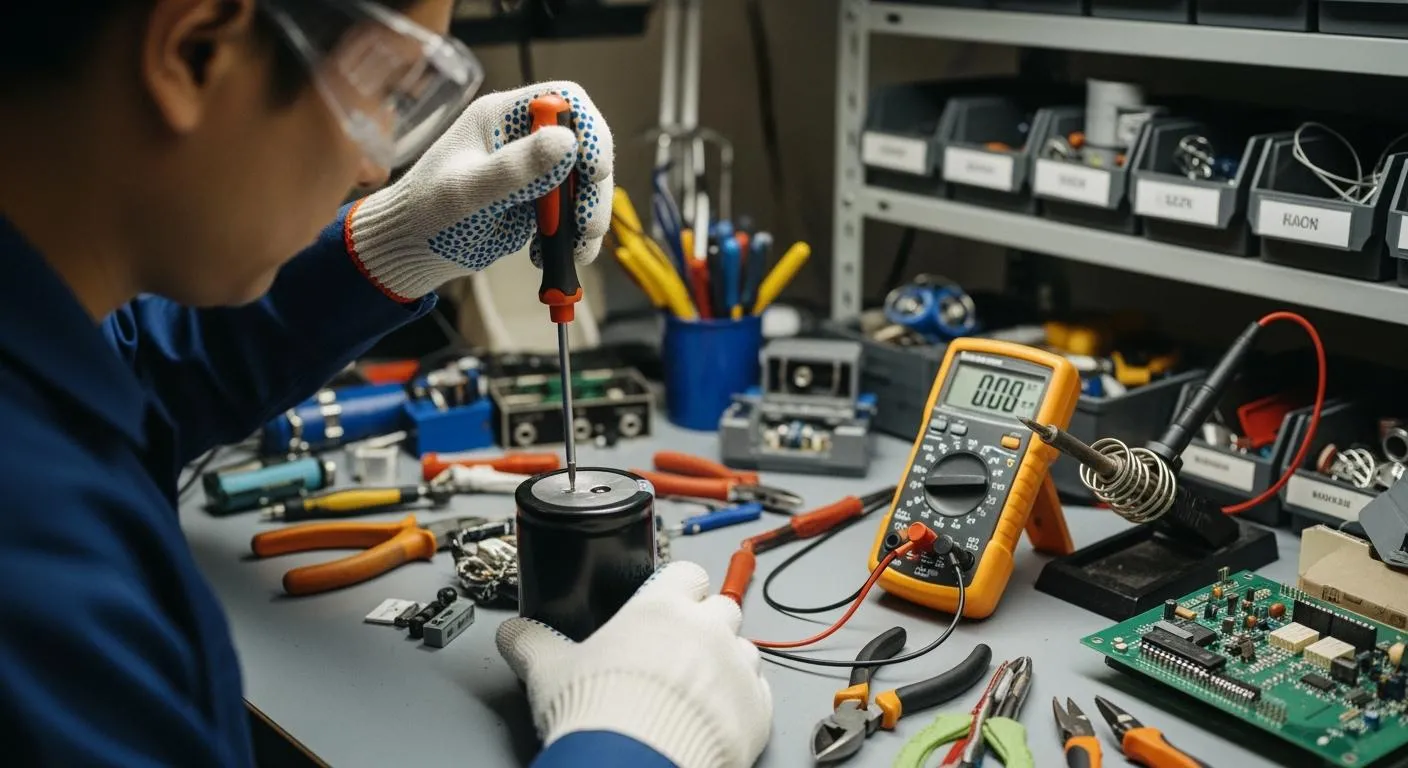
To discharge a capacitor in electronics, you release the stored electrical energy safely so it does not pose a risk during repair or testing. Always use a multimeter to check the voltage across the terminals before you begin. Modern devices often use surface-mount technology, which makes capacitors smaller and more efficient. You might use a resistor or inductor to control the discharge, depending on the application. Updated methods keep you safe and protect sensitive components.
Key Takeaways
- Always check the voltage across capacitor terminals with a multimeter before discharging. This step ensures safety and prevents electric shock.
- Use appropriate tools for discharging capacitors. Manual methods work for small capacitors, while automated tools are better for large or high-voltage capacitors.
- Select a resistor with the correct resistance value to control the discharge rate safely. This practice prevents sparks and damage to the circuit.
- After discharging, always check for residual voltage. Some capacitors can regain voltage due to dielectric absorption, posing a risk if not monitored.
- Wear protective gear and work in a safe environment. Insulated tools and safety equipment reduce the risk of injury during capacitor discharge.
Discharge a Capacitor: Methods

When you work with electronics, you often need to discharge a capacitor before you can handle or repair a circuit. The right discharge methods help you stay safe and protect your devices. Always check the voltage with a multimeter before you start any capacitor discharge process. This section explains both manual and automated discharge methods, and helps you choose the best approach for your needs in 2026.
Manual Discharge Techniques
You can use several manual discharge methods when you need to discharge a capacitor. These techniques work well for many electronics projects, especially when you do not have access to advanced tools. Here are some common manual discharge methods:
- Use needle nose pliers or a screwdriver to bridge the capacitor terminals. This method is quick, but it can cause arcing, shock, or even damage to the capacitor or circuit.
- Some voltmeters now include a Low-Z mode. This feature allows you to discharge a capacitor more quickly than with standard voltmeters.
- A resistor with a suitable resistance value can safely control the rate of capacitor discharge. You connect the resistor across the terminals and wait for the voltage to drop.
Tip: Always use a multimeter to confirm that the voltage has dropped to a safe level before you touch the capacitor or continue working on the circuit.
Manual discharge methods remain popular because they are simple and require little equipment. However, you must use caution to avoid injury or damage.
Automated Discharge Tools
Automated discharge tools have become more common in 2026. These tools offer faster and safer capacitor discharge, especially for large or high-voltage capacitors. The table below compares the performance of different discharge methods:
| Method | Discharge Time (t_discharge) | Efficiency |
|---|---|---|
| Manual resistive discharge | ≈ 5RC | ≈ 0% |
| Active automated system | ≈ 2RC | up to 95% |
| Regenerative system | ≈ 3RC | energy recovery up to 85% |
Automated systems use electronic circuits to control the discharge process. Some advanced tools even recover energy during capacitor discharge, making them efficient and environmentally friendly. You can find these tools in professional repair shops and advanced electronics labs.
Nova Technology Company (HK) Limited stands out as a HiSilicon-designated solutions partner. The company specializes in chip-level solutions and system integration for the integrated circuit industry. Their expertise covers capacitor discharge tools, power management ICs, and system-level applications in smart devices, automotive electronics, and industrial automation.
Choosing the Right Method
You need to consider several factors when you select discharge methods for a capacitor. The voltage and capacitance ratings play a key role in your decision. Here are some important points to remember:
- The charge stored in a capacitor increases as voltage and capacitance increase. The equation Q = CV shows this relationship.
- Higher capacitance means the capacitor can store more charge at the same voltage.
- You must understand this relationship to control energy storage and discharge rates in practical applications.
If you work with small, low-voltage capacitors in basic electronics, manual discharge methods may be enough. For large or high-voltage capacitors, automated discharge tools provide better safety and efficiency. Always match your discharge methods to the specific capacitor and application.
Note: Never skip the step of checking the voltage with a multimeter before and after you discharge a capacitor. This habit keeps you safe and ensures the capacitor discharge process is complete.
By understanding and applying the right discharge methods, you can handle capacitors safely and effectively in any electronics project.
How a Capacitor Works

Storing and Releasing Energy
You need to understand how a capacitor works to handle electronics safely. A capacitor stores energy by holding an electric charge between two metal plates. These plates sit on either side of a special material called a dielectric. When you connect a capacitor to a power source, electrons move onto one plate. This plate becomes negatively charged. The other plate loses electrons and becomes positively charged. This process creates a potential difference, which means there is an electric field across the dielectric.
- A capacitor stores energy in the electric field between its plates.
- The dielectric keeps the plates from touching and helps the capacitor hold the charge.
- The amount of energy stored depends on the size of the capacitor and the voltage applied.
- You can calculate the stored energy with the formula: E = 1/2CV². Here, E stands for energy in joules, C is the capacitance in farads, and V is the voltage in volts.
When you disconnect the power source, the capacitor keeps its charge until you give it a path to release the energy. If you connect the two plates with a wire or resistor, the stored energy flows out. This is how a capacitor releases energy back into the circuit.
Why Capacitor Discharge Is Critical
You must always discharge a capacitor before working on a circuit. Even after you turn off the power, a charged capacitor can hold enough energy to shock you or damage sensitive parts. Some capacitors, especially those in power supplies or industrial equipment, can store dangerous amounts of energy.
If you skip the discharge step, you risk injury or equipment failure. Discharging a capacitor makes sure the circuit is safe to touch. It also protects the components from sudden surges of current. Knowing how a capacitor works helps you see why this step matters. You keep yourself and your devices safe by following proper discharge methods every time.
Capacitor Discharge: Step-by-Step
Preparing Tools and Workspace
You need to set up your workspace before you start any capacitor discharge. This step helps you avoid hazards and keeps you safe. Begin by gathering the right tools for capacitor discharge. You should use protective gear like insulated gloves and safety glasses. These items protect you from shock and other risks. Make sure your workspace is dry and free from clutter. Remove any metal objects that could cause accidental short circuits.
- Wear protective gear to prevent electrical hazards.
- Use insulated tools for handling capacitors.
- Check the capacitor voltage and energy storage before you begin.
- Keep a fire extinguisher nearby in case of emergencies.
- Learn emergency procedures for unexpected situations.
- Get proper training in capacitor discharge and energy storage safety considerations.
You must assess the risks by checking the voltage and stored electrical energy in the capacitor. High-voltage capacitors need extra care. Always plan for gradual discharge to avoid sudden energy release. This practice reduces the chance of shock and damage.
Manual Discharge Procedure
You can discharge a capacitor manually using simple tools. Follow these steps for effective capacitor discharge:
- Check the voltage across the capacitor terminals with a multimeter. This step confirms the amount of stored electrical energy.
- Use insulated tools and keep your hands away from the terminals. This reduces the risk of shock.
- Select a resistor with the right resistance and power rating. Connect the resistor across the capacitor terminals. This method controls the discharge rate and prevents sparks.
- Wait for the voltage to drop. Monitor the process with your multimeter.
- Double-check the voltage before you reassemble the circuit.
Tip: Mark the capacitor terminals and wires. Use diagrams to avoid mixing up connections. Always check the voltage and microfarad ratings before you install a new capacitor.
Common mistakes can lead to hazards. Never skip the discharge step. Even a small charge can shock you. Use the correct wire gauge and make sure all connections are tight. Pay attention to polarity and grounding. Wrong connections can cause damage.
Using Discharge Tools
You can use specialized tools for capacitor discharge. These tools make the process safer and more efficient. Choose the right tool based on the capacitor size, voltage, and application. The table below shows the best tools for different situations:
| Tool Type | Best For | Voltage Range | Key Feature |
|---|---|---|---|
| Discharge Pen / Probe | PCB-level electrolytic caps | Up to ~400V | LED indicator, handheld probes |
| Resistor-based DIY Tool | General lab/repair work | Up to ~600V | Customizable resistance, low cost |
| Light Bulb Discharge Rig | Capacitor banks, power supplies | 100V–300V DC | Visual brightness confirms energy |
| Discharge Stick | Industrial/HV capacitors | 1kV+ | Long insulated pole, grounding clamp |
| Automatic Discharge Unit | Production/industrial | Any voltage | Controlled speed, adjustable params |
You should select a discharge tool that matches the capacitor’s voltage and energy storage. For small capacitors, a discharge pen or resistor-based tool works well. For large or high-voltage capacitors, use a discharge stick or automatic discharge unit. These tools help you achieve effective capacitor discharge and reduce hazards.
Checking for Residual Voltage
After you discharge a capacitor, you must check for residual voltage. Some capacitors can recover a small amount of voltage due to dielectric absorption. This effect can create hazards if you touch the terminals too soon. Follow these steps to check for residual voltage:
- Set your multimeter to DC voltage.
- Touch the probes to the capacitor terminals.
- Read the voltage. If it shows 0 volts, the capacitor is fully discharged.
- If you see any voltage, repeat the discharge process until the reading is close to 0V.
Note: Residual voltage can return in some capacitors. Keep a short-circuit ground across the terminals after discharge. Use permanent shorting bars for high-voltage applications.
The table below shows typical dielectric absorption recovery rates for different capacitor types:
| Dielectric | Typical DA Recovery | Time Constant |
|---|---|---|
| Polypropylene film | 0.01–0.05% | Seconds |
| Polyester film | 0.2–0.5% | Minutes |
| Aluminum electrolytic | 1–5% | Minutes to hours |
| Ceramic (Class II) | 0.5–2.5% | Minutes |
| Tantalum | 2–5% | Minutes to hours |
| Mica | 0.003–0.01% | Seconds |
You must always check the voltage after capacitor discharge. This step ensures you avoid shock and other hazards. Proper discharge methods protect you and your devices from risks caused by stored electrical energy.
Safety and Troubleshooting
Essential Safety Precautions
You must always treat every capacitor as if it holds dangerous stored electrical energy. High-voltage capacitors can store enough energy to cause severe injury or even death. Follow these steps to protect yourself from hazards:
- De-energize the circuit. Turn off the power and lock it out before you begin.
- Use protective gear. Wear insulated gloves, safety glasses, flame-resistant clothing, and dielectric footwear. These items shield you from arc flashes and shock.
- Connect your discharge tool across the capacitor terminals. Use only one hand if possible and keep the other away from conductive surfaces.
- Wait for the stored electrical energy to release. If your tool has an indicator, watch for it to show zero voltage.
- Always check with a multimeter to confirm the capacitor has no remaining stored electrical energy.
Tip: Insulating mats and ESD-safe footwear add extra safety considerations, especially when you work with high-voltage circuits.
Handling Different Capacitor Types
Different capacitor types require unique discharge methods and safety considerations. The table below shows the best approach for each type:
| Capacitor Type | Discharge Method | Special Notes |
|---|---|---|
| Electrolytic | Use a resistor matched to the circuit. Monitor polarity and allow reforming time after storage. | Watch for stored electrical energy even after long periods. |
| Film | Use constant current discharge. Parallel resistors improve reliability. | Self-healing properties help prevent hazards. |
| Ceramic | Use fast discharge methods. Compensate for temperature and voltage effects. | Stored electrical energy can return due to dielectric absorption. |
You must always match your discharge method to the capacitor type. This practice helps you avoid hazards and ensures safe handling of stored electrical energy.
Troubleshooting Common Issues
You may face several problems during capacitor discharge. Here are some common issues and solutions:
- Supercapacitors can lose voltage quickly during discharge. Use balancing resistors or select a higher-capacity supercapacitor to manage energy storage.
- Excessive self-discharge in supercapacitors reduces stored electrical energy. Check connections and replace the capacitor if needed.
- If you see bulging or popping in aluminum electrolytic capacitors, replace them. Always check polarity and voltage ratings.
- Ripple current can limit the performance of aluminum electrolytic capacitors. Use higher-rated capacitors or connect several in parallel to handle the stored electrical energy.
Note: If a capacitor fails to discharge, turn off the power, use insulated tools, and check for physical damage. Always verify with a multimeter before touching the terminals.
You must stay alert to hazards and always follow safety considerations. Proper troubleshooting keeps your circuits safe and protects you from the dangers of stored electrical energy.
You must follow these steps for safe capacitor discharge:
- Disconnect power at the breaker panel.
- Verify power is off with a voltage tester.
- Wear PPE and use insulated tools.
- Work in a dry environment.
- Always check voltage with a multimeter.
| Voltage Range | Risk Level | Recommended Method |
|---|---|---|
| Below 10V | Very Low | Multimeter verification only |
| 10V–50V | Low-Medium | Insulated screwdriver |
| 50V–100V | Medium | Discharge pen or resistor tool |
| 100V–400V | High | Resistor-based tool with LED |
| 400V–1000V | Very High | High-voltage discharge stick |
| Above 1000V | Extreme | Discharge stick, full PPE, permit |
Stay updated with new discharge tools and always consult device manuals. You protect yourself and your equipment by following these guidelines.
FAQ
How do you know if a capacitor is fully discharged?
You check the voltage across the terminals with a multimeter. If the reading shows zero volts, the capacitor is safe to handle. Always repeat this step after using any discharge method.
Can you use any resistor to discharge a capacitor?
You must choose a resistor with the correct resistance and power rating. Too low resistance can cause sparks. Too high resistance can make the process slow. Use a resistor that matches the capacitor’s voltage and energy.
Is it safe to discharge a capacitor with a screwdriver?
You should avoid using a screwdriver. This method can cause arcing and damage the capacitor or circuit. Use a resistor or a discharge tool for safer results.
What happens if you skip discharging a capacitor?
You risk electric shock or damaging sensitive components. Some capacitors hold enough energy to cause injury. Always discharge before working on any circuit.
Why does voltage sometimes return after discharge?
Some capacitors show residual voltage because of dielectric absorption. You must check the voltage again after discharge. Keep the terminals shorted for extra safety.