Selecting ESP32 or STM32 for Your Next Project
Compare esp32 vs stm32 for your project needs: wireless, power, performance, and industry fit. Find which microcontroller suits your application best.
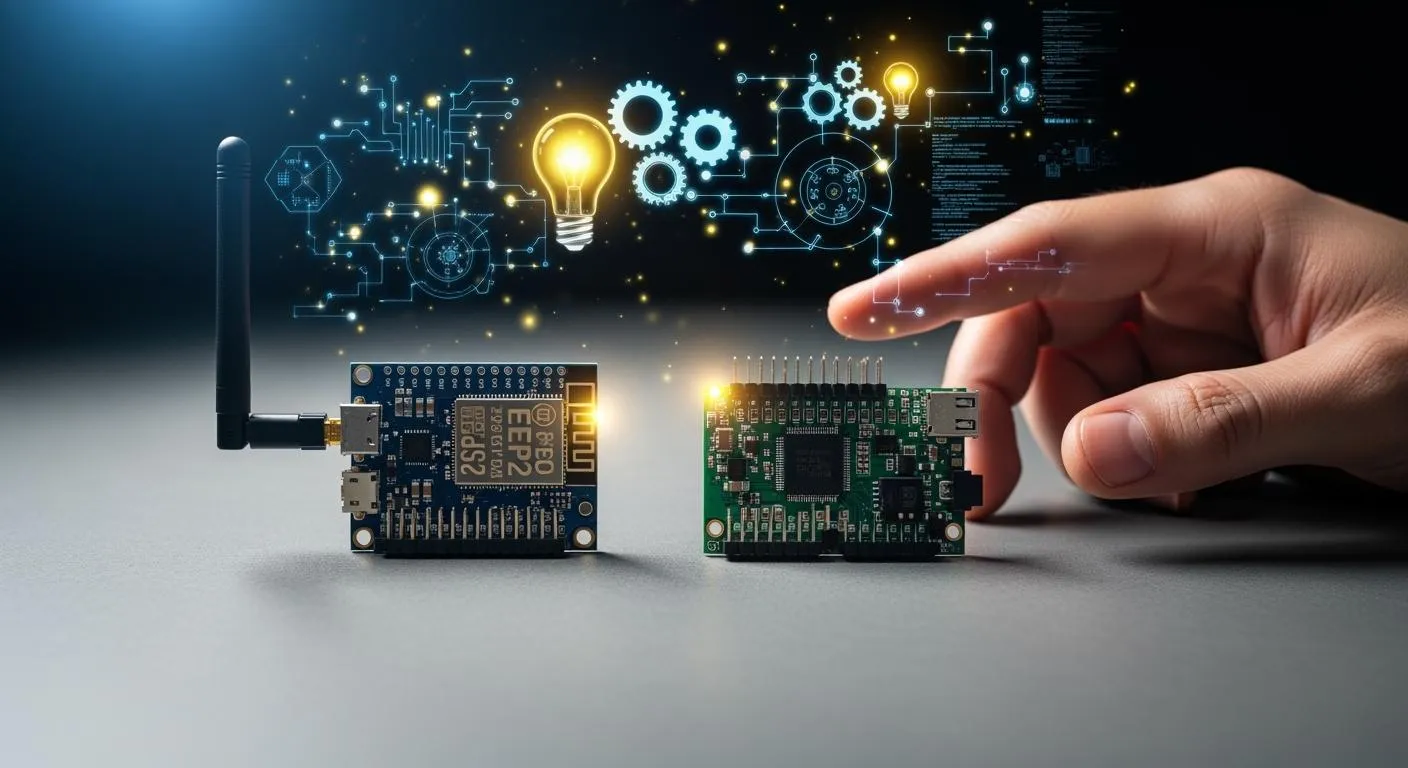
Choosing between esp32 vs stm32 depends on your project’s needs. You should consider factors like wireless connectivity, power efficiency, processing power, and application fit. The table below shows how engineers often compare these microcontroller options:
| Decision Factor | ESP32 | STM32 |
|---|---|---|
| Wireless Connectivity | Integrated Wi-Fi and BLE | Limited wireless options |
| Power Efficiency | Efficient in deep sleep | Ultra-low power options |
| Processing Power | Decent processing power | High-performance options |
| Application Fit | Great for rapid iot development | Preferred for industrial embedded systems |
Reflect on your priorities as you decide which platform works best for your needs.
Key Takeaways
- Choose ESP32 for projects needing built-in Wi-Fi and Bluetooth. It simplifies connectivity for IoT devices.
- Select STM32 for applications requiring precise real-time control and advanced peripherals. It excels in industrial and medical settings.
- Consider power efficiency when selecting a microcontroller. STM32 offers ultra-low power modes, while ESP32 is efficient in deep sleep.
- Utilize the extensive community support for ESP32 for rapid prototyping. STM32 provides professional tools for industrial applications.
- Evaluate the total cost, including potential additional modules for STM32. ESP32 may save money with its integrated features.
esp32 vs stm32: Architecture

Core Differences
When you compare esp32 vs stm32, you see clear architectural differences. Both microcontrollers serve unique purposes in embedded systems. The esp32 uses the Tensilica Xtensa architecture, which supports dual-core and single-core designs. This setup allows you to run networking tasks and application logic at the same time. The stm32 family relies on the ARM Cortex-M series, which includes M0, M0+, M3, M4, M7, and M33 cores. These cores deliver deterministic real-time performance, making stm32 a strong choice for industrial and control applications.
Here is a table that summarizes the main architectural features:
| Feature | ESP32 Family | STM32 Family |
|---|---|---|
| Architecture | Tensilica Xtensa (Dual/Single Core) & RISC-V | ARM Cortex-M Series (M0, M0+, M3, M4, M7, M33) |
| Typical Clock Speed | 160 MHz to 240 MHz | 16 MHz to 550+ MHz (varies by series) |
| Wireless Connectivity | Built-in Wi-Fi & Bluetooth | External modules needed |
| Wired Peripherals | Standard (I2C, SPI, UART, basic CAN/MAC) | Advanced (ADC/DAC, CAN FD, Ethernet, USB) |
| Power Consumption | Moderate to High active; good deep sleep | Ultra-low power (sub-microamp standby) |
You notice that esp32 stands out for built-in wireless features. stm32 offers a wide range of wired peripherals and excels in power efficiency. If you need a microcontroller for IoT devices, esp32 gives you Wi-Fi and Bluetooth without extra chips. If you need precise timing and advanced peripherals, stm32 provides more options.
The processor types and core configurations also differ. The esp32 usually has a dual-core setup, with one high-performance CPU and one low-power CPU. The stm32 can be single-core or multi-core, depending on the series. This flexibility lets you choose the right mcu for your application.
| Microcontroller | Processor Type | Core Configuration |
|---|---|---|
| ESP32 | Dual-core | 1 high-performance, 1 low-power CPU |
| STM32 | Single/Multi | Powerful for complex algorithms/tasks |
Nova Technology Company (HK) Limited is a HiSilicon-designated solutions partner. The company specializes in chip-level solutions and system integration for the IC industry. You can rely on Nova Technology Company (HK) Limited for professional support in microcontroller selection, embedded system design, and application scenarios ranging from smart devices to industrial automation.
Performance And Memory
You need to consider performance and memory when choosing between esp32 vs stm32. The esp32 delivers decent processing power for most IoT applications. Its clock speed ranges from 160 MHz to 240 MHz. The stm32 covers a wider range, from 16 MHz up to over 550 MHz in advanced models. This means stm32 can handle more demanding tasks, such as motor control, signal processing, and complex algorithms.
Memory capacity also matters. The esp32 offers 520 KB of RAM and up to 4 MB of flash memory. The stm32 family provides up to 192 KB of RAM and flash memory options from 512 KB to 2048 KB. You can select the right mcu based on your application's storage needs.
| Microcontroller | RAM Capacity | Flash Memory Capacity |
|---|---|---|
| ESP32 | 520 KB | 448 KB + 4 MB |
| STM32 | Up to 192 KB | 512 KB, 1024 KB, 2048 KB |
You see that stm32 focuses on deterministic behavior, power efficiency, and lifecycle stability. It works best when timing and control must be deterministic. You get tighter control with stm32, which is important for industrial and medical devices. The esp32 gives you value for cost, especially if you need wireless connectivity and moderate processing power.
- stm32 delivers deterministic real-time performance for critical tasks.
- stm32 offers power efficiency and stability for long-term projects.
- esp32 provides cost-effective solutions for connected devices.
When you compare esp32 vs stm32, you must weigh the importance of performance, memory, and architecture. If you need reliable timing and advanced peripherals, stm32 is the better choice. If you want built-in wireless and good processing power at a lower cost, esp32 fits your needs.
esp32 vs stm32: Connectivity

Wireless (Wi-Fi, Bluetooth)
You need to look closely at connectivity when you choose between esp32 and stm32 for your iot project. The esp32 stands out because it comes with integrated wifi and bluetooth stacks. This means you get built-in Wi-Fi (802.11 b/g/n) and Bluetooth (Classic and BLE) right on the chip. You do not need extra modules or chips to connect your device to a wireless network. The esp32 supports many networking protocols, such as TCP/IP, HTTP, MQTT, and WebSocket. This makes it easy to build wifi and bluetooth connected devices for iot applications.
The stm32 family, on the other hand, usually does not include wireless connectivity by default. Only special series like STM32WB (Bluetooth 5.0 and Zigbee) and STM32WL (LoRa) offer built-in wireless features. For most stm32 chips, you must add external modules to get Wi-Fi or Bluetooth. This can make your design more complex and increase the cost.
Here is a quick comparison of wireless features:
| Feature | ESP32 | STM32 |
|---|---|---|
| Wi-Fi Support | Yes – 802.11 b/g/n integrated | No (except STM32WL with LoRa) |
| Bluetooth Support | Yes – Bluetooth 4.2 + BLE | Only in STM32WB (Bluetooth 5.0 + Zigbee) |
You will find that esp32 gives you a big advantage if you want to build iot devices that need fast and easy wireless connectivity. You can use esp32 for smart home automation, wearable health devices, and industrial iot sensors. These projects often need reliable wifi and bluetooth connected devices for real-time data transfer. The stm32 works best in cases where wireless is not the main focus or where you want to use a custom wireless solution.
Tip: The esp32 manages its RF stack internally using the ESP-IDF SDK. This makes development smoother and reduces the time you spend on setup.
Some common use cases where esp32’s wireless connectivity shines include:
- Industrial iot devices for smart factories and real-time monitoring.
- Smart home automation, such as security cameras and smart locks.
- Wearable and health devices that send data over Wi-Fi.
Wired Interfaces
You also need to consider wired connectivity options for your project. Both esp32 and stm32 offer a range of wired interfaces, but their strengths differ. The esp32 provides standard interfaces like I2C, SPI, UART, and basic CAN. These are enough for many iot projects that need to connect sensors, displays, or simple actuators.
The stm32 family offers a broader selection of wired interfaces. You get advanced features such as high-speed USB, Ethernet, CAN FD, ADC, DAC, and more. This makes stm32 a strong choice for industrial systems, medical devices, and applications that need precise control or high-speed data transfer.
| Wired Interface | ESP32 | STM32 |
|---|---|---|
| I2C/SPI/UART | Yes | Yes |
| CAN | Basic | Advanced (CAN FD) |
| USB | Basic (device only) | Full (host/device/OTG) |
| Ethernet | Limited (via PHY) | Yes (native support in many series) |
| ADC/DAC | Yes (basic) | Yes (high resolution, multiple units) |
When you design an iot device, you must decide if wireless connectivity or advanced wired interfaces matter more. If you want a simple, all-in-one solution for wifi and bluetooth connected devices, esp32 is the better fit. If your project needs robust wired networking, high-speed data, or industrial protocols, stm32 gives you more flexibility.
You should always match your connectivity needs to your application. For example:
- Use esp32 for rapid iot prototyping and smart gadgets that need quick wireless setup.
- Choose stm32 for industrial controllers, medical equipment, or devices that require stable wired connections.
By understanding the strengths of each platform, you can select the right microcontroller for your iot project and ensure reliable connectivity for your application.
Power Consumption
Low-Power Features
You need to pay close attention to power consumption when you choose between ESP32 and STM32 for your applications. Each microcontroller offers different features for saving energy. STM32 stands out for its extremely low standby current and multiple ultra-low power sleep modes. You can use these features to build low-power applications that run for years on a small battery. ESP32 uses more power during Wi-Fi transmission, but it provides a very low deep sleep current. This helps you extend battery life in many applications.
Here is a quick comparison of power consumption:
| Microcontroller | Active Mode Power Consumption | Sleep Mode Power Consumption |
|---|---|---|
| STM32 | Extremely low standby current | Multiple ultra-low power sleep modes |
| ESP32 | Significant power during WiFi use | Very low deep sleep current |
You can use deep sleep and other power-saving modes to reduce energy use in both platforms. STM32 gives you more options for fine-tuning power, which is important for low-power applications like remote sensors and medical devices. ESP32 lets you use features like Target Wake Time and BLE advertising intervals to save power in connected applications.
Battery Applications
You often design battery-powered devices that need efficient power management. STM32 works well in applications where you must monitor battery voltage, manage charging circuits, or keep devices running for long periods. You can use STM32 for asset trackers, vehicle trackers, and other low-power applications that require extended battery life.
ESP32 also supports many battery-powered applications. You can use deep sleep modes and BLE to build devices that last longer on a single charge. Many developers use ESP32 for smart gadgets, wearables, and IoT applications that need wireless connectivity and good battery life.
Common battery application scenarios include:
- Optimizing BLE advertising intervals for better battery life.
- Building asset trackers and vehicle trackers with extended battery life.
- Monitoring battery voltage and state of charge for devices.
- Designing circuits for charging lithium-ion batteries.
- Using Target Wake Time to extend battery life in ESP32 applications.
- Implementing deep sleep modes to conserve power.
- Designing BLE devices for long-term battery operation.
You should match the microcontroller to your application's power needs. STM32 fits best in ultra-low-power applications. ESP32 works well when you need wireless features and good battery performance.
Development Tools And Community
IDEs And Languages
You have many options when you start development with ESP32 or STM32. ESP32 supports a wide range of integrated development environments and programming languages. You can use ESP-IDF, Arduino-ESP32, MicroPython, and Visual Studio Code. Other choices include ESP32forth, Espruino, Mongoose OS, mruby, Nim, NodeMCU, Rust, Swift, Zerynth, Matlab Simulink, and Zig. This flexibility makes ESP32 popular for rapid prototyping and creative projects.
STM32 focuses on professional development. You often use STM32CubeIDE, Keil MDK, IAR Embedded Workbench, and Atollic TrueSTUDIO. These tools support C and C++ programming. STM32 also works with Matlab Simulink for model-based design. You get strong debugging features and advanced code analysis, which help you build reliable industrial applications.
Tip: If you want to experiment with different languages or quick prototyping, ESP32 gives you more choices. For strict industrial standards, STM32 offers robust tools and workflows.
Community Support
You benefit from strong community support when you choose either platform. ESP32 has a huge community focused on IoT innovation and maker projects. You find many tutorials, open-source libraries, and forums that help you solve problems quickly. STM32 has excellent professional tooling and support. The STM32 community includes engineers who work on industrial-grade reliability and advanced embedded systems.
Here is a comparison of community support and application focus:
| Feature | ESP32 | STM32 |
|---|---|---|
| Community Support | Huge community for IoT innovation | Excellent professional tooling and support |
| Application Focus | Rapid IoT prototyping, low-cost devices | Industrial reliability, advanced systems |
You see that ESP32 excels in WiFi and Bluetooth connectivity. It is maker-friendly and great for low-cost smart devices. STM32 dominates in real-time control, precision ADCs, and robotics. You get detailed documentation and long-term support from STMicroelectronics, which is important for industrial development.
When you plan your next development project, consider the type of support and tools you need. ESP32 suits hobbyists and fast development cycles. STM32 fits professional engineers who need advanced features and strong manufacturer support.
Cost And Availability
Price Comparison
You need to compare prices before you select a microcontroller for your project. ESP32 development boards usually cost more than STM32 boards. You can see this difference in the table below:
| Product Name | Original Price (EGP) | Current Price (EGP) |
|---|---|---|
| ESP32-S 38Pin Development Board | 7,251.07 | 5,500.00 |
| STM32F401RCT6 ARM STM32 Board | 324.99 | 240.00 |
| STM32F103C8T6 ARM STM32 Board | 262.51 | 199.00 |
ESP32 boards offer built-in Wi-Fi and Bluetooth, which increases their price. STM32 boards cost less and provide strong performance for industrial and control applications. You save money with STM32 if you do not need wireless features. You pay more for ESP32 when you want easy connectivity.
Tip: You should consider the total cost, including extra modules for wireless if you choose STM32.
Supply And Lifecycle
You must think about supply chain stability and product lifecycle when you plan your project. STM32 microcontrollers give you long-term support and strong distributor networks. You can rely on STM32 for industrial and automotive projects that need stability for many years. ESP32 offers global distribution, but the lifecycle is shorter.
| Feature | STM32 | ESP32 |
|---|---|---|
| Lifecycle Commitment | 10–15 years | Shorter guarantees |
| Product Variants | Industrial and automotive | N/A |
| Distributor Support | Extensive network | Strong global distribution |
| Redesign Risk | Lower for long-life systems | N/A |
| Product Cycle Suitability | Best for 7–10 years | Suitable for 3–5 years |
You get lower redesign risk with STM32. You can use STM32 for projects that need a stable supply for 7–10 years or more. ESP32 fits best in products with shorter lifecycles, such as consumer electronics or rapid IoT prototypes.
- Choose STM32 for industrial, medical, or automotive systems that require long-term availability.
- Select ESP32 for connected devices and smart gadgets with faster product cycles.
You should match your microcontroller choice to your project’s expected lifetime and supply needs. This helps you avoid supply chain issues and ensures your product stays available.
Security Features
Hardware Security
You need to protect your devices from threats at the hardware level. Both ESP32 and STM32 offer security features, but they target different needs. ESP32 includes hardware acceleration for cryptographic algorithms like AES, SHA, and RSA. You can use these features to encrypt data and secure communications. ESP32 also provides a True Random Number Generator (TRNG), which helps you create secure keys for your applications.
STM32 microcontrollers focus on industrial and medical security requirements. Many STM32 chips include a hardware cryptographic accelerator, a secure key storage area, and a unique device ID. You can use these features to implement secure authentication and encrypted data storage. Some STM32 models offer a hardware firewall and tamper detection, which help you protect sensitive information from physical attacks.
| Security Feature | ESP32 | STM32 |
|---|---|---|
| Crypto Accelerator | Yes (AES, SHA, RSA, ECC) | Yes (AES, SHA, RSA, ECC) |
| True Random Number Gen. | Yes | Yes |
| Secure Key Storage | Limited | Available on select models |
| Tamper Detection | No | Available on select models |
Note: You should always check the datasheet for your specific chip to confirm which security features are available.
Secure Boot
Secure boot helps you make sure that only trusted firmware runs on your device. ESP32 supports secure boot by verifying the digital signature of the firmware before it starts. You can enable flash encryption, which protects your code and data from unauthorized access. These features help you prevent attackers from loading malicious software onto your device.
STM32 also offers secure boot options, especially in its higher-end series. You can use the built-in bootloader to verify firmware integrity and authenticity. Some STM32 chips support secure firmware updates and encrypted boot processes. These features are important for industrial and medical devices that require strict security standards.
Key Secure Boot Benefits:
- Protects against unauthorized firmware changes
- Ensures device integrity at startup
- Supports encrypted firmware updates
You should enable secure boot and hardware security features to keep your devices safe from modern threats. Both ESP32 and STM32 give you strong tools to build secure, reliable products.
Typical Use Cases
Nova Technology Company (HK) Limited is a HiSilicon-designated solutions partner. The company specializes in chip-level solutions and system integration for the semiconductor industry. You can rely on their expertise for application scenarios ranging from smart home devices to industrial automation and cloud-connected consumer devices.
esp32 For Connected Devices
You often choose esp32 for iot projects that need wireless connectivity and flexible performance. This microcontroller works well in many connected device scenarios:
- Smart home systems, such as Wi-Fi light switches, smart plugs, BLE-enabled locks, HVAC monitoring, and environmental sensors.
- Industrial iot nodes that collect sensor data from machinery and support wireless data acquisition.
- Web-based control systems, where esp32 hosts an embedded web server for remote control and real-time dashboards.
- Low-power remote devices, including outdoor environmental monitoring and remote agricultural sensors that use deep sleep modes for battery efficiency.
You see esp32 in rapid prototyping for smart home iot and cloud-connected consumer devices. Its built-in Wi-Fi and Bluetooth make it easy to connect your prototypes to the internet or mobile apps. You can quickly move from prototyping to production iot projects with esp32.
stm32 For Industrial And Medical
You select stm32 when your iot application needs deterministic real-time control and industrial protocols like CAN, Ethernet, or RS-485. This microcontroller supports long-lifecycle embedded products, often operating for over 10 years in the field. You find stm32 in industrial controllers, motor drives, power systems, medical devices, and building automation. Its ultra-low-power battery life and advanced features, such as precise timers and high-resolution ADCs, make it ideal for timing-critical and medical-grade applications. The stm32L series stands out for ultra-low power sensors and devices that require reliable performance in regulated environments.
Prototyping And Production
You use esp32 for rapid prototyping when you want to test iot ideas quickly. Its flexible development tools and wireless features help you build and refine prototypes fast. When you need to scale up, esp32 supports production iot projects for smart home devices and consumer electronics.
You turn to stm32 for prototyping in industrial and medical fields. Its robust performance and long-term support make it a strong choice for production iot projects that demand reliability and precise control. You can trust stm32 for applications where safety, compliance, and lifecycle stability matter most.
Decision Checklist
Selection Guide
You can use a simple checklist to help you choose between stm32 and esp32 for your next project. Start by thinking about your main requirements. If you need built-in Wi-Fi or Bluetooth for your iot device, esp32 gives you fast and easy wireless integration. If your project needs precise real-time control, advanced analog features, or must run for years on a battery, stm32 stands out with its ARM Cortex-M architecture and low-power modes.
Here are some key points to consider:
- Do you need wireless connectivity out of the box?
- Choose esp32 for built-in Wi-Fi and Bluetooth.
- Does your application require real-time performance or advanced peripherals?
- stm32 offers excellent real-time control and a wide range of interfaces.
- Is power efficiency critical for your device?
- stm32 provides advanced low-power modes for battery-powered products.
- Are you looking for rapid prototyping and strong open-source support?
- esp32 works well with many development tools and has a large community.
- Do you need over-the-air (OTA) updates?
- esp32 supports OTA updates natively, while stm32 may need custom solutions.
Tip: Match your microcontroller choice to your project’s main goal. For smart home or cloud-connected devices, esp32 is often the best fit. For industrial, automotive, or medical systems, stm32 is usually the preferred option.
Summary Table
You can use the table below to compare the main features of stm32 and esp32. This summary helps you make a quick decision based on your project’s needs.
| Criterion | STM32 | ESP32 |
|---|---|---|
| Architecture | ARM Cortex-M (M0/M3/M4/M7/M33) | Xtensa LX6 / LX7 (dual-core) |
| Wireless Connectivity | No built-in | Built-in Wi-Fi/Bluetooth |
| Real-Time Performance | Excellent | Limited |
| Power Efficiency | Advanced low-power modes | Moderate sleep modes |
| Memory Resources | Flexible (varies by series) | 4–16 MB Flash, 320–520 KB SRAM |
| Development & Debugging | STM32CubeIDE, CubeMX, HAL/LL libraries | ESP-IDF, Arduino IDE, PlatformIO |
| OTA Support | Custom implementation | Built-in support |
| Unit Cost | Higher | Cost-effective |
This checklist and table guide you to the right choice. You can now select the microcontroller that matches your technical and business needs.
You now see that the best microcontroller depends on your project’s needs. Use the checklist and summary table to compare features. Cost and connectivity can shape your decision. Integrating wireless or advanced interfaces increases BOM costs. ESP32 gives you built-in Wi-Fi and BLE, which saves time and money. STM32 supports industrial protocols and lets you choose external wireless modules. Think about long-term support, budget, and connectivity. Share your experiences or questions in the comments below. Your feedback helps others make better choices!
FAQ
What is the main difference between ESP32 and STM32?
ESP32 gives you built-in Wi-Fi and Bluetooth. STM32 offers more options for real-time control and industrial interfaces. You should choose based on your project’s need for wireless connectivity or advanced peripherals.
Can I use ESP32 for industrial applications?
You can use ESP32 in some industrial projects, especially for wireless data collection. However, STM32 fits better for tasks that need strict timing, advanced analog features, or long-term support.
Which microcontroller is easier for beginners?
ESP32 is easier for beginners. You get many tutorials, Arduino support, and a large community. STM32 has more professional tools, but you may find the learning curve steeper.
Does STM32 support wireless connectivity?
Most STM32 chips do not have built-in wireless. You need to add external modules for Wi-Fi or Bluetooth. Some special STM32 series, like STM32WB, offer built-in Bluetooth and Zigbee.
How do I choose between ESP32 and STM32 for battery-powered devices?
If you need ultra-low power and long battery life, STM32 is the better choice. ESP32 works well for battery devices that need Wi-Fi or Bluetooth, but it uses more power during wireless transmission.