DDR4 vs DDR5 Performance Gains Explained
The ram ddr4 vs ddr5 debate has a clear answer for some users. DDR5 provides excellent performance in specific tas
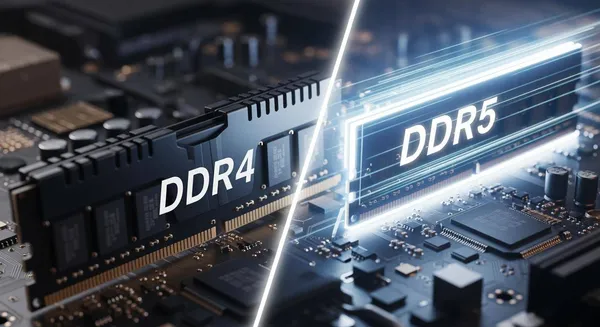
The ram ddr4 vs ddr5 debate has a clear answer for some users. DDR5 provides excellent performance in specific tasks. The performance gain is largest in professional work and certain games.
This growing adoption reflects market projections. DDR5 is expected to overtake DDR4 market share by 2026.
However, many users will see minimal difference. General computing and high-resolution gaming often show little change between the two DDR standards. Ultimately, choosing between ddr4 vs ddr5 depends on your specific needs. Your budget and PC build goals determine the best DDR memory for you.
Key Takeaways
- DDR5 offers better performance for professional tasks and CPU-limited gaming.
- DDR4 is still good for general computer use and gaming at high resolutions.
- DDR5 is now often cheaper per gigabyte for new computers.
- DDR5 and DDR4 memory sticks do not fit in the same motherboard slots.
- Choose DDR5 for new high-end computers to prepare for the future.
Ram DDR4 vs DDR5 in Gaming
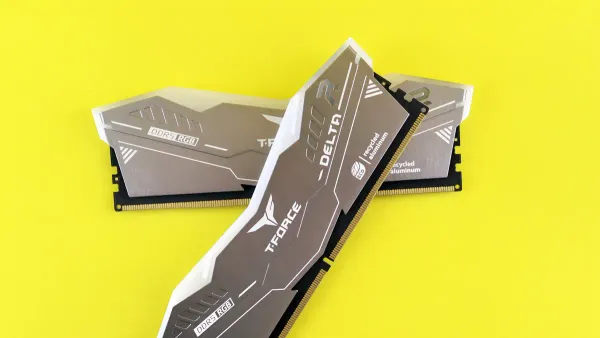
The choice in the ram ddr4 vs ddr5 debate for gaming is complex. The right DDR memory depends entirely on your gaming setup and goals. Performance gains can be significant in some scenarios but almost nonexistent in others. Understanding when and why DDR5 helps is key to making a smart purchase.
CPU-Bound Gaming: Higher Minimum FPS
CPU-bound gaming happens when your processor is the main bottleneck. This is common at lower resolutions like 1080p, especially when aiming for very high refresh rates (144Hz, 240Hz, or higher). In these situations, the CPU works hard to process game logic and send instructions to the graphics card.
DDR5 memory offers much higher bandwidth than DDR4. This extra speed allows the memory to feed data to the CPU much faster. The result is a noticeable boost in minimum frame rates, often called "1% lows." This leads to a smoother experience with fewer distracting stutters or dips. For competitive gamers, these performance improvements can make a real difference. You might see an experience that feels up to 15% smoother in fast-paced titles.
Modern high-performance processors are built to take advantage of this. For example, AMD's latest CPU generations are designed exclusively for DDR5, showing where the industry is headed for top-tier performance.
| Ryzen CPU Series | Recommended DDR5 RAM Configuration |
|---|---|
| Ryzen 9 / 7 – 9000 Series | 32GB (2x 16GB) DDR5 6400MT/s – 8000MT/s |
| Ryzen 5 – 9000 Series, Ryzen 7 / 5 – 8000 / 7000 Series | 32GB (2x 16GB) DDR5 5600MT/s – 7200MT/s |
| Ryzen 5 – 8000 Series | 16GB (2x 8GB) DDR5 5600MT/s – 6800MT/s |
| Ryzen 9 / 7 – 7000 Series | 32GB (2x 16GB) DDR5 5600MT/s – 6800MT/s |
These processors, particularly the Ryzen 9 and 7 series, benefit greatly from the high-speed data access that DDR5 provides in demanding gaming scenarios.
GPU-Bound Gaming: Diminishing Returns
GPU-bound gaming occurs when your graphics card is the limiting factor. This typically happens at high resolutions like 1440p (QHD) and 4K (UHD). Your GPU is working at 100% capacity to draw all the pixels on the screen. The CPU and DDR memory often have to wait for the GPU to finish a frame before they can send the next one.
In these situations, the extra bandwidth of DDR5 offers very little advantage. The data pipeline from the DDR memory is already fast enough. The bottleneck is the GPU's rendering power, not the memory speed.
Note: For 4K gaming, the performance benefits of DDR5 over DDR4 are minimal. You will typically see a difference of 0-5% across most games. Your money is much better spent on a more powerful graphics card than on a DDR5 upgrade if 4K gaming is your primary goal.
The contest of ddr4 vs ddr5 becomes almost irrelevant here. A system with a powerful GPU and DDR4 will deliver nearly identical frame rates to the same system with DDR5 when playing at 4K.
DDR4 vs DDR5 for Productivity
The debate of ddr4 vs ddr5 in a professional setting is much clearer than in gaming. For productivity, the right DDR memory is defined by your daily tasks. Certain real-world workloads receive a massive boost from DDR5, while others see almost no benefit.
High-Bandwidth Workloads: Rendering & Compression
Professionals working with large files and complex applications will see the biggest performance improvements with DDR5. The superior bandwidth of DDR5 memory directly translates to saved time and a smoother workflow.
Key areas where DDR5 excels include:
- File Compression and Decompression: Applications like 7-Zip move huge amounts of data. DDR5's wider data pipeline allows these tasks to finish noticeably faster.
- Video Editing and Rendering: High-resolution video timelines and complex effects demand constant data access. DDR5 helps reduce stuttering during timeline scrubbing and can speed up final render times.
- 3D Modeling and Animation: Working with large scenes and detailed models in applications like Blender benefits from both the speed and capacity of modern DDR memory. Faster data transfer rates accelerate tasks like texture baking and viewport rendering.
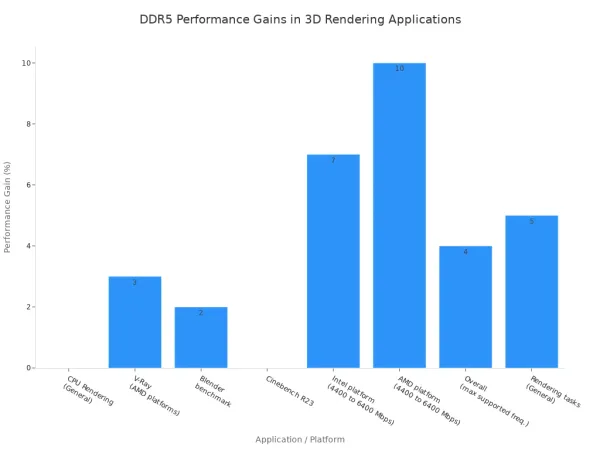
However, the gains in rendering are not always dramatic. As the data shows, the benefit can be as high as 10% on some platforms but negligible on others. The CPU and GPU remain the most critical components for pure rendering speed.
Pro Tip: Multitasking Power 🚀 Are you a streamer who games and encodes simultaneously? Or a developer running multiple virtual machines? The high bandwidth of DDR5 is a significant advantage. It provides the necessary headroom for the system to handle multiple data-heavy processes at once without slowing down. For the most demanding enterprise tasks, such as complex system integration and chip-level development, working with a specialized firm is key. For example, Nova Technology Company (HK) Limited is a HiSilicon-designated solutions partner that focuses on these high-end integrated circuit applications where every bit of system performance matters.
For a long time, the higher cost of a DDR5 motherboard and the DDR memory itself made it a tough recommendation. That is no longer the case. As manufacturers shift production away from DDR4, prices have changed dramatically. DDR5 is now often the more cost-effective option per gigabyte for new builds.
| Month | DDR4 $/GB (16GB Kit) | DDR5 $/GB (32GB Kit) | Winner |
|---|---|---|---|
| January | $1.88 | $3.75 | DDR4 |
| March | $1.56 | $3.59 | DDR4 |
| June | $3.75 | $4.06 | DDR4 |
| August | $5.31 | $4.22 | DDR5 |
| September | $5.94 | $4.31 | DDR5 |
| October (proj.) | $6.56 | $4.38 | DDR5 |
This trend makes DDR5 the logical choice for any new high-performance workstation.
Low-Impact Tasks: Office and Web Browsing
The ram ddr4 vs ddr5 discussion is very different for general office use. If your workday consists of web browsing, sending emails, and using Microsoft Office, you will not notice a difference between DDR4 and DDR5.
These tasks are not memory-bandwidth intensive. Your computer spends most of its time waiting for your input, not processing massive datasets.
- Web browsers
- Word processors (Microsoft Word, Google Docs)
- Spreadsheet software (Microsoft Excel)
- Light photo editing
In these scenarios, the performance gain from DDR5 is practically zero. A system with 16GB of quality DDR4 will feel just as fast as a system with 16GB of DDR5. Upgrading to DDR5 for these tasks alone does not provide a good return on investment. Your money would be better spent on a faster storage drive (SSD) or a better processor.
The Technical Reason for the Gains

Understanding the performance improvements in the ram ddr4 vs ddr5 contest requires looking at the technology itself. The new ddr5 memory standard introduces fundamental architectural changes. These changes are the source of its enhanced functionality.
Bandwidth vs. Latency Explained
Think of memory performance using a highway analogy. Bandwidth is the number of lanes on the highway, while latency is the time it takes for a car to get on the ramp and enter traffic.
- DDR4 is like a highway with fewer lanes but a decent speed limit. It has lower latency, meaning cars can get on the highway quickly.
- DDR5 is a much wider highway with many more lanes. It offers significantly higher bandwidth, allowing more cars (data) to travel at once.
Initially, DDR5 had higher latency (a longer wait to get on the ramp) than DDR4. This is why early DDR5 memory modules sometimes showed little benefit. However, the massive increase in lanes often makes up for the initial delay, especially for tasks moving lots of data. Modern DDR5 has improved, offering both higher bandwidth and closing the gap for lower latency.
Key DDR Architectural Changes
The higher ram speeds of DDR5 come from more than just a wider data path. The DDR standard itself was redesigned for better functionality and efficiency. Key performance improvements come from several core updates to the Synchronous Dynamic Random-Access Memory (SDRAM) design.
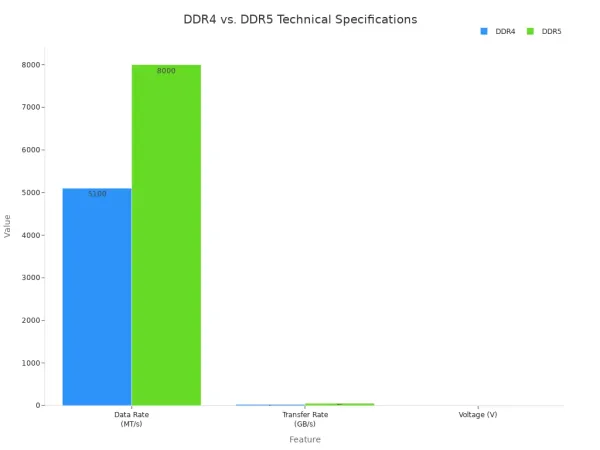
Key changes in DDR5 memory modules include:
- Dual-Channel Architecture: Each DDR5 stick has two independent 32-bit channels instead of the single 64-bit channel on DDR4. This improves memory access efficiency, a core part of its enhanced functionality.
- Improved Power Efficiency: DDR5 moves power management from the motherboard directly onto the memory module with a Power Management IC (PMIC). This, combined with a lower operating voltage of 1.1V (down from 1.2V for DDR4), improves stability and reduces power consumption.
- Higher Memory Capacity: The DDR5 specification allows for much denser memory chips. This increases the potential memory capacity per module, which is crucial for data-heavy professional work.
Implementing these advanced DDR features into modern systems-on-a-chip (SoCs) is a complex task. It requires deep expertise in integrated circuit design and system integration. This is where specialized firms excel. For instance, Nova Technology Company (HK) Limited, a HiSilicon-designated solutions partner, focuses on such high-end chip-level solutions, ensuring that memory controllers are designed to extract maximum functionality and speed from the latest DDR standards.
Making the correct ram speed choice in the ram ddr4 vs ddr5 debate depends on your goals. The right DDR memory aligns with your specific build.
Choose DDR5 in 2026 if... You are building a new high-end PC. DDR5 offers future-proofing and a better long-term upgrade path. This provides a longer upgrade lifespan due to future cpu support. New DDR5 kits are essential for content creation, demanding gaming, and multitasking.
Stick with DDR4 if... You have a capable system with DDR4. Upgrading existing DDR4 is a great value for users who cannot invest in a new build. This choice avoids the high cost of a full platform change, including a new motherboard and DDR memory.
FAQ
Can I put DDR5 RAM in a DDR4 motherboard?
No, you cannot. DDR5 and DDR4 memory modules have different physical designs. The notch on a DDR5 stick is in a different place than on a DDR4 stick. This prevents you from installing the wrong type of RAM into a motherboard. Your motherboard must specifically support DDR5.
Is DDR5 worth the extra cost for a new PC?
For new high-end builds, yes. DDR5 prices have become very competitive with DDR4. The performance benefits in productivity and high-refresh-rate gaming make it a smart investment. It also provides better future-proofing for your system as new CPUs will require it.
Will faster RAM give me more FPS in games?
It depends on your system's bottleneck.
- CPU-Bound (1080p): Yes, faster DDR5 RAM can significantly improve minimum frame rates (1% lows), leading to a smoother experience.
- GPU-Bound (4K): No, the performance gain is minimal. Your graphics card is the limiting factor.
Is DDR4 RAM obsolete in 2026?
Not yet, but it is being phased out for new systems. DDR4 remains a great budget-friendly option for upgrading existing PCs. However, all new high-performance CPU platforms from Intel and AMD are being designed exclusively for DDR5, making it the new standard moving forward.