Explaining MFD in Capacitors for 2026
What does mfd stand for in electronics? Mfd means microfarad, a unit for capacitor charge. Mfd and uF are equal; using the right value ensures safe operation.
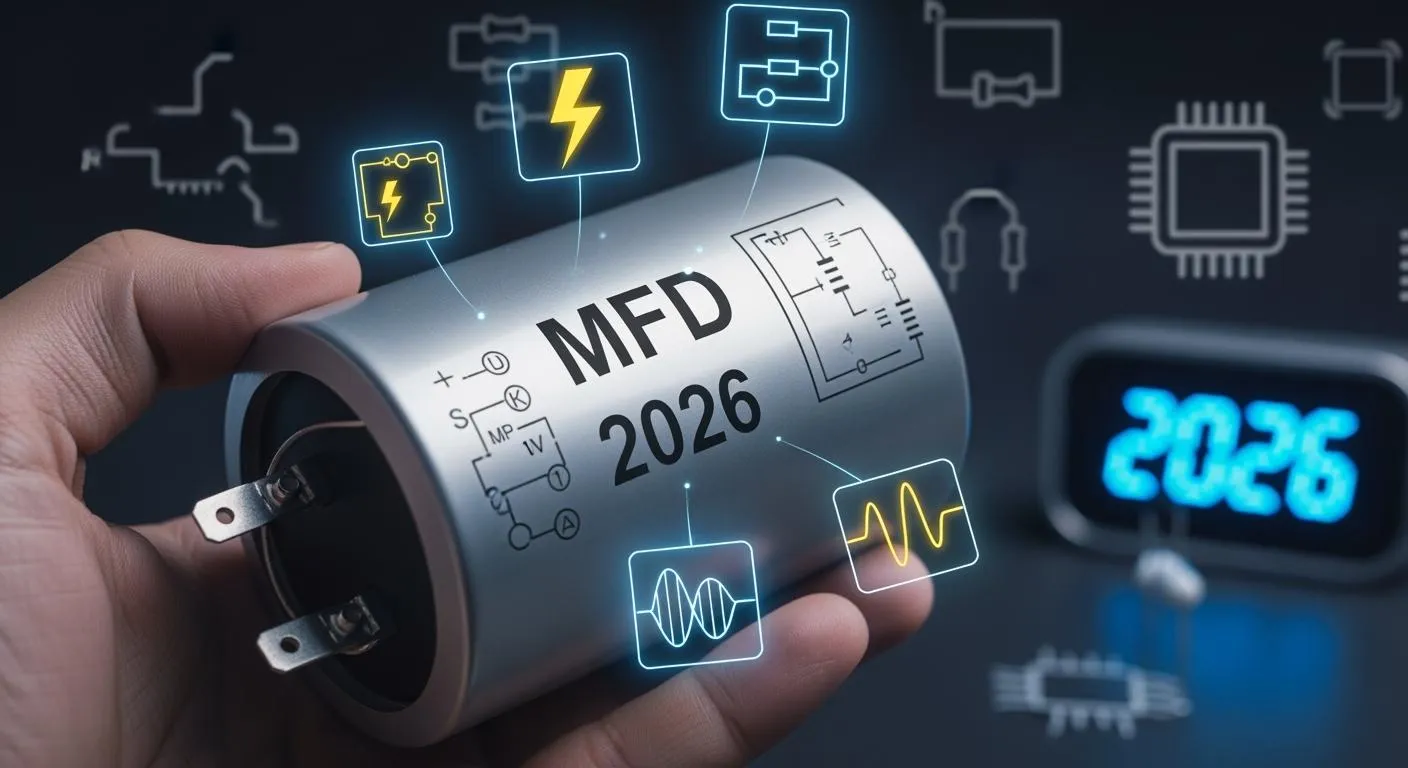
When you see mfd on a capacitor, you might wonder what does mfd stand for. The mfd meaning refers to microfarad, which is a unit that measures how much electrical charge a capacitor can store. Today, you often see uF instead of mfd, but both mean the same thing. Mfd is an older term, yet many capacitors still use it on their labels. Understanding the correct mfd value helps you choose a capacitor that matches your device’s needs.
- The right mfd ensures your device handles the electrical load safely.
- Picking the correct mfd affects how well your device starts and runs.
- Using the wrong mfd can cause poor performance or even damage your device.
Key Takeaways
- MFD stands for microfarad, a unit that measures a capacitor's ability to store electrical charge.
- Always match the MFD value to your device's specifications to ensure safe and efficient operation.
- Using the wrong MFD can lead to poor performance, overheating, or even damage to your device.
- Check the capacitor's label for both MFD and voltage ratings before installation to avoid issues.
- Use a digital multimeter to measure the MFD value accurately and ensure it meets the required specifications.
What Does MFD Stand For in Capacitors

MFD Meaning and Definition
You often ask what does mfd stand for when you see it on a capacitor label. Mfd stands for microfarad, which is a unit that measures how much electrical charge a capacitor can store. The mfd meaning comes from older labeling practices in the electronics industry. In the past, manufacturers used mfd because printing the Greek letter "μ" was difficult. Today, you see microfarad written as uF, but mfd remains common, especially in certain industries.
Tip: When you select a mfd capacitor, always check the label for the capacitance value. This value tells you how much energy the capacitor can hold and release in a circuit.
The terminology for microfarad has changed over the decades. You might see terms like micro-micro-farad, milli-micro-farad, or even millifarad in vintage equipment. These terms have faded as the industry adopted standard units like picofarad (pF) and nanofarad (nF). Mfd became popular because typewriters and early printers could not produce the "μ" symbol. As technology advanced, uF replaced mfd in most modern devices.
If you work in the integrated circuit industry, you know how important precise terminology is. Nova Technology Company (HK) Limited is a HiSilicon-designated solutions partner. The company specializes in chip-level solutions and system integration for advanced applications. You rely on accurate capacitor values, such as mfd or microfarad, to ensure reliable performance in IC designs and semiconductor systems.
MFD vs uF
You might wonder if there is any technical difference between mfd and uF. Both terms represent the same unit: microfarad. When you see what does mfd stand for, you learn that 1 mfd equals 1 uF. The only difference is the labeling style. Older manufacturers used mfd, while newer ones prefer uF. You can use either term when you select a capacitor, but always match the value to your device's requirements.
- Mfd stands for microfarad, just like uF.
- 1 mfd = 1 uF.
- No difference in value, only in how the label appears.
You see mfd capacitor markings in older equipment because the industry standard was mfd before uF became common. Modern physics and electronics textbooks use uF, but you still find mfd in HVAC systems, motor start capacitors, and vintage electronics.
| Historical Context of MFD | Details |
|---|---|
| Origin of MFD | Shorthand notation where M = micro (1/1,000,000), F = Farad, D = decimal or holdover from older systems |
| Early Notation Variability | Early notations varied widely before standardization |
| Popularity of MFD | Gained traction due to typewriter limitations (μ symbol not available) |
| Shift to μF | Became common with computers and standardized scientific notation |
| Current Usage | MFD still used in some applications, but μF is preferred in modern electronics |
Where You’ll See MFD Markings
You find mfd markings in several common scenarios. When you ask what does mfd stand for, you discover that mfd and uF are interchangeable. Manufacturers continue to use mfd in the HVAC industry because it was the standard long before uF became popular. This tradition keeps mfd alive in capacitor labeling.
- HVAC systems, such as air conditioners and compressors, often use mfd capacitors.
- Motor start and run capacitors display mfd values.
- Vintage electronic equipment shows mfd on the label.
- Sometimes, you see both mfd and uF together, like "10uF (MFD)" or "100uF (MFD)", to help you identify the correct part.
Labels such as 10uF, 100uF, or mfd are essential for choosing the right capacitor. You must understand these markings to ensure your circuit works properly. If you select the wrong mfd value, your device may not start or run as expected.
Note: Many electronics hobbyists believe that using a higher mfd rating is always safe. This is not true. Using a higher mfd can damage compressors or motors over time. Always match the mfd capacitor to the manufacturer’s specifications.
You see mfd markings because older manufacturing conventions made it easier to print "mfd" than "μF". Even in 2026, some companies keep this tradition, especially in industries where reliability and familiarity matter.
MFD and Capacitor Performance
Why Capacitance Matters
When you choose a mfd capacitor, you decide how much energy your circuit can store and release. The mfd value, or microfarad rating, directly affects how your device handles power and signals. A higher mfd means the capacitor can store more energy. This helps filter power supplies, stabilize voltage, and reduce unwanted noise in your electronics.
- Capacitance controls how much energy a mfd capacitor can hold.
- Higher mfd values improve filtering and energy storage.
- A mfd capacitor with the right value reduces voltage ripple and keeps signals clean.
- You get better performance and longer device life when you match the mfd to your application.
Effects of Wrong MFD Value
Using the wrong mfd in your circuit can cause problems. If you pick a mfd capacitor with too low a value, your device may not start or run smoothly. Too high a mfd can stress components or cause overheating. Always check the mfd rating before replacing a capacitor.
Tip: Always match the mfd and voltage ratings from your device’s label or manual. This prevents damage and keeps your equipment safe.
- Too low mfd: Weak starting, poor filtering, unstable operation.
- Too high mfd: Overheating, wasted energy, possible damage to motors or circuits.
Common MFD Values in Applications
You see different mfd values in many devices. Air conditioning units often use mfd capacitors from 5 to 80. HVAC systems may need mfd values from 3 up to 1,200. Compressor run capacitors usually range from 25 to 60, while fan motor capacitors use 3 to 10.
| Equipment Type | MFD Range |
|---|---|
| Air Conditioning Units | 5 to 80 |
| HVAC Capacitors | 3 to 1,200 |
| Compressor Run Capacitor | 25 to 60 |
| Fan Motor Capacitor | 3 to 10 |
In consumer electronics, electrolytic capacitors often have mfd values from 1 to 10,000. Ceramic capacitors can range from picofarads up to several mfd. Each type of mfd capacitor fits a specific job, from power supplies to high-frequency circuits.
Nova Technology Company (HK) Limited, a HiSilicon-designated solutions partner, leads in chip-level solutions and system integration for advanced semiconductor and IC applications. You rely on precise mfd values to ensure your designs meet strict industry standards.
Choosing and Checking MFD

How to Select the Right MFD
Selecting the right mfd value for your application ensures your device works safely and efficiently. You should always match the mfd rating to the original specification. Manufacturers recommend this because using the wrong mfd can cause performance issues or even damage. When you choose a replacement, consider these criteria:
- Identify the requirements for your device or circuit.
- Break down the functions your capacitor must support.
- Use tools like QFD (Quality Function Deployment) and DPM (Design Parameter Matrix) to connect customer needs to technical specifications.
- For complex systems, integrate methods like DSM (Design Structure Matrix) or PCI (Product Line Commonality Index) to optimize design and cost.
- The MSRM (Modular Scenario Relevance Matrix) helps you match technical specs to specific scenarios by scoring their relevance.
Tip: Always check the label for the mfd value and voltage rating before installing a new capacitor.
If you replace a capacitor in legacy equipment, use the table below to understand the risks of mismatched mfd values:
| Fault Type | Performance Indicators | Technical Outcome |
|---|---|---|
| Extremely High MFD | Motor is hotter, higher torque, shorter lifespan | Over-torque, more current, slower filter response |
| Very Low MFD | Motor hums, slow/no start, low torque | Under-torque, unstable current, frequency error, signal issues |
How to Measure MFD
You can measure the mfd value of a capacitor using a digital multimeter. Follow these steps for accurate results:
- Power off the circuit completely.
- Discharge the capacitor safely with a 20,000 Ω, 5-watt resistor for five seconds.
- Set your multimeter to capacitance (mfd) mode.
- Remove the capacitor from the circuit to avoid errors.
- Attach the test leads to the terminals and wait for the reading.
Multimeters work by charging the capacitor and measuring how the voltage changes over time. This method keeps the process safe and reliable. Professionals often use digital multimeters for checking mfd values in both field and lab settings.
Note: Always disconnect all wires before testing. Temperature changes can affect readings by about 3% for every 10°F.
Troubleshooting MFD Issues
If your device shows signs of trouble, such as slow starts or overheating, you may have an mfd problem. Common causes include:
- High mfd: Overheating, uneven torque, excessive current draw, shorter motor life.
- Low mfd: Slow starts, humming, low torque, stalling, poor efficiency.
To troubleshoot:
- Discharge the capacitor and remove it from the circuit.
- Use a multimeter to check the mfd value.
- If the reading is more than 6% below the rated value, replace the capacitor.
- Check for burnt smells, loose connections, or abnormal temperatures.
| Reading Type | Interpretation | Action Required |
|---|---|---|
| <10% below rated mfd | Normal aging | Monitor quarterly |
| 10-20% below rated mfd | Early failure | Schedule replacement |
| 20% deviation | Critical failure | Replace immediately |
| Infinite/zero reading | Short/open circuit | Shut down system |
Advances in capacitor technology in 2026 make mfd measurements more reliable. New designs offer better stability, higher voltage ratings, and improved thermal management, which help you maintain safe and efficient systems.
You now understand why mfd matters when you select or replace capacitors. Matching the mfd value to your device keeps your electronics safe and running smoothly. If you choose the wrong mfd, you risk overheating, poor performance, or even device failure. Always check the mfd and voltage ratings before installation.
Remember:
- Check the mfd value for every replacement.
- Use a multimeter to confirm the mfd matches the label.
- Select capacitors with the correct mfd for your circuit type and environment.
A careful approach to mfd selection helps you extend the life of your equipment and avoid costly repairs.
FAQ
What does MFD mean on a capacitor?
MFD stands for microfarad. You use this unit to measure how much electrical charge a capacitor can store. Today, you often see "uF" instead of "MFD" on new capacitors.
Can you replace a capacitor with a different MFD value?
You should always match the MFD value to your device’s specifications. Using a different value can cause poor performance or damage. Always check your manual before replacing a capacitor.
Why do some capacitors still use MFD instead of uF?
Manufacturers used "MFD" in the past because it was easier to print. Some industries, like HVAC, still use "MFD" for tradition and clarity. Both terms mean the same thing.
How do you check the MFD value of a capacitor?
You can use a digital multimeter with a capacitance setting. First, disconnect and discharge the capacitor. Then, connect the meter’s leads to the terminals and read the value.
What happens if a capacitor’s MFD is too high or too low?
If the MFD is too high, your device may overheat or wear out faster. If it is too low, your device may not start or run smoothly. Always use the correct MFD for safety.