Exploring the Benefits of 24 Bit ADCs in Industrial Measurement
Imagine you work in a factory where even tiny changes in temperature or pressure can impact product quality. You need high-r

Imagine you work in a factory where even tiny changes in temperature or pressure can impact product quality. You need high-resolution measurements to catch these small shifts. A 24 bit ADC provides the maximum accuracy and precision required for reliable measurement. These 24 bit ADCs help convert analog signals from sensors into digital data, allowing you to monitor and control processes with exceptional accuracy. Over the past decade, demand for high accuracy and high-resolution 24 bit ADCs has grown as industries rely on smart systems for real-time feedback and control.
- Industrial automation uses 24 bit ADCs in PLCs, HMIs, and edge devices.
- The need for high accuracy, low noise, and robust measurements keeps increasing with advanced manufacturing.
Key Takeaways
- 24-bit ADCs provide extremely high resolution, allowing you to detect tiny changes in sensor signals for precise industrial measurements.
- These ADCs offer a wide dynamic range and ultra-low noise, ensuring stable and accurate data even in noisy or changing environments.
- Integrated features like programmable gain amplifiers and digital filters simplify system design and reduce the need for extra components.
- Proper PCB layout, grounding, and calibration are essential to maximize the accuracy and noise performance of 24-bit ADC systems.
- Choose your ADC based on your application needs: use 24-bit ADCs for high-precision tasks and lower resolution ADCs for faster or low-power applications.
ADC Resolution
What is an ADC
You use analog-to-digital converters, or ADCs, to turn real-world signals like temperature, pressure, or voltage into digital data. This process lets machines and computers understand and process information from sensors. ADCs work by sampling the analog signal and assigning it a digital value. Each ADC has a certain resolution, which tells you how many different values it can use to represent the input signal. For example, an 8-bit ADC can show 256 different levels. The more bits an ADC has, the more finely it can divide the input range. This is similar to using a ruler with more marks to measure smaller changes.
Tip: When you choose an ADC, always check its resolution. This tells you how small a change in the signal it can detect.
Why Resolution Matters
Resolution is a key factor in high-resolution measurements. It defines the smallest change in the input signal that the ADC can detect. You calculate this by dividing the full-scale voltage range by the number of possible output codes, which is 2 raised to the number of bits. For example, a 10-bit ADC with a 5V range can detect changes as small as 4.88 millivolts. Higher resolution means the ADC can pick up smaller changes, which is important for precise control and monitoring.
When you use higher resolution ADCs, you reduce quantization error. This error is the difference between the actual analog value and the digital value the ADC gives you. Lower quantization error means your digital data matches the real signal more closely. In industrial measurement systems, this accuracy is vital. You need to detect tiny changes in signals from sensors to keep processes running smoothly. High resolution also increases the signal-to-noise ratio, making your data clearer and more reliable.
You often see high resolution ADCs in applications where you must measure small signals, such as in laboratory instruments or industrial automation. These ADCs help you achieve better results by allowing you to see details that lower resolution ADCs would miss.
24 Bit ADC Benefits

Precision in Measurement
You need to detect the smallest changes in signals to achieve maximum accuracy in industrial settings. A 24 bit adc gives you extremely high resolution, dividing the input into over 16 million steps. This level of detail lets you see tiny shifts in temperature, pressure, or force that lower resolution adcs would miss. You can rely on 24-bit adc technology for highly accurate measurements in digital multimeters, sensor calibration, and process control.
- You can measure small signals from sensors like RTDs, thermocouples, and bridge sensors with high accuracy.
- Integrated analog front-ends and low-noise programmable gain amplifiers in 24-bit delta-sigma adcs help you reduce signal chain complexity.
- Low noise and high signal-to-noise ratio (SNR) ensure your measurements stay stable, even when the environment changes.
Note: You get strong DC performance and stable readings across temperature ranges, which is essential for high-accuracy measurement in industrial environments.
Dynamic Range
Dynamic range tells you how well an adc can measure both very small and very large signals. A 24-bit adc gives you a much wider dynamic range than a 16-bit adc. This means you can capture weak signals without losing detail, even when strong signals are present.
| ADC Bit Depth | Maximum Theoretical Steps | Typical Dynamic Range | Notes |
|---|---|---|---|
| 16-bit | 65,536 | ~96 dB (up to 120 dB with dithering) | Minimum for general industrial signals |
| 24-bit | 16,777,216 | >160 dB (with DualCoreADC® technology) | Best for precision and high-performance measurements |
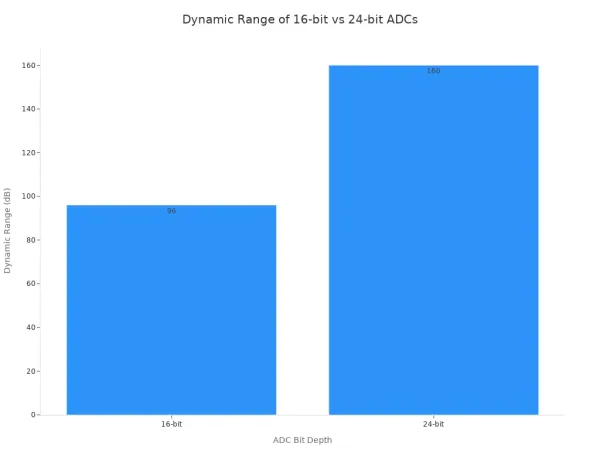
You do not need to set perfect input gain for every signal level. A 24-bit delta-sigma adc keeps a consistent SNR across its entire range, making it easier for you to handle signals that change in amplitude. This is especially useful in high-performance data acquisition systems and high-performance daq devices, where you need to measure a wide range of signals with high accuracy.
Noise Performance
Noise can hide small signals and reduce the accuracy of your measurements. 24-bit delta-sigma adcs use oversampling and noise shaping to push unwanted noise out of the signal band. The delta-sigma modulator runs at a much higher frequency than the output data rate, spreading quantization noise over a wide range. Digital filters then remove this noise, giving you a cleaner signal.
- You get ultra-low noise performance, often below 1 µVRMS, which is ideal for high-accuracy sensor applications.
- Chopper-stabilized amplifiers and programmable gain stages in delta sigma adc designs help you amplify low-level signals without adding extra noise.
- You can maintain high accuracy and stability, even when temperature or environmental conditions change.
Tip: You should use proper PCB layout, grounding, and calibration to maximize the effective number of bits (ENOB) in your 24-bit adc system.
Anti-Aliasing and Filtering
Aliasing happens when unwanted high-frequency signals fold into your measurement band, causing errors. 24-bit delta-sigma adcs help you avoid this problem by using high oversampling rates and digital filtering. The delta-sigma architecture pushes noise out of the band of interest, and the built-in digital filters remove it before you see the data.
- You do not need complex analog filters at the input, which simplifies your system design.
- Digital filters in delta sigma adc chips can be programmed to reject common sources of interference, such as 50/60 Hz mains noise.
- You get stable, reliable measurements even in noisy industrial environments.
Real-World Industrial Scenarios
You see 24-bit delta-sigma adcs in many industrial applications:
- In automation, you use them for precise sensor data acquisition—measuring position, force, torque, temperature, pressure, and flow rate. This precision lets you fine-tune manufacturing processes and improve product quality.
- In automotive systems, you rely on 24-bit adc technology for engine control units to digitize fuel pressure, temperature, and oxygen sensor data. This leads to better fuel economy and emissions control.
- Digital multimeters and high-performance data acquisition systems use 24-bit delta-sigma adcs to deliver highly accurate measurements, which are critical for process control and quality assurance.
Callout: You benefit from high accuracy, wide dynamic range, low noise, and simplified filtering when you choose 24-bit delta-sigma adcs for your industrial measurement needs.
Practical ADC Considerations

System Noise
You face many sources of noise when you use high-resolution converters in industrial settings. Resistor noise, amplifier noise, clocking noise, and power supply noise all combine to affect your measurements. These noise sources can lower the accuracy of your adc and make it harder to detect small changes in the input signal quality. Delta-sigma converters help you reduce some of this noise by using oversampling and digital filtering. You also need to watch for quantization noise, aliasing, and common mode noise from ground loops. Time skew and clock jitter can cause timing errors, especially in multi-channel systems. Electromagnetic interference, cabling issues, and cross-talk can also add unwanted signals.
To keep your delta-sigma system accurate, follow these best practices:
- Place decoupling capacitors close to each supply pin.
- Use ferrite beads to block switching transients.
- Keep analog and digital grounds separate, then connect them at a single point.
- Plan your PCB layout to keep noisy circuits away from sensitive analog paths.
- Use shielded cables and proper grounding to block EMI.
Tip: Oversampling and averaging in delta-sigma designs help you fight thermal noise and power supply fluctuations. Always debug noise sources by swapping power supplies one at a time.
Cost and Complexity
You might think a 24-bit delta-sigma adc will always cost more, but the full picture is different. Delta-sigma converters often include features like integrated programmable gain amplifiers, voltage references, and digital filters. This means you need fewer external parts, which lowers your total system cost and saves board space. For example, you can connect sensors directly to a delta sigma adc without extra amplifiers or level shifters. The table below shows how a 24-bit delta-sigma adc can simplify your design:
| Aspect | Impact of 24-bit Delta-Sigma ADC |
|---|---|
| Noise Performance | Ultra-low noise, direct digitization of low-level signals |
| Analog Front End Complexity | Fewer amplifiers and buffers needed |
| Calibration & Components | Less calibration, fewer external parts |
| Input Range Flexibility | Wide input range, programmable speed/resolution |
| System Cost | Lower overall cost despite higher ADC price |
| Direct Sensor Connection | No need for extra buffering |
| Speed and Accuracy | Programmable rates for best performance |
Note: You save time and reduce errors by using a delta-sigma adc with integrated features. This makes your system easier to design and maintain.
Application Suitability
You should always match your delta-sigma adc to your application. High resolution works best when you need to see tiny changes, like in precision measurements or high-fidelity audio. Check if your application needs fast sampling or low power. Delta-sigma converters give you strong noise reduction, which helps in noisy environments. If you build battery-powered devices, look for delta sigma adc models with low power modes. Think about your budget, too. Sometimes, a lower-cost converter is enough if you do not need the highest resolution.
When you choose a delta-sigma adc, consider:
- Resolution: Needed for small signal detection.
- Sampling Rate: Must fit your signal’s frequency.
- Noise Sensitivity: Delta-sigma designs excel here.
- Power Consumption: Important for portable systems.
- Cost: Balance performance with your budget.
- Design Flexibility: Look for programmable features and easy integration.
Callout: Delta-sigma converters offer the best mix of resolution, noise performance, and flexibility for most industrial measurement tasks. Always check your system’s needs before making a final choice.
ADCs vs Lower Resolution
Performance Comparison
You often need to choose between 24 bit delta-sigma ADCs and lower resolution ADCs like 12 or 16 bit models. The main difference comes from measurement accuracy, dynamic range, and noise performance. A 24 bit delta-sigma ADC can detect very small changes in signals. This is important when you need high precision in industrial sensor acquisition. For example, you can measure tiny temperature shifts with a 24 bit ADC, which is not possible with a 12 or 16 bit ADC. The delta-sigma design helps you reduce noise and errors, but you must use careful calibration and good analog front-end design to get the best performance.
Lower resolution ADCs have higher noise floors and less effective resolution. You may find that a 12 or 16 bit ADC works well for faster acquisition tasks, but it cannot match the accuracy or reliability of a 24 bit delta-sigma ADC in demanding industrial environments. You should remember that resolution alone does not guarantee accuracy. System noise and errors can limit the true performance of your ADC.
When Lower Resolution is Enough
You do not always need the highest resolution. In many industrial applications, lower resolution ADCs meet your needs. For example, temperature monitoring in factories often uses low-speed acquisition. Here, a 12 or 16 bit ADC can provide enough performance. Portable equipment, such as battery-powered gas analyzers, also benefits from lower resolution ADCs because they use less power and still deliver reliable results. You can improve the effective range and noise performance by using signal amplification and filtering before the ADC.
Tip: If your application does not require detecting very small changes, you can save cost and power by choosing a lower resolution ADC.
Selection Guidelines
You should match your ADC choice to your measurement needs. Use these steps to guide your selection:
- Pick an analog reference voltage that fits your signal’s range to reduce quantization error.
- Choose a lower resolution ADC for signals with low signal-to-noise ratio to avoid unnecessary errors.
- Add pre-filtering and amplification to your signal before acquisition to improve performance.
The table below shows how application needs affect your ADC choice:
| Application Type | ADC Type | Resolution | Sampling Rate | Power Use | Best For |
|---|---|---|---|---|---|
| High-accuracy process control | Delta-sigma (24 bit) | Very High | Low | Moderate | Precise, low-speed acquisition |
| Fast data logging | SAR (12-16 bit) | Moderate | High | Low | Quick, moderate acquisition |
| Portable measurement devices | SAR (12-16 bit) | Moderate | Moderate | Very Low | Battery-powered acquisition |
You should always consider the trade-offs between resolution, dynamic range, noise performance, speed, and power. Delta-sigma ADCs give you the best results for high-precision acquisition, but lower resolution ADCs work well for many everyday industrial tasks.
You gain many benefits when you use a 24 bit adc for industrial measurement. These ADCs offer high resolution, low noise, and flexible input options, making them ideal for accurate measurements in harsh environments.
- High resolution from oversampling and averaging supports continuous, reliable measurements.
- Low noise and integrated features help you measure small signals in sensors and transmitters.
- Programmable gain amplifiers and multiple channels give you flexibility for different tasks.
| ADC Type | Speed | Resolution | Complexity | Power Use | Cost |
|---|---|---|---|---|---|
| Delta-Sigma (24 bit) | Low-Med | High | Complex | Moderate | Moderate |
| SAR (12-16 bit) | Medium | Medium | Moderate | Low | Budget |

You should match your ADC choice to your measurement needs, balancing accuracy, cost, and system complexity. New ADC technology will keep improving measurement speed, power use, and reliability, helping you meet future industrial challenges.
FAQ
What makes a 24-bit ADC better for industrial measurement?
You get higher resolution and better accuracy with a 24-bit ADC. This helps you detect tiny changes in sensor signals. You can trust your measurements for quality control and process monitoring.
Tip: Use 24-bit ADCs when you need precise data from sensors.
Do 24-bit ADCs work well in noisy environments?
You benefit from built-in digital filters and oversampling in 24-bit ADCs. These features help you reduce noise and interference. You get stable readings even in harsh industrial settings.
- Shield cables
- Use proper grounding
- Follow PCB layout best practices
Are 24-bit ADCs harder to set up than lower resolution ADCs?
You may find setup easier because many 24-bit ADCs include integrated amplifiers and filters. You connect sensors directly and use fewer extra parts. You save time and reduce errors during installation.
| Feature | 24-bit ADC | Lower Resolution ADC |
|---|---|---|
| Integrated Amplifier | ✅ | ❌ |
| Digital Filtering | ✅ | ❌ |
| Direct Sensor Input | ✅ | ❌ |
When should you choose a lower resolution ADC instead?
You should pick a lower resolution ADC for fast data logging or battery-powered devices. These ADCs use less power and cost less. You do not need high resolution if your application does not require detecting small changes.
Note: Match your ADC choice to your measurement needs.