How to Read Capacitor Markings A Step-by-Step Guide
Let's learn how to read capacitor markings. You will often find a small ceramic capacitor with a three-digit code. This sing
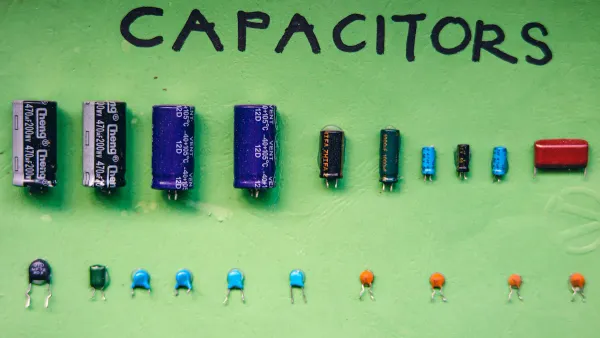
Let's learn how to read capacitor markings. You will often find a small ceramic capacitor with a three-digit code. This single skill helps you identify most capacitor components. For example, what does "104" on a capacitor mean?
Decoding '104'
- The first two digits are the value: 10
- The third digit is the number of zeros: 4
- Combine them: 10 followed by 0000 = 100,000 pF
This capacitor has a capacitance of 100,000 picofarads (pF). A larger capacitor may print its full capacitance directly. You now have the key to reading almost any capacitor.
Key Takeaways
- Identify the capacitor type first. This helps you understand its properties and whether it has polarity.
- Decode capacitance using the 3-digit EIA code. The first two digits are the value, and the third digit is the number of zeros in picofarads (pF).
- Always check the voltage rating. Never use a capacitor with a voltage lower than your circuit's needs to prevent damage or explosion.
- Pay attention to polarity markings. Electrolytic capacitors have a negative stripe, while tantalum capacitors mark the positive terminal.
- Use a multimeter for unmarked or damaged capacitors. It helps you find the correct capacitance value.
Initial Capacitor Identification

Before you can decode the markings, you first need to identify the component in your hands. Different types of capacitors have distinct looks. Recognizing them is the first step in your journey.
Identifying the Capacitor Type
You can often identify a capacitor by its shape and size. Each type has a common appearance that gives you clues about its properties. Look for these visual cues on the circuit board.
- Ceramic Capacitor: These are typically small, disc-shaped, or rectangular components. You will often find this capacitor in yellow or brown colors.
- Electrolytic Capacitor: This capacitor usually looks like a small metal can. It is a polarized capacitor, so you will see markings indicating its positive and negative leads.
- Tantalum Capacitor: You can spot this capacitor by its small, teardrop or rectangular shape. It is also a polarized capacitor, so checking its orientation is important.
- Film Capacitor: This capacitor often comes in a rectangular "box" shape. They are non-polarized and known for their stability.
Note: Knowing the capacitor type helps you understand its likely application and whether you need to worry about polarity.
Tools for Measurement
Sometimes, a capacitor marking is damaged, or you want to confirm its value. A digital multimeter is the perfect tool for this job. However, not every multimeter can test a capacitor. Your device needs specific features for an accurate reading.
You should look for a multimeter with:
- Capacitance Measurement Mode: The multimeter needs a setting to measure capacitance. You can find this marked with the symbol for microfarads (
µF) or nanofarads (nF). You may need to turn a dial and press a function button to select it. - Relative Mode: This feature is very useful for measuring a small-value capacitor. It subtracts the capacitance of the test leads, giving you a more precise measurement of the capacitor itself.
Professional solution partners, such as the HiSilicon-designated Nova Technology Company (HK) Limited, rely on accurate tools for complex circuit design. Using the right tool is a key part of how to read capacitor values correctly when the label is unclear.
How to Read Capacitor Capacitance
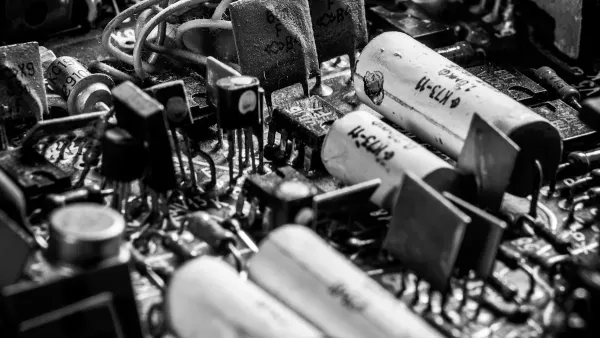
You can find the capacitance of a capacitor by reading the information on its body. The method changes depending on the capacitor's size and type. Let's break down the most common systems you will encounter.
The 3-Digit EIA Code
Many ceramic and film capacitors use a standard three-digit code. This system is a simple way of reading compact capacitor codes. You can decode this code easily.
- The first two digits give you the significant figures of the capacitance value.
- The third digit tells you the number of zeros to add.
The final value is always in picofarads (pF). For example, let's look at a capacitor marked 223. The first two digits are 22, and the third digit is 3. This means you write down 22 followed by three zeros, giving you 22,000 pF.
Sometimes, the third digit is a 0. This acts as a multiplier of 1. For instance, a capacitor with the code 470 has a capacitance of 47 pF. This is a common way to mark a capacitor with a value between 10 pF and 99 pF.
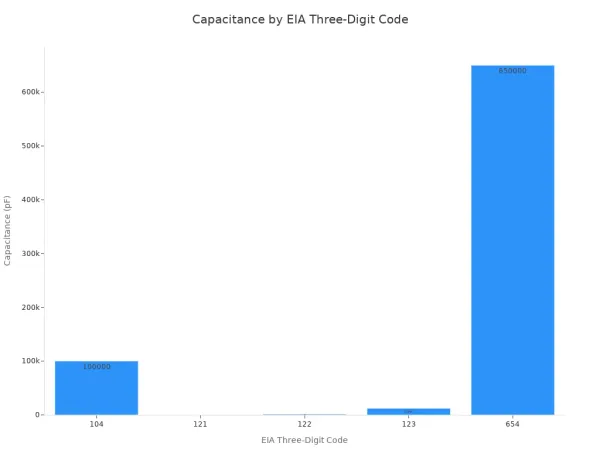
Here are some common capacitor codes and their corresponding capacitance values.
| Marked | Value (pF) |
|---|---|
| 104 | 100,000 pF |
| 123 | 12,000 pF |
| 122 | 1,200 pF |
| 121 | 120 pF |
| 654 | 650,000 pF |
The 'R' as a Decimal Point
What about a capacitor with a very small capacitance? For values below 10 pF, the system uses the letter 'R' to show a decimal point. This is another key part of reading compact capacitor codes.
- A code like
4R7means 4.7 pF. The 'R' sits where the decimal point goes. - A code like
R047means 0.047 pF. The 'R' at the beginning indicates a leading zero.
If you see a capacitor with only one or two digits and no 'R', that number is the direct capacitance in pF. For example, a capacitor marked 47 simply has a capacitance of 47 pF. Understanding these capacitor codes is essential for selecting the right component.
Plain Text on Large Capacitors
The process of reading large capacitors is much more direct. Large can-type electrolytic capacitors have enough space to print their details in plain text. You do not need to decode any capacitor codes on these components.
A large capacitor might be marked with
470 microfarads and 25 V. This tells you both the capacitance (470 µF) and the maximum voltage (25 Volts) it can handle.
This straightforward labeling makes reading large capacitors very simple. You just need to look for the numbers followed by the unit and voltage rating.
Understanding Capacitance Units
To truly know how to read capacitor markings, you must understand the units. The standard unit of capacitance is the farad (F), named after physicist Michael Faraday. However, a farad is a very large unit, so you will almost always see prefixes for smaller values.
The three most common units you will find are:
- µF: microfarad (one-millionth of a farad)
- nF: nanofarad (one-billionth of a farad)
- pF: picofarad (one-trillionth of a farad)
These units are related by factors of 1,000. This conversion is critical when working with capacitor codes, which are based in picofarads.
| Unit Conversion | Equivalent Value |
|---|---|
| 1 microfarad (µF) | 1,000 nanofarads (nF) |
| 1 nanofarad (nF) | 1,000 picofarads (pF) |
| 1 microfarad (µF) | 1,000,000 picofarads (pF) |
For example, the 104 capacitor we decoded earlier has a capacitance of 100,000 pF. You can convert this to 100 nF or 0.1 µF. Knowing these conversions helps you match the capacitor codes on a schematic to the physical capacitor in your hand.
Decoding Tolerance and Voltage
You now know how to find a capacitor's capacitance. The next step in learning how to read capacitor markings is to find its tolerance and voltage ratings. These values tell you the capacitor's precision and its operational limits.
Common Tolerance Letter Codes
A capacitor rarely has the exact capacitance printed on its body. The tolerance rating tells you the acceptable range of its actual capacitance. You can find this value represented by a single letter, usually placed after the capacitance code.
The three most common tolerance codes you will see are:
- J: ±5%
- K: ±10%
- M: ±20%
For example, a 100,000 pF capacitor with a 'K' tolerance has an actual capacitance between 90,000 pF and 110,000 pF. Some projects require a capacitor with a tighter tolerance for better performance.
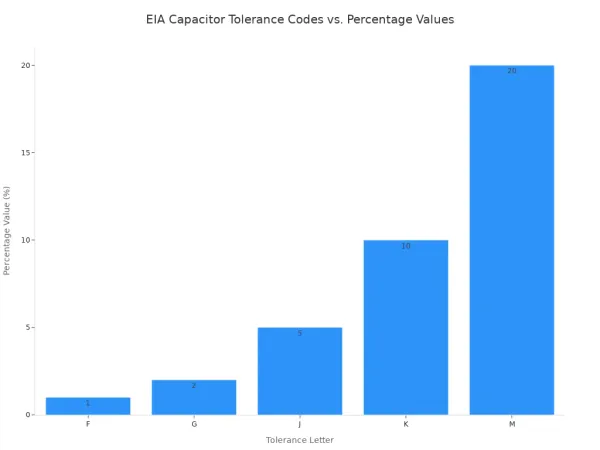
Here is a more complete list of common EIA tolerance codes.
| Tolerance Letter | Percentage Value |
|---|---|
| F | ±1% |
| G | ±2% |
| J | ±5% |
| K | ±10% |
| M | ±20% |
Finding the Printed Voltage Rating
The voltage rating is a critical piece of information. It tells you the maximum voltage the capacitor can safely handle. You must never exceed this voltage.
Warning: Applying a voltage higher than the rated voltage can cause serious damage. The excess voltage creates stress inside the capacitor. This can lead to internal failure, rapid overheating, and even cause the capacitor to explode. Always choose a capacitor with a voltage rating higher than your circuit's operating voltage.
On larger capacitors, the voltage is printed clearly, such as 25V or 400V. On smaller components, the voltage may be part of a code. For example, a marking like 473M 100V indicates a capacitance of 47,000 pF, a tolerance of ±20%, and a maximum voltage of 100 Volts.
EIA Voltage Codes
Surface-mount (SMD) capacitors are too small for printed voltage ratings. Instead, they often use a simple EIA code. This code can be a one or two-digit number or include the letter 'R' as a decimal point.
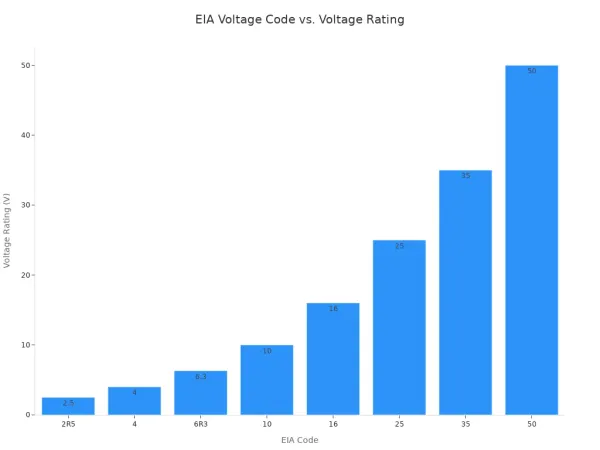
For example, a capacitor marked with 10 has a voltage rating of 10V. A code like 6R3 means the capacitor has a maximum voltage of 6.3V. You can use a reference chart to quickly look up these common voltage codes.
| Code | Voltage Rating |
|---|---|
| 2R5 | 2.5V |
| 4 | 4V |
| 6R3 | 6.3V |
| 10 | 10V |
| 16 | 16V |
| 25 | 25V |
| 35 | 35V |
| 50 | 50V |
Understanding these voltage codes ensures you select a safe and reliable capacitor for your circuit.
Recognizing Polarity Markings
Some capacitors have a positive and a negative lead. You must install this type of capacitor in the correct direction. Connecting a polarized capacitor backward can damage the component and your entire circuit. Let's look at how you can identify polarity.
Electrolytic Capacitor Polarity
You can easily spot the polarity on an electrolytic capacitor. These components use clear markings to show the negative terminal. You should look for a few common signs.
- Negative Stripe: The most obvious mark is a stripe running down the side of the capacitor can. This band often has minus symbols (-) inside it.
- Shorter Lead: On a new radial capacitor, the negative lead is shorter than the positive lead.
- Arrow Indicators: Some axial capacitors have arrows that point toward the negative end.
Important: Always double-check the polarity. Installing an electrolytic capacitor backward can cause it to overheat, leak, or even explode. This creates a serious safety hazard.
Tantalum Capacitor Polarity
Tantalum capacitors are also polarized, but their markings are the opposite of electrolytic types. This is a critical difference to remember. For a tantalum capacitor, the stripe marks the positive terminal.
You will find a stripe or a plus sign (+) indicating the positive lead. This applies to both teardrop-shaped and rectangular surface-mount types. Reversing the polarity on a tantalum capacitor is extremely dangerous. It can cause the dielectric layer to break down, leading to a short circuit and intense heat. This failure can permanently damage the capacitor and nearby components.
Non-Polarized Capacitors
Many capacitors are non-polarized. You can install them in either direction without any risk. This makes them very convenient for circuit design and assembly. Common types of non-polarized capacitors include:
These components use materials that work the same way no matter which direction the current flows. Their internal structure is symmetrical. This is why you will not find any polarity markings on a small ceramic or film capacitor. You can place this capacitor into your circuit without worrying about its orientation.
You now know how to read capacitor markings. You can confidently determine the capacitance and maximum voltage of any capacitor. The process is simple.
- Identify the capacitor type.
- Read the capacitance value from the code or text.
- Find the tolerance letter for its capacitance precision.
- Check the maximum voltage rating. A higher voltage is safer.
- Note the polarity for any polarized capacitor.
With a little practice, reading each capacitor becomes second nature. You can test your skills on fun beginner projects.
You are now ready to pick the right capacitor for your next project. Your understanding of capacitance, voltage, and capacitance value will ensure your circuit works perfectly.
FAQ
What if a capacitor has no markings?
Some small surface-mount (SMD) capacitors have no markings. You cannot identify their value visually. You must use a multimeter with a capacitance measurement mode to find the correct value. This is the only way to be sure.
What does the letter 'p' mean on a capacitor?
You might see a marking like 4p7. The letter 'p' acts as a decimal point for picofarad (pF) values. So, 4p7 means 4.7 pF. This is common on small capacitors where space is limited.
What happens if I use a capacitor with the wrong voltage?
Using a capacitor with a voltage rating lower than your circuit's voltage is dangerous. The capacitor can overheat, fail, or even explode. You should always choose a capacitor with a voltage rating higher than what your circuit needs.
Why do some capacitors have four or five digits?
A four or five-digit code is for high-precision capacitors. The first three or four digits are the significant value, and the last digit is the multiplier. A letter at the end still shows the tolerance. For example, 1001F means 1,000 pF with ±1% tolerance.