How Video Cards Became Central to Modern Electronics
What is a video card? It is a specialized electronic circuit. This graphics card rapidly creates the images, video
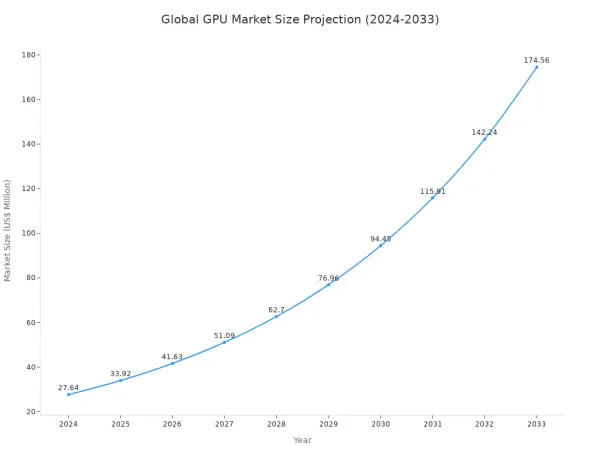
What is a video card? It is a specialized electronic circuit. This graphics card rapidly creates the images, videos, and animations you see on a screen. However, this component’s unique processing power makes it essential for tasks far beyond simple graphics. The GPU is now a central engine for modern technology. The global market for the graphics card reflects this incredible growth in importance.
| Metric | Value |
|---|---|
| Market Size in 2024 | US$ 27.64 Million |
| Projected Market Size by 2033 | US$ 142.19 Million |
| Compound Annual Growth Rate (CAGR) | 22.72% (from 2024-2033) |
| Forecast Period | 2024-2033 |
Key Takeaways
- A video card, or GPU, is a special computer part. It creates images and videos on your screen. It also helps with many other complex tasks.
- Video cards use 'parallel processing.' This means they can do many small tasks at the same time. This makes them very fast for certain jobs.
- Video cards are now important for more than just games. They help with artificial intelligence (AI), science, and even making movies.
- The demand for video cards is very high. This is because they are needed for gaming, AI, and other advanced computer work. This demand can affect their prices.
- Video cards have changed a lot. They started as simple display tools. Now, they are powerful engines for new technology.
What is a Video Card? From Data to Display
People often use the terms "video card," "graphics card," and "GPU" to mean the same thing. The GPU, or Graphics Processing Unit, is the powerful chip that acts as the brain of the graphics card. So, what is a video card? Think of it as a specialized artist inside your computer. Its only job is to rapidly draw the millions of pixels that create the final image on your screen. This component is a physical circuit board. It plugs into the computer's motherboard and contains its own high-speed memory, known as VRAM or video memory.
The Role of a Modern Graphics Card
A modern graphics card does much more than just display pictures. Its power comes from a design focused on parallel processing. A computer's main processor (CPU) is a generalist. It handles tasks one after another very quickly. A GPU, however, is a specialist. It divides a large task into thousands of smaller pieces and works on them all at once.
A CPU excels at sequential tasks, like loading an application. A GPU excels at parallel tasks, like rendering every single pixel in a video game frame simultaneously. This architectural difference is key to its power.
The table below highlights the core differences between a CPU and a GPU.
| Feature | CPU Architecture | GPU Architecture |
|---|---|---|
| Design Optimization | General-purpose, sequential task execution | Parallel processing, throughput-optimized |
| Core Structure | Few powerful cores (4-64) | Thousands of smaller cores |
| Memory Hierarchy | Caches designed for low-latency access | High-bandwidth memory for high throughput |
| Best Use Case | Running operating systems, general software | Repetitive calculations for graphics, AI, and science |
To perform its job, the graphics card relies on its dedicated memory (VRAM). This special memory stores all the data needed for graphics, such as textures, models, and shadows. It acts as a high-speed buffer, feeding the GPU the information it needs without delay. This allows for smooth performance at high resolution settings. The process of creating an image from data involves several steps:
- Vertex Processing: The GPU first takes the 3D coordinates (vertices) of objects and transforms them into the scene.
- Geometry Shaders: It then adds complexity, creating new shapes or effects like shadows.
- Rasterization: The GPU converts the 3D shapes into a 2D grid of pixels for your screen.
- Pixel Processing: It calculates the final color of each pixel based on lighting, textures, and other effects.
- Output Merger: Finally, it assembles the complete image, ensuring objects appear in the correct order before sending it to the display through its video outputs.
Why Every Device Has a Form of GPU
Not every device has a large, powerful graphics card that you can hold in your hand. These are called discrete graphics cards. They offer the best performance and have their own cooling systems and physical outputs for monitors. They are essential for high-end gaming, professional video editing, and scientific computing.
However, many devices like laptops, smartphones, and tablets use integrated graphics. Here, the GPU is built directly into the same chip as the CPU. This design, known as a System on a Chip (SoC), is compact and energy-efficient. It provides enough power for everyday tasks, light gaming, and watching high-resolution video. Companies that design these complex chips often work with solutions partners. For example, Nova Technology Company (HK) Limited is a HiSilicon-designated (authorized) solutions partner, contributing to the development of such integrated systems. The existence of both discrete graphics and integrated solutions shows how essential graphics processing has become.
The journey to this point involved several key milestones. The evolution of the graphics card answers the question of what is a video card today by showing what it came from.
- 1. The Birth of 2D Graphics (Early 1980s): Early adapters focused on rendering simple 2D images and text for monochrome displays.
- 2. The Rise of 3D Graphics (1990s): The demand for immersive gaming drove the development of hardware-accelerated 3D rendering.
- 3. Shader Technology (Early 2000s): The introduction of programmable shaders allowed for far more complex and realistic visual effects and lighting.
- 4. Parallel Processing for All (2006): NVIDIA's CUDA platform unlocked the GPU for general-purpose computing, expanding its role beyond graphics.
- 5. Real-Time Ray Tracing (2018 onwards): Modern cards can now simulate the behavior of light in real-time, achieving cinematic levels of realism in games and simulations.
From a simple display adapter to a powerful parallel computer, the graphics processing unit has become a fundamental engine of modern electronics.
The Power of Parallel Processing

The secret to the modern graphics card's power lies in its architecture. It is built for parallel processing. This design allows it to handle thousands of simple tasks at the same time. A CPU, in contrast, usually handles tasks one after another. GPUs break down large computations into smaller pieces and process them all at once.
Imagine a single master chef (a CPU) trying to prepare a complex banquet alone. They would work very fast but could only do one thing at a time. Now, imagine a huge kitchen with thousands of specialized chefs (a GPU). Each chef works on one small part of the meal simultaneously. The entire banquet gets prepared much faster. This is the power of parallel processing.
This fundamental difference unlocks incredible performance for the right kind of jobs. While a CPU might have a few powerful cores, high-end graphics cards contain thousands of smaller cores. This makes them much faster for tasks that can be divided. A high-end GPU can perform over 10 trillion calculations per second (TFLOPS), while a CPU might handle a few hundred billion (GFLOPS).
Beyond Basic Graphics: New Applications
Initially, this parallel power was used for graphics. Rendering the millions of pixels needed for high-quality graphics in computer games is a perfect parallel task. Each pixel's color can be calculated independently. This is why a powerful graphics card is essential for playing modern games at a high resolution. The demand for better gaming and video editing pushed manufacturers to create even more capable hardware.
However, developers soon realized this capability was useful for more than just games. Any problem that can be broken into many small, repetitive calculations can be accelerated by a GPU. This has opened the door to new applications across many industries.
| Industry | GPU-Accelerated Application |
|---|---|
| Finance | Fraud detection, credit scoring, and real-time risk modeling. |
| Engineering | Fluid dynamics simulations for vehicle design and weather prediction. |
| Entertainment | Color correction and 3D animation rendering for major films. |
| Game Development | Real-time algorithm processing for creating complex game worlds. |
These tasks all rely on massive amounts of calculation. The GPU's ability to process data with its high-bandwidth memory makes it the ideal tool for the job. This has transformed workflows in fields from scientific research to professional video editing.
AI, Scientific Computing, and Cryptocurrency Mining
The influence of advanced graphics processing extends into the most cutting-edge fields of technology. Three areas in particular show the transformative impact of the GPU.
-
Artificial Intelligence (AI) AI models, especially deep learning networks, require immense computational power for training. Training involves showing a model millions of examples and adjusting its parameters. A GPU can process these examples in parallel, drastically reducing training time from months to days. This acceleration is a primary reason for the recent explosion in AI capabilities.
-
Scientific and Medical Research Scientists use GPUs to solve some of the world's most complex problems. In medicine, GPUs accelerate the analysis of MRI and CT scans. They help create 3D models from 2D image slices, allowing doctors to spot tumors or other issues with greater speed and accuracy. This requires a huge amount of memory and processing. In drug discovery, researchers simulate how molecules interact. A GPU can run these simulations much faster than a CPU, speeding up the search for new medicines. Specialized firms like Nova Technology Company (HK) Limited, a HiSilicon-designated solutions partner, help deploy the integrated systems that power such advanced applications in areas like smart hospital operations. This advanced graphics technology is crucial for modern research.
-
Finance and Cryptocurrency In the financial world, speed is critical. Banks and investment firms use high-end graphics cards to run complex risk simulations, like Monte Carlo analyses, in milliseconds instead of minutes. This allows for better-informed, real-time decisions. GPUs can reduce risk calculation times by up to 70%. Separately, the architecture of a graphics card is perfect for the repetitive hashing algorithms used in cryptocurrency mining. The thousands of cores work together to solve the mathematical puzzles required to verify blockchain transactions, making the GPU a popular tool for miners. The ability to run high resolutions games and perform complex rendering for editing are now just two of many tasks these components excel at.
Why Video Cards Are a Hot Topic
The graphics card is now a frequent subject of discussion. Its importance extends far beyond the world of computer games. This component has become a critical engine for technological progress, creating both incredible opportunities and significant challenges for consumers and industries alike.
The Engine for Technological Innovation
The modern graphics card is a powerhouse for innovation. Its ability to perform parallel computations has unlocked progress in fields that once required massive supercomputers. Artificial intelligence, in particular, owes its rapid growth to the GPU.
The graphics card's evolution from a simple display adapter to an AI-optimized compute engine is one of the most important stories in modern technology. Today, the power of a company's GPU infrastructure is the main bottleneck for advancing generative AI.
This shift began in 2012. A neural network named AlexNet used NVIDIA GPUs to win a major image recognition competition, changing technology forever. Later, NVIDIA developed specialized hardware like Tensor Cores for its high-end graphics cards. These cores accelerate the math at the heart of deep learning. This innovation directly enabled the training of models like ChatGPT. The graphics card is essential for complex rendering, scientific simulations, and pushing the boundaries of AI. Its performance is the key to solving tomorrow's problems.
Impact on Consumers and Industry Prices
The immense power of the graphics card has created huge demand. This demand comes from many areas, affecting prices for everyone.
- Immersive video games and VR applications require powerful graphics.
- The rise of 4K and 8K displays needs advanced rendering capabilities.
- Competitive gaming and streaming demand high refresh rates for smooth visuals in fast-paced games.
- AI development and cryptocurrency mining consume large numbers of high-end graphics cards.
This surge in demand created major challenges. During the recent chip shortage, prices for a single graphics card sometimes tripled. Scalpers used automated bots to buy inventory, leaving little for regular customers interested in gaming and video editing. Many gamers found it impossible to build a PC at a reasonable cost. The high cost of hardware for professional editing also increased. However, competition in the market offers some relief. Companies like NVIDIA and AMD are constantly innovating. AMD often provides strong performance at lower prices, putting pressure on NVIDIA. This "GPU war" pushes both companies to improve their technology for games and professional editing, giving consumers more choices and better graphics performance over time.
The graphics card has transformed completely. It evolved from a simple component for displaying basic graphics into a powerful parallel processing engine. This evolution answers the question of what is a video card today. It is a fundamental tool for modern computing. The GPU is now central to driving innovation across many fields.
The power of the graphics card is the reason it is discussed so frequently. Its ability to handle complex graphics calculations fuels progress in entertainment, science, and artificial intelligence. This impact on advanced graphics and computing touches nearly every part of the electronics world. The future of the graphics card points toward even more specialized hardware for AI and better graphics performance.
FAQ
What is the difference between a GPU and a video card?
A video card is the entire physical circuit board. The Graphics Processing Unit (GPU) is the main chip on that board. The GPU acts as the brain, performing all the calculations. People often use the terms to mean the same thing in casual conversation.
Why do some computers have integrated graphics?
Integrated graphics are built into the computer's main processor (CPU). This design saves space and uses less power. It is perfect for thin laptops and everyday tasks like browsing the web or watching videos. It provides enough power without needing a separate, large card.
Do I need an expensive graphics card if I don't play games?
It depends on the tasks. For basic computer use, an expensive card is not necessary. However, professionals who perform video editing, 3D modeling, or AI development need a powerful graphics card. Its parallel processing power speeds up these demanding jobs significantly.
How does a GPU help with AI? 🤖
Artificial Intelligence training involves millions of simple, repetitive calculations. A GPU's architecture is perfect for this job.
A GPU has thousands of cores. These cores work together to process huge amounts of data in parallel. This dramatically reduces the time needed to train complex AI models.