Never Fear a Switch Mode Power Supply Schematic Again
A complex switch mode power supply schematic can look intimidating. You can conquer it with a simple 4-Block Method. This ap
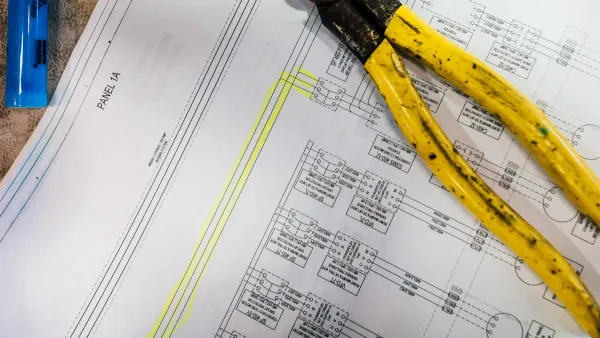
A complex switch mode power supply schematic can look intimidating. You can conquer it with a simple 4-Block Method. This approach acts as your map. It divides the design into four core sections: the input stage, the switching core, the output filter, and the feedback loop that controls the final output. Understanding the switch mode power supply is a key skill. The market for switch-mode power supplies is expanding rapidly, promising a strong future.
| Metric | Value |
|---|---|
| Industry Size (2025) | USD 28,012.7 Million |
| Forecast (2035) | USD 40,284.9 Million |
| CAGR (2025-2035) | 3.7% |
This method helps you trace the path from the initial input to the regulated output voltage, giving you a clear view of the circuit's stable output.
Key Takeaways
- Understand a switch mode power supply schematic using the 4-Block Method. This method divides the design into input, switching, output, and feedback sections.
- The input stage cleans and converts raw AC power into DC. Key parts include fuses, EMI filters, and bridge rectifiers.
- The switching core is the heart of the power supply. It uses a PWM controller, a switching transistor, and a transformer to chop DC into high-frequency AC and provide isolation.
- The output stage rectifies and filters the high-frequency AC. It creates a smooth, stable DC output voltage for your device.
- The feedback loop acts as the power supply's brain. It constantly monitors the output voltage and makes adjustments to keep it stable.
The Basics of Input Filtering and Rectification
Think of this first block as the power supply's security guard and translator. Its job is to protect the sensitive inner circuits from the rough, unpredictable mains power. It also performs the first critical power conversion. An SMPS must handle a wide range of voltages from the wall outlet.
The nominal mains voltage varies worldwide from 100 to 240VAC and is usually poorly regulated. Universal input supplies are designed to work over a range from 90 Vac to 264 Vac.
This section takes that messy AC input and begins the conversion process into a stable power source. Understanding these basics is the first step to mastering any schematic.
Key Components
When you look at the input section of a schematic, you will typically find these parts right after the power connector.
| Component | Symbol/Appearance |
|---|---|
| Fuse | F or a wavy line in a box |
| Inrush Limiter | NTC (Negative Temp. Coefficient) |
| EMI Filter | Common-mode choke, X and Y capacitors |
| Bridge Rectifier | BR or four diodes in a diamond shape |
Component Purpose
Each component has a specific role in cleaning the input power and starting the energy conversion.
-
Protection and Filtering: The fuse is your first line of defense, protecting against overcurrent events. The EMI filter, using common-mode chokes and special X/Y capacitors, stops high-frequency noise. A common-mode choke is engineered to block this noise from entering or exiting the power supply without disrupting the main power flow.
-
Inrush Current Limiting: At power-on, the main capacitor acts like a short circuit, drawing a huge current spike. An NTC thermistor prevents this.
- When cold, the NTC has high resistance, limiting the initial current.
- As current flows, it heats up.
- Its resistance drops to a very low value, allowing normal operation.
-
Rectification (AC to DC Conversion): The bridge rectifier is the heart of this stage. It takes the alternating current (AC) from the wall and performs the initial conversion into a pulsating direct current (DC). This raw DC conversion is then sent to a large bulk capacitor, creating a high-voltage DC bus ready for the next stage. This completes the first power conversion step.
The Switch Mode Power Supply Core: Switching and Isolation
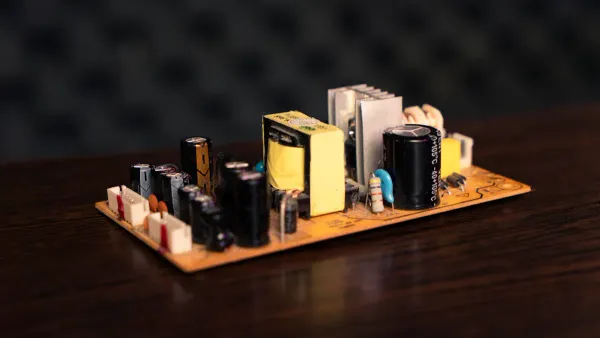
You have now reached the heart of the switch mode power supply schematic. This block performs the most defining actions of an SMPS. It takes the high-voltage DC from the input stage and "chops" it into high-frequency AC. This clever step is the key to achieving high efficiency and a compact size. This stage handles the primary power conversion and provides critical safety isolation before sending energy to the output.
Key Components
This core section is a small team of powerful components working together. You can spot them between the large input capacitor and the output section.
| Component | Common Schematic ID | Purpose |
|---|---|---|
| PWM Controller | U, IC | The primary-side "brain" that generates control signals. |
| Switching Transistor | Q (often a MOSFET) | A very fast electronic switch. |
| High-Frequency Transformer | T | Isolates the input from the output and scales voltage. |
Component Purpose
Each part in this stage has a highly specialized job, from generating a signal to performing the heavy lifting of energy conversion.
-
The PWM Controller: The Brains of the Primary Side 🧠
The Pulse Width Modulation (PWM) controller is the intelligent chip driving the whole operation. It tells the switching transistor exactly when to turn on and off. It does this by generating a high-frequency signal. The controller adjusts the 'on-time' (duty cycle) of this signal to control the total amount of power delivered to the output.
A PWM controller works in one of two main ways. It can compare a reference voltage to a sawtooth wave to set the duty cycle. Or, it can use a digital counter that triggers the switch based on a set value. Both methods achieve the same goal: precise control over the final output.
Advanced controllers are essential for modern switch-mode power supplies. For example, companies like Nova Technology Company (HK) Limited, a HiSilicon-designated solutions partner, provide support for the sophisticated chips used in these applications.
-
The Switching Transistor: The High-Speed Switch ⚡
The switching transistor, usually a MOSFET, acts as an incredibly fast and powerful switch. It receives the control signal from the PWM controller and gets to work.
- The controller sends a signal to the MOSFET's Gate pin.
- The MOSFET turns on, allowing current to flow from the high-voltage DC bus through the transformer's primary winding.
- The controller then turns the signal off.
- The MOSFET shuts off instantly, cutting the current flow.
This on-off cycle happens thousands or even millions of times per second. This action chops the smooth DC into a high-frequency square wave. This rapid switching is the fundamental principle behind the high efficiency of a switch mode power supply.
-
The High-Frequency Transformer: The Isolator and Converter 🌉
The transformer uses the high-frequency square wave to transfer energy from the primary side to the secondary side. It performs two critical jobs:
- Voltage Conversion: The ratio of wire turns between the primary and secondary coils determines the output voltage. It can step voltage down (e.g., from 300V to 12V) or step it up. This is the main DC-DC power conversion step.
- Galvanic Isolation: There is no direct electrical connection between the input and output windings. Energy transfers only through a magnetic field. This isolation creates a vital safety barrier, protecting you and your devices from the high voltage on the primary side. This feature is essential for a safe and stable output.
-
Common Designs (Topologies)
Engineers use these core components in different arrangements, or "topologies," to achieve a specific output. You will often encounter two main families on a switch mode power supply schematic.
- Flyback Converter: This is the most common design for low-power applications. When the switch is on, it stores energy in the transformer's magnetic field. When the switch turns off, that stored energy "flies back" and is delivered to the output.
- Buck-Derived Converters: This family includes forward, push-pull, and bridge converters. In these designs, energy transfers to the output directly while the switch is on. They are often used for higher power needs to deliver a regulated output.
This block's combination of intelligent control and high-frequency energy conversion is what makes switch-mode power supplies so efficient and versatile for any required output.
Output Rectification and Filtering
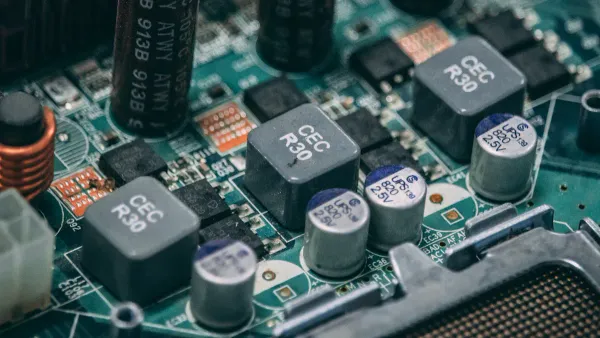
The energy has successfully crossed the isolation barrier. Now you have reached the final stage of the dc-dc power conversion. This block takes the high-frequency AC from the transformer's secondary side and performs the last power conversion. Its job is to produce the clean, stable DC output voltage your device needs. A smooth output is the ultimate goal.
Key Components
You can identify this section on the schematic right after the transformer. It prepares the final output.
| Component | Schematic Symbol/Appearance | Purpose |
|---|---|---|
| Output Rectifier | A diode symbol, often with an "S" shape for a Schottky. | Converts AC back to DC. |
| Output Filter | L (Inductor) and C (Capacitors). | Smooths the pulsating DC into a clean output. |
Component Purpose
These components work together to complete the final conversion and deliver a usable output.
-
The Output Rectifier: The One-Way Gate 🚦
The rectifier diode acts like a one-way valve. It allows current to flow in only one direction, which is the key to the AC-to-DC conversion. For low-voltage power supplies, designers often use a special type called a Schottky diode.
Schottky diodes are perfect for this job. They have a lower forward voltage drop and faster switching speed than standard diodes. This means less power is wasted as heat, making the final output more efficient.
-
The Output Filter: The Ripple Smoother 🌊
After rectification, the voltage is DC, but it's a rough, pulsating DC. The output filter, typically an LC or Pi filter, smooths this out to create a steady output voltage. The process is simple:
- An input capacitor removes a large part of the AC ripple.
- The inductor resists changes in current, blocking more ripple.
- An output capacitor cleans up any remaining ripple, ensuring a very smooth DC output.
The capacitors used here are special. They must have a very low Equivalent Series Resistance (ESR). A low ESR is critical because it helps the capacitor react quickly to changes in load and effectively filter out high-frequency noise, leading to a cleaner final output. This ensures the power supply delivers a stable output under all conditions.
The Feedback Loop: Brains of the Operation
You have arrived at the control center of the switch mode power supply. This feedback loop is the "brain" that makes it a regulated power supply. The previous blocks do the heavy lifting of power conversion. This block provides the intelligence. It constantly watches the output and tells the switching core how to adjust. This ensures your device gets a perfectly stable voltage, no matter what.
This circuit is the key to a stable output. It completes the control loop in any switch mode power supply schematic.
Key Components
This section looks like a small, delicate circuit connecting the output side back to the primary side. You will find these key parts creating the link.
| Component | Schematic Symbol/Appearance | Purpose |
|---|---|---|
| Voltage Reference | U, IC. The TL431 symbol looks like a Zener diode. | A precision error detector. |
| Optocoupler | U, IC. A box with a diode and a transistor inside. | The isolated messenger. |
| Compensation Network | R and C around the reference IC. | Stabilizes the feedback response. |
Component Purpose
Each part of the feedback loop has a critical job in monitoring the output and controlling the entire system with precision.
-
The Voltage Reference: The Precision Ruler 📏
The voltage reference, often a chip like the popular TL431, acts as a highly accurate ruler. Its job is to measure the output voltage and spot any errors. It works in a simple but brilliant way:
- A voltage divider (two resistors) samples a small, proportional fraction of the main output voltage.
- This sample voltage is fed to the reference pin of the TL431.
- The TL431 compares this sample to its own ultra-stable internal reference, which is exactly 2.5V.
If the output voltage is perfect, the sample voltage will be exactly 2.5V. If the output voltage drifts too high or too low, the sample voltage changes. The TL431 detects this tiny change and adjusts the current it sends to the next component.
-
The Optocoupler: The Isolated Messenger 📨
The optocoupler is a clever device that sends the error signal across the isolation barrier safely. It is essential for keeping the high-voltage primary side electrically separate from the low-voltage output side you touch.
An optocoupler provides feedback by converting an electrical signal into light. This light crosses the isolation barrier without any physical electrical connection. This process ensures the user is protected from dangerous mains voltage while allowing the control signal to regulate the output.
Here is how it performs this signal conversion:
- The TL431 controls the current flowing into an LED inside the optocoupler.
- The LED emits light with an intensity proportional to that current.
- This light shines on a phototransistor on the other side of the barrier.
- The phototransistor turns on and conducts a current that mirrors the light's brightness. This action creates a new electrical signal on the primary side, completing the signal conversion.
-
Closing the Loop: Controlling the PWM
The electrical signal from the optocoupler now provides direct feedback to the PWM controller on the primary side. This signal tells the controller exactly what is happening at the output.
The PWM controller uses this information to make immediate adjustments.
- If the output voltage is too high: The feedback signal tells the PWM controller to reduce the duty cycle (the 'on-time') of the main switching transistor. Less 'on-time' means less energy is transferred through the transformer, and the output voltage drops back to its target.
- If the output voltage is too low: The feedback signal tells the controller to increase the duty cycle. More 'on-time' transfers more energy, and the output voltage rises to its target.
This constant cycle of measuring and adjusting happens thousands of times per second. It is what keeps the final output incredibly stable, even when the load changes suddenly.
-
Constant Voltage (CV) vs. Constant Current (CC) Mode
Most switch-mode power supplies operate in Constant Voltage (CV) mode, where the feedback loop's primary goal is to maintain a fixed output voltage. However, some designs, like battery chargers, also use a Constant Current (CC) mode. The feedback mechanism simply changes its focus.
Mode Regulation Focus How it Works Constant Voltage (CV) The output voltage The feedback loop keeps the output voltage at a set level. Constant Current (CC) The output current The feedback loop adjusts the voltage to keep the output current at a set limit. -
The Compensation Network: Keeping it Stable
You will often see a few extra resistors and capacitors around the TL431. This is the compensation network. Its job is to prevent the feedback loop from overreacting.
- It stabilizes the control loop to prevent wild oscillations.
- It ensures the regulator responds quickly to load changes without becoming unstable.
This network fine-tunes the response, making sure the power supply is both fast and stable. This final piece of the puzzle guarantees a reliable and clean output for any application.
You now have the 4-Block Method to analyze any switch mode power supply schematic. This map breaks the design into simple parts:
- Input: Cleans and converts the initial power.
- Switching: Chops and isolates the energy.
- Output: Rectifies and smooths the final voltage.
- Feedback: Regulates the output for stability.
Practice this approach on a real switch mode power supply schematic. You can trace the path from the initial input to the final output. This practice turns fear into confidence.
FAQ
Why are switch mode power supplies so common?
You find SMPS in most electronics because they are very efficient. They waste little power as heat. This efficiency allows manufacturers to build smaller, lighter, and cooler products, from phone chargers to TVs.
What is the most important safety feature in an SMPS?
The transformer provides galvanic isolation. It creates a safety barrier between the high-voltage input and the low-voltage output. This feature protects you and your devices from dangerous mains voltage.
What is the difference between the two rectifier stages?
The two rectifiers perform similar jobs at different points.
- The input rectifier changes the wall's AC power into high-voltage DC.
- The output rectifier converts the transformer's high-frequency AC into the final, low-voltage DC output.
Why is the feedback loop so important?
The feedback loop makes the power supply "regulated." It constantly checks the output voltage. It then tells the PWM controller to make adjustments. This action guarantees a stable output, even when the load changes.