A Guide to 5 Volt Voltage Regulators and Their Use in Modern Devices
A 5 volt voltage regulator supplies a steady 5V output to electronic circuits, protecting devices from unstable power source
A 5 volt voltage regulator supplies a steady 5V output to electronic circuits, protecting devices from unstable power sources. Many modern electronics rely on a voltage regulator for safe and consistent operation. Sensitive devices face serious risks when voltage changes suddenly. Common problems include equipment damage, unexplained malfunctions, and shorter lifespans.
- Voltage fluctuations can cause operational failures and data errors.
- Devices may overheat or fail early.
- Communication systems and safety equipment can stop working.
A 5 volt voltage regulator helps prevent these issues and keeps devices running reliably.
Key Takeaways
- A 5 volt voltage regulator provides a steady 5V output to protect electronic devices from power fluctuations and damage.
- Stable voltage is crucial for device performance, preventing resets, overheating, and data errors in sensitive electronics.
- Linear regulators like the 7805 offer low noise and simple design, ideal for low-power and noise-sensitive applications.
- Switching regulators deliver higher efficiency and less heat, making them suitable for high-power and battery-powered devices.
- Choosing the right regulator involves matching input voltage, output current, efficiency, and protection features to your device's needs.
5 Volt Voltage Regulator Basics
What Is a 5 Volt Voltage Regulator?
A 5 volt voltage regulator is an electronic component that delivers a constant 5v output, even when the input voltage changes. Many devices use this type of voltage regulator to protect sensitive circuits from power fluctuations. The regulator takes a higher input voltage and reduces it to a steady 5v output, which is essential for microcontrollers, sensors, and other digital electronics.
The main electrical characteristics of a 5 volt voltage regulator define how it performs in a circuit. The table below shows the most important features:
| Characteristic | Description |
|---|---|
| Input Voltage (VIN) | The voltage supplied to the regulator, which must be higher than the output voltage. |
| Output Voltage (VOUT) | The regulated voltage output, fixed at 5 volts for a 5V regulator. |
| Output Current (IOUT) | The maximum current the regulator can supply to the load. |
| Quiescent Current | The current consumed internally by the regulator when no load is present, important for efficiency. |
| Switching Frequency | Relevant for switching regulators; higher frequency allows smaller components and better efficiency. |
| Thermal Resistance | Indicates the regulator's ability to dissipate heat, critical for maintaining safe operating temperature. |
| Feedback Voltage | The voltage used in the feedback loop to maintain output voltage accuracy. |
| Internal Components | Includes pass transistor, error amplifier, voltage reference, and resistor feedback network that regulate output voltage. |
A voltage regulator with these features ensures that devices receive the correct voltage and current for safe operation.
Why Stable Voltage Matters
Stability in voltage is critical for modern electronics. Devices like microcontrollers and sensors need a steady 5v output to function correctly. If the voltage drops too low, these devices may reset or stop working. If the voltage rises too high, parts can overheat or become damaged. For example, when a CO2 sensor or an Arduino receives less than 7 volts, it may fail to record data. If the input goes above 12 volts, the voltage regulator can overheat, risking permanent damage.
| Risk / Symptom | Description / Cause | Impact on Microcontrollers and Sensors |
|---|---|---|
| Voltage too low | Voltage drops below tolerance due to current limit or ripple | Instability, failure to record sensor readings, potential resets |
| Voltage ripple | Oscillations from power supply instability or switching | Erratic behavior or sensor inaccuracies |
| Voltage swell | Voltage spikes after current dips or wiring issues | Potential irreversible damage if exceeding operating voltage limits |
| Analog reference disturbances | Voltage variations affecting analog reference voltage | Reduced accuracy of analog sensor readings |
A voltage regulator helps prevent these problems by keeping the voltage stable. Linear regulators, such as the LM7805, provide excellent output stability and low noise. They work well in noise-sensitive applications, like audio equipment or precision sensors. Switching regulators offer higher efficiency but can introduce electrical noise, which may affect voltage stability in sensitive circuits.
Note: Stable voltage extends the lifespan of consumer electronics. Devices like smartphones, laptops, and televisions rely on voltage regulators to avoid damage from power fluctuations. Stable voltage reduces stress on components, lowers repair costs, and improves energy efficiency. Power management circuits also help extend battery life by up to 50% in some devices.
Maintaining voltage stability is not just about performance. It also protects users and equipment from hazards like electrical fires or data loss. A 5 volt voltage regulator plays a key role in ensuring that modern devices operate safely and reliably.
How a Voltage Regulator Works
Voltage Stabilization
A voltage regulator keeps the 5v output steady, even when the input voltage changes. This process is called voltage regulation. Devices rely on a stable output voltage to work correctly. The regulator uses several mechanisms to maintain stability. Some regulators use feedback control loops. These loops compare the output voltage to a reference and adjust the circuit to keep the voltage stable. Others use transistors as variable resistors to control the voltage drop. Switching regulators use fast on-off switches and energy storage parts like inductors and capacitors. Each method helps the regulator deliver a stable output voltage.
The table below shows the main mechanisms used for voltage regulation:
| Mechanism Type | Description | Key Components/Principles |
|---|---|---|
| Electromechanical Regulators | Use servomechanisms to select transformer taps or adjust wipers to maintain voltage within acceptable range. | Servomechanism, autotransformer taps, dead band control |
| Diode-based Regulators | Use voltage drop characteristics of diodes or zener diodes for simple voltage regulation at low voltages. | Diodes, zener diodes |
| Feedback Voltage Regulators | Compare output voltage to a fixed reference and use negative feedback to control regulation element. | Reference voltage, error amplifier, regulation element |
| Linear Series Regulators | Adjust voltage drop across a transistor to maintain output voltage. | Transistor, feedback loop |
| Switching Regulators | Control output by switching elements on/off and using energy storage components to regulate voltage. | Switches, inductors, capacitors, feedback loop |
Stability is important for every electronic device. If the voltage regulator cannot keep the voltage steady, devices may fail or behave unpredictably. Good voltage stability protects sensitive circuits and helps electronics last longer.
Protection for Electronics
Voltage regulators include many protection features to keep electronics safe. These features prevent damage from overheating, short circuits, and excessive current. For example, thermal overload protection shuts down the regulator if it gets too hot. Short-circuit prevention stops damage when wires touch by mistake. Current limiting keeps the current from getting too high, which protects small parts inside devices. Some regulators use diodes to guard against reversed power connections.
Here are common protection features found in voltage regulators:
| Protection Feature | Description |
|---|---|
| Thermal Overload Protection | Automatically shuts down the regulator to prevent damage from overheating. |
| Short-Circuit Prevention | Protects the device and circuit from damage due to short circuits. |
| Current Limiting | Limits current to prevent excessive current draw that could damage components. |
| Polarity Reversal Protection | Uses diodes to protect the circuit from damage caused by incorrect power supply connections. |
| Safe-Area Compensation | Maintains the output transistor within safe operational boundaries under fluctuating loads. |
Thermal shutdown protections, such as thermal fuses and bimetallic switches, break the circuit when heat rises too much. These features help avoid equipment damage and reduce downtime. Overcurrent protection devices like fuses and circuit breakers stop excessive current and prevent fires. These protections make voltage regulators reliable and safe for modern electronics.
Tip: Regular maintenance and proper selection of voltage regulators improve stability and safety in electronic systems.
Types of Voltage Regulators
Linear Voltage Regulators
Linear voltage regulators play a major role in electronics by providing a stable output voltage. They work by controlling a transistor in its linear region, which dissipates the difference between input and output voltage as heat. This process is simple and reliable, making linear voltage regulators popular in many consumer devices. The most common types of voltage regulators include fixed linear voltage regulators and adjustable models.
The main advantage of linear voltage regulators is their low output noise. Sensitive analog circuits, such as audio amplifiers and sensor modules, benefit from this clean power. Devices like smartphones and laptops use linear voltage regulators to stabilize their power supply. LDO regulators, a special type of linear voltage regulator, operate with a very small difference between input and output voltage. This feature makes LDOs ideal for battery-powered devices.
| Output Voltage | Typical Use Case in Consumer Electronics |
|---|---|
| 1.8 V | Low-voltage CMOS logic circuits |
| 2.5 V | Low-voltage CMOS logic circuits |
| 3.3 V | Low-voltage CMOS logic circuits |
| 5 V | Transistor-transistor logic (TTL) circuits |
| 12 V | Communications circuits and peripheral devices (e.g., disk drives) |
Linear voltage regulators are compact and cost-effective. They require fewer components than switching voltage regulators. However, their efficiency depends on the input-output voltage difference. For example, a linear voltage regulator converting 24V to 6V at 1A load will waste a lot of energy as heat. Efficiency equals the ratio of output voltage to input voltage. When the input voltage is much higher than the output, efficiency drops and heat dissipation increases. Heat sinks are often needed to keep the regulator cool.
Tip: Use linear voltage regulators for low-noise applications and when the input voltage is close to the output voltage.
7805 Voltage Regulator
The 7805 voltage regulator stands out as one of the most widely used fixed-output regulators. It delivers a steady 5V output, making it perfect for microcontrollers, LED drivers, and educational circuits. The 7805 voltage regulator uses a bandgap reference and an error amplifier to maintain voltage stability. Its internal feedback loop quickly responds to changes in load or input voltage.
| Parameter | Value/Description |
|---|---|
| Input Voltage Range | 7V to 35V |
| Output Voltage | Nominal 5V (approx. 4.65V to 5.2V) |
| Maximum Output Current | 1A to 1.5A (depending on source) |
| Dropout Voltage | Approximately 2V at 1A load |
| Power Supply Rejection Ratio (PSRR) | 62dB at 120Hz |
| Operating Temperature Range | 0°C to 125°C |
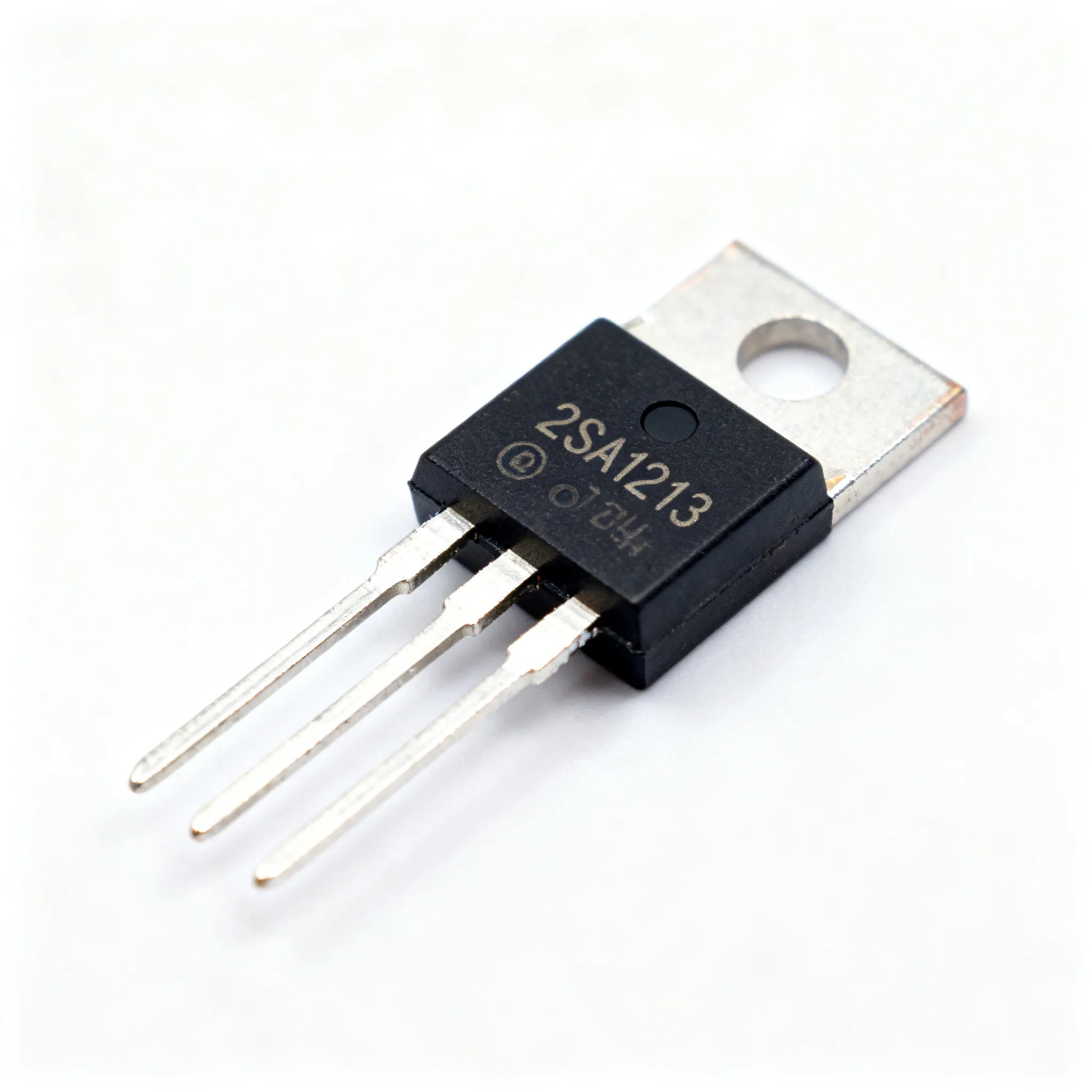
| Package Types | TO-220 and others |
| Protection Features | Thermal shutdown, short circuit protection, safe operating area protection |
The 7805 voltage regulator includes thermal shutdown and current limiting. These features protect devices from overheating and short circuits. The regulator maintains stable voltage under changing conditions, which makes it reliable for powering Arduino projects and battery-powered devices.
Compared to other linear voltage regulators, the 7805 voltage regulator has a fixed 5V output and supports up to 1.5A current. The LM317, another popular linear regulator, offers adjustable output but similar heat dissipation. Both require heat sinks at higher currents. The 7805 voltage regulator is simpler and cost-effective for fixed 5V applications, but it cannot handle very high currents. For higher current needs, engineers often use the LM338, which supports up to 5A.
| Feature | 7805 | LM317 | Switching Regulator |
|---|---|---|---|
| Output Current | Typically up to 1A, variants up to 1.5A | Can supply more than 1.5A | High current capacity, varies |
| Heat Dissipation | High, dissipates excess power as heat, requires heat sinks at higher currents | Similar heat dissipation, also requires heat sinks | Much lower heat due to higher efficiency |
| Efficiency | Low, especially with large input-output voltage difference | Low, similar to 7805 | High (70-95%) |
| Complexity | Simple, fixed 5V output | More complex, adjustable output | More complex, requires additional components |
The 7805 voltage regulator is best for low-cost, fixed 5V applications where current demands are moderate and noise must be low.
Switching Voltage Regulators
Switching voltage regulators use a different approach to control voltage. They rapidly switch a transistor on and off, storing energy in inductors and capacitors. This method allows switching voltage regulators to transfer power efficiently, with less heat wasted. The most common types include buck, boost, and buck-boost converters.
- Buck converter steps down voltage from a higher input to a lower output.
- Boost converter increases voltage from a lower input to a higher output.
- Buck-boost converter can either increase or decrease voltage, depending on the circuit design.
Switching voltage regulators achieve much higher efficiency than linear voltage regulators. For example, a buck converter can reach efficiencies of 80-95%, even when the input voltage is much higher than the output. This efficiency means less heat and better thermal performance. Switching voltage regulators are ideal for high-power applications and systems where energy savings matter.
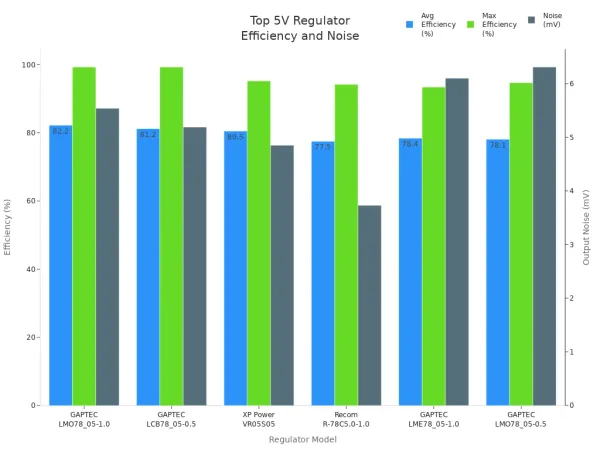
Popular models for high-efficiency 5V power supplies include GAPTEC Electronic LMO78_05-1.0, XP Power VR05S05, and Recom Power R-78C5.0-1.0. These dc-dc switching regulators offer efficiencies above 90% and low output noise. Analog Devices also provides step-down buck switching regulators with efficiencies up to 96%. Their Silent Switcher® and µModule® products combine high efficiency with low noise, making them suitable for industrial and communication systems.
Switching voltage regulators have several advantages:
- High efficiency and better thermal performance.
- Ability to step-up, step-down, or buck-boost voltages.
- Support for higher current and wider input/output voltage ranges.
- Less waste heat and cooler operation.
- Generation of switching noise, which can affect sensitive circuits.
- Need for external components like inductors and capacitors.
- Increased design complexity and cost.
- Larger physical size when heat sinking is not required.
Note: Switching voltage regulators are preferred when power efficiency is critical, especially with larger input-output voltage differences. However, linear voltage regulators remain the best choice for low-noise, low-power, and simple designs.
The types of voltage regulators available today allow engineers to choose the best solution for each application. Understanding how linear voltage regulators work and how switching regulators work helps designers balance efficiency, noise, and cost.
Choosing a Voltage Regulator IC
Key Parameters
Selecting the right voltage regulator IC starts with understanding the most important performance parameters. Each parameter affects how well the voltage regulator works in a real device. The table below shows the main factors to consider:
| Parameter | Description |
|---|---|
| Input Voltage | The voltage range the regulator can handle, ensuring it accommodates power supply fluctuations. |
| Output Voltage | The required stable output voltage to ensure system performance and safety. |
| Output Current | Maximum current the regulator can supply, must exceed device's max current to avoid damage. |
| Switching Frequency | Frequency of switching regulators affecting size, efficiency, and noise levels. |
| Quiescent Current | Current consumed when the regulator is idle, important for battery-powered devices to save power. |
| Thermal Resistance | Ability to dissipate heat; lower values improve reliability and prevent overheating. |
| Efficiency | Determines power loss and heat generation, critical for battery life and thermal management. |
| EMI Sensitivity | Consideration for electromagnetic interference, influencing regulator choice between linear or switching. |
| Physical Size | Constraints on PCB space affecting regulator selection, especially for compact designs. |
Input voltage and output current ratings play a big role in voltage regulator IC selection. The input voltage must stay within the IC’s safe range. The output current rating should always be higher than the device’s maximum current. This prevents overheating and failure. Dropout voltage is also important for linear regulators. The input voltage must be higher than the output voltage by at least the dropout value to maintain good load regulation and line regulation. High efficiency helps reduce heat and saves battery life, especially in portable devices.
Selection Tips
Choosing the best voltage regulator IC involves more than just checking voltage and current. Here are some practical tips:
- Define the application’s input voltage range and maximum load current.
- Select the regulator type. Use a linear regulator like the 7805 voltage regulator for low noise and simple designs. Choose a switching regulator for higher efficiency or when stepping up or down voltage.
- Check that the input voltage range covers the power source, considering dropout voltage for linear types.
- Ensure the output current rating exceeds the load’s maximum current by at least 20% for safety.
- Evaluate efficiency needs. Battery-powered devices benefit from high efficiency and low quiescent current.
- Consider EMI sensitivity. Linear regulators create less noise, while switching types may need extra filtering.
- Pay attention to thermal resistance and heat dissipation. Good thermal management prevents overheating.
- Select the right package size for the available space.
- Always use the recommended capacitors from the datasheet. This ensures stable load regulation and line regulation.
- Test the voltage regulator IC in the real circuit before final use.
Common mistakes include using voltage dividers or Zener diodes for regulation, ignoring dropout voltage, and neglecting heat management. Some designers use outdated regulators like the AMS1117 instead of newer, more efficient options. The 7805 voltage regulator remains a popular choice for fixed 5V needs, but modern switching regulators offer better efficiency for higher input voltages.
Tip: Always read the datasheet and follow manufacturer guidelines for how to connect a voltage regulator. This helps avoid instability and poor performance.
Voltage Regulator Applications
Modern Devices
Modern devices depend on voltage regulators to maintain safe and reliable operation. The LM340T5 5V voltage regulator plays a vital role in many electronics. It supplies a stable 5V output for microcontrollers, sensors, and digital gadgets. This steady voltage helps devices work correctly and last longer. Engineers use the LM340T5 in consumer electronics, automotive systems, telecommunications, and industrial machinery. Its built-in protection features, such as overcurrent and overheating safeguards, make it suitable for demanding environments.
Devices like smartphones, tablets, and smart home controllers need regulated power supply to avoid damage from voltage spikes. In automotive engineering, voltage regulators protect sensitive control units and sensors. Industrial machines rely on stable voltage for accurate data collection and safe operation. The LM340T5’s adaptability allows it to support many types of modern devices that require precise voltage for critical functions.
Tip: Power management circuits with voltage regulators help extend battery life and improve device reliability.
Power Supply Units
Power supply units in consumer electronics use 5V voltage regulators to deliver consistent power. The LM340T5 provides a precise 5V output, which is essential for digital devices. Stable voltage reduces the risk of damage to sensitive components and improves safety. Designers often add heat sinks and thermal paste to manage heat dissipation, which increases efficiency and extends the lifespan of components.
- Capacitors placed near the regulator help reduce voltage ripple and improve output stability.
- Diodes protect circuits from faults like reverse polarity.
- The LM340T5’s fixed output eliminates the need for constant monitoring, boosting reliability.
When designing a regulated power supply, engineers consider headroom voltage and dropout voltage. Low dropout regulators (LDOs) work well when the input voltage is close to 5V. Proper placement of regulators on the PCB helps with thermal management and signal integrity. Switching regulators, such as buck and boost converters, offer higher efficiency and reduce transformer size. However, they require careful design to minimize noise and ripple.
| Design Consideration | Description |
|---|---|
| Heat Dissipation | Use heat sinks or cooling to prevent overheating. |
| Efficiency | Buck and boost regulators improve power utilization. |
| Noise Minimization | Filtering and layout reduce ripple and noise. |
| Stable Output | Capacitors and fast response maintain voltage stability. |
Selecting the right voltage regulator and testing it in the final circuit ensures efficient and safe power delivery in consumer electronics.
5V voltage regulators keep electronic devices safe and reliable by providing steady power. Engineers and hobbyists who understand regulator types can choose the best option for each project, balancing efficiency, noise, and heat. This knowledge improves circuit design and device longevity. When troubleshooting, users should check input voltage, ground connections, and heat management. For hands-on learning, tutorials and guides on building 5V regulator circuits offer step-by-step instructions and practical tips.
Learning about voltage regulators helps everyone build better, safer electronics.
FAQ
What happens if a voltage regulator overheats?
The voltage regulator may shut down or reduce output to protect itself. Overheating can damage the regulator and connected devices. Adding a heat sink or improving airflow helps keep the regulator cool.
Can a 5V regulator power USB devices?
Yes, a 5V regulator can power USB devices. Most USB devices need a stable 5V supply. The regulator must provide enough current for the device. Always check the device’s current requirements before connecting.
How do you know if a voltage regulator is faulty?
- The output voltage drops or fluctuates.
- Devices reset or stop working.
- The regulator feels very hot.
A multimeter can help check the output voltage.
What is the difference between LDO and standard linear regulators?
| Feature | LDO Regulator | Standard Linear Regulator |
|---|---|---|
| Dropout Voltage | Very Low | Higher |
| Efficiency | Better with low input-output difference | Lower |
LDO regulators work better when input voltage is close to output voltage.
Why does my circuit need capacitors with a voltage regulator?
Capacitors help smooth out voltage spikes and reduce noise. They improve stability and prevent sudden changes in output voltage. Most datasheets recommend placing capacitors close to the regulator’s input and output pins.