A power factor correction capacitor can cut your energy bills.
A power factor correction capacitor can lower your energy bills, particularly for commercial and industrial facilities. It d

A power factor correction capacitor can lower your energy bills, particularly for commercial and industrial facilities. It delivers savings in two primary ways. First, power factor correction eliminates expensive utility penalties for reactive energy. Second, it reduces the total current a system draws, which cuts energy waste and boosts overall efficiency.
Improving power factor correction is a direct path to greater energy efficiency, ensuring you use the energy you draw more effectively.
Key Takeaways
- Power factor correction helps businesses save money on electricity bills. It stops extra charges from utility companies.
- A low power factor means your electrical system wastes energy. It makes your equipment work harder than it needs to.
- Power factor correction reduces the total electricity your building pulls from the grid. This lowers your monthly costs.
- Capacitors fix a low power factor by balancing the energy used by motors. This makes your system more efficient.
- If your business uses many motors, a professional can check if power factor correction is right for you. It can save you a lot of money.
Direct Cost Savings From Power Factor Correction

Installing a power factor correction capacitor creates direct and measurable financial benefits. Businesses can significantly reduce their monthly electricity costs. These savings come from eliminating penalties, lowering demand charges, and improving overall energy efficiency. Effective power factor correction turns an inefficient system into a cost-effective one.
Eliminating Reactive Power Penalties
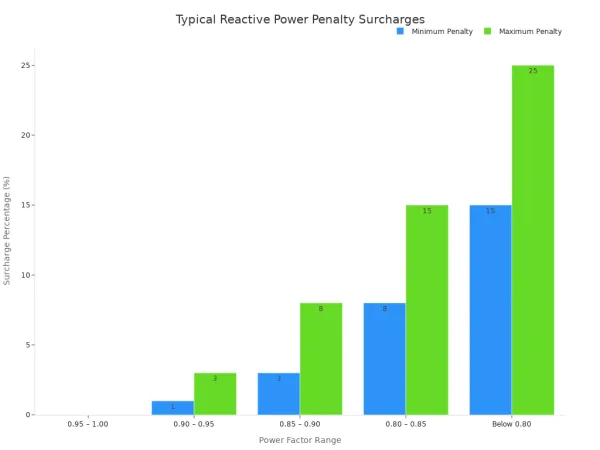
Utility companies often add surcharges to the bills of facilities with poor power factor. They establish specific power factor thresholds in their contracts. A facility's power factor must stay above this number to avoid penalties. Most utilities set this target between 0.85 and 0.95.
Note: Falling below your utility's required power factor level is like paying a tax for inefficiency. Power factor correction helps you avoid this unnecessary cost.
The most common threshold is 0.95. However, this can vary.
| Threshold Type | Power Factor Value |
|---|---|
| Most Common | 0.95 |
| Conservative | 0.90 |
| Aggressive | 0.98 |
Failing to meet these targets leads to financial penalties, which increase as the power factor worsens. The surcharges can become substantial. For example, a power factor of 0.85 could lead to an 8% surcharge on your bill.
A case study shows the powerful impact of eliminating these charges. One facility achieved significant annual savings after implementing power factor correction. The results speak for themselves.
| Cost/Saving Category | Before (Annual) | After (Annual) |
|---|---|---|
| Reactive Power Charge | £641.75 | £0 |
| Reduced Agreed Supply Capacity | N/A | £1,761.68 |
| Total Annual Saving | N/A | £4,165.12 |
By improving its power factor, the facility completely removed its reactive energy charges and unlocked further savings.
Lowering Peak Demand (kVA) Charges
Many utilities bill commercial customers based on peak demand. This charge is measured in kilovolt-amperes (kVA). Peak demand represents the highest amount of energy a facility draws from the grid at any one time. A low power factor inflates this kVA demand. The relationship is simple:
Power Factor = Real Power (kW) / Apparent Power (kVA)
This means an inefficient system needs more apparent power (kVA) to produce the same amount of useful work (kW). For instance, a system needing 2,000 kW of real power with a perfect power factor of 1.0 would draw 2,000 kVA. If the power factor drops to 0.85, the system must draw 2,353 kVA to do the same work. This higher kVA demand results in higher monthly charges.
Power factor correction lowers this kVA demand, leading to immediate cost reductions. An automotive parts manufacturer provides a great example.
| Industry | Action Taken | Result |
|---|---|---|
| Automotive Parts Manufacturing | Installed a 1,200 kVAR capacitor bank | Reduced peak demand charges by 15% annually |
This company improved its efficiency and cut its peak demand charges by a significant margin. Better energy efficiency directly translated to lower operational costs.
Reducing Wasted Energy and Heat Loss
A poor power factor forces a system to draw more current than necessary. This excess current does not perform useful work. Instead, it generates heat as it moves through transformers, wiring, and other electrical components. This heat is a form of energy waste, known as I²R loss.
This waste increases exponentially as power factor decreases. Even a small drop in efficiency can cause a large increase in energy loss.
- A drop in power factor from 0.9 to 0.7 can increase line losses by 65%.
- A drop from 1.0 to 0.7 can more than double the energy lost as heat.
Power factor correction reduces the total current flowing through your system. Less current means less heat, less wasted energy, and a more efficient operation. This improved energy efficiency not only lowers your energy bill but also extends the life of your electrical equipment by reducing thermal stress. It is a fundamental step toward a more sustainable and cost-effective energy profile.
Improving Energy Efficiency by Understanding Power Factor

Improving your facility's energy efficiency starts with understanding power factor. This key metric reveals how effectively your equipment uses electrical energy. A high power factor means your system uses energy efficiently. A low power factor signals that you are wasting energy and likely overpaying for it. Effective power factor correction turns this wasted energy into real savings.
What Is Power Factor?
Power factor measures the efficiency of an electrical system. It compares the real power used for work (kW) to the total power drawn from the grid (kVA). A simple analogy is a glass of beer.
- Real Power (kW): This is the beer itself. It is the useful energy your equipment consumes to perform work, like running a motor.
- Reactive Power (kVAR): This is the foam. It is the energy required to create magnetic fields for equipment like motors to operate, but it does no useful work.
- Apparent Power (kVA): This is the entire glass, containing both beer and foam. It represents the total energy your utility must supply.
A low power factor is like having too much foam in your glass. You are paying for a full glass (kVA) but only getting to use the beer (kW). Power factor correction helps reduce the foam, improving your overall energy efficiency.
Common Causes of Poor Power Factor
Poor power factor is almost always caused by inductive loads. This type of equipment requires reactive energy to create magnetic fields. Facilities with many inductive loads often have low power factor and poor energy efficiency. Common sources include:
- Induction motors (found in pumps, fans, and conveyors)
- Transformers
- Older fluorescent and HID lighting ballasts
- Welding equipment and arc furnaces
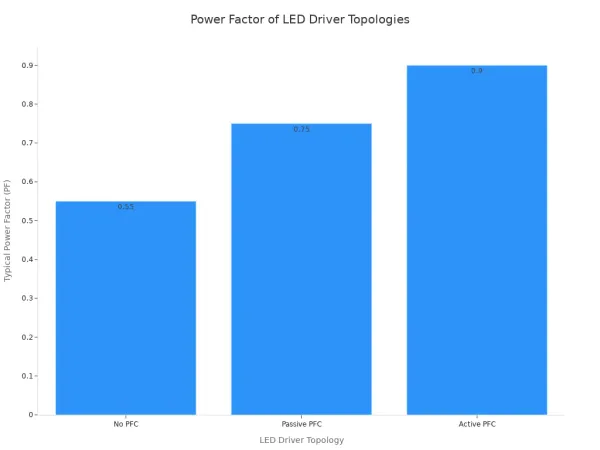
Even modern LED lighting can contribute to a low power factor, depending on the quality of its internal driver. Low-cost LED lamps often have a power factor as low as 0.5, while industrial-grade fixtures with active power factor correction can achieve 0.9 or higher.
Counteracting Inductive Loads
A power factor correction capacitor works by counteracting inductive loads. Inductive loads, like motors, consume reactive energy. Capacitive loads, on the other hand, are considered sources of reactive energy. In an inductive circuit, the current lags behind the voltage. In a capacitive circuit, the current leads the voltage.
By installing a power factor correction capacitor, you create a local source of reactive energy. This balances out the reactive energy consumed by your motors and other equipment.
This balancing act is the core of power factor correction. The capacitor supplies the necessary reactive energy directly to the inductive loads. As a result, your system no longer needs to draw that reactive energy from the utility grid. This reduces the total current, lowers kVA demand, and boosts system efficiency, leading to a more optimized use of energy.
Is a Power Factor Correction Capacitor Right for You?
Deciding to install a power factor correction capacitor is a strategic investment in your facility's financial health. This technology is not for everyone, but for the right business, it offers a clear path to lower energy bills and greater operational efficiency. Understanding if your facility is a good candidate involves looking at your equipment, your utility bills, and your operational patterns.
Identifying Ideal Candidates
Facilities that benefit most from power factor correction share common traits. They often operate a large number of inductive loads. This equipment includes induction motors for pumps, fans, conveyors, and air conditioning units. These machines consume reactive energy, which lowers a facility's power factor. Your electricity bill is a key indicator. If it shows charges for reactive power or a power factor below 0.90, your facility is a prime candidate.
Certain industries are particularly well-suited for power factor correction due to their reliance on motor-driven equipment. Ideal candidates often include:
- Agriculture and Food & Beverage processing
- Manufacturing and facilities with Air & Gas Compressors
- Data Centers
- Commercial Buildings with elevators and large HVAC systems
Operational patterns also reveal a need for improved energy efficiency. One of the best practices for implementing power factor correction is to analyze how equipment is used.
Many machines, like grinders, punch presses, and plastic injection molders, have motors sized for peak loads but often run at partial capacity. A lightly loaded motor is inefficient and draws excessive reactive energy. This is a clear sign that power factor correction could deliver significant benefits.
Calculating Your Potential Savings and ROI
Calculating your potential savings and return on investment (ROI) is a critical step. Businesses often see a full return on their investment within one to three years. The savings come from eliminating penalties and reducing demand charges. For example, a Midwest manufacturing plant installed a capacitor bank and achieved a payback period of just 14 months, leading to substantial annual savings.
The typical payback period can vary by facility type.
| Facility Type | Average Payback Period |
|---|---|
| Manufacturing Plant | 18–24 months |
| Data Center | 14–18 months |
| Commercial Building | 22–30 months |
Professionals calculate the required capacitor size to determine project costs. They use a formula to find the necessary reactive power (Qc) to improve your power factor. The basic formula is:
Qc = P (tanØ1 – tanØ2)
Pis the real power in kilowatts (kW).Ø1is the angle of your current power factor.Ø2is the angle of your target power factor.
For a preliminary estimate, you can use free online tools. Several companies, like EnergyAce and myElectrical.com, offer calculators. These tools typically ask for your connected load (kW), current power factor, and desired power factor to estimate your needs. This analysis is one of the best practices for implementing power factor correction before making an investment.
The Next Step: Professional Assessment
The final step before investing is a professional assessment. This process provides the detailed data needed to design an effective solution and maximize your energy savings. A qualified electrician or engineer will conduct a site survey to ensure the best possible efficiency. This is one of the best practices for implementing power factor correction.
A professional assessment typically involves several key steps:
- Preparation: The technician establishes safety measures before starting.
- Instrumentation: They use a power energy analyzer to record demand, power factor, and total energy use.
- Connection: They connect sensors to your main electrical panels to gather data.
- Testing: The analyzer monitors your system's energy consumption over a specific period, often a full week, to capture different load cycles.
- Analysis: The expert analyzes the data to identify inefficiencies and calculate the precise capacitor size needed.
- Documentation: They generate a detailed report with findings, conclusions, and specific recommendations for your power factor correction solution.
This professional analysis ensures you get the right equipment for your facility's unique energy profile. For this specialized work, it is important to engage with qualified experts. For instance, companies like Nova Technology Company (HK) Limited, a HiSilicon-designated solutions partner, have the expertise to perform these detailed assessments and help businesses improve their overall energy efficiency.
Installing a power factor correction capacitor is a proven strategy to stop overpaying for electricity. It increases system efficiency and eliminates costly penalties on your energy bill. This approach focuses on using energy more effectively, not simply reducing total consumption. Successful power factor correction projects, like a courthouse that modernized its system in one day, show the immediate benefits.
Your Next Steps:
- Grab your latest utility bill. Look for terms like 'power factor,' 'kVA demand,' or 'kVAR charges.'
- If you find these charges, contact a qualified electrician to discuss a power factor correction assessment for your facility.
FAQ
How much does a power factor correction capacitor cost?
The cost of a power factor correction system varies. It depends on the facility's size and electrical load. Most businesses see a full return on their investment within one to three years from energy savings. A professional assessment determines the exact cost for a specific site.
Can a person install a PFC capacitor themselves?
No. Installing a power factor correction capacitor is a job for a qualified electrician. The work involves high-voltage equipment. Incorrect installation is dangerous and can damage the electrical system. Professional installation ensures safety and proper function.
Will a PFC capacitor help a home energy bill?
Power factor correction offers minimal benefit for most residential customers. Utility companies typically do not penalize homes for poor power factor. These capacitors provide the most significant savings for commercial and industrial facilities with large motor loads.
Does power factor correction reduce energy consumption?
Power factor correction does not reduce the real power (kW) an appliance needs. Instead, it improves energy efficiency. It reduces the total apparent power (kVA) drawn from the grid. This lowers wasted energy and eliminates utility penalties, which cuts the overall electricity bill.