Beginner’s Handbook for Reading Resistor Color Codes
You can learn how to read resistor color codes by matching the colored bands on a resistor to numbers on a standard chart. T

You can learn how to read resistor color codes by matching the colored bands on a resistor to numbers on a standard chart. This process uses simple memory tricks.
- Try the mnemonic "BBROYGBVGW" to remember the order of the colors from zero to nine.
- Think of the colors of the rainbow, but skip indigo, then add black and brown for smaller values and gray and white for larger ones.
No electronics experience is needed. With these tips, you will quickly identify resistor values.
Key Takeaways
- Use the mnemonic 'BBROYGBVGW' to remember the order of resistor colors from zero to nine.
- Always start reading resistor bands from the end closest to the edge, keeping the gold or silver band on the right.
- For 4-band resistors, calculate resistance using the formula: (1st digit x 10 + 2nd digit) x Multiplier.
- Check the tolerance band to understand how much the actual resistance value may vary.
- Practice reading resistors regularly and use a color code chart to avoid mistakes.
Resistor Color Code Basics

What Is a Resistor?
A resistor is a small electronic part that helps control the flow of electricity in a circuit. You use resistors to make sure the right amount of current passes through different parts of your project.
"The primary function of a resistor is to limit or regulate the current, leading to a controlled reduction in voltage across a specific section of the circuit."
If you did not use resistors, too much current could damage other parts. The value of a resistor is measured in ohms (Ω). This number tells you how much the resistor slows down the current.
Color Bands Meaning
Resistors use colored bands to show their resistance value and other important details. The color bands follow a system called resistor color coding, which is defined by international standards.
You will see three, four, five, or even six bands on a resistor. Each band has a special meaning:
- The first two bands show the main numbers of the resistance value.
- The third band is the multiplier, which tells you how many zeros to add.
- The fourth band shows the tolerance, or how much the actual value might differ from the stated value.
- The fifth band, if present, gives extra information like reliability or temperature stability.
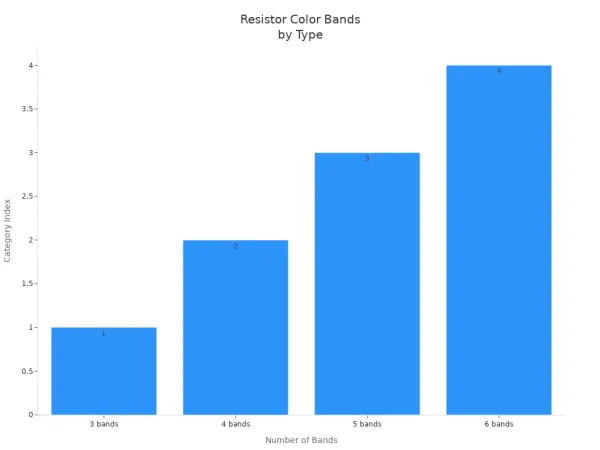
Here is a table that shows the different types of resistor color code bands:
| Number of Bands | Description |
|---|---|
| 3 | Commonly used for basic resistors. |
| 4 | Most common configuration. |
| 5 | Used for more precise values. |
| 6 | Less common, for specialized uses. |
You can also see the different categories in this chart:
Starting Point
When you read a resistor color code, always start from the end where the color band is closest to the edge. The gold or silver band, which shows tolerance, usually sits on the right side.
- Make sure you do not mix up the starting point.
- Always read from left to right, beginning with the band nearest the edge.
- If you see a gold or silver band, keep it on the right.
Many beginners make mistakes by reading the bands in the wrong direction or confusing similar colors like brown, red, and orange. Good lighting helps you see the colors clearly. If you are unsure, use a chart to double-check the resistor value.
How to Read Resistor Color Codes
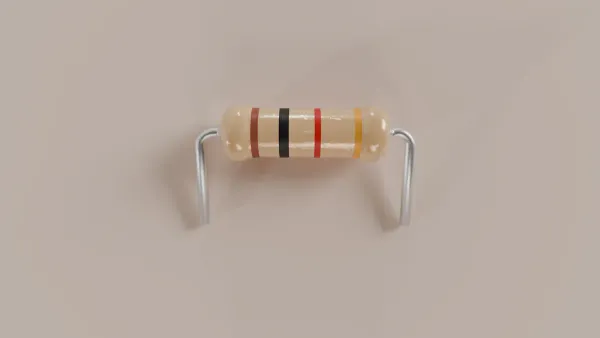
Learning how to read resistor color codes helps you find the resistance value of any resistor quickly. You can follow a few simple steps for each type of resistor. Always start from the end where the color band is closest to the edge. Keep the gold or silver band on the right side. This band shows the tolerance. Read resistors from left to right for the most accurate results.
4-Band Resistor
You will see four colored bands on most resistors. These bands tell you the resistance value and tolerance. Here are the steps for reading resistor color codes on a 4-band resistor:
- Look at the first two bands. Use a resistor color code chart to match each color to its number. These numbers are the significant digits.
- Check the third band. This band is the multiplier. It tells you how many zeros to add after the first two digits.
- Calculate the resistance value. Use this formula:
Resistance (Ω) = (1st digit x 10 + 2nd digit) x Multiplier - Find the tolerance. The fourth band shows how much the actual value might differ from the stated value.
Tip: Always keep the gold or silver band on the right when you read resistors. This helps you avoid mistakes.
5-Band Resistor
You will find 5-band resistors in many electronic components that need precise values. The 5 band resistor color code gives you more accuracy. Here is how to read resistor color codes for a 5-band resistor:
| Step | What to Do |
|---|---|
| 1 | Identify the first three bands. Match each color to its number using a chart. These are your significant digits. |
| 2 | Look at the fourth band. This is the multiplier. It tells you how many zeros to add. |
| 3 | Calculate the resistance value. Use this formula: (1st digit x 100 + 2nd digit x 10 + 3rd digit) x Multiplier |
| 4 | Check the fifth band. This band shows the tolerance. |
- You often see 5-band resistors in fixed value axial resistors. These resistors appear in many types of electronic circuits.
Note: When you read resistors with five bands, always start from the end with the band closest to the edge. Keep the tolerance band (gold or silver) on the right.
6-Band Resistor
A 6-band resistor works like a 5-band resistor but gives you extra information. The sixth band tells you about the temperature coefficient. This value shows how much the resistance changes when the temperature changes. Here are the steps for reading resistor color codes on a 6-band resistor:
- Find the first three bands. Match each color to its number. These are the significant digits.
- Check the fourth band. This is the multiplier.
- Calculate the resistance value using the same formula as the 5-band resistor.
- Look at the fifth band. This band shows the tolerance.
- Read the sixth band. This band tells you the temperature coefficient, measured in parts per million per Kelvin (ppm/K). Lower values mean the resistor stays more stable when the temperature changes.
| Feature | Description |
|---|---|
| Sixth Band | Shows the temperature coefficient (ppm/K) |
| Importance | Tells you how much resistance changes with temperature |
| Application | Needed for high-precision circuits that must stay stable in different temperatures |
Tip: If you need to read resistors for high-precision projects, always check the sixth band for temperature stability.
You now know the steps for reading resistors with 4, 5, or 6 bands. Practice these steps for reading resistors, and you will get faster and more confident. Remember, learning how to read resistor color codes is a skill you can use in every electronics project. Always use a resistor color code chart if you are unsure.
Resistor Color Code Chart
Color Chart
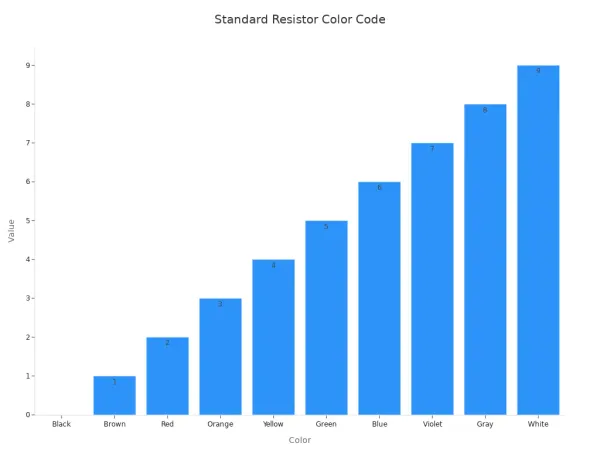
You can use a resistor color code chart to quickly find the value of any resistor. Each color stands for a number. You match the color bands on your resistor to the numbers in the chart. This helps you figure out the resistance value in ohms.
Here is the standard resistor color code chart:
| Band | Color | Value |
|---|---|---|
| 1 | Black | 0 |
| 2 | Brown | 1 |
| 3 | Red | 2 |
| 4 | Orange | 3 |
| 5 | Yellow | 4 |
| 6 | Green | 5 |
| 7 | Blue | 6 |
| 8 | Violet | 7 |
| 9 | Gray | 8 |
| 10 | White | 9 |
You may find it hard to remember the order of the colors. Mnemonics make this easier. Try these popular phrases:
- BB Roy of Great Britain had a Very Good Wife
- Big Boys Race Our Young Girls But Violet Generally Wins
- Bad Booze Rots Our Young Guts But Vodka Goes Well
Each word’s first letter matches a color in the chart. You can pick the one that helps you most.
Tip: Keep a printed resistor color code chart at your workspace. This saves time and helps you avoid mistakes.
Tolerance Bands
The last band on a resistor often shows the tolerance. Tolerance tells you how much the actual value can differ from the number you read on the chart. For example, a resistor with a 5% tolerance can have a real value that is 5% higher or lower than what you calculate.
- Tolerance bands help you choose the right resistor for your project.
- If you need high accuracy, look for resistors with a narrow tolerance band.
- Narrow-tolerance resistors cost more but give you a value closer to what you want.
Note: Tolerance affects the overall accuracy of your circuit. Always check the tolerance band before you use a resistor.
Tips & Mistakes
Memory Aids
You can remember the color code order with simple tricks. Try using a phrase where each word’s first letter matches a color. For example, “Big Boys Race Our Young Girls But Violet Goes Wild” helps you recall the sequence. Practice saying the phrase out loud while looking at a resistor. This method helps you match each color to its number quickly. You can also keep a printed color chart at your desk. If you use the chart often, you will start to remember the order without thinking. Some people use flashcards or quiz apps to test themselves. These tools make learning the color code fun and easy.
Common Errors
Many people make mistakes when reading resistor color codes. You might read the bands in the wrong direction or mix up similar colors like brown and red. Poor lighting can make it hard to see the bands clearly. Sometimes, faded color bands cause confusion. If you have trouble telling colors apart, use a magnifying glass or work under a bright LED lamp. Here is a table that shows common visual challenges and how you can solve them:
| Visual Challenge | Solution |
|---|---|
| Faded color bands | Use resistor calculators and error-checking tools. |
| Ambiguous orientation | Start from the end closest to the edge or opposite the tolerance band. |
| Confusion between colors | Keep a color code chart handy and practice the sequence. |
| Poor lighting | Use high-quality LED lighting or daylight bulbs. |
| Color blindness | Use color blindness apps or measure with electronic tools like multimeters. |
Tip: Always double-check the resistance value if you feel unsure. Practice helps you avoid most mistakes.
Tools for Checking
You can use several tools to check the value of a resistor. The most common tool is a multimeter. It measures the resistance in ohm and gives you a direct reading. An ohmmeter works well for checking only resistance. For more precise work, you might use a Wheatstone Bridge or an LCR meter. These tools help you find the exact resistance value, especially in professional labs or manufacturing. If you have trouble seeing the color bands, use a digital app or a multimeter for quick results.
| Instrument | Best Use Case |
|---|---|
| Multimeter | General troubleshooting and repair |
| Ohmmeter | Sensitive resistance measurements |
| LCR Meter | Testing resistance, inductance, and capacitance |
Note: If you cannot read the color bands, always use a tool to measure the resistor directly.
You can read any resistor by following a few simple steps:
- Count the number of color bands.
- Match each band to its number using a color code chart.
- Apply the multiplier and find the resistance value.
- Check the tolerance band for accuracy.
Mistakes happen, especially with similar colors or faded bands. Use this table to avoid common errors:
| Mistake | Solution |
|---|---|
| Forgetting the multiplier | Always check the third band |
| Mixing up colors | Use good lighting and a chart |
Practice often, use memory aids, and verify your results with a multimeter. You will get better with each try.
FAQ
What if I cannot tell two colors apart on a resistor?
You can use a magnifying glass or a bright LED lamp to see the bands better. If you still feel unsure, measure the resistor with a multimeter for an accurate reading.
Why do some resistors have only three color bands?
Three-band resistors show only the main value and the multiplier. You will not see a tolerance band. These resistors usually have a standard 20% tolerance.
Can I use a phone app to read resistor color codes?
Yes, you can use many free apps to scan and identify resistor color codes. These apps help you check your answers and avoid mistakes.
What does the temperature coefficient band mean?
The temperature coefficient band shows how much the resistance changes with temperature. You will see this band on six-band resistors. Lower values mean the resistor stays more stable as temperatures change.
Where can I find more resistor color code questions for practice?
You can find more resistor color code questions in electronics textbooks, online quizzes, and educational websites. Practice helps you get faster and more confident.