Choosing the Right Box Build PCB Assembly Partner for Your Project
Selecting the right box build partner shapes every stage of electronics manufacturing. Experience, technical skill, and strict quality standards define a reliable box build assembly provider.

Selecting the right box build partner shapes every stage of electronics manufacturing. Experience, technical skill, and strict quality standards define a reliable box build assembly provider. The right choice in box build assembly reduces risk and speeds up delivery for electronic products. Turnkey solutions simplify the supply chain and improve project outcomes. Companies that value strong assembly support see smoother electronics production.
Key Takeaways
-
Choose a box build partner with strong experience and quality certifications to ensure reliable and efficient electronics assembly.
-
Turnkey solutions simplify production by managing sourcing, assembly, testing, and logistics in one seamless process, saving time and reducing costs.
-
Look for providers offering prototyping, customization, and value-added services to speed up development and meet unique project needs.
-
Effective communication and flexible project management help keep assembly projects on schedule and adapt to changes smoothly.
-
Check lead times and pricing models carefully, and confirm included services to avoid delays and hidden costs in your project.
Box Build Assembly Services
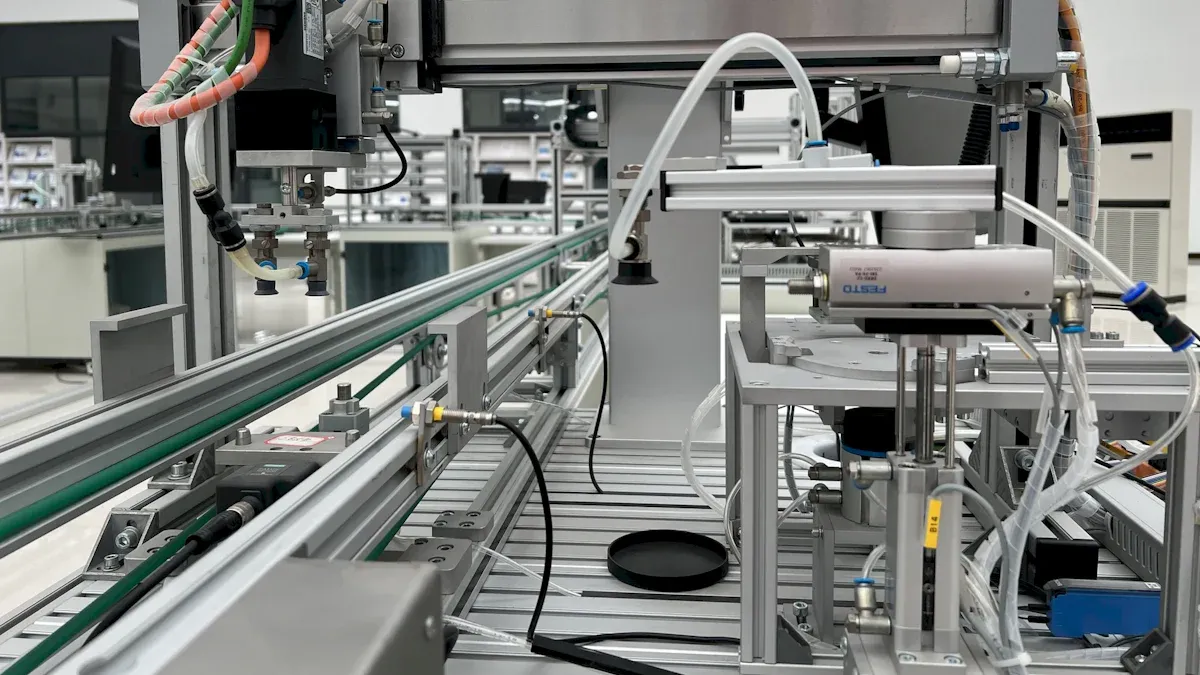
Box build assembly services cover every step from mechanical assembly to final product testing. These services ensure that each project receives complete assembly, precise integration, and thorough validation. Companies rely on these services to manage complex builds, reduce risks, and deliver reliable products.
System Integration
System integration forms the backbone of box build assembly services. Providers handle the assembly of mechanical and electronic sub-assemblies, wiring, and enclosure installation. They also manage system-level integration, ensuring that all components work together seamlessly.
Providers with AS9100D certification demonstrate rigorous quality management. They focus on risk mitigation, counterfeit part prevention, and strict configuration management. Enhanced traceability and process control guarantee consistent performance and fast root cause analysis if issues arise. Flexible partnership models, such as turnkey, kitted, or hybrid, allow customers to choose the right balance of control and convenience.
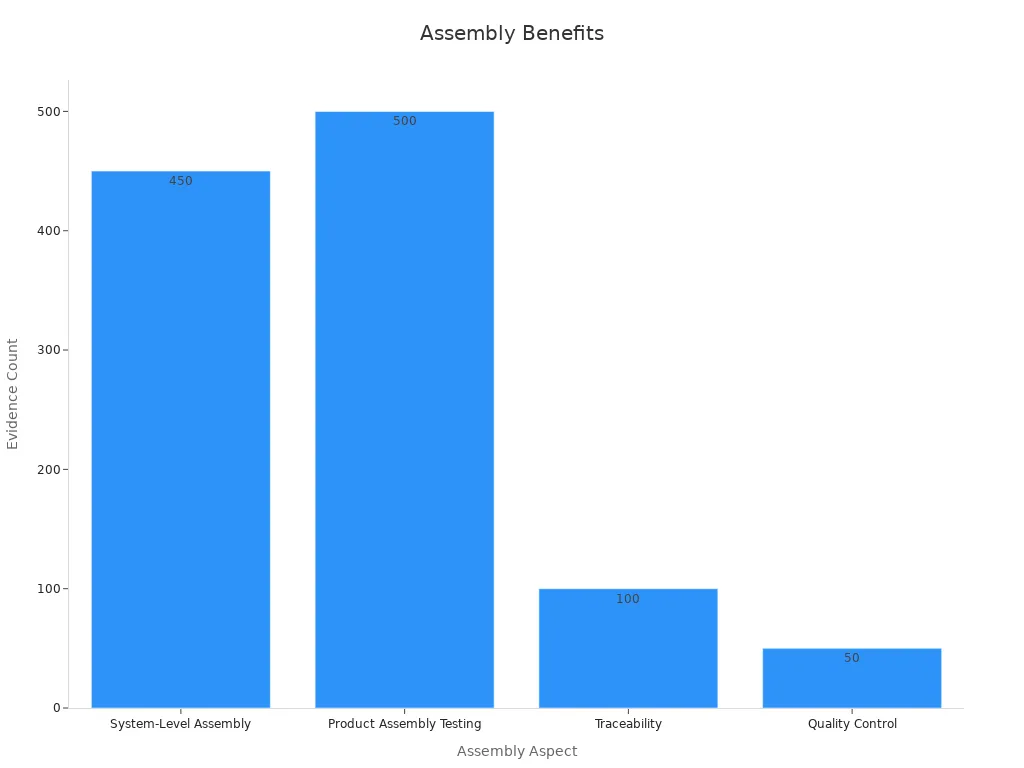
The following table highlights key performance metrics and benefits of comprehensive box build assembly services:
|
Aspect |
Evidence / Data Points |
Benefits / Description |
|---|---|---|
|
System-Level Assembly |
Ensures flawless integration of electronic systems and components, including box build assemblies, with precision and traceability. |
|
|
Product Assembly Testing |
500 successful product assembly tests conducted |
Comprehensive testing including automated inspection, functional validation, and environmental stress testing ensures flawless operation and compliance with standards like EMI/EMC, thermal cycling, and vibration analysis. |
|
Traceability |
100 traceability checkpoints of assembled components |
Guarantees component-level traceability, enhancing quality control and accountability throughout the assembly process. |
|
Quality Control |
50 quality control checkpoints |
Multiple quality control stages ensure high product reliability and adherence to specifications. |
|
Sub-Level Product Assembly |
Descriptive evidence of assembling complex electronic and mechanical sub-assemblies |
Reduces production complexities, lowers costs, and improves total cost of ownership by precise sub-assembly integration. |
Providers also conduct final system testing to verify that the complete assembly meets all requirements. This step includes functional validation, environmental stress testing, and compliance checks for standards such as EMI/EMC and vibration analysis.
Prototyping and Customization
Prototyping and customization add significant value to box build assembly services. Rapid prototyping, including additive manufacturing like 3D printing, enables faster and more flexible product development. For example, the STAND+ project used 3D printing to accelerate production and reduce costs for a non-slip safety shoe. This approach supports tight schedules in industries such as entertainment and fabrication, providing quick turnaround and reliable communication.
Software prototyping also plays a key role. By creating functional mock-ups, companies clarify ideas, gather feedback, and communicate with stakeholders. This method helps startups and established businesses adapt products to specific needs and impress investors. Careful testing and iteration during prototyping reduce risks and improve project outcomes. These methods support customization success and efficiency, making them essential in box build projects where speed, flexibility, and cost control matter.
Logistics and Direct Shipment
Logistics and direct shipment complete the scope of box build assembly services. Providers offer custom packaging, inventory management, and direct shipment to end customers. These services simplify the supply chain and reduce handling risks. Companies benefit from streamlined delivery, improved traceability, and reduced lead times.
Deep manufacturing expertise, US-based operations, and a collaborative approach contribute to operational efficiency and high-quality outcomes. Rigorous supplier control extends quality assurance beyond the provider’s operations, reducing upstream risks.
Box build assembly services ensure that every step, from pcb assembly to final delivery, meets the highest standards. Companies gain confidence in their electronics production, knowing that each stage receives careful attention and expert management.
Turnkey Solutions
Turnkey solutions transform the way companies approach electronics projects. These services combine every step, from sourcing materials to delivering finished products, into a single, streamlined process. Companies benefit from a unified workflow that reduces errors, improves collaboration, and allows teams to focus on their core business. Centralized procurement catalogs, vendor management, and integrated material tracking all contribute to a smoother experience. By using a single provider for all stages, businesses avoid the confusion and delays that often come with managing multiple suppliers.
End-to-End Manufacturing
End-to-end manufacturing means that one partner handles every phase of production. This includes understanding the Bill of Materials, sourcing electronic components, metal fabrication, custom cable building, full unit integration, testing, and packaging. Each step connects seamlessly to the next, reducing the risk of miscommunication or delays. Companies that use this approach often see lower operational costs and improved efficiency.
A single, vertically integrated process allows startups to move from prototype to production without interruption. Original Equipment Manufacturers (OEMs) can outsource final assembly and testing, which helps them reduce facility size and costs. Turnkey providers deliver fully integrated and tested products that meet strict specifications.
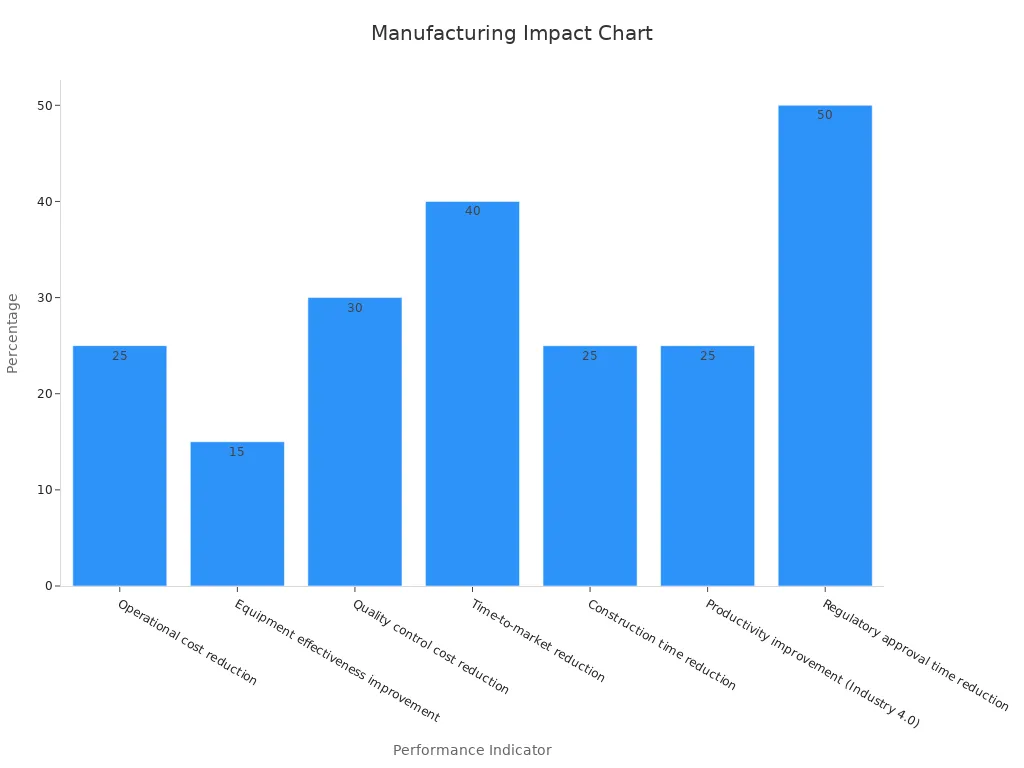
The following table shows how end-to-end manufacturing improves performance in key areas:
|
Performance Indicator |
Improvement / Reduction Percentage |
|---|---|
|
Up to 25% |
|
|
Equipment effectiveness improvement |
Up to 15% |
|
Quality control cost reduction |
Up to 30% |
|
Time-to-market reduction |
Up to 40% |
|
Construction time reduction |
Up to 25% |
|
Productivity improvement (Industry 4.0) |
Up to 25% |
|
Regulatory approval time reduction |
Up to 50% |
Turnkey assembly services also help companies save money by leveraging economies of scale. Providers buy materials in large quantities, which lowers prices for customers. They optimize production processes to minimize waste and increase yield. Managing the entire process from procurement to final assembly and testing shortens lead times. This faster time-to-market helps companies stay competitive and meet customer demands quickly.
Companies that choose turnkey solutions avoid the need to invest in expensive equipment and extra staff. Providers use their experience and buying power to deliver cost savings and rapid prototyping. Early detection of design flaws speeds up the move to full production. By handling procurement, assembly, testing, and logistics, turnkey partners reduce administrative work and help products reach the market faster.
Supply Chain Management
Effective supply chain management is a key advantage of turnkey projects. Providers use advanced systems to track materials, manage vendors, and document every step. This approach reduces errors and improves planning. Companies gain real-time visibility into their supply chain, which helps them respond quickly to changes or disruptions.
The table below highlights important supply chain metrics and their impact on reducing manufacturing risks:
|
Metric |
Description & Impact on Manufacturing Risks |
|---|---|
|
Finds the root causes of product returns, such as defects or order errors, and helps target improvements to reduce future mistakes. |
|
|
Order-Picking Accuracy |
Measures error-free order picking; higher accuracy means fewer incorrect shipments and lower risk of delays or customer complaints. |
|
Customer Service Level |
Tracks the ability to meet delivery promises; higher levels show better order fulfillment and less risk of lost sales or reputation damage. |
|
Cycle Time |
Includes order, production, and replenishment times; shorter cycle times mean fewer delays and more reliable schedules. |
|
Total Supply Chain Cost |
Adds up all supply chain expenses; lower costs mean less financial risk and better efficiency. |
|
Supplier Lead Time |
Monitors how quickly suppliers deliver; shorter lead times improve predictability and reduce the risk of production stoppages. |
Turnkey providers define clear goals, analyze logistics data, and develop strong procurement strategies. They focus on supplier quality and reliability, which reduces dependency on high-risk vendors. Inventory management practices, such as Just-In-Time (JIT), help balance supply and demand. Integrated management systems give real-time updates, allowing teams to adjust quickly to any disruption.
Companies that use turnkey supply chain management see fewer errors, faster deliveries, and lower costs. They can focus on innovation and growth, knowing that their manufacturing and logistics are in expert hands.
Quality and Certifications

Quality Control
Manufacturers in box build assembly focus on quality control to deliver reliable products. They use process standardization, clear work instructions, and standard operating procedures to reduce errors and inconsistencies. Lean manufacturing principles help minimize waste and optimize workflows. Technicians receive regular training to maintain high skill levels. Inline testing and automated equipment detect issues early, which supports improved quality assurance. Companies set clear quality standards and use traceable reporting systems to ensure each product meets client requirements.
Quality control measures include automated optical inspection systems that catch misaligned components and soldering problems. Statistical process control tracks data such as trace width and soldering temperature. This helps maintain consistency and spot variations quickly. Comprehensive testing and validation, including functional and in-circuit testing, confirm the integrity of each assembly. Suppliers must meet strict quality standards, and companies track defect rates, corrective actions, and customer feedback to drive continuous improvement.
Regular audits and process controls ensure that every step meets industry standards. Companies use visual inspections, X-ray analysis, and environmental stress testing to confirm product durability and performance.
Industry Standards
Certifications play a key role in electronic manufacturing. They show that a company meets strict industry and legal requirements. These certifications build consumer confidence and open access to global markets. They also help reduce supply chain risks.
-
Regulatory adherence prevents legal issues and recalls.
-
Certifications like ISO and FDA approval signal safety and quality.
-
CE marking allows products to enter the European market.
-
Proper certifications lower the risk of supply chain disruptions.
|
Certification/Standard |
Purpose/Focus |
Industry/Application |
|---|---|---|
|
Quality Management System ensuring consistent product quality |
General electronic manufacturing |
|
|
Quality management for medical devices, regulatory compliance |
Medical device manufacturing |
|
|
AS9100 |
Quality management for aerospace industry |
Aerospace electronics |
|
ISO 14001 |
Environmental management, minimizing environmental impact |
Environmental responsibility in manufacturing |
|
RoHS |
Restriction of hazardous substances |
Environmental compliance in electronics |
|
CE Marking |
EU regulatory compliance for safety, health, environment |
European market access |
|
CSA |
Canadian safety certification |
Canadian market access |
|
FCC |
Electromagnetic compatibility in the US |
US market access and EMC compliance |
|
UL and IEC Standards |
Product safety testing and certification |
Product safety assurance |
|
ITAR |
US government regulation for defense-related products |
Government-specific compliance |
|
NIST SP 800-171 |
Security requirements for protecting controlled information |
Government and sensitive projects |
|
BSCI |
Social compliance, ethical labor practices |
Supply chain social responsibility |
|
FDA Approval |
Health and safety certification for food, pharma, medical devices |
Health safety and regulatory compliance |
Certification processes often require third-party audits and ongoing inspections. This ensures that companies maintain high standards over time. Certified manufacturers gain marketing advantages and legal protection. They also benefit from improved product design and performance.
Project Management
Communication
Effective communication drives successful box build assembly projects. Project managers track the number and type of communications, monitor open rates, and gather feedback from stakeholders. These actions help teams understand how well information flows during each project phase. Teams also measure response times to requests for proposals or information. Fast and consistent response times show that communication works well, which leads to better project outcomes.
Project managers use communication control to adjust methods, channels, and frequencies. They share regular reports on communication performance, stakeholder feedback, and lessons learned. This transparency builds trust and keeps everyone aligned. When teams respond quickly and clearly, they solve problems faster and keep projects on schedule.
Regular communication monitoring and reporting ensure that all stakeholders stay informed and engaged throughout the project lifecycle.
Flexibility
Flexibility in project management allows teams to adapt to changing requirements and unexpected challenges. Many assembly providers use Agile, Extreme Project Management (XPM), or Scrumban to stay responsive. These methods focus on adaptability, continuous improvement, and close collaboration with stakeholders. Projects that use flexible management approaches are nearly 20% more likely to finish on time and within budget.
Manufacturers also apply Six Sigma’s DMAIC process to reduce defects and improve quality. They track metrics such as project completion rates, cycle time, and budget adherence. Flexible scheduling systems, like hierarchical scheduling and dynamic scheduling, help teams handle changes in demand or capacity. These systems stabilize workflow, minimize waiting times, and maximize equipment use.
|
Flexibility Model |
Key Benefit |
|---|---|
|
Agile/Scrumban |
Adapts quickly to changing requirements |
|
Six Sigma (DMAIC) |
Reduces defects and improves process quality |
|
Responds to real-time changes efficiently |
|
|
Hierarchical Scheduling Policy |
Stabilizes workflow under uncertainty |
Flexible project management ensures that assembly projects stay efficient, even when conditions change. Teams that embrace adaptability deliver higher quality products and meet customer needs more reliably.
Experience and Track Record
Industry Applications
A box build assembly partner with a strong track record brings clear advantages to every project. Companies with years of experience deliver faster time-to-market and fewer field failures. They also help reduce warranty claims. Skilled teams coordinate complex integration of multiple PCBs, power supplies, user interfaces, and external connections. This expertise ensures quality and seamless operation.
-
Extensive experience leads to measurable improvements such as faster delivery and lower warranty costs.
-
Skilled coordination of complex assemblies maintains high quality and smooth operation.
-
Structured assembly methods, including modular designs and automation, boost efficiency and scalability.
-
Consistent procedures and reliable sourcing support quality from prototypes to mass production.
-
Effective electromechanical assembly reduces downtime and warranty expenses, which is vital in industries like medical devices and telecommunications.
These benefits show that experience in box build assembly is not just helpful—it is essential for reliability and efficiency.
Case Studies
Real-world projects highlight the value of technical expertise and proven processes. The following table presents several case studies that demonstrate how experienced partners solve challenges and deliver measurable results:
|
Case Study/Application |
Technical Challenge |
Solution Highlights |
Numerical/Quantitative Results |
|---|---|---|---|
|
Non-Tactile Switch Activation |
Activation by PCB edge, withstand humidity and heat |
Modified switch, polyimide tape, epoxy coating |
Passed heat, humidity, and drop tests |
|
Sensor Technology |
Tight trace and space, unsupported traces |
Protective shield, individual packaging |
Yield improved from 15% to over 90% |
|
Thermal Sensor Flex Design |
Flatness not met with original design |
Test matrix with alternative designs |
Consistent production, increased volumes |
|
Medical Device Light Wand |
Prototype not meeting requirements |
Design optimization, precise tape placement |
Successful prototype, moved to preproduction |
|
Battery Management Solution |
Poor panel density, high cost |
Split circuit, improved panelization |
Cost reduction over 40% |
|
Flexible Heater for RV |
30+ components, long lead times |
Simplified design, single switch control |
40% cost reduction, improved reliability |
|
Wearable Device Multilayer Flex |
Inefficient panel array |
Improved array, assembly services |
30% material savings, expanded services |
|
Industrial Hand-held Device |
Complex 10-layer rigid-flex, supplier failures |
Design redline, adjusted vias and stacking |
High yields, cost-effective production |
|
Extended Length Flex for Temperature |
Measuring over 300 feet |
Custom design, inventory support |
Over 2 million units produced |
These examples prove that a partner’s experience and technical ability can drive success, lower costs, and improve product quality across many industries.
Cost and Value
Pricing Models
Box build assembly partners offer several pricing models to fit different project needs. Some companies use fixed pricing for standard services, which helps customers plan budgets with confidence. Others provide cost-plus models, where the final price includes material costs and a set service fee. Volume-based discounts reward larger orders, making high-volume production more affordable. Transparent pricing builds trust and helps customers compare options. Companies should always ask for detailed quotes that list all included services, such as testing, packaging, and logistics.
Lead Times
Lead times play a key role in project success. Industry sources show that simple prototype boards can be ready as soon as the next day. Standard production runs usually take between 5 and 15 days. The number of copper layers, component count, and assembly steps all affect how long a project takes. In China, most standard projects follow this 5 to 15-day timeline, with faster options available for an extra fee. Customers feel more satisfied when manufacturers deliver on time. Delays from missing documents, part shortages, or complex designs can hurt trust and increase costs. Companies that manage production well and communicate clearly keep customers happy by meeting promised schedules.
Value-Added Services
Value-added services set top assembly partners apart from the rest. These services include rapid prototyping, design support, and supply chain management. Some providers offer custom packaging, direct shipment, and inventory management. Others help with regulatory compliance and product certification. These extra services save time and reduce risk for customers. They also help companies bring products to market faster and with fewer problems. Choosing a partner with a wide range of services gives businesses more flexibility and support throughout the project.
Tip: Always review which value-added services are included in your quote. This ensures you get the best support for your project without hidden costs.
Selecting the right box build partner requires careful attention to experience, quality, and service range. Turnkey solutions and integrated services help companies reduce risk and speed up delivery. The box build market is growing fast, with forecasts showing strong expansion through 2031. Companies should:
-
Use reliable market data and focus on growth drivers.
-
Assess regulatory and raw material trends.
-
Work with established partners for better results.
Contact a trusted provider to discuss your project and get a quote.
FAQ
What is box build assembly in electronics manufacturing?
Box build assembly includes the integration of PCBs, wiring, enclosures, and mechanical parts into a finished product. Providers test and package the final unit, ready for shipment.
How does turnkey box build assembly benefit companies?
Turnkey assembly streamlines the process. One partner manages sourcing, assembly, testing, and logistics. This approach reduces errors, saves time, and lowers costs.
Which certifications should a reliable box build partner have?
Key certifications include ISO 9001, ISO 13485, AS9100, and RoHS. These standards show strong quality management, safety, and regulatory compliance.
Can a box build partner handle custom requirements?
Yes. Many providers offer prototyping, design support, and custom packaging. They adapt to unique project needs and help companies launch new products faster.
What factors affect box build assembly lead times?
Lead times depend on design complexity, component availability, and testing needs. Clear communication and complete documentation help speed up the process.