IP2721 Datasheet Explained with Specifications and Key Features
The IP2721 is a USB Type-C Power Delivery protocol IC. It controls how devices use power from USB-C ports. It makes sure voltage and current are correct for each device. If you read the IP2721 Datasheet, you can pick the right voltage, current, and safety features.
The IP2721 is a USB Type-C Power Delivery protocol IC. It controls how devices use power from USB-C ports. It makes sure voltage and current are correct for each device. If you read the IP2721 Datasheet, you can pick the right voltage, current, and safety features. The IC works with 4.5V to 23V input and gives up to 2A output. It also has built-in safety features. This helps engineers make USB-C power systems that are safe and work well.
Key Takeaways
-
The IP2721 is a simple USB Type-C Power Delivery chip. You can pick 5V, 15V, or 20V with the SEL pin. It does not need programming. It uses hardware to control power and talk to devices safely. Built-in protections help stop overcurrent, overvoltage, and short circuits. These keep your devices safe. The chip works with input voltages from 4.5V to 23V. It can give up to 2A of current. But it does not control the current by itself. The IP2721 is good for basic USB-C power projects. You can use it in power banks and chargers. For more advanced or high-power needs, other ICs may work better.
IP2721 Datasheet & Specs
Overview
The IP2721 is a USB Type-C Power Delivery protocol IC. It helps devices get the right voltage from a USB-C port. Many engineers read the IP2721 Datasheet to learn what it can do. This IC is good for power management systems. It lets devices charge fast and controls power in USB-C ports. The IP2721 does not need any programming, so it is easy to use.
Key Specifications
The IP2721 Datasheet gives important technical details. The IC can use different fixed voltage levels. You can pick 5V, 15V, or 20V by changing the SEL pin. The IC does not check or talk about the current. It only asks for the voltage you set. If the power supply cannot give enough current, overcurrent protection may turn on. The device works in temperatures from -40°C to 85°C. This means the IC works well in many places.
|
Parameter |
Value/Description |
|---|---|
|
Input Voltage Range |
4.5V to 23V |
|
Output Voltage Options |
5V, 15V, 20V (selectable via SEL) |
|
Maximum Output Current |
Up to 2A (not negotiated) |
|
PD Profile Support |
Fixed voltage, no current negotiation |
|
Operating Temperature |
-40°C to 85°C |
|
Protection Features |
Overcurrent, overvoltage, short-circuit |
Note: The IP2721 does not talk about current. Make sure your power supply gives enough current for the voltage you pick.
Features
The IP2721 Datasheet shows many helpful features. The IC supports USB Type-C PD protocol for fixed voltage. It is easy to set up and does not need software. The device has built-in protection for overcurrent, overvoltage, and short circuits. These features help keep devices safe. The IC works in many power systems like fast chargers and USB-C adapters. Its wide temperature range makes it work well in different places. The simple design and low price make the IP2721 a good choice for engineers who want basic PD support.
Pinout & Schematic
Pinout
The IP2721 uses a simple pin configuration that helps it manage USB Type-C power delivery. Each pin has a special job in making sure devices get the right power safely. The chip uses hardware to handle the USB PD protocol, so it can talk to other devices and set the right voltage.
|
Pin Name |
Function |
|---|---|
|
CC1 |
Connects to the USB Type-C port’s CC1 line. It helps the chip detect the cable and start power delivery negotiation. |
|
CC2 |
Connects to the USB Type-C port’s CC2 line. It works with CC1 to detect cable orientation and manage communication. |
|
SEL |
Sets the voltage level for power delivery. Users can choose 5V, 15V, or 20V by changing this pin. |
|
VBUSG |
Controls the gate of an external NMOS transistor. This pin helps turn power on or off based on negotiation. |
|
VIN |
Connects to the power input. It links to the drain of the external NMOS transistor and often uses a capacitor for stability. |
|
VBUS |
Connects to the source of the external NMOS transistor. It sends regulated power to the device. |
|
GND |
Provides the ground reference for the chip. |
The pinout allows the IP2721 to detect USB connections, talk over the CC lines, and control power flow. This setup makes power delivery safe and reliable.
Typical Schematic
A typical IP2721 circuit uses an external NMOS transistor to control power from the USB-C port. The chip connects its CC1 and CC2 pins to the USB Type-C connector. The SEL pin sets the voltage. VIN connects to the power source, and VBUSG controls the NMOS gate. VBUS delivers power to the device, and GND completes the circuit.
USB-C Connector
   |      |      |
  CC1   CC2   VBUS
   |      |      |
  IP2721 Pins: CC1, CC2, VBUS
   |      |      |
  SEL pin sets voltage (5V/15V/20V)
   |
  VBUSG pin controls NMOS gate
   |
  VIN (power in) --> NMOS Drain
   |
  VBUS (power out) <-- NMOS Source
   |
  GND (ground)
This design lets the IP2721 detect when a device plugs in, talk to it, and safely deliver the right voltage. The chip’s hardware-based protocol engine manages all the communication and power switching, making USB-C power delivery easy for engineers.
Applications
Use Cases
The IP2721 chip is found in many new devices that use USB Type-C power delivery. Engineers and hobbyists like this chip because it is simple and lets you pick different voltages. Here are some common ways people use it:
-
Power banks: The chip helps power banks change energy and give steady power. It also helps them charge things quickly.
-
Smartphones: It helps phones charge fast and keeps them from getting too hot.
-
Wireless charging stations: The IP2721 helps these stations give the right voltage to each device.
-
VR headsets and UAVs (drones): The chip gives power to cool gadgets that need steady and changeable voltage.
-
USB-C PD trigger modules: Many small power packs and DIY projects use these modules to change USB-C power to voltages like 9V, 12V, 15V, or 20V.
-
DIY audio amplifiers: People who build their own audio gear use IP2721 modules to power amplifiers that need 12-24V.
The VBUS soft start and voltage choices make the IP2721 great for portable power and custom electronics.
Considerations
To use the IP2721 safely, you must follow its voltage and temperature rules. Always check these numbers before you build your circuit.
|
Parameter |
Value Range |
Unit |
|---|---|---|
|
VIN input voltage range |
0.3 to 30 |
V |
|
CC1 and CC2 input voltage |
-0.3 to 30 |
V |
|
Other pins voltage range |
-0.3 to 10 |
V |
|
Junction temperature range |
-40 to 150 |
°C |
|
Ambient temperature range |
-40 to 120 |
°C |
-
The chip gives fixed output voltages of 5V, 15V, or 20V, set by the SEL pin.
-
The datasheet does not say a current limit, so you must make sure your power source can give enough current.
-
Built-in safety features like overcurrent and overvoltage protection help stop damage.
-
The IP2721 works with USB Type-C PD protocols, so it fits many portable and DIY projects.
Tip: Always set the voltage to match your device and make sure your power supply can handle the load. This stops overheating and keeps your project safe.
Alternatives
Comparable ICs
Some engineers want more features or higher power than the IP2721. There are many other USB Type-C PD protocol ICs to choose from. These chips give different choices for power, control, and safety. The table below lists some popular ICs and what they can do:
|
IC Model |
Vendor |
Key Features |
Power Rating |
Protocol Support |
Certifications |
Typical Applications |
|---|---|---|---|---|---|---|
|
TPS65988 |
Texas Instruments |
Dual-role, 100W, I²C/MCU control, Alt Mode |
100W |
USB PD 3.0, Type-C 1.3 |
USB-IF Certified |
Laptops, docks, automotive |
|
FUSB302B |
ON Semiconductor |
PD PHY, needs external MCU, PPS support |
N/A |
USB PD 3.0 |
USB PD 3.0 |
Smartphones, power banks |
|
CYPD3177 |
Infineon |
Integrated ARM MCU, 100W, Dual Role Power |
100W |
USB PD 3.0 |
AEC-Q100 |
Automotive, notebooks |
|
STUSB4500 |
STMicroelectronics |
Standalone, 100W, no MCU needed |
100W |
USB PD 2.0, Type-C 1.2 |
USB-IF Certified |
Chargers, monitors, industrial |
|
TPS25750 |
Texas Instruments |
Buck-boost, 100W, integrated power path |
100W |
USB PD 3.1 |
USB PD 3.1 |
Docks, industrial systems |
|
EZ-PD CCG3PA |
Infineon |
Automotive-grade, 100W, moisture detection |
100W |
USB PD 3.0 |
AEC-Q100 |
Car charging, infotainment |
|
R9A02G011 |
Renesas |
USB PD 3.1, 100W, dual-role |
100W |
USB PD 3.1 |
USB-IF TID Certified |
Power banks, monitors |
|
FUSB307B |
ON Semiconductor |
TCPC interface, 100W, dual-role power |
100W |
USB PD 3.0 |
USB PD 3.0 |
Docks, multi-port chargers |
|
LDR6020 |
Lii Semiconductor |
Dual-role power, 60W, plug-and-play |
60W |
USB PD 3.0 |
USB PD 3.0 |
Budget adapters, accessories |
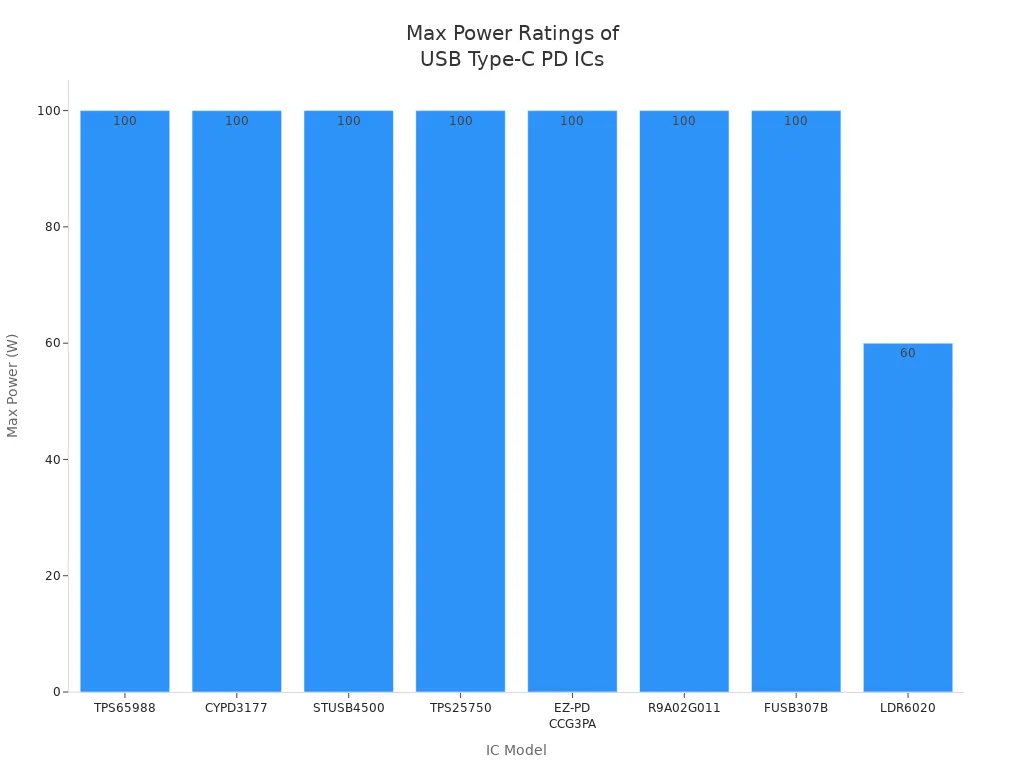
Most of these ICs can give up to 100W of power. This is much more than the IP2721, which only gives 2A.
Differences
The biggest differences between the IP2721 and other ICs are power, protocol, and control. For example, the CH224K controller works with USB PD 3.0 and 2.0, BC1.2, and other fast charging types. It can ask for up to 100W. It also has features like positive or negative insertion detection, automatic switching, and E-Mark simulation. The CH224K has built-in overvoltage and overtemperature protection. You can set the output voltage with one resistor or a three-pin setup.
The IP2721 is simple and uses fixed voltages. It is easy to use for basic power delivery projects. Other ICs, like the TPS65988 or STUSB4500, have more advanced features. These include dual-role power, built-in MCUs, or support for newer USB PD standards.
Engineers should always check the datasheet before picking an IC. This makes sure the chip fits the project’s voltage, current, and protocol needs. Safety and device compatibility are important when making a choice.
Pros & Cons
Advantages
The IP2721 has many good points for USB-C power projects. This chip lets a device ask for the highest voltage from a USB-C power supply, up to 20V. This helps engineers power things that need more energy, like laptops or fast chargers. You can pick 5V, 15V, or 20V with the SEL pin, so the chip works for many designs.
The IP2721 uses built-in hardware to handle USB Power Delivery. It finds out when a device is plugged in by using the CC pins. The chip then talks to the power source to set the right voltage. This automatic process helps stop mistakes and keeps devices safe.
The IP2721 has important safety features. It uses hardware CRC to keep data safe when talking to other devices. The chip controls an outside NMOS transistor to manage power. This helps stop problems like too much voltage, not enough voltage, or sudden power spikes. The VBUS soft start makes sure power turns on slowly, which protects the device and the power supply.
The simple design means engineers do not need to write code or use a microcontroller. This makes the IP2721 easy to use in many projects, like power banks or DIY electronics. The chip works in many temperatures and does not cost much, which makes it even better.
Drawbacks
The IP2721 also has some downsides. The chip only gives fixed voltage levels. It does not check or control current, so users must make sure their power supply can give enough power. Not checking current can be less safe for some high-power uses.
The datasheet does not compare the chip’s safety features to industry rules. It does not say if it has thermal shutdown or ESD protection. Some other USB-C PD chips have more features, like dual-role power, settings you can change, or support for new PD standards.
-
The IP2721 may not work for projects that need changing voltage or current.
-
It may not give enough details for strict safety or certification needs.
-
Users must check if the chip’s fixed voltage choices fit their device.
Tip: The IP2721 is good for simple USB-C power delivery. For more advanced or high-power projects, engineers might want to pick other ICs with more features.
The IP2721 is a good choice for USB Type-C PD power control. It can find devices by itself and uses special hardware for the PD protocol. The VBUS soft start helps keep things safe and makes it simple to use.
Some important features that make it useful in many ways are:
|
Feature |
Description |
|---|---|
|
Works with 4.5V to 23V, so it fits many power sources. |
|
|
Adjustable Output Voltage |
Lets you pick different voltages for different devices. |
|
Built-in Protection |
Stops damage from too much current or getting too hot. |
Engineers should look at the IP2721 Datasheet and check other options to find the best one for their project.
FAQ
What does the SEL pin do on the IP2721?
The SEL pin lets you pick the output voltage. You can set it to 5V, 15V, or 20V. This helps different devices get the power they need.
Can the IP2721 control output current?
The IP2721 does not control how much current comes out. It only asks for a set voltage. You must check that your power supply gives enough current for your device.
Does the IP2721 need programming or a microcontroller?
You do not need to program the IP2721. The chip works by itself. It uses its own hardware to handle USB Power Delivery. This makes it simple to use in many projects.
What protection features does the IP2721 offer?
The IP2721 has overcurrent, overvoltage, and short-circuit protection. These features help keep devices safe from harm when using power.
Where can engineers use the IP2721?
Engineers use the IP2721 in power banks, chargers, USB-C adapters, and DIY electronics. Its easy design and fixed voltages make it good for many USB-C power projects.