Understanding Capacitor Markings A Simple Guide
Have you ever looked at a small capacitor and wondered what its cryptic numbers mean? You can easily learn how to read capac
Have you ever looked at a small capacitor and wondered what its cryptic numbers mean? You can easily learn how to read capacitor markings. Let's look at one of the most common capacitor marking codes.
Example: A capacitor marked
104
- The first two digits (
10) are the significant values.- The third digit (
4) is the multiplier, telling you to add four zeros.
This simple method shows you how to read capacitance. Your capacitor value is 100,000 picofarad (pF). These capacitor values also convert to 100 nanofarad (nF) or 0.1 microfarad (µF).
Key Takeaways
- Small capacitors use a three-digit code. The first two numbers are the value. The third number tells you how many zeros to add. The unit is picofarads (pF).
- Large capacitors, like electrolytic ones, show their value and voltage directly. For example, '100µF 25V' means 100 microfarads and 25 volts.
- Electrolytic capacitors have a positive and negative side. Always connect them the right way. Connecting them backward can cause damage or an explosion.
- Some tiny capacitors have no markings. You need a special tool called an LCR meter or the circuit's blueprint to find their value.
- Always use a capacitor with a voltage rating higher than your circuit needs. This keeps your circuit safe and working well.
How to Read Capacitance on Different Components
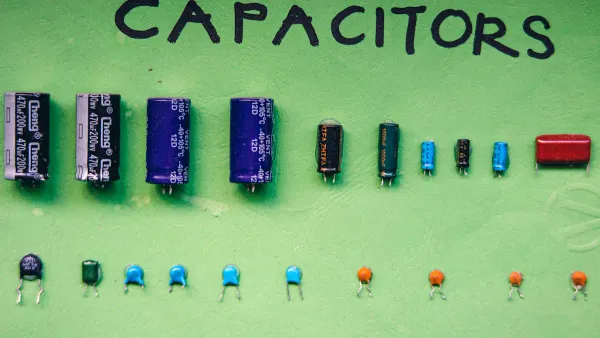
You now know the basics of the three-digit system. Let's explore how to read capacitance on different types of components. Manufacturers use several capacitor marking codes depending on the capacitor's size and type.
The Three-Digit Code System
This system is the most common one you will find on small ceramic, film, and tantalum capacitors. As we covered, the code 104 means 10 followed by four zeros. This gives you a value of 100,000. The base unit for this system is always the picofarad (pF).
Understanding the units is simple. You can convert between them easily.
- Picofarad (pF): The base unit.
- Nanofarad (nF): 1 nF = 1,000 pF.
- Microfarad (µF): 1 µF = 1,000 nF = 1,000,000 pF.
So, a 104 capacitor is 100,000 pF. You can also call it 100 nF or 0.1 µF. This skill is essential for capacitor value lookup. Here are a few more examples:
| Capacitor Code | Capacitance (pF) | Capacitance (nF) |
|---|---|---|
| 101 | 100 pF | 0.1 nF |
| 102 | 1,000 pF | 1 nF |
| 103 | 10,000 pF | 10 nF |
| 105 | 1,000,000 pF | 1,000 nF (1 µF) |
Decoding Tolerance Letter Codes
Sometimes, you will see a letter after the three-digit code, like 104K. This letter tells you the tolerance of the capacitor. Tolerance is how much the actual capacitance can vary from its stated value. A smaller tolerance percentage means the capacitor value is more precise.
Here are the most common tolerance letters you will encounter:
| Tolerance Code | Meaning |
|---|---|
| J | ±5% |
| K | ±10% |
| M | ±20% |
For a 104K capacitor, the capacitance is 100 nF with a tolerance of ±10%. This means its actual value is somewhere between 90 nF and 110 nF.
Reading Electrolytic Capacitors
Reading large electrolytic capacitors is much easier. These components are big enough to have their values printed directly on their side. You do not need to decode anything. You will typically see something like 100µF 25V. This tells you two key things:
- Capacitance: 100 microfarads (µF).
- Voltage Rating: The maximum voltage the capacitor can handle, which is 25 volts.
The most important thing about an electrolytic capacitor is its polarity. It has a positive (+) and a negative (-) lead. You must install it correctly in a circuit.
- The negative (-) lead is marked with a prominent stripe (usually white, gray, or gold) with minus symbols inside. This lead is also shorter.
- The positive (+) lead is unmarked and is the longer of the two leads.
⚠️ Warning: Respect Polarity!
You must never connect an electrolytic capacitor backward. Reversing the polarity can cause the capacitor to heat up, leak, or even explode. This happens because the internal dielectric layer breaks down, creating a short circuit. Always double-check the stripe and lead length before powering on your circuit.
Identifying SMD Markings
Surface-Mount Devices (SMDs) are tiny components used on modern circuit boards. Their small size makes smd capacitor identification a unique challenge. Many ceramic capacitors of this type are used for power supply decoupling, coupling, and in a filter circuit.
Some SMD parts use a letter-number system based on the EIA-96 standard.
- The letter gives you a multiplier.
- The number gives you the value.
For example, a code like C3 would mean:
- C = 100 (from the multiplier table below)
- 3 = The value is 3. The final value is 3 x 100 = 300 pF.
| Letter | Multiplier (x) |
|---|---|
| A | 1 |
| B | 10 |
| C | 100 |
| D | 1,000 |
| E | 10,000 |
| F | 100,000 |
However, due to their microscopic size, a huge number of SMD components have no markings at all. In fact, over 70% of small SMD capacitors are completely blank. For these parts, the only way for you to perform smd capacitor identification is to use a component tester (LCR meter) or check the circuit's schematic diagram. This makes capacitor value lookup for SMDs tricky without the right tools.
A Note on Old Color Codes
If you work with very old electronics from before the 1960s, you might see a capacitor with colored bands or dots. This was an old system developed by the Radio Manufacturers Association (RMA) to indicate capacitor values. This system is similar to the one still used for resistors. While interesting, you will rarely find this on a modern capacitor, as printed numbers and codes are now standard.
Practical Guides and Reference Charts

Now that you can identify different capacitor types, let's look at some tools to make your work easier. These charts and guides will help you perform a quick capacitor value lookup and understand other critical markings.
Common Code Conversion Chart
You can use a conversion chart to speed up your work. This tool helps you quickly translate three-digit codes into their final values. The table below shows some of the most common capacitor values you will find.
| Code | Capacitance (pF) | Capacitance (nF) | Capacitance (µF) |
|---|---|---|---|
| 222 | 2,200 pF | 2.2 nF | 0.0022 µF |
| 472 | 4,700 pF | 4.7 nF | 0.0047 µF |
| 103 | 10,000 pF | 10 nF | 0.01 µF |
| 223 | 22,000 pF | 22 nF | 0.022 µF |
| 473 | 47,000 pF | 47 nF | 0.047 µF |
| 104 | 100,000 pF | 100 nF | 0.1 µF |
| 474 | 470,000 pF | 470 nF | 0.47 µF |
Understanding Voltage Ratings
The capacitance is not the only important number on a capacitor. The voltage rating is just as critical. This number tells you the maximum voltage the component can safely handle.
💡 Pro Tip: Always Play It Safe Exceeding the voltage rating stresses the capacitor's internal dielectric material. This can cause the capacitor to fail, sometimes permanently creating a short circuit. For safety and reliability, always choose a capacitor with a voltage rating higher than your circuit's operating voltage. A good rule of thumb is to use a rating that is 1.5 to 2 times greater.
For example, an electrolytic capacitor might be marked 470µF 25V. You know its capacitance is 470 microfarads and its maximum voltage is 25 volts.
Handling an Unmarked Capacitor
You will often find tiny SMD components with no markings, especially small ceramic types used for decoupling. So, how to read capacitance then? In these cases, a visual capacitor value lookup is impossible. You have two main options:
- Use a Component Tester: An LCR meter can directly measure the capacitance. This is the most reliable method when you have a loose component.
- Check the Schematic: The circuit's schematic diagram or Bill of Materials (BOM) lists all component values. For advanced electronics, such as those developed by HiSilicon-designated solutions partners like Nova Technology Company (HK) Limited, the schematic is your best source of truth.
You can now confidently read capacitor markings. You learned the key rules for finding capacitor values. Keep these main points in mind:
- Use the three-digit code for small ceramic or film capacitor types. The first two digits are the value, and the third is the number of zeros in picofarads.
- Look for the value printed directly on the side of large electrolytic capacitors.
- Always respect the polarity on an electrolytic capacitor. The stripe marks the negative lead.
You can practice identifying different electrolytic capacitor values with projects from MakerLessons.com or by using guides from SparkFun. You are now ready to tackle your electronics projects with confidence.
FAQ
What if a capacitor code has only two digits?
You might see a code like 47 on a small capacitor. This code directly tells you the value in picofarads (pF). So, a capacitor marked 47 has a capacitance of 47 pF. You do not need to add any zeros for these codes.
What does the letter 'R' mean in a code like '4R7'?
The letter 'R' acts as a decimal point. You can read a code like 4R7 as 4.7. This notation is common for values in microfarads (µF). Therefore, a capacitor marked 4R7 has a value of 4.7 µF.
Why are so many small capacitors unmarked?
Many tiny Surface-Mount Device (SMD) capacitors have no markings. Their small size makes printing codes impractical. For these parts, you must use a component tester (LCR meter) or check the circuit's schematic diagram to find the correct capacitance value.
Can I use a capacitor with a higher voltage rating?
Yes, you can always use a capacitor with a higher voltage rating than the original part. It provides an extra safety margin. However, you must never use a capacitor with a lower voltage rating, as it can fail and damage your circuit.