What Does the 220 Resistor Color Code Mean
If you grab a 220 ohm resistor, you’ll spot its color code right away. For a standard 4-band resistor, the 220 resistor colo

If you grab a 220 ohm resistor, you’ll spot its color code right away. For a standard 4-band resistor, the 220 resistor color code is Red, Red, Brown, Gold. You might also see a 5-band version, which uses Red, Red, Black, Black, Gold. Each band on the resistor tells you something important: the first bands give you the digits, the next one is the multiplier, and the last band shows the tolerance. You want to find the correct resistor fast, especially when working with delicate electronics or LED projects. Knowing how to read resistor color codes saves you time and helps you build circuits with confidence.
Key Takeaways
- The 220 ohm resistor color code uses red, red, and brown bands for digits and multiplier, with a gold band showing ±5% tolerance.
- 4-band resistors have two digit bands, one multiplier, and one tolerance band; 5-band resistors add an extra digit for more accuracy.
- Always read resistor bands starting from the side opposite the tolerance band to get the correct value.
- Use a multimeter to check resistor values when color bands are hard to see or unclear.
- A 220 ohm resistor safely limits current in LED circuits and many other electronics projects, protecting components and improving reliability.
220 Resistor Color Code
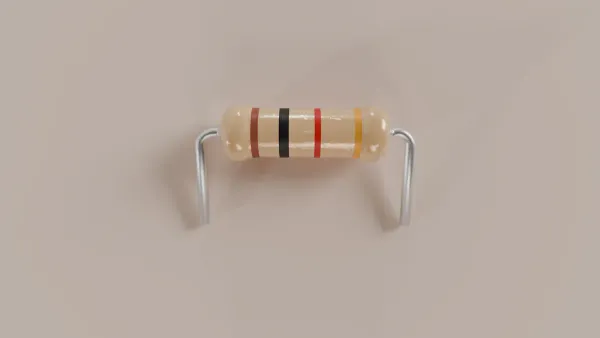
When you look at a resistor, you see colored bands. These bands tell you the value of the resistor. You use the resistor color code to figure out the resistance. Let’s break down how you read the 220 resistor color code for both 4-band and 5-band resistors.
4-Band Color Code
You’ll find the 4-band color code on most standard resistors. For a 220 ohm resistor, the bands are Red, Red, Brown, and Gold. Each band has a job:
- The first band is red. It stands for the digit 2.
- The second band is also red. That’s another 2.
- The third band is brown. This is the multiplier, which means you multiply by 10.
- The fourth band is gold. This shows the tolerance, which is ±5%. Sometimes you see silver, which means ±10%.
Here’s a table to help you see what each band means:
| Band Number | Function | Color | Value |
|---|---|---|---|
| 1 | 1st Digit | Red | 2 |
| 2 | 2nd Digit | Red | 2 |
| 3 | Multiplier | Brown | ×10 (10^1) |
| 4 | Tolerance | Gold or Silver | ±5% (Gold) or ±10% (Silver) |
You calculate the resistance by putting the digits together and multiplying. So, 2 and 2 make 22. Multiply 22 by 10, and you get 220 ohms. The tolerance band tells you how much the actual value can change. If you see gold, the resistor can be 5% higher or lower than 220 ohms.
Tip: If you ever forget what the colors mean, just remember the phrase “BBROYGBVGW” for Black, Brown, Red, Orange, Yellow, Green, Blue, Violet, Grey, White. Each color stands for a number from 0 to 9.
5-Band Color Code
Some resistors use five bands. The 5-band color code gives you more accuracy. For a 220 ohm resistor, you see Red, Red, Black, Black, and Gold.
- The first band is red. That’s 2.
- The second band is red. Another 2.
- The third band is black. This is 0.
- The fourth band is black. This is the multiplier, which means you multiply by 1.
- The fifth band is gold. This is the tolerance, ±5%.
You put the digits together: 2, 2, and 0. That makes 220. Multiply by 1, and you still get 220 ohms. The gold band means the resistor can be off by 5%.
Here’s a table that shows the difference between 4-band and 5-band resistor color codes:
| Band Position | 4-Band Resistor | 5-Band Resistor |
|---|---|---|
| 1st Band | 1st significant digit | 1st significant digit |
| 2nd Band | 2nd significant digit | 2nd significant digit |
| 3rd Band | Multiplier | 3rd significant digit |
| 4th Band | Tolerance | Multiplier |
| 5th Band | N/A | Tolerance |
You use the 5-band color code when you need more precise resistor color code values. The extra digit helps you get the exact resistance you want.
Quick Reference Table
You might need to check resistor color codes quickly. Here’s a table with common resistor color codes for 220 ohm and 220k ohm resistors:
| Resistance Value | 4-Band Color Code | 5-Band Color Code |
|---|---|---|
| 220 Ω | Red, Red, Brown, Gold | Red, Red, Black, Black, Gold |
| 220 kΩ | Red, Red, Yellow, Gold | Red, Red, Black, Orange, Gold |
Notice the difference between a 220 ohm resistor and a 220k ohm resistor. For 220k ohms, the multiplier band is yellow (which means ×10,000), not brown or black. If you mix up the color code, you could use the wrong resistor in your circuit.
If you want to calculate the resistance, just follow these steps:
- Look at the first two (or three) bands. These are the digits.
- Find the multiplier band. Multiply the digits by this number.
- Check the tolerance band. This tells you how much the resistor value can change.
You use resistor color codes every time you build a circuit. They help you pick the right resistor for your project. If you ever get stuck, you can use a multimeter to double-check the value.
Resistor Color Code System
The resistor color code system helps you figure out the value of any resistor just by looking at its colored bands. This system is used all over the world, so you can pick up a resistor from any manufacturer and read it the same way. The IEC 60062 standard makes sure the colors mean the same thing everywhere. You’ll see resistors with three to six bands. Most of the time, you’ll work with four-band or five-band resistors. Each band tells you something important—digits, multiplier, tolerance, and sometimes temperature coefficient.
Reading Color Codes
You might feel nervous about reading resistor color codes, but you can do it with a few easy steps. Let’s walk through how to read a 220 ohm resistor:
- Hold the resistor so you can see all the bands. Find the tolerance band first. It’s usually gold or silver and spaced farther apart.
- Start reading from the opposite end of the tolerance band. The first band is red. That means 2.
- The second band is also red. That’s another 2.
- The third band is brown. This is the multiplier. Multiply by 10.
- The fourth band is gold. This shows the tolerance, which is ±5%.
- Put the digits together: 22. Multiply by 10. You get 220 ohms.
- The tolerance means your resistor could be anywhere from 209 ohms to 231 ohms.
Tip: Always check the reading direction. If you start from the wrong end, you’ll get the wrong value. Good lighting helps you see the colors clearly. If you have trouble telling colors apart, use a magnifying glass or a reference chart.
Common mistakes happen when you mix up similar colors like red and brown. You might also read the bands backward. Practice reading resistor color codes and keep a chart nearby. If you’re color blind or the bands look faded, don’t worry—there’s another way.
Using a Multimeter
Sometimes the color bands on a resistor are hard to see. Maybe they’re faded or the colors look too similar. You can use a digital multimeter to check the resistance directly. Just place the 220 ohm resistor between the probes. The multimeter will show you the resistance in ohms. This method gives you a quick and reliable answer. Multimeters are usually more accurate than reading resistor color codes, especially when the bands are unclear. You might see a small difference because of the meter’s quality or how you hold the probes, but it’s still the best way to double-check your resistor.
Note: If you ever feel unsure about reading resistor color codes, grab your multimeter. It’s a handy tool for every electronics project.
Resistor Uses

LED Example
You probably see LEDs everywhere—on toys, remotes, and even your computer. If you want to light up an LED safely, you need a resistor. The 220 ohm resistor is a favorite for this job. It limits the current so your LED does not burn out. Without a resistor, the LED could get too much current and stop working.
Let’s look at a simple example. Imagine you have a 3V battery and an LED with a forward voltage of 2.8V. You want to know what resistor to use. You can use Ohm’s Law:
R = (V_supply - V_LED) / I
If you want about 10mA of current, you would use a 20 ohm resistor. But if you use a 220 ohm resistor, the current drops to about 0.9mA. That is still enough to see the LED glow, and it saves power. This lower current also helps your battery last longer and keeps your LED safe.
Tip: Always use a resistor with the right power rating. If the resistor gets too hot, it might fail. For most LED projects, a standard 1/4 watt resistor works well.
Other Applications
The 220 ohm resistor does more than just protect LEDs. You will find it in many circuits:
- It helps create voltage dividers, which split voltage for sensors or other parts.
- It limits current in transistor circuits, making sure transistors work the right way.
- It stabilizes voltage or current in feedback circuits, especially in power supplies.
- It manages signal levels in audio circuits, keeping sound clear.
- It acts as a load for testing circuits or as a pull-up/pull-down resistor to keep signals steady.
You can use a 220 ohm resistor in Arduino projects, sensor circuits, and even amplifiers. It protects sensitive parts by controlling current and voltage. This makes your circuits safer and more reliable.
Note: Always check your circuit’s needs. Sometimes you need a different resistor value for the best results.
You can spot a 220 ohm resistor by checking its color bands. Start with the tolerance band, usually gold, then read the bands from the opposite side. The first two bands show the digits, and the third band is the multiplier. For a 220 ohm resistor, you’ll see red, red, and brown. This method works for every resistor you use. If you ever feel unsure, grab your multimeter and measure the resistor directly. Using the right resistor keeps your circuits safe and reliable. Practice reading resistor color codes and use charts like this one to help:
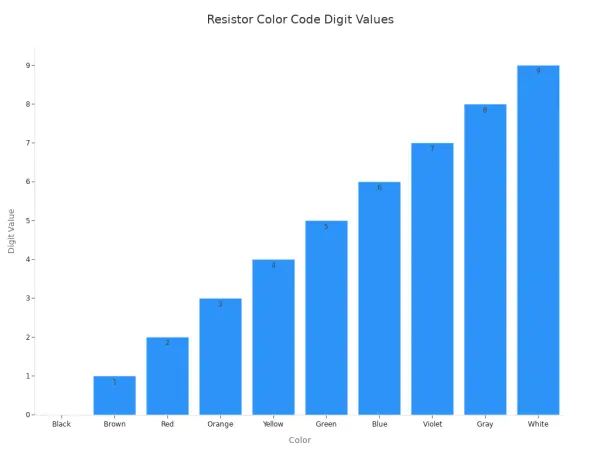
Remember, mastering resistor color codes makes troubleshooting and building electronics easier. You’ll avoid mistakes and keep your projects running smoothly.
FAQ
What happens if you use the wrong resistor value?
If you use the wrong resistor, your circuit might not work as expected. LEDs could burn out or not light up. Other parts may get too much or too little current. Always double-check the resistor color code before you build.
Can you use a 220 ohm resistor for any LED?
You can use a 220 ohm resistor for many standard LEDs, but not all. Some LEDs need more or less resistance. Always check the LED’s voltage and current rating. Use Ohm’s Law to pick the right resistor for your project.
How do you know which way to read a resistor’s color bands?
Look for the tolerance band, usually gold or silver. It sits farther from the other bands. Start reading from the opposite end. This helps you get the correct resistor value every time.
What tools help you check a resistor’s value?
You can use a multimeter to measure a resistor’s value directly. This tool gives you a digital reading. If the color bands are hard to see, a multimeter makes it easy to find the exact resistor value.