What Makes NAND Flash Memory Ideal for Enterprises
NAND flash memory stands as a crucial component in enterprise storage, supporting the rapid growth of data in modern organiz

NAND flash memory stands as a crucial component in enterprise storage, supporting the rapid growth of data in modern organizations. You often face the challenge of balancing speed, reliability, and cost when choosing the right storage solution. Recent surveys show that IT leaders focus on:
- Reliability as the top priority for 80% of decision-makers
- Performance as critical for 33%
- Value for money as important for 38%
Selecting the right type of NAND ensures your storage infrastructure meets your business needs. Consider which NAND flash memory is best for enterprise use to align with your IT goals.
Key Takeaways
- NAND flash memory offers high speed and performance, making it essential for enterprises that require quick data access and efficient application performance.
- Reliability is a top priority; enterprise-grade NAND flash has a lower failure rate and higher endurance, ensuring data safety during heavy workloads.
- Choosing the right type of NAND—SLC, MLC, TLC, or QLC—depends on your specific business needs, balancing factors like performance, endurance, and cost.
- Regular monitoring and maintenance of NAND devices can extend their lifespan and improve overall performance, safeguarding your data.
- Understanding your workload patterns is crucial; match the NAND type to your applications to optimize storage efficiency and reliability.
Key Benefits of NAND Flash Memory
Speed and Performance
You need fast access to data in your enterprise systems. NAND flash memory delivers high performance compared to traditional hard disk drives. The table below shows how much faster flash storage can be:
| Type | Speed |
|---|---|
| Flash Memory | 200 to 550 MB/s |
| Hard Disk Drive | 80 to 160 MB/s |
NAND flash SSDs can reach speeds 20-40 times faster than hard drives. Because solid-state drives have no moving parts, you get quicker data retrieval and lower failure rates. This speed means your applications load faster, and your systems handle more tasks at once. However, you should know that not all SSDs perform the same. Factors like drive interface, bits per cell, and storage protocol affect overall performance. NVMe SSDs are designed to reduce flash latencies and improve response times for high performance needs.
Reliability and Endurance
Reliability is critical for enterprise storage. NAND flash memory offers strong data reliability, especially in enterprise-grade drives. The uncorrectable bit error rate (UBER) for enterprise SSDs is much lower than for client drives. This means you can trust your data to stay safe during heavy workloads. The table below highlights the difference:
| Usage Case | UBER Requirement | Failure Rate Comparison |
|---|---|---|
| Client | < 10^-15 | 10 times more failures than enterprise |
| Enterprise | < 10^-16 | Significantly lower failure rate |
Endurance also matters. SLC NAND provides the highest endurance, followed by MLC, TLC, and QLC. Higher endurance means longer lifespan and better performance under stress. If you run demanding applications, you should choose NAND types with higher endurance to ensure long-term reliability.
Scalability and Cost
Your data needs keep growing. NAND flash memory scales well to meet these demands. Enterprise storage capacity requirements increase by over 25% each year. Advances in NAND technology, such as 3D NAND, allow for greater density and lower cost per gigabyte. The table below compares costs:
| Storage Type | Cost per GB |
|---|---|
| eMLC SSD | $0.50 - $1.00 |
| SLC SSD | $2.00 - $5.00 |
All-flash arrays now reach around $2 per GB, and HDD prices are close to SSD prices. Flash storage is more affordable than ever, especially as larger capacity drives become common. Data reduction techniques can further lower your effective storage costs, making NAND flash memory a smart investment for growing enterprises.
What Is NAND Flash Memory
Technology Overview
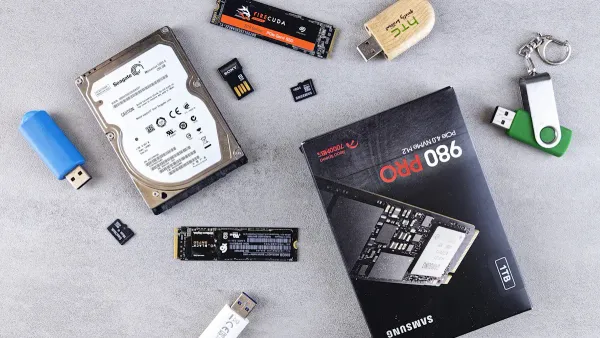
You rely on NAND flash memory as a core technology in modern electronic components and integrated circuits. This memory stores your data in an array of memory cells made from floating-gate transistors. Each cell can hold a charge, which represents digital information.
NAND flash memory operates based on principles such as tunneling, where a signal voltage is sent to the floating gate, allowing electrons to be pushed across the oxide layer. This process alters the charge on the oxide layer, creating a barrier between the floating and control gates. When the charge drops below a certain threshold, the cell's value changes to digital 0. The memory is non-volatile because it retains its state even when power is removed.
NAND architecture connects cells in series, which increases storage density and reduces costs. This structure makes it different from NOR flash, which uses a parallel configuration. You can see the main differences in the table below:
| Feature | NAND Flash | NOR Flash |
|---|---|---|
| Cell Structure | Series configuration | Parallel configuration |
| Storage Density | Higher storage capacity | Lower storage density |
| Access Speed | Slower random access | Faster random access |
| Write/Erase Mechanism | Page-based erase | Byte/sector-based erase |
| Endurance | Higher endurance for write cycles | Lower endurance |
| Ideal Use Case | High-speed data transfer applications | Code execution in embedded systems |
You benefit from high storage density, lower cost, and built-in error correction codes that protect your data. Wear-leveling algorithms help extend the life of your NAND devices.
Enterprise Relevance
You see NAND flash memory at the heart of enterprise storage solutions. It powers SSDs in servers, data centers, and network appliances. Modern innovations have made NAND flash technology reliable, addressing concerns about data retention and longevity.
NAND enables you to handle large volumes of data quickly and efficiently. You gain:
- Faster application performance for databases and analytics.
- Improved user experience with reduced load times.
- Optimized workloads for big data analytics and virtualization.
Enterprise-class NAND flash memory supports high endurance, so you can perform multiple full drive writes daily. This reliability ensures your critical data remains safe and accessible, making NAND essential for your IT infrastructure.
Which NAND Flash Memory Is Best for Enterprise Use
Choosing which NAND flash memory is best for enterprise use depends on your business needs. You must consider performance, endurance, reliability, and cost. Each type of NAND—SLC, MLC, TLC, QLC, and 3D NAND—offers unique advantages and trade-offs. Understanding the differences helps you select the right solution for your electronic components and integrated circuits.
SLC: Top Performance and Reliability
SLC, or single-level cell NAND, stores one bit of data per cell. You get the highest performance and reliability with SLC. This type of NAND flash memory is best for applications where data integrity and speed matter most.
- SLC delivers fast data access and high write endurance.
- You can trust SLC for critical enterprise workloads, such as banking, financial services, healthcare, and telecommunications.
- SLC supports up to 100,000 program/erase cycles, giving you the longest lifespan among different kinds of NAND.
- You see SLC used in SSDs for servers that require constant uptime and low error rates.
Note: SLC is the most expensive NAND flash memory. You pay more, but you gain unmatched reliability and endurance.
You should choose SLC when you need the best performance and cannot risk data loss. Sectors that handle sensitive information, like BFSI and healthcare, rely on SLC for their storage needs. As your business generates more data and moves toward cloud computing, SLC ensures your systems remain fast and secure.
MLC: Balance of Cost and Endurance
MLC, or multi-level cell NAND, stores two bits of data per cell. You get a balance between cost and endurance with MLC. This makes it a popular choice for many enterprise applications.
- MLC offers around 3,000 program/erase cycles, which is lower than SLC but higher than TLC and QLC.
- You benefit from moderate endurance and high capacity, making MLC suitable for data centers and cloud storage.
- Enterprise MLC drives use endurance ratings like Drive Writes per Day (DWPD) to show how much data you can write daily.
MLC costs less than SLC, so you can deploy more storage at a lower price. You see MLC in environments where you need good performance but do not require the extreme endurance of single-level cell NAND. As your business grows and you rely more on digital transformation, MLC helps you manage large amounts of data efficiently.
Tip: Multi-level cell NAND is ideal for general business workloads, where you need a mix of speed, reliability, and cost savings.
TLC and 3D NAND: Capacity and Improved Viability
TLC, or triple-level cell NAND, stores three bits of data per cell. You get higher storage density and lower costs with TLC. When combined with 3D NAND technology, TLC becomes even more attractive for enterprise use.
- 3D NAND stacks memory cells vertically, increasing storage density and capacity.
- You can store terabytes of data with better write speeds and improved endurance compared to older 2D NAND.
- 3D NAND reduces power consumption and increases write speeds, making it suitable for large-scale deployments.
- TLC and 3D NAND offer a lower cost per gigabyte, helping you scale your storage without breaking your budget.
TLC works best for read-heavy workloads, such as big data analytics and virtualization. 3D NAND technology makes TLC more reliable and extends its lifespan, so you can use it for a wider range of enterprise applications.
Callout: If you need to store large volumes of data and want to keep costs low, TLC with 3D NAND is a smart choice. You get more storage, better performance, and improved reliability.
QLC: High Density, Lower Endurance
QLC, or quad-level cell NAND, stores four bits of data per cell. You get the highest storage density and the lowest cost per gigabyte with QLC. However, you must consider its lower endurance and reliability.
| Type of NAND | P/E Cycle Count | Suitability for Write Operations |
|---|---|---|
| QLC | ~1,000 cycles | Less suitable for frequent writes |
| TLC | ~3,000 cycles | More suitable for frequent writes |
- QLC is best for read-heavy applications, such as data archiving and backup.
- You should avoid QLC for mission-critical workloads that require frequent writes, as its endurance is much lower than SLC, MLC, or TLC.
- Tighter voltage thresholds in QLC increase error rates, making error correction more challenging.
When you compare costs, QLC offers the lowest price per gigabyte. This makes it attractive for large-scale storage where you do not need high write endurance. However, if you need reliability and performance for your enterprise, you should choose other types of NAND flash memory.
Reminder: QLC is not recommended for critical enterprise applications that demand high endurance and reliability.
Which NAND Flash Memory Is Best for Enterprise Use? A Quick Comparison
You can use the table below to compare the main features of each NAND type:
| NAND Type | Bits per Cell | Endurance (P/E Cycles) | Performance | Reliability | Cost per GB | Best Use Case |
|---|---|---|---|---|---|---|
| SLC (Single Level Cell) | 1 | 90,000–100,000 | Highest | Highest | Highest | Mission-critical, high-performance |
| MLC (Multi Level Cell) | 2 | ~3,000 | High | High | High | General enterprise workloads |
| TLC (Triple-Level Cell) | 3 | ~3,000 | Moderate | Moderate | Moderate | Read-heavy, large-scale storage |
| 3D NAND (with TLC) | 3 | ~3,000+ | Moderate+ | Moderate+ | Moderate | Big data, virtualization |
| QLC | 4 | ~1,000 | Lower | Lower | Lowest | Archiving, backup |
As you move from SLC to QLC, cost decreases, but so do endurance and performance. You should match the NAND type to your workload. For the best reliability and performance, choose SLC. For a balance of cost and endurance, select MLC. If you need high capacity and improved viability, TLC with 3D NAND is a strong option. Use QLC only for non-critical, read-heavy storage.
Remember: When deciding which NAND flash memory is best for enterprise use, always consider your data needs, workload patterns, and budget. The right choice ensures your electronic components and integrated circuits deliver the performance and reliability your business demands.
Performance and Endurance

Workload Suitability
You need to match your enterprise workloads with the right type of nand flash memory. Each nand type offers different levels of performance and endurance. SLC nand provides the highest performance and reliability for write-heavy tasks. MLC and eMLC nand work well for moderate workloads. TLC nand suits lighter workloads where you need more capacity but less frequent writes. The table below helps you compare these options:
| NAND Type | Write Cycles | Workload Suitability |
|---|---|---|
| SLC | 50,000–100,000 | Write-heavy tasks |
| MLC | Up to 3,000 | Moderate workloads |
| eMLC | Up to 10,000 | Moderate workloads |
| TLC | 300–1,000 | Lighter workloads |
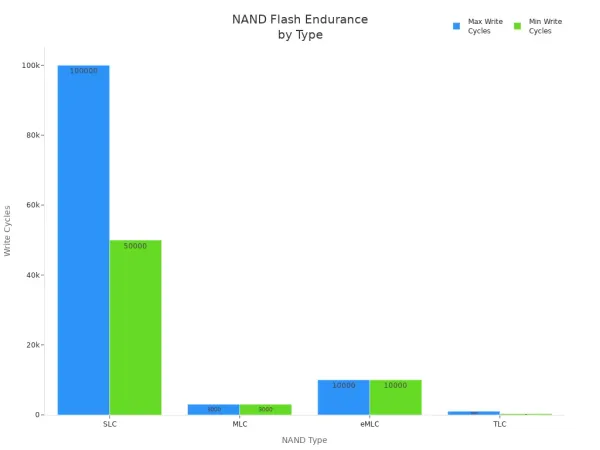
You see that SLC nand stands out for demanding applications in electronic components and integrated circuits. MLC and eMLC nand balance cost and endurance for everyday business tasks. TLC nand gives you more storage at a lower price, but you should use it for read-heavy or archival data.
Lifespan Considerations
You must monitor the lifespan of your nand flash memory to protect your data reliability. Enterprises use several strategies to manage nand endurance and prevent data loss:
- You track the Write Amplification Factor (WAF) to understand how much extra writing occurs on your drives.
- You calculate drive endurance by considering flash cell endurance and storage temperature.
- You analyze usage patterns to predict how long your nand devices will last.
These steps help you maintain performance and reliability in your storage systems. You avoid unexpected failures and keep your data safe. When you choose nand for your electronic components and integrated circuits, you ensure your infrastructure supports both current and future workloads.
Tip: Regular monitoring and smart workload allocation extend the life of your nand flash memory and improve overall performance.
Cost Analysis
Price vs. Value
When you evaluate nand flash memory for your enterprise, you must look beyond the initial price tag. Nand offers high density and cost-effectiveness, making it a strong choice for high-capacity storage in electronic components and integrated circuits. The price of nand microchips has dropped sharply, so SSDs are now more affordable for businesses. Compared to NOR flash, nand is more popular and established in the market. You see nand used in many enterprise storage solutions because it delivers reliable performance at a lower cost.
You may hear about phase-change memory (PCM) as an alternative. PCM provides faster write speeds and works well in network routers and switches. However, PCM is not yet a mainstream solution for enterprise storage. Nand remains the preferred option for most applications due to its proven value.
- Nand flash memory is cost-effective for large-scale storage.
- Nand is widely adopted in the electronics industry.
- PCM is emerging but not yet common for enterprise use.
Total Cost of Ownership
You must consider more than just the purchase price when you choose nand for your enterprise. The total cost of ownership (TCO) includes several factors that affect your long-term investment. The table below shows what you need to review:
| Factor | Description |
|---|---|
| Initial Purchase Price | The upfront cost of nand flash memory, which varies based on capacity, speed, and brand. |
| Longevity | The lifespan of the memory, influenced by endurance ratings and the number of write/erase cycles. |
| Reliability | The failure rates of memory components, affecting costs due to data loss and system downtime. |
| Data Retention | The duration data remains intact without power, crucial for industrial applications. |
| Replacement Costs | Costs incurred from replacing components, influenced by the frequency of failures. |
| Manufacturer Support | The level of support and warranty provided, impacting long-term costs and peace of mind. |
You need to factor in maintenance and upgrade costs. When you replace SSDs, you pay for new products, validation, and labor. You also risk data loss and recovery expenses. SLC nand offers the highest endurance, so you replace it less often than QLC or MLC. If you want to lower your TCO, choose nand types with longer lifespans and strong manufacturer support.
Tip: Always review the operational environment and replacement frequency. These details help you control costs and protect your data in electronic components and integrated circuits.
Choosing the Right NAND Flash Memory
Application Fit
You need to match the right type of nand to your enterprise workloads. Each nand flash memory type offers unique strengths for electronic components and integrated circuits. SLC nand works best for write-intensive applications, such as database servers in enterprise data centers. MLC and TLC nand provide balanced cost and performance, making them suitable for gaming systems and laptops. QLC nand fits archival storage, where you need budget-friendly solutions for read-heavy workloads.
| NAND Type | Application | Characteristics |
|---|---|---|
| SLC | Database servers | High endurance |
| MLC/TLC | Gaming, laptops | Balanced cost and performance |
| QLC | Archival storage | Budget-friendly, read-intensive workloads |
You should consider how your data moves through your systems. For example, databases and virtualization platforms in enterprise data centers require high endurance and reliability. Archival storage needs high capacity and lower cost, which QLC nand provides.
Tip: Always review your workload patterns before selecting nand. Write-intensive applications demand higher endurance, while read-heavy workloads benefit from greater capacity and lower cost.
Decision Checklist
You can use a simple checklist to guide your selection of nand for enterprise workloads. This framework helps you make informed decisions for your electronic components and integrated circuits:
- Understand your use case and desired outcomes before choosing a technology.
- Emphasize storage tiering. Consider multiple flash tiers alongside traditional storage options.
- Analyze your data access habits. Many production workloads involve data that is infrequently accessed.
- Consider broader storage solutions. Do not focus only on flash memory.
You should evaluate your current infrastructure and future needs. For databases, select SLC nand for maximum reliability. For big data analytics, TLC or 3D nand offer scalability. For backup and archiving, QLC nand delivers cost savings.
Note: Matching nand type to your workloads ensures your enterprise data centers run efficiently and your data remains secure.
Best Practices for Enterprises
Management Strategies
You must develop strong management strategies for your enterprise storage systems. Start by monitoring the health of your nand devices. Use software tools to track performance and predict failures. You should set up regular audits for your electronic components and integrated circuits. Create a schedule for firmware updates to keep your nand running smoothly. Assign roles to your IT team so each member knows their responsibility for managing nand flash memory.
Tip: Document every change you make to your storage infrastructure. This helps you troubleshoot problems quickly.
Data Protection
You need to protect your data from loss and corruption. Use redundancy methods like RAID to safeguard your nand-based storage. Implement backup routines that run daily or weekly. Store copies of your data in different locations to reduce risk. Encrypt sensitive information before saving it to nand. You should test your recovery process often to ensure you can restore data when needed.
| Protection Method | Benefit |
|---|---|
| RAID | Prevents data loss |
| Encryption | Secures sensitive data |
| Backups | Enables quick recovery |
Note: Always verify your backups. Unchecked backups may fail when you need them most.
Maintenance Tips
You must maintain your nand storage to extend its lifespan. Clean your electronic components and integrated circuits regularly to prevent dust buildup. Monitor temperature and humidity in your server rooms. Replace aging nand devices before they fail. Use wear-leveling algorithms to distribute write cycles evenly across your nand. Schedule downtime for maintenance so you do not disrupt business operations.
- Check device health monthly.
- Update firmware as soon as new versions release.
- Train your staff on proper handling of nand storage.
Callout: Proactive maintenance reduces unexpected failures and keeps your enterprise running efficiently.
Recommendations
Summary Points
You need to focus on several key factors when choosing storage for your enterprise. NAND flash memory offers speed, reliability, and scalability for electronic components and integrated circuits. You should match the type of NAND to your workload. SLC provides the highest endurance for mission-critical applications. MLC and TLC balance cost and performance for general business needs. QLC delivers high capacity for archival storage, but you must avoid it for frequent write operations.
Tip: Always review your workload patterns before selecting NAND. This step helps you protect your data and extend the life of your storage devices.
You can use the table below to recap the main strengths of each NAND type:
| NAND Type | Best Use Case | Endurance Level | Cost Efficiency |
|---|---|---|---|
| SLC | Mission-critical workloads | Highest | Lowest |
| MLC | General enterprise tasks | High | Moderate |
| TLC/3D | Big data, virtualization | Moderate | High |
| QLC | Archival, backup | Lowest | Highest |
Next Steps
You should take action to optimize your enterprise storage. Start by assessing your current infrastructure. Identify which electronic components and integrated circuits rely on NAND for data storage. Review your workload requirements and future growth plans. Select the NAND type that aligns with your business goals.
- Evaluate your storage needs for speed, endurance, and capacity.
- Consult with vendors who specialize in NAND solutions for enterprise environments.
- Implement monitoring tools to track NAND health and performance.
- Train your IT staff on best practices for managing NAND-based systems.
- Schedule regular reviews to keep your storage strategy up to date.
Note: You can improve reliability and reduce costs by choosing the right NAND for each application. This approach helps you safeguard your data and support business growth.
You see that nand flash memory gives your enterprise storage the speed, reliability, and performance you need for electronic components and integrated circuits. When you select the right nand type, you protect your data and control cost. You should review your workloads and monitor technology trends. You can consult with experts to optimize your nand storage solutions. Take action to keep your business ahead in the fast-changing electronics industry.
FAQ
What is the main advantage of NAND flash memory in integrated circuits?
NAND flash memory gives you high storage density and fast data access. You can use it in electronic components to boost performance and reliability for enterprise systems.
How does NAND flash memory improve reliability in enterprise storage?
You get built-in error correction codes with NAND flash memory. These codes protect your data from corruption and help maintain system stability in integrated circuits.
Which NAND type should you choose for frequent write operations?
You should select SLC NAND for frequent writes. SLC offers the highest endurance and reliability, making it ideal for mission-critical electronic components and integrated circuits.
Can you use QLC NAND for enterprise databases?
You should avoid QLC NAND for enterprise databases. QLC has low endurance and suits read-heavy or archival tasks, not frequent write operations in integrated circuits.